

What if an uneven walkway outside your Dallas property doesn’t need to be replaced? A raised edge may mean a concrete slab has settled, while cracks, worn joints, or surface damage may need a different repair. Identifying the condition is the first step in commercial property trip hazard removal.
As a property manager, you need to address pedestrian safety and complaints while planning around entrances, walkways, and daily operations. This guide explains how to document uneven transitions, distinguish settlement from visible concrete damage, and compare lifting with other repair approaches.
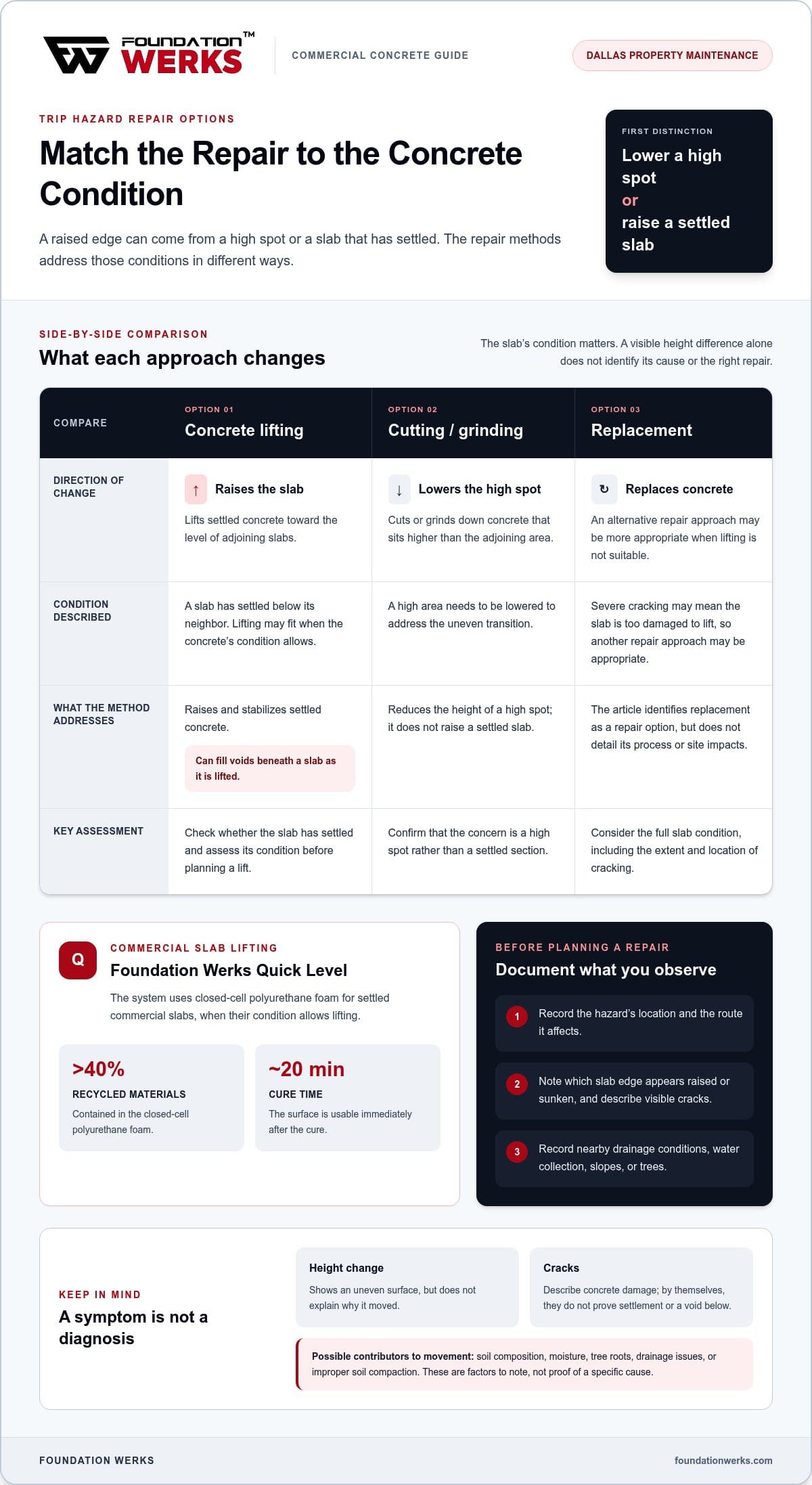
For settled commercial slabs, Foundation Werks’ Quick Level system uses closed-cell polyurethane foam containing over 40% recycled materials. The foam cures in approximately 20 minutes, and the surface is usable immediately after that cure. Understanding the options helps you plan a practical next step for your Dallas property and its visitors.
Key Takeaways
- Identify where uneven transitions occur on commercial properties and why they deserve attention.
- Understand how soil, moisture, roots, drainage, or compaction may contribute to concrete settling.
- Compare trip hazard repair options by what they change and how they may affect site operations.
- Document the affected route, adjoining slabs, visible cracks, and nearby drainage conditions before planning repairs.
- Learn how foam injection can raise a settled slab and what to consider when assessing its condition.
Commercial Property Trip Hazards: Recognize Uneven Concrete in Dallas
A trip hazard is an uneven transition that can catch a pedestrian’s foot. On a commercial property, it may be a raised slab edge, a sunken panel beside a level one, or a damaged section in an otherwise smooth walkway. These changes can be easy to miss when people are entering a building, carrying items, or moving along a busy route.
Commercial property trip hazard removal starts with identifying where the walking surface changes and recording what you see. Inspect sidewalks, walkways, entrances, and other concrete slabs regularly. A noticeable edge calls for prompt attention, particularly on a frequently used route. It does not, by itself, explain the cause or identify the right repair.
Where commercial property managers may notice uneven concrete
Walk the routes people use, including entrances and the connections between sidewalk panels. Look for edges that sit higher or lower than adjoining slabs, as well as cracks, broken corners, and changes near drainage features. Regular observations make it easier to track whether a condition is changing.
- Record the hazard’s location and the route it affects.
- Note which slab edge appears raised or sunken.
- Describe visible cracks and nearby drainage conditions.
Consistent notes give maintenance teams a useful record for planning and comparing site conditions.
What a visible trip hazard can and cannot tell you
A height change shows that the surface is uneven, but it doesn’t show why. Soil composition, moisture, tree roots, drainage issues, or improper soil compaction may contribute to movement beneath a slab. Cracks or surface wear may point to another condition. Treat these as observations to document, not proof of a particular cause.
The distinction matters when choosing a repair. Cutting or grinding lowers a high spot, while lifting raises a slab that has settled below its neighbor. Other surface damage may need a different approach. A visual check helps define the concern, but assessing the slab and its surroundings is important when matching the repair to the condition.
Managers may encounter references to ADA thresholds for changes in level. Treat specific measurements as guidance that needs current verification and context, not as universal legal advice. Requirements can depend on the site and situation, so a single number is not a complete assessment of pedestrian safety.
While the condition is being assessed, keep a clear record of the affected route and visible changes. This gives your maintenance team a practical starting point for prioritizing the concern and planning what to do next.
Why Commercial Concrete Settles and Creates Trip Hazards
A concrete slab relies on the ground beneath it for support. If that support changes, one section may move while an adjoining section stays in place, leaving an uneven transition. When support beneath a slab changes, adjoining concrete can settle at different rates and leave an uneven transition.
Several site conditions may contribute. Soil composition affects how the ground responds to moisture. Tree roots can disturb the area beneath or beside a slab. Drainage issues may allow water to collect or move soil, while improper compaction can leave the ground unevenly supported. These factors can overlap, so a visible height difference alone does not identify the cause.
How soil and moisture changes affect commercial slabs
Soil can change as moisture conditions shift. Depending on the soil and site, it may shrink, expand, or lose support as water moves through or away from the area. Poor drainage can leave water near a slab, while runoff or erosion may carry supporting material away. Either condition can affect the ground beneath the concrete. These are possible contributors, not a diagnosis of a particular property.
Nearby conditions provide useful context. Note whether the uneven area is near a downspout, a place where water collects, a slope, or a tree. Record what you see without assuming it proves the cause. A careful assessment considers the slab and its surroundings together.
When settlement, voids, or slab damage may be involved
A void is an unsupported space beneath a concrete slab. It may form when supporting material shifts or washes away, allowing part of the slab to settle. Lifting and stabilization can raise a settled slab and fill voids beneath it. The slab’s condition also matters: severe cracking may mean the concrete is too damaged to lift, making another repair approach more appropriate.
Cracks and settlement can appear together, but they are not the same thing. A crack describes damage in the concrete; on its own, it does not show whether the slab has moved or whether there is a void underneath. Look at the full pattern: whether adjoining panels sit at different heights, whether the slab appears settled, and where cracking is concentrated. These observations help guide a closer evaluation without treating a visible symptom as a confirmed diagnosis.
This distinction is central to commercial property trip hazard removal. If a slab has settled and its condition allows it to be lifted, raising and stabilizing may address the height difference without replacing the entire panel. If the concrete is badly damaged, lifting may not be appropriate. Assessing both the surface and its support helps match the work to the condition.
For a settled commercial slab, commercial concrete raising can lift and stabilize the concrete when its condition allows.
Trip Hazard Repair Options: Compare Concrete Lifting, Cutting, and Replacement
The right repair depends on what has changed. A high area and a settled slab can create similar-looking edges, but the methods address them in opposite ways: cutting or grinding lowers concrete, while lifting raises it. Replacement is another option when the panel’s condition calls for new concrete. No single approach suits every uneven transition.
| Method | What it changes | Condition it may suit | Operational considerations |
|---|---|---|---|
| Lifting and stabilization | Raises a settled slab and supports the area beneath it. | A slab that has settled and remains suitable for lifting. | Work focuses on the affected slab; plan pedestrian access around the work area. |
| Cutting or grinding | Lowers a high portion by removing surface material. | A raised area where lowering the concrete is appropriate. | Consider access during the work and how the resulting surface affects the route. |
| Replacement | Replaces an existing concrete panel with new concrete. | A panel whose condition makes lifting or surface reduction unsuitable. | Keep the affected area out of use during the work and until the new concrete is ready for use. |
When raising and stabilizing may address a settled slab
Polyurethane foam can be injected beneath concrete to raise and level a settled slab while supporting the area below it. This approach may suit commercial slabs or walkways where settlement has left adjoining concrete at different heights. The slab’s condition remains important, and lifting does not establish compliance with any access standard.
How surface cutting and replacement differ from lifting
Cutting or grinding reduces a high area by removing material from the surface. It may fit when the raised side, rather than a settled slab, is causing the uneven transition. Replacement takes a different approach: the affected panel is replaced with new concrete. That is a broader surface change and is not automatically necessary for every height difference.
Cracks or joint problems can also affect a walkway and may need attention alongside, or instead of, changing the slab height. For those conditions, commercial concrete crack repair guidance can help distinguish surface damage from settlement.
For commercial property trip hazard removal, first determine whether the concrete is high, settled, or damaged. Then consider which method addresses that condition and how to manage the work area while repairs are underway. Foundation Werks provides commercial concrete raising for settled slabs, giving Dallas property managers an option when lifting and stabilization fit the observed condition.
How Dallas Facility Managers Can Assess and Plan Trip Hazard Repairs
A clear process turns a reported uneven area into a repair plan that fits the property. Start with what you can observe, then use those details to assess the condition and coordinate work. Keep pedestrian access and daily operations in view throughout. This makes commercial property trip hazard removal easier to plan without assuming that every uneven slab needs the same treatment.
Use this four-step workflow:
- Locate the concern. Walk the affected route and note where the uneven concrete sits, such as at an entrance, along a sidewalk, or between adjoining slabs.
- Document what’s visible. Take photos and write a brief, factual description. Record whether the area appears raised, sunken, cracked, or near a drainage concern.
- Assess the condition. Consider the affected slab alongside adjacent concrete and nearby site conditions. A visible height change is useful information, but it does not confirm the cause or dictate a repair by itself.
- Plan around operations. Identify pedestrian paths, entrances, deliveries, and other business activity that may need coordination while work is underway.
Document the location and visible condition
A simple location log can make observations useful to a maintenance team. Include the route or nearby landmark, the date observed, a photo, and a short description of the surface. Note nearby drainage features or visible water concerns. Keep the record factual: it supports maintenance planning, but it is not proof of legal compliance or a technical diagnosis.
Use consistent descriptions when revisiting the area. Record whether an edge appears raised or sunken, whether cracks are visible, and which neighboring slab is affected. This helps staff compare observations over time and communicate the issue clearly during repair planning.
Plan repairs around commercial access
Before work begins, identify the entrances and walking routes people rely on, then plan how to coordinate access around the work area. Foundation Werks’ polyurethane foam cures in approximately 20 minutes. The repaired surface is usable immediately after that cure, giving managers a clear timing detail when planning site activity.
Keep the plan practical. Identify the route people can use while work is underway and coordinate timing with the operations that depend on the area. If an uneven surface extends into an indoor warehouse, uneven warehouse floor repair in Dallas may be relevant to the assessment.
Good records and thoughtful scheduling connect the observed condition to a repair plan that works for the property. Keep the notes available to the people coordinating maintenance and site access.
Foundation Werks Quick Level for Commercial Trip Hazard Removal in Dallas
When an uneven transition comes from a settled slab, raising the concrete may be an alternative to replacement. Foundation Werks’ Quick Level system provides commercial concrete raising and leveling. It uses pressurized polyurethane foam beneath the slab to lift and stabilize the concrete.
The process works beneath the slab. Small, dime-size holes are drilled through the concrete so foam can be injected below it. As the foam expands, it raises and levels the slab. The holes are then sealed with concrete patch. This approach addresses settled concrete without treating every crack, damaged surface, or uneven edge as the same repair problem.
What to expect from the Quick Level process
Quick Level uses closed-cell, eco-conscious polyurethane foam containing over 40% recycled materials. The material is Made in the U.S.A. Injected beneath the slab, the foam raises and levels the concrete. The small injection holes are patched after the work.
The foam cures in approximately 20 minutes, and the surface is usable immediately after that cure. This gives managers a practical detail for coordinating access around the repair. You still need to plan the work area, but the cure time can help inform how to manage pedestrian routes and site operations.
Concrete raising typically costs less than half the cost of full replacement. The right approach depends on the slab’s condition, and Quick Level is designed to lift and level concrete. Other visible damage may need separate consideration.
A clear next step for Dallas commercial properties
Foundation Werks is family-owned and not a franchise. The company provides transparent estimates and puts customer education first, helping property managers understand the proposed work and how it relates to the observed concrete condition. Its displayed Google rating is 4.9 / 5, based on Trustindex-verified reviews.
For commercial property trip hazard removal, bring together your site observations, photos, and access needs. These details help frame a clear discussion about raising and leveling a settled slab and planning the work around property operations. Request an estimate to review the concern at your Dallas property.
Take the Next Step Toward Safer Concrete Routes
A practical repair plan starts with a clear picture of the area and how people use it. Bring together your observations, the routes that need to remain accessible, and the operating needs that may affect scheduling. This gives the repair discussion a useful starting point based on your property’s conditions.
For commercial property trip hazard removal, connect the visible condition with an approach suited to the concrete. Foundation Werks provides commercial concrete raising and leveling in Dallas. Share your site observations and access needs to discuss the work and how it may fit your operations.
Careful planning helps you address an uneven route with pedestrian access in mind. When you’re ready, contact Foundation Werks to request a free estimate for your Dallas commercial property.
Frequently Asked Questions
Can polyurethane foam be used to raise a commercial sidewalk slab?
Yes. Foundation Werks uses its Quick Level concrete raising and leveling system on commercial projects, including sidewalks. Pressurized foam is injected beneath a slab to raise and level it. The slab’s condition is part of the assessment. For a Dallas property manager, noting which panels meet at the uneven edge and whether the slab is cracked helps make that assessment more specific. This method does not guarantee ADA compliance.
How quickly can a commercial walkway reopen after concrete raising?
The foam cures in approximately 20 minutes, and the repaired surface is usable immediately after that cure. This describes the foam’s cure time, not the full project schedule or the time needed to coordinate site access. Managers may still need to plan pedestrian routing and communicate which area is being worked on. Consider the repair scope and site operations when planning the broader schedule.
Does the foam used for concrete lifting contain recycled materials?
Yes. Foundation Werks’ patented, eco-conscious polyurethane foam contains over 40% recycled materials and is Made in the U.S.A. These are material details, not a measure of the environmental impact of a specific repair. When documenting materials, distinguish the foam’s recycled content and country of origin from project-level claims such as total waste avoided or emissions reduced.
Will closed-cell polyurethane foam break down beneath a commercial slab?
Foundation Werks’ closed-cell foam does not break down over time. This describes the material’s stated characteristic, not a guarantee about every slab or repair outcome. Concrete and site conditions remain relevant to the work. Keep material information separate from maintenance observations, such as new cracking or changes in the surrounding surface.
How much does commercial trip hazard removal cost in Dallas?
Foundation Werks provides transparent, project-specific estimates rather than a published dollar amount. Concrete raising typically costs less than half the cost of full replacement. This comparison is not a project quote; the estimate depends on the scope of work. Reviewing the proposed scope alongside the slab’s condition helps clarify what the estimate covers.
Does Foundation Werks offer monthly payment options for commercial concrete work?
Yes. Foundation Werks offers monthly payment options with a 60-second pre-qualification that does not affect your credit score. Review the project estimate to understand the proposed work, then consider the monthly payment plan as you budget. Keep the estimate and payment details together so your team can review the project scope and available option.