

What if the concrete you see settling is only part of the problem, and a gap beneath it is leaving the slab without proper support? In Dallas, soil composition and moisture changes can affect how well the ground supports concrete. Drainage issues, tree roots, or poor soil compaction can also contribute to voids. It’s understandable to worry that an unsupported slab may keep shifting.
Foundation void filling can fill gaps beneath concrete and support the slab as part of lifting and stabilization work. This guide explains how voids form, what foam injection involves, and how to compare it with lifting or replacement. The right approach depends on the cause of the void and the support and elevation the concrete needs.
For Dallas projects, Foundation Werks uses its Quick Level system to inject closed-cell polyurethane foam through small holes. The patented, eco-conscious foam contains over 40% recycled materials, is Made in the U.S.A., and does not break down over time. It cures in approximately 20 minutes, and the repaired surface is usable immediately after that cure. Here’s what the process can address and what to consider when comparing it with full replacement.
Key Takeaways
- A void is an unsupported space beneath concrete, not a crack on its surface. Recognizing the difference helps you describe the condition.
- Foundation void filling uses foam injected through small holes to fill space beneath a slab. The injection holes are then sealed with concrete patch.
- Filling a void addresses support, while lifting corrects elevation. An assessment helps determine whether the slab needs support, elevation correction, or replacement.
- Document where movement appears and note drainage, moisture, roots, and prior site conditions to give the assessment useful context.
- Foundation Werks’ Quick Level system provides a foam-based option for void filling, concrete raising, and stabilization on Dallas projects.
What Foundation Void Filling Addresses Beneath a Concrete Slab
A void is an unsupported space beneath concrete, while a crack is visible damage on the concrete surface. The two can occur together, but they describe different conditions. Foundation void filling addresses the gap beneath a slab by filling that space and restoring support. It does not automatically repair surface cracks, which may need separate attention depending on their condition and the project scope.
Concrete relies on the ground beneath it for support. If that support is lost or uneven, a slab may settle, shift, or become uneven, and stress can contribute to cracking. A slab’s foundation (architecture) is part of its support system, but a surface crack alone cannot show whether a gap exists below. Understanding the distinction helps you focus on what needs assessment instead of assuming every crack calls for the same repair.
For a visual overview of void filling beneath concrete, watch this video:
How voids form beneath concrete in Dallas
There isn’t one cause for every property. Soil composition and moisture changes can affect how well the ground supports a slab. In Dallas, shifts between wet and dry conditions may contribute to soil movement: soil can swell as it takes on moisture and shrink as it dries. Other possible factors include water washing soil away because of drainage issues, tree roots seeking moisture, and soil that wasn’t adequately compacted before concrete was placed.
These are possibilities to consider, not a diagnosis. A tree near a slab, for example, doesn’t prove roots have created a gap. Likewise, uneven drainage may be useful context without explaining every sign of movement. The cause depends on site conditions and the history of the concrete, so avoid treating a general explanation as a conclusion about your property.
Signs that may point to lost support
A sunken edge, a section that sits lower than adjoining concrete, or a slab that appears uneven may signal a change in support. Cracks can also be clues, particularly when they occur alongside movement. None of these signs proves that a void is present. Surface appearance shows what has happened to the concrete, not necessarily what is happening beneath it.
Before choosing a repair, arrange a project assessment to understand the slab’s condition and the work needed. The assessment can help distinguish a support issue beneath the slab from a need to correct elevation, address surface damage, or consider replacement. Record what you’ve noticed and where, including whether the condition seems to have changed. Share relevant details about drainage, moisture, nearby roots, or prior work. That context helps guide the assessment without relying on guesswork.
How Polyurethane Foam Void Filling Supports a Concrete Slab
Polyurethane foam injection fills open space beneath a slab so the concrete has support where a gap has formed. The process starts by identifying the project scope: which concrete is affected and whether the work calls for filling voids, lifting, or both. This assessment helps guide where injection is needed and keeps the repair focused on the condition beneath the slab.
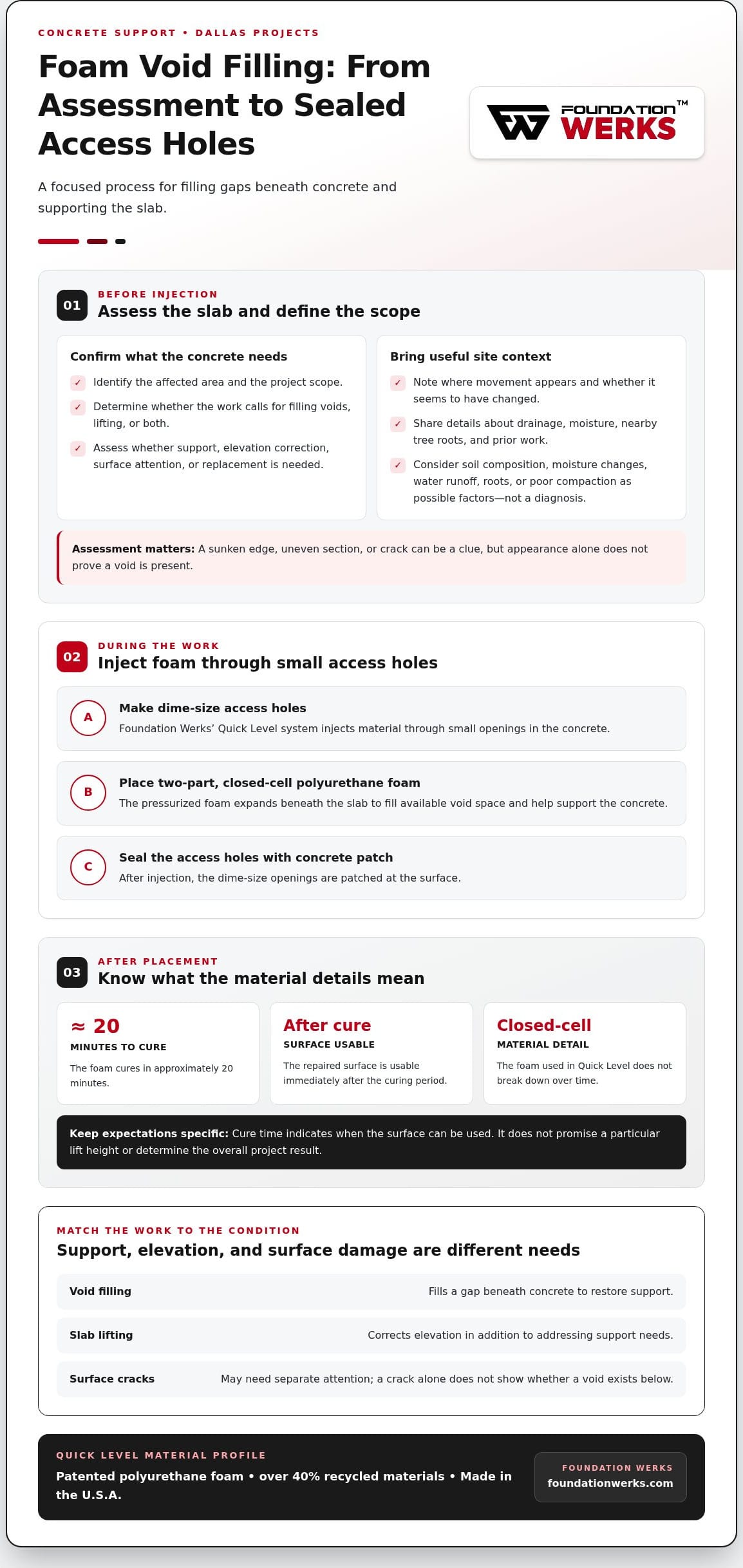
Foundation void filling with foam follows a straightforward sequence: identify the work area, inject material through small access holes, then seal those holes with concrete patch. Foundation Werks’ Quick Level system uses pressurized, two-part, closed-cell polyurethane foam that expands beneath the slab as it’s placed. The goal is to fill the void and support the concrete, not to treat every visible crack as though it came from a gap below.
What happens during foam injection
For Foundation Werks’ Quick Level system, access holes are dime-size. The two-part foam is injected through these openings into the space beneath the concrete. As the material expands, it fills available void space and helps support the slab. Injection can be part of concrete raising and stabilization work, but the amount of movement or elevation correction depends on the project, not on the hole size alone.
Once injection is complete, the dime-size access holes are sealed with concrete patch. This closes the openings made for the work and leaves the slab surface patched at those points. The process is:
- Assess the project and identify the area and scope of work.
- Inject the foam through dime-size holes so it can expand beneath the slab and fill void space.
- Seal the access holes with concrete patch after injection.
What to expect after the foam is placed
The foam used in Quick Level is closed-cell and does not break down over time. It cures in approximately 20 minutes. The repaired surface is usable immediately after that cure, so wait until the curing period is complete before using it. Cure time tells you when the surface can be used; it does not promise a particular lift height or determine the overall result of a project.
That timing can help property owners plan around the work, but the repair still needs to match the slab’s support needs. Filling a gap may be part of stabilization, while raising a settled section involves correcting its elevation as well. The work scope is identified before injection so the process addresses the specific project instead of relying on a one-size-fits-all assumption.
For Dallas concrete projects, Foundation Werks provides polyurethane void filling and stabilization. If you’re considering support work for a slab, learn about Foundation Werks concrete services and its Quick Level approach.
Void Filling, Slab Lifting, or Replacement: Match the Work to the Problem
A slab can need support beneath it, a change in elevation, or replacement. These are related concerns, but they call for different work. Foundation void filling addresses unsupported space under existing concrete. Lifting or leveling focuses on correcting the slab’s position. Replacement is a separate option that replaces the concrete. An assessment helps identify which need is central and whether more than one type of work is involved.
| Work | Primary purpose | Visible result | Project considerations |
|---|---|---|---|
| Void filling | Fill unsupported space beneath a slab. | May improve support; elevation correction is not automatic. | Useful when the main concern is a gap beneath existing concrete. |
| Lifting or leveling | Correct a settled slab’s position. | Changes the slab’s elevation or alignment. | May be paired with filling voids when the project calls for both support and elevation correction. |
| Replacement | Replace concrete rather than address it in place. | New concrete takes the place of the existing slab. | Considered as a distinct approach based on the condition and scope of the project. |
When filling support voids is the central need
If the concern is an unsupported area beneath a slab, filling that space may be the primary goal. It helps address support below the concrete, but it doesn’t necessarily change the slab’s height. A settled section may need elevation correction as well. These aims can overlap, yet neither should be assumed from a crack or low spot alone. Void filling also doesn’t automatically repair every crack or resolve drainage conditions.
How lifting and replacement differ from void filling
Lifting targets the slab’s position. Filling targets the space below it. In some projects, injection can support concrete as part of lifting and stabilization; the scope depends on what the assessment identifies. Replacement takes another route by replacing the concrete. The right comparison depends on the slab’s condition and the work needed. Mudjacking is another lifting method, but the key decision here is the project’s purpose, not a material-by-material debate.
For Dallas projects, raising or stabilizing concrete typically costs less than half of full concrete replacement. That comparison can help frame the options, but it doesn’t determine which approach fits a particular slab. The assessment should clarify whether the need is support, elevation correction, replacement, or a combination. Foundation Werks’ concrete lifting and stabilization addresses Dallas concrete projects where support and slab position are part of the work.
How to Prepare for a Foundation Void-Filling Assessment in Dallas
A little preparation can make a concrete assessment more focused. You don’t need to diagnose what’s happening beneath the slab. Instead, note what you can see, where it appears, and any site conditions that may help explain the project’s history. This gives Foundation Werks useful context for discussing foundation void filling and developing a scope for your Dallas property.
Information to gather before discussing the slab
Start with a simple record of the affected area. Describe whether the concrete looks uneven, settled, or cracked, and note if the condition seems to have changed. Identify the slab’s location, such as a walkway, driveway, patio, or commercial concrete area. Also note whether the property is residential or commercial, since that helps describe the project clearly.
- Mark where you see changes, such as a low edge, uneven joint, or crack.
- Note when you first noticed the condition and whether it appears different now.
- Describe visible drainage concerns, standing water, or the direction water seems to move.
- Mention nearby trees or roots, moisture patterns, and any prior work or site changes you know about.
Keep observations separate from conclusions. For example, describe water flowing toward a slab rather than assuming it has washed away soil underneath. Drainage history can be useful context, and if water management is also a concern, French drain installation is among the concrete and drainage services Foundation Werks provides. Roots nearby or previous grading work are similarly worth mentioning, but they don’t establish the cause by themselves.
What a clear project estimate should help explain
A project-specific estimate should connect the visible condition to the proposed work. It should make clear what concrete area is included, whether the scope focuses on support, elevation correction, or another approach, and what work is being proposed. This helps you understand how the plan relates to the problem you described, rather than treating every uneven slab as the same repair.
Foundation Werks takes a transparent, no-surprise approach to estimates. Use the discussion to understand the recommended scope and how it addresses the observed concrete condition. If drainage or moisture is part of the background, that context can inform the conversation without turning into a diagnosis or an assumption that one repair addresses every site concern.
Before the assessment, gather your notes and point out the affected area. You don’t need special measurements or technical terms. Clear observations and relevant site history are a practical starting point for a useful discussion and a project scope tailored to your Dallas property.
Foundation Werks Void Filling in Dallas: What the Quick Level System Offers
For Dallas concrete projects, Foundation Werks uses its Quick Level poly concrete raising and leveling system to fill voids and support concrete as part of lifting and stabilization work. The system uses patented, eco-conscious, closed-cell polyurethane foam. It addresses space beneath a slab and supports project-specific lifting or leveling goals where needed.
Confirmed material and service details
The foam contains over 40% recycled materials and is Made in the U.S.A. Its closed-cell structure does not break down over time. These are material details, not a promise that every slab will respond the same way. The condition of the concrete and the project scope guide the work, whether the need centers on filling a void, lifting a settled section, or stabilizing concrete.
Quick Level foam is injected through dime-size holes. It cures in approximately 20 minutes, and the repaired surface is usable immediately after that cure. This gives property owners a clear expectation for the material’s cure and surface-use timing. Cure time itself doesn’t establish how much a slab will lift or what result a specific project will achieve.
Foundation Werks is family-owned, and customer education is part of its service approach. The aim is to explain the observed condition, the proposed scope, and how the work relates to the concrete, so property owners can make an informed decision. The company has a 4.9 / 5 Google rating based on Trustindex-verified reviews.
A clear next step for Dallas property owners
Every slab has its own condition and support needs. A project-specific assessment helps shape an estimate around the affected concrete and the work proposed, rather than assuming that void filling, lifting, or stabilization means the same thing on every property. A transparent estimate should make the scope understandable before work begins.
For Dallas projects, Foundation Werks also offers a monthly payment plan with a 60-second pre-qualification that does not affect your credit score. Consider it alongside the project estimate as you review the proposed scope and your payment preferences. The payment option doesn’t replace understanding what the project includes.
If you’ve noticed a settled or uneven concrete area, a project discussion can focus on its condition and scope. Foundation Werks can explain the concrete lifting, leveling, and void-filling work proposed for your Dallas property.
Take the Next Step with Confidence
Uncertainty beneath concrete can make it tempting to jump straight to a repair choice. A more useful first move is to turn what you’ve noticed into a clear conversation about the slab’s condition and how you use the space. That keeps the focus on matching the work to the actual need, rather than treating every symptom as the same problem.
With foundation void filling, the key decision isn’t simply whether foam can be injected. It’s whether filling below the slab fits the condition, and whether support, elevation correction, or another concrete solution should shape the project scope. A transparent estimate gives you a practical basis for weighing the recommendation and deciding how to proceed.
You don’t need to arrive with a diagnosis. Bring your observations, ask for the proposed scope to be explained in plain language, and take the time you need to feel comfortable with the next step. For a Dallas property, a focused discussion can help turn an uncertain concern into a clearer plan for the concrete.
Request a transparent estimate from Foundation Werks
A well-informed decision starts with understanding what your slab needs. You can take the next step with confidence.
Frequently Asked Questions
How much does foundation void filling cost?
Foundation void filling is priced based on the concrete condition and the scope of work, so an assessment is needed for a project-specific estimate. For Dallas projects, raising or stabilizing concrete typically costs less than half of full concrete replacement. If you’re comparing options, consider the proposed work along with the estimate so you understand what the scope is intended to address.
Can void filling repair cracks in concrete?
Void filling addresses space beneath concrete, but it doesn’t automatically repair cracks on the surface. A crack may need separate attention, depending on its condition and cause. For example, a cracked patio with a settled section may involve both support and surface concerns. An assessment can clarify whether the proposed work addresses the void, the crack, or both, rather than assuming one treatment resolves every visible issue.
Is polyurethane foam for concrete void filling made in the United States?
Yes. The polyurethane foam Foundation Werks uses for Dallas concrete projects is Made in the U.S.A. It is part of the company’s Quick Level system for concrete raising and leveling. Material origin can be considered alongside the work scope and the condition of the affected concrete.
Does Foundation Werks offer monthly payments for void-filling work?
Yes. Foundation Werks offers a monthly payment plan for Dallas projects. The pre-qualification takes 60 seconds and does not affect your credit score. Consider it alongside the project estimate as you review the proposed scope and your payment preferences. The payment option doesn’t replace understanding what the project includes.
Can void filling be used for both residential and commercial concrete?
Yes. Foundation Werks’ Quick Level system is used for residential and commercial projects in Dallas. Examples include a home’s driveway or patio and a commercial concrete slab or walkway. The property type helps describe the project, but the concrete condition and intended work still guide the scope. Share which slab is affected and how it’s used when discussing the project.
What is the difference between filling a void and raising a slab?
Filling a void targets unsupported space beneath concrete; raising a slab targets its position. A settled section may need elevation correction as well as support below, so the work can involve both aims. For example, filling a gap may support a slab without necessarily correcting how high it sits. The project assessment helps identify whether the priority is support, elevation, or both.