

Could a sunken driveway or uneven commercial floor be raised without removing the concrete? In many cases, poly foam injection services can lift and stabilize a slab that’s still intact, with small drill holes and minimal surface patchwork. Whether it suits your project depends on the slab’s condition, site access, and what’s causing the settlement.
It’s understandable to worry about disruption to landscaping, daily routines, or business operations. In the Dallas-Fort Worth area, shifting clay soils can contribute to concrete movement, but foam injection isn’t the right approach for every slab. Concrete that’s badly broken or deteriorated may need a different repair plan.
This guide explains how polyurethane foam injection works, which residential and commercial concrete problems it may address, and what the work process can mean for your property. You’ll also learn how foam raising compares with other repair approaches, what practical trade-offs to consider, and which project details help shape a useful estimate. The goal is to help you make a confident decision based on your concrete’s condition, not guesswork.
Key Takeaways
- Uneven slabs, gaps, or altered drainage can point to support issues beneath the concrete. Recognizing these signs helps you describe the problem clearly.
- Poly foam injection services follow a practical sequence: assess the area, drill access holes, inject expanding foam, and evaluate the slab.
- Compare foam raising, mudjacking, and replacement by considering slab condition, repair goals, disruption, and whether the existing concrete can remain in use.
- For a more useful project estimate, note affected areas, access constraints, how the surface is used, and whether the work is residential or commercial.
- Foundation Werks offers concrete raising, void filling, and stabilization, including advanced solutions for gravel areas, blacktop, and pavers.
What Poly Foam Injection Services Address in Concrete
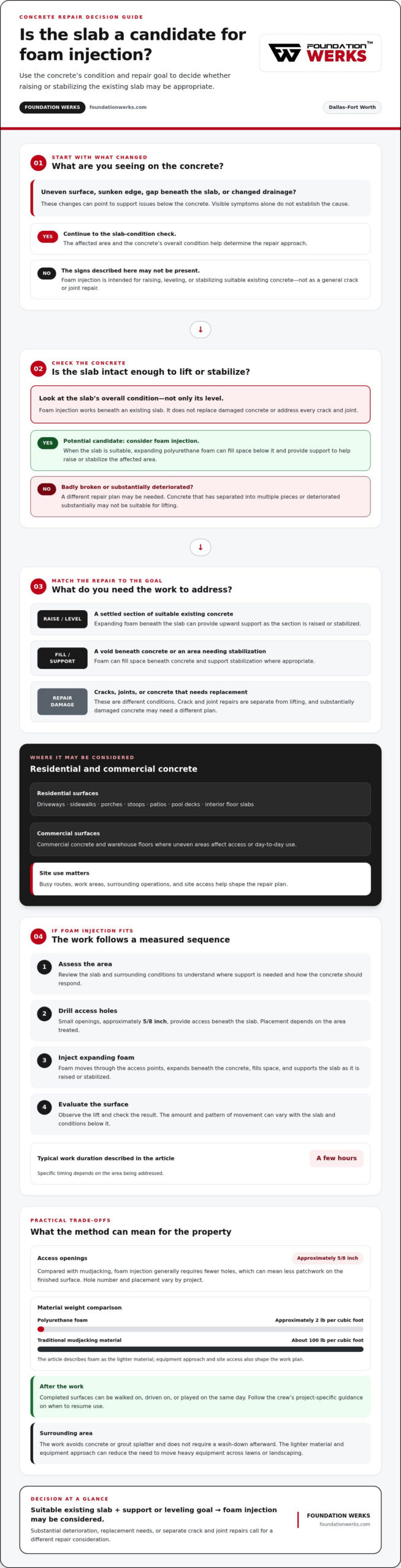
Poly foam injection raises, levels, or stabilizes suitable concrete by placing expanding polyurethane foam beneath an existing slab. As the foam expands, it fills space below the concrete and can provide support that helps lift a settled section. These poly foam injection services are intended for slabs that remain suitable to work with, not concrete that needs to be replaced or cracks and joints that need separate repairs.
An uneven surface may be more than a trip hazard. A sunken edge, a gap beneath a slab, or water draining differently across a driveway can point to changes in the support below the concrete. Settlement or a void may be involved, but visible symptoms alone don’t establish the cause. The slab’s overall condition and the affected area both matter in choosing an appropriate repair approach.
Foam injection works on the existing slab. It isn’t the same as replacing damaged concrete, and it doesn’t describe crack or joint repair. Those repairs address different conditions. A slab that has separated into multiple pieces or deteriorated substantially may not be a suitable candidate for lifting. In that case, the repair decision needs to account for the concrete’s condition rather than assuming that raising it will address the problem.
Which residential concrete surfaces may be candidates?
Driveways, sidewalks, porches, stoops, patios, pool decks, and interior floor slabs may be considered when the concrete is intact enough to lift or stabilize. Picture a walkway that has settled beside the lawn, or a garage floor with one uneven section. The material used in this method is polyurethane foam, a material with a range of applications. Suitability still depends on the slab’s condition, so a cracked surface shouldn’t automatically be treated as liftable.
Where commercial foam injection can help
Commercial concrete and warehouse floors may need attention when uneven areas affect access or complicate day-to-day use. Foam injection can also fill voids beneath concrete and support stabilization where appropriate. The practical question is how the affected slab is used and whether it can remain in place. Busy routes, work areas, and surrounding operations help define the repair needs; detailed warehouse stabilization planning is a separate consideration.
For both residential and commercial properties, identifying the specific slab and describing what has changed can make the next assessment more useful. A shift in level, a new gap, or a change in drainage gives helpful context, while the concrete’s visible condition helps distinguish lifting from replacement or a separate crack or joint repair.
How Polyurethane Foam Injection Raises and Stabilizes a Slab
Once a slab is selected for lifting or stabilization, the work follows a measured sequence. The crew assesses the area, plans access points, injects foam beneath the concrete, and evaluates the surface as it responds. Each project is different, so slab condition and site layout shape the work plan. Poly foam injection services typically take a few hours from start to finish, though the specific work depends on the area being addressed.
- Assess the area. The crew reviews the slab and its surrounding conditions to understand where support is needed and how the concrete should respond.
- Drill access holes. Small openings, approximately 5/8 inch, provide access beneath the slab. Their placement depends on the area being treated.
- Inject the foam. Foam moves through the access points and expands beneath the concrete, filling space and supporting the slab as it is raised or stabilized.
- Evaluate the surface. The crew observes the lift and checks the result. The amount and pattern of movement can vary with the slab and conditions below it.
What happens during foam injection?
The access holes let the foam reach the space beneath the concrete without removing the slab. As the material expands, it occupies voids and applies upward support. This controlled process helps raise a settled section or stabilize an area that needs support. The goal is to work with the existing concrete, not to conceal every crack or treat every damaged slab as a lifting candidate.
Compared with mudjacking, foam injection generally requires fewer holes, which can mean less patchwork on the finished surface. The hole size and number of access points are part of the approach, not a promise that every project will look identical. For a broader look at how the methods differ, see Polyurethane Foam Concrete Lifting vs. Mudjacking.
What should customers expect after the work?
Completed surfaces can be walked on, driven on, or played on the same day. That can help limit interruptions around a home or business, though the crew’s project-specific guidance should determine when to resume use. The work also avoids concrete or grout splatter and doesn’t require a wash-down afterward, helping keep the surrounding area cleaner.
The foam weighs approximately 2 pounds per cubic foot, compared with about 100 pounds per cubic foot for traditional mudjacking material. The lighter material and equipment approach can also reduce the need to move heavy equipment across lawns or landscaping. This may matter when access is tight or a property owner wants to limit disturbance around the slab. Actual site access still shapes the plan.
If you’re considering a lift, share where the slab has settled and note any access or landscaping concerns. Explore concrete raising with Foundation Werks to understand how the service can fit your project.
How to Compare Foam Injection With Other Concrete Repair Options
The right repair depends on what the concrete can still do, not just how uneven it looks. Start by considering the slab’s condition, the goal of the work, and how much disruption the site can accommodate. Poly foam injection services can raise or stabilize suitable existing concrete, but they aren’t interchangeable with replacement or crack and joint repairs.
| Approach | Slab condition | Repair goal | Disruption and use |
|---|---|---|---|
| Foam raising | Existing slab is sufficiently solid to lift | Raise or level settled concrete | Keeps suitable concrete in place, with small injection holes and limited surface patchwork |
| Mudjacking | Existing slab is suitable for lifting | Raise settled concrete by filling beneath it | Also works with the existing slab; the access method and surface patching differ from foam injection |
| Replacement | Slab is severely damaged or too compromised to lift | Replace concrete that can’t serve its purpose | Requires a more extensive work area, and the new concrete must be placed before the surface can return to use |
These approaches address different conditions, so a simple ranking doesn’t help. Foam injection and mudjacking both aim to raise existing concrete. Replacement changes the slab itself. For more detail on the lifting-versus-replacement decision, the separate guide Concrete Lifting vs. Replacement: ROI Comparison explores that choice without reducing it to one factor.
When lifting or stabilization may fit the project
A settled slab that remains sufficiently solid may be considered for lifting. Stabilization can also mean filling a void or supporting material beneath a surface without the same goal of raising the concrete. Those are related, but distinct, repair objectives. The assessment should clarify whether the priority is correcting the slab’s level, supporting an unsupported area, or addressing both.
The cause of movement matters, too. Foam can fill space and support concrete, but that doesn’t mean it resolves every source of settlement or damage. Project conditions help determine the work plan and what outcome is realistic.
When another repair approach may be more appropriate
Severely cracked, broken, or deteriorated concrete may be too compromised to lift. Replacement may be the more suitable path when the slab can’t remain in service as a single surface. By contrast, commercial crack and joint repair targets specific openings or joints; raising a slab changes its position and support. These are different needs, even if they appear in the same area.
Commercial property teams weighing crack or joint work can explore Commercial Concrete Crack Repair: The 2026 Facility Manager’s Guide for more context. The practical comparison is whether the problem is a level or support issue, damage within the concrete, or a slab that needs replacement. Identifying that distinction helps match the repair approach to the condition and the site’s day-to-day use.
How to Prepare for Poly Foam Injection Services
A clear description of the concrete problem helps shape a useful, project-specific assessment. Before requesting an estimate, note where the surface has changed, what kind of slab is involved, and how the area is used. These details help distinguish a residential lifting project from commercial concrete work or a broader void-filling and stabilization need. You don’t need to diagnose the cause yourself. Share what you’ve observed and what you want the repair to accomplish.
Information to gather before requesting an estimate
Walk the affected area and make a few notes. Photos can also help show the location and extent of the issue. Focus on observable details rather than trying to determine what is happening beneath the surface.
- Surface type: Identify whether the area is a driveway, sidewalk, patio, interior slab, commercial floor, or another concrete surface.
- Visible changes: Describe uneven sections, gaps, or places where drainage appears to have changed. Note which areas seem affected.
- Approximate size: Estimate the length and width of the section needing attention. A rough description is useful even if you don’t have exact measurements.
- Access and surroundings: Mention nearby landscaping, narrow access routes, or other features that may affect work around the slab.
- Desired outcome: Explain whether you’re looking to raise a settled slab, fill a void, or stabilize material beneath a surface.
Also describe the project type. A homeowner may be focused on one walkway, while a facility manager may need to discuss several floor zones or an area used for daily operations. If the need involves larger-scale stabilization, say so at the outset. Poly foam injection services can address different project types, and the details help clarify the scope being considered.
Planning around access and site use
Access affects how the work area can be approached. Explain where crews can reach the concrete and whether lawns, landscaping, stored items, or nearby activity are relevant. This doesn’t mean you need to prepare the site in a specific way before requesting an estimate. It gives the team practical context for considering the project plan.
For commercial properties, identify the affected floor zones and how each area is used. Note if the concrete serves a regular access route, a work area, or a space with operating constraints. That context helps frame the repair around the site’s day-to-day needs, rather than treating every slab as an isolated surface. For residential projects, mention the household use of the area and any access considerations around the home.
A project-specific assessment determines whether lifting, void filling, or stabilization fits the concrete’s condition and what the work may involve. Sharing clear observations helps start that conversation with realistic expectations.
Foundation Werks Poly Foam Injection Services in Dallas-Fort Worth
Foundation Werks provides residential and commercial concrete raising, void filling, and stabilization across the Dallas-Fort Worth area. The right approach depends on the surface and the goal: a sunken concrete slab may call for raising, while an empty space below a slab may need void filling or stabilization. A project-specific assessment helps match the work to the site’s condition and use.
From McKinney to Frisco and Dallas, property owners and facility teams can discuss poly foam injection services for concrete concerns at their home or business. Sharing the location, affected surface, and visible changes helps frame the project clearly. Commercial needs can range from a specific slab to a larger stabilization concern.
Match the service to the surface and repair goal
For a suitable sunken concrete slab, polyurethane concrete raising can lift and support the existing surface. If there’s a gap beneath concrete, void filling addresses the space below, while stabilization focuses on supporting material beneath a surface. These goals can overlap, but they aren’t identical. Describing what needs to change helps clarify which service approach fits.
Not every area is a concrete slab. Foundation Werks’ Deep Foamjection™ is used for stabilization involving gravel areas, blacktop, and pavers. This gives property owners and commercial teams an option to discuss when the surface or material beneath it differs from a standard concrete slab. The work plan should reflect the actual surface and the outcome the property needs.
Drainage may also be relevant. If water flow or drainage concerns are part of the property’s broader needs, French drain installation may be worth discussing as a separate service consideration. The specific repair approach depends on the conditions at the site; raising concrete alone shouldn’t be assumed to address every drainage concern.
Take the next step with a project-specific estimate
Residential owners can describe the affected area, such as a driveway, walkway, patio, or another concrete surface. Commercial decision-makers can identify the floor zones involved, how those areas are used, and any operating considerations that may shape the project. For larger stabilization needs, explain the materials and surface involved, whether gravel, blacktop, pavers, or concrete.
Foundation Werks offers free estimates. To help make the discussion specific, share the property’s location, the visible issue, and the result you’re hoping to achieve. Customers can also request an estimate by calling 800-464-9684. There’s no need to arrive with a repair diagnosis. Clear observations give the team a useful starting point for considering the project scope.
Make Your Next Concrete Repair Decision With Confidence
Choosing a repair doesn’t have to start with a technical diagnosis. Start with what you can observe, what the surface needs to do, and how much disruption your property can reasonably accommodate. Those priorities help frame a useful conversation about whether poly foam injection services fit the situation or whether another repair approach deserves consideration.
For a home or commercial property, the next step is to connect the condition of the concrete with the outcome you want. A project-specific assessment can help clarify the scope and set realistic expectations before work begins. You don’t need to have every answer in advance. A clear description of the issue and the way the area is used is a practical place to start.
With the right information and a repair plan suited to the site, you can move forward with greater clarity and confidence.
Frequently Asked Questions
How quickly can I use concrete after foam injection?
Completed concrete can be walked on, driven on, or played on the same day the work is finished, according to Foundation Werks. Follow the crew’s project-specific guidance for your surface and intended use. For example, let them know whether the treated area is a walkway, driveway, or play space so their instructions address how you plan to use it. Timing guidance doesn’t mean every slab is suitable for lifting.
Will polyurethane foam lose density beneath a concrete slab?
Foundation Werks states that its polyurethane foam doesn’t lose density over time. That describes the foam material, not a guarantee that a slab or surrounding soil can never move. If an area changes later, the foam’s density is only one part of understanding the condition; the concrete, its support, and site conditions also matter. Keep the distinction in mind when discussing material performance and the overall state of a surface.
How large are the drill holes for foam injection?
Foundation Werks uses access holes approximately 5/8 inch wide. The company describes them as nearly invisible, and its process typically uses fewer holes than mudjacking, which can mean less patchwork. The number and placement depend on the work area, so a narrow sidewalk and a broad slab may have different layouts. The specific arrangement is determined by the project rather than a fixed pattern for every surface.
Can foam injection raise concrete that is badly cracked?
Not necessarily. Solid slabs may be raised and stabilized, but concrete with severe cracking or extensive damage may be too compromised to lift. A crack alone doesn’t establish whether raising is appropriate; the slab’s overall condition matters. If the concrete is broken into sections or badly deteriorated, the repair plan should reflect that condition instead of assuming injection will close cracks or restore a slab that can’t be lifted.
How long does a typical foam injection project take?
A typical Foundation Werks project takes a few hours from start to finish. Treat that as a general duration, not a set appointment length: the surface and scope of work affect the plan. A contained area and a larger project may involve different work. Project duration is also separate from when the completed concrete can be used, so discuss both timing questions with the crew.
How much do poly foam injection services cost?
The cost of poly foam injection services depends on the concrete area and the work required, so a project-specific estimate is the useful way to understand your scope. Foundation Werks offers free estimates by phone at 800-464-9684. Call to describe the affected surface and location. The company serves residential and commercial customers in Frisco, McKinney, Dallas, Prosper, Allen, Fairview, Southlake, Irvin, North Dallas, and the wider DFW area.
Does foam injection work for gravel, blacktop, and pavers?
Foundation Werks offers Deep Foamjection™ for soil stabilization involving gravel areas, blacktop, and pavers. This differs from raising a concrete slab: the focus is stabilizing beneath these surface types rather than lifting a concrete panel. If your property has one of these areas, describe the surface and the concern, such as an area needing support. The project assessment helps determine how the stabilization work relates to the site.