

If the foam is designed to last, why might a concrete slab still settle again? It’s a fair question when you’re weighing a repair. If you’re asking, “What is polyurethane foam and how long does it last?” the key distinction is between the durability of the material and the performance of the repair at your property.
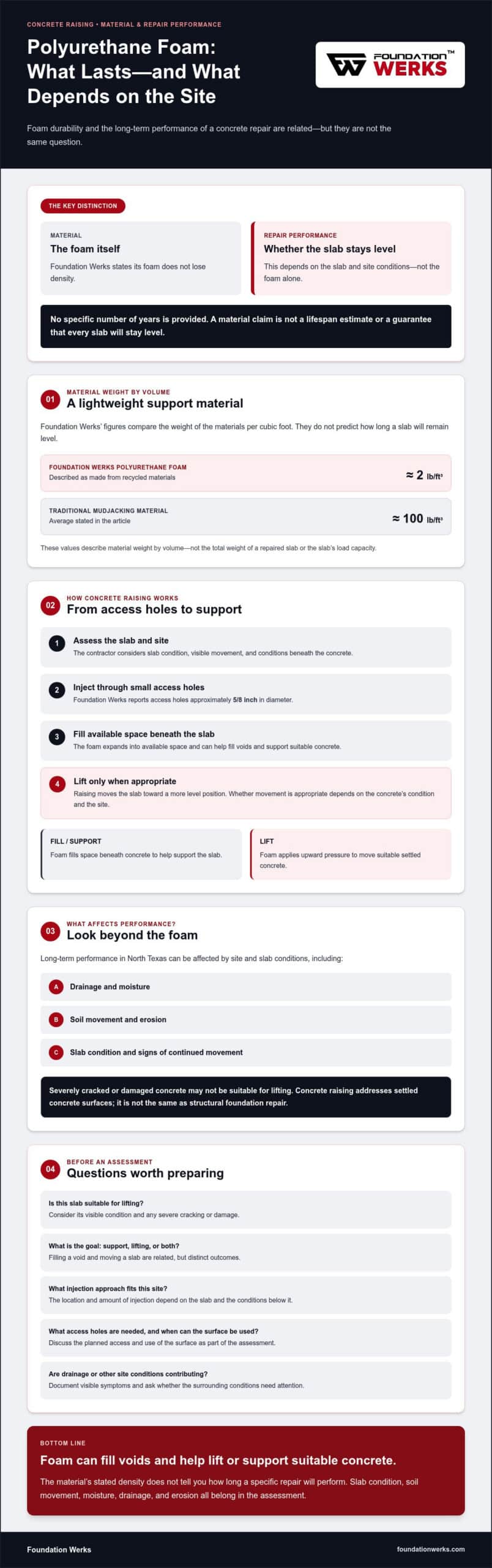
Polyurethane foam is a lightweight material injected beneath concrete to fill voids and help lift or support a slab. Foundation Werks describes its patented foam, made from recycled materials, as approximately 2 pounds per cubic foot. Traditional mudjacking material averages approximately 100 pounds per cubic foot. Those figures compare material weight by volume. They don’t predict how long a particular slab will remain level.
This guide explains how polyurethane foam is used in concrete raising, what can affect a repair’s performance, and what to ask before choosing an approach. Soil movement, moisture, drainage, and slab condition can all matter. For a concrete surface in the Dallas area, an on-site assessment can help determine whether it is suitable for lifting and whether drainage or other site conditions need attention.
Key Takeaways
- Polyurethane foam is injected beneath concrete to fill voids and help lift or support a suitable slab. The repair’s performance depends on more than the foam alone.
- Concrete raising addresses settled concrete surfaces. It is not the same as structural foundation repair.
- Foundation Werks states that its foam does not lose density, but this is not a lifespan estimate or a guarantee that every slab will stay level.
- When considering long-term performance in North Texas, look at drainage, erosion, slab condition, and signs of continued movement.
- Before an assessment, document visible symptoms and ask about slab suitability, the injection approach, access holes, and when the surface can be used.
What Is Polyurethane Foam Used for in Concrete Raising?
Polyurethane foam is a cellular polymer material injected beneath settled concrete to fill available space and help lift or support the slab. In concrete raising, it works below the surface rather than as a coating on top. To understand what polyurethane foam is and how long it lasts, start with what it does: it can fill voids and support suitable concrete, but it does not by itself diagnose or fix every condition affecting the slab or the ground beneath it.
What is polyurethane foam made of?
Polyurethane is a family of polymer materials. In foam form, it has a cellular structure, and different polyurethane foams have different properties and uses. The Polyurethane foam overview describes common foam classifications and applications. Foundation Werks describes its concrete-raising foam as lightweight and made from recycled materials. That description applies to the company’s foam, not to every polyurethane foam product.
How is foam used beneath a concrete slab?
For concrete raising, a contractor injects foam through small access holes drilled in the slab. The foam expands into available space beneath the concrete, where it can fill voids and apply upward pressure to help lift the slab. Foundation Werks reports that its access holes are approximately 5/8 inch in diameter.
Filling a void and raising a slab are related but distinct goals. Foam may fill space beneath concrete without moving the surface to a desired height. Whether a slab can be lifted, and how much movement is appropriate, depends on its condition and the site. Severely cracked or damaged concrete may not be suitable for lifting.
An assessment helps determine whether the goal should be support, lifting, or both. A contractor can consider the slab, visible movement, and the conditions beneath it before recommending an approach. Concrete raising addresses settled concrete surfaces. It is not the same as structural foundation repair.
How Polyurethane Foam Supports and Stabilizes Concrete
Polyurethane foam supports concrete by expanding into available space beneath a slab. When the slab and site are suitable, injection can fill voids and apply upward force to raise settled concrete. The amount and location of injection depend on the site. Slab condition, the location of voids, and what is happening below the concrete all affect the approach.
What happens during foam injection?
A contractor first evaluates the slab and determines where access is needed. Foam is injected through small holes and expands beneath the surface. The injection approach is selected for the specific site rather than applying the same pattern or amount to every slab.
Filling a void and lifting concrete are different outcomes. Foam may fill an underlying void to support the slab, while raising involves moving the slab toward a more level position. Whether that movement is appropriate depends on the concrete’s condition and the site. Severely damaged concrete may not be suitable for lifting, and concrete raising should not be confused with structural foundation repair.
Does lightweight foam affect the slab differently?
Foundation Werks describes its foam as approximately 2 pounds per cubic foot and traditional mudjacking material as averaging approximately 100 pounds per cubic foot. These figures compare the weight of the materials by volume. They do not represent the total weight of a repaired slab or measure the slab’s capacity to carry a load.
The comparison helps explain why polyurethane foam is described as a lightweight support material. It does not establish how long a repair will perform or guarantee a particular lifting result. The American Chemistry Council discusses polyurethane in building and construction applications, but general material applications do not establish how a specific concrete repair will perform.
In short, foam fills space and can help lift or support suitable concrete. The slab’s condition and the site determine whether that approach fits. If you’re considering work in the Dallas area, learn more about concrete raising and stabilization from Foundation Werks.
How Long Does Polyurethane Foam Last? Material Life Versus Repair Life
If you’re asking, “What is polyurethane foam and how long does it last?” the answer has two parts. Foundation Werks does not provide a specific number of years for the lifespan of a concrete repair. The company states that its foam does not lose density, but that material claim is not a timeline or a guarantee that a particular slab will stay level.
These are separate questions: Does the foam retain a material property, and does the completed repair continue to perform at the site? A slab’s performance can change even if the foam’s density does not. Keeping those questions separate helps put durability statements in context without treating a product characteristic as a promise about every repair.
What does “does not lose density” mean?
Density describes how much material is contained in a given volume. In everyday terms, it relates to how much the foam weighs for the space it occupies. Foundation Werks states that its foam does not lose density. This is a claim about the company’s foam, not a statement that the slab cannot move for other reasons.
Why can a repair’s lifespan differ from the foam’s material properties?
A repair’s performance depends on the conditions around and above the foam. Continued soil movement, water draining toward or beneath a slab, or erosion may affect support. The concrete itself matters as well. A slab with substantial cracking or damage may not be suitable for lifting, so its condition should be assessed before an approach is chosen.
The injection approach matters too. The foam needs to be placed to address the site’s voids and support needs. A general statement about foam durability cannot tell you whether a particular slab was suitable for lifting, whether the repair addressed the conditions at the site, or how the area will behave afterward.
For a practical evaluation, ask what signs of movement were observed, whether drainage or erosion could be affecting the slab, and how the contractor determined that the concrete was suitable for lifting. These questions connect the foam’s stated properties to the repair being considered without assuming that every property will have the same result.
What Can Affect Foam Concrete Repair Performance in North Texas?
Foundation Werks is based in McKinney and serves the Dallas metropolitan area. Every repair should be considered in the context of its own site. Foam can support a slab, but it cannot correct every cause of movement beneath it. Water flow, erosion, slab condition, and signs of continued settling are useful clues when deciding whether lifting or stabilization is appropriate.
Which site conditions should an assessment check?
Start by observing the area around the concrete. Does water collect beside it after rain? Has a downspout or drainage path changed? Look for cracks, uneven slab edges, and sections that appear unsupported. Note where and when you’ve seen changes. Photos can help record symptoms, but they cannot establish the cause of soil movement. An on-site evaluation can consider the slab and surrounding conditions together.
Ongoing water or soil changes may need attention alongside the slab work. For example, if drainage directs water toward a settled walkway, raising the concrete without considering that pattern may leave an important site factor unaddressed. Ask what conditions the assessment identified and whether they could affect the repair. Foundation Werks also offers French drain installation and commercial concrete crack and joint repairs where those services fit the project.
When might lifting not be appropriate?
Not every slab is a good candidate. Concrete that is severely cracked or damaged may not be suitable for lifting, so the surface should be assessed before work is recommended. Concrete raising and stabilization address concrete slabs. They are not structural foundation piering, a service Foundation Werks does not offer.
For a commercial property, note whether uneven areas are isolated or extend across a larger warehouse floor. A broader floor issue may call for evaluation beyond one sunken section. Cracks should also be considered separately from level changes, since their location and condition can influence the next step. Ask how the contractor assesses slab suitability and distinguishes a lifting need from a crack or joint repair.
Before an assessment, document visible movement and drainage patterns. These observations can help guide a site-specific conversation without assuming the cause from appearance alone. Foundation Werks provides polyurethane concrete raising and stabilization in the Dallas metropolitan area, including Frisco, McKinney, Dallas, Prosper, Allen, Fairview, Southlake, Irvin, North Dallas, and DFW.
How to Judge a Polyurethane Foam Repair and Choose Your Next Step
Understanding what polyurethane foam is and how long it lasts is only part of choosing a repair. The right next step depends on the slab and the conditions at your property. Before discussing work, note what you’re seeing and ask how the contractor will decide whether the concrete can be raised or stabilized.
Questions to ask before choosing foam concrete raising
Use these questions to understand the proposed work:
- How will you assess the slab’s condition and identify voids beneath it?
- What foam specifications and injection approach are proposed, and where will access holes be placed?
- What does the quoted work include, and do drainage concerns need separate attention?
- When can the surface be used after the work? Foundation Werks states that raised concrete can be used the same day the work is completed. Confirm what to expect for your project.
A clear explanation should connect the proposed injection approach to the condition of your concrete. It should also distinguish the foam’s material properties from the expected performance of the repair at your site.
When should you request an on-site assessment?
Consider an assessment if settlement has left an uneven surface, visible gaps, or new concerns about water collecting nearby. Note where movement appears and whether drainage patterns have changed. Photos can help record what you see, while an on-site visit lets a contractor evaluate the slab and surrounding conditions directly.
An assessment can help determine whether the concrete is suitable for lifting or stabilization. Do not assume that every cracked or damaged slab can be raised. Ask how the contractor reached the recommendation and what site factors could affect the result.
Foundation Werks offers polyurethane concrete raising and stabilization in the Dallas metropolitan area, along with free estimates. If you’re seeing settlement or want to understand your options, an assessment can help clarify whether the slab is suitable and what conditions should be considered.
Make Your Next Concrete Repair Decision with Confidence
What is polyurethane foam and how long does it last? It is an injection material used to fill space beneath concrete and support or raise a suitable slab. Foundation Werks describes its foam as approximately 2 pounds per cubic foot and states that it does not lose density. Neither statement gives a lifespan for the completed repair. Performance also depends on the slab and site conditions.
Look at the full picture before choosing a solution. Note uneven surfaces, visible gaps, drainage patterns, and signs of ongoing movement. Ask how slab suitability will be assessed, what injection approach is proposed, and what the work includes. A site-specific evaluation can help clarify whether concrete raising or stabilization fits the conditions without promising the same result for every property.
Foundation Werks is based in McKinney, Texas, and serves the Dallas metropolitan area, including Frisco, McKinney, Dallas, Prosper, Allen, Fairview, Southlake, Irvin, North Dallas, and DFW. The company offers free estimates. If settlement has you weighing your options, an assessment can help you understand what may be appropriate for the concrete and its surroundings.
Frequently Asked Questions
How long does polyurethane foam last under concrete?
The answer to “What is polyurethane foam and how long does it last?” depends on whether you mean the material or the completed repair. Foundation Werks states that its foam does not lose density, but does not specify a number of years for a repair. Slab condition, drainage, ongoing site movement, and workmanship can affect performance, so a material claim is not a guaranteed lifespan for the concrete above it.
Does polyurethane foam lose density over time?
Foundation Werks states that its foam does not lose density. Density describes how much material is contained in a given volume. This company-specific claim describes a property of the foam; it does not establish that every slab will remain level under all site conditions. Continued movement or drainage concerns may affect the concrete above the foam, so consider both the material and the site when assessing repair performance.
Can polyurethane foam raise severely cracked concrete?
Not every slab is suitable for lifting, and severely cracked or damaged concrete may be too compromised to raise. An assessment should consider the slab’s condition, visible movement, and any voids beneath it. Ask the contractor to explain how they determine suitability and whether stabilization or another repair approach may be more appropriate. A crack alone does not determine the answer without an evaluation of the full slab.
Is polyurethane foam lighter than mudjacking material?
Foundation Werks describes its polyurethane foam as approximately 2 pounds per cubic foot and traditional mudjacking material as averaging approximately 100 pounds per cubic foot. These figures compare the materials by volume. They do not represent the total weight or load capacity of a repaired slab, and they do not guarantee a particular repair result. The appropriate method depends on the concrete’s condition and the site.
How soon can I use concrete after polyurethane foam lifting?
Foundation Werks states that raised concrete can be walked on, driven on, or used the same day the work is completed. Ask the contractor to confirm the expected timing for your project before work begins. The site and work plan may shape what to expect, so do not assume every property has identical use instructions. Confirm when the repaired area can be used and whether any restrictions apply.
What can shorten the life of a foam concrete repair?
A specific repair lifespan cannot be determined from the foam material alone. Slab condition, ongoing movement, drainage, water-related erosion, and workmanship are factors to discuss during an assessment. Document where water collects and note visible movement or uneven edges. Foundation Werks serves the Dallas metropolitan area from McKinney, including Frisco, McKinney, Dallas, Prosper, Allen, Fairview, Southlake, Irvin, North Dallas, and DFW. Ask what site conditions were observed.