

What if a dock access problem that looks like a failing leveler actually starts with settled concrete? An uneven ramp can disrupt daily operations and make it harder to tell whether the issue lies in the slab, its joints, drainage, or mechanical dock equipment. Loading dock ramp repair starts by identifying the source, rather than assuming the entire ramp needs replacement.
A clear repair plan begins with assessing the slab and the area beneath it. A solid but settled slab may be suitable for polyurethane raising, while severe damage, deteriorated joints, unsupported areas, or drainage concerns may call for other work. Mechanical dock equipment is a separate consideration from the concrete.
This guide covers signs of ramp distress, how to compare repair options, and what to gather before requesting an estimate for your North Texas facility. Whether your property is in Frisco, McKinney, Dallas, Prosper, Allen, Fairview, Southlake, Irving, North Dallas, or elsewhere in the DFW area, these steps can help you plan around dock access and facility operations.
Key Takeaways
- Note changes in ramp level, cracks, joint condition, and drainage to describe the problem clearly.
- Loading dock ramp repair depends on the concrete’s condition. Settled slabs, damaged joints, unsupported areas, and severely deteriorated concrete may need different approaches.
- Polyurethane raising may suit a solid slab that has settled. An assessment helps determine whether lifting is appropriate.
- Record where the problem appears and how it affects access before planning work around facility operations.
- Foundation Werks provides commercial concrete repair services in the Dallas-Fort Worth area, including polyurethane raising, void filling, crack and joint repair, and drainage work.
Loading Dock Ramp Repair Starts with Identifying the Concrete Problem
An uneven, cracked, or settled loading ramp can interrupt dock access and make transitions harder for equipment and people to navigate. Start by determining whether the concrete surface has moved or deteriorated. A mechanical dock issue can also affect operations, but it calls for a different repair than a damaged or uneven slab.
Concrete loading dock ramp repair involves assessing and repairing damaged or uneven ramp slabs and related concrete surfaces to improve their condition and support reliable dock access. This guide focuses on the concrete and its support. Mechanical dock-leveler components are a separate issue.
Which signs point to a concrete ramp problem?
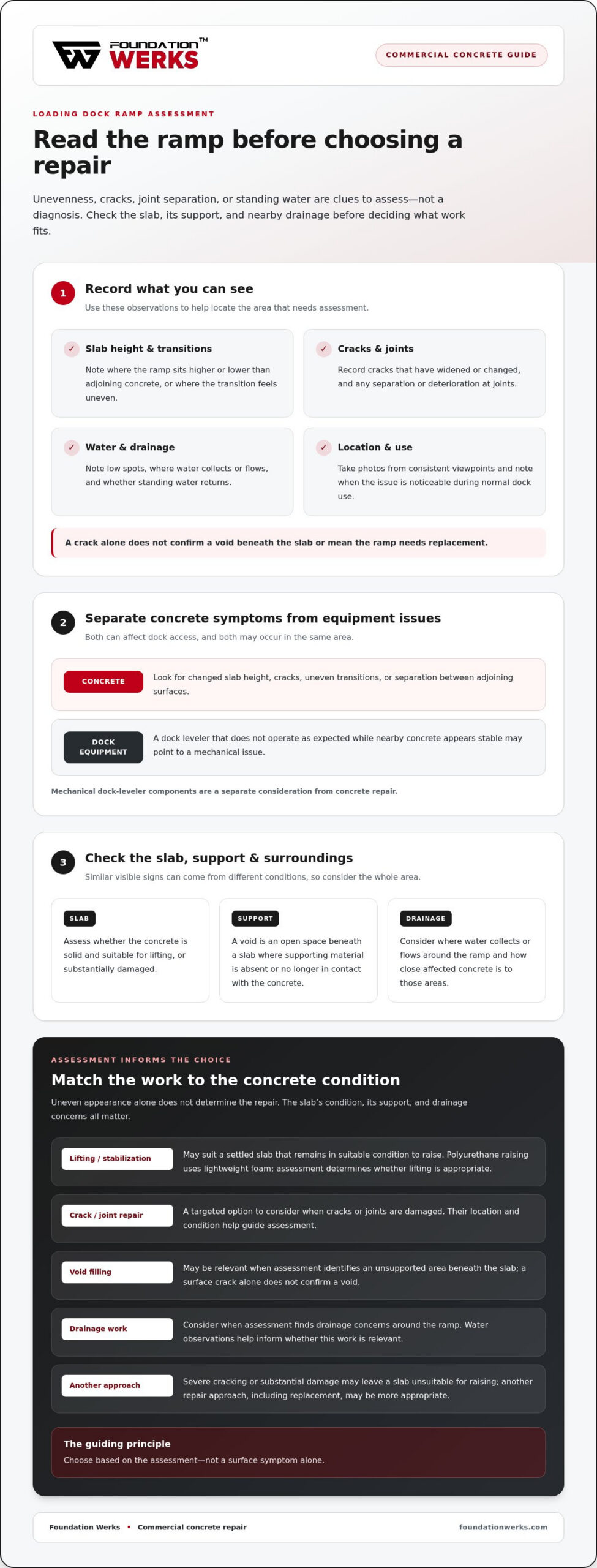
Look for a slab that sits higher or lower than adjoining concrete, an uneven transition where surfaces meet, or cracks that have widened or changed. Separation at a joint is another sign to note. These observations help locate areas for assessment, but they do not establish the cause or determine the right repair.
Standing water may point to a low spot or drainage concern. Deteriorated joint material may mean the connection between concrete sections needs attention. Neither sign proves a single cause. Concrete can deteriorate through different mechanisms, including reinforcement corrosion, chemical damage, and shrinkage. The causes of concrete degradation help illustrate why visible symptoms need to be considered in context. A crack alone does not mean the slab must be replaced.
Is the issue concrete or dock equipment?
Concrete movement often appears as a changed slab height, a crack, or separation between adjoining surfaces. A mechanical problem may instead involve a dock leveler that does not operate as expected while the surrounding concrete appears stable. Both problems can occur in the same area, so distinguish what is happening to the slab from what is happening to the equipment.
For loading dock ramp repair, document what you observe. Note where unevenness, cracks, water, or joint deterioration appear. Take photos from consistent viewpoints and record when the issue is noticeable during normal dock use. This gives the assessment a useful starting point without treating a visible symptom as a diagnosis.
Why North Texas Loading Dock Ramps Settle, Crack, or Lose Support
A concrete ramp needs consistent support beneath the slab. If support is lost in one area, that section may settle and leave a height difference or uneven transition. A crack is a visible break in the concrete, but it does not prove that a void exists underneath or identify what caused the damage.
A void is an open space beneath a concrete slab where supporting material is absent or no longer in contact with the concrete. An unsupported area can affect how the slab bears loads and may contribute to movement. A surface crack alone does not confirm a void.
How voids, settlement, and drainage relate
Cracks and deteriorated joints are conditions to assess, not diagnoses. Their location and pattern, and how they relate to settled areas, can help guide an inspection, but different conditions can produce similar visible signs. Include drainage in the assessment. Note where water collects or flows around the ramp, whether standing water returns, and how close the affected concrete is to those areas. These observations help determine whether void filling or drainage improvements are relevant. Neither should be assumed necessary based on a crack alone.
For loading dock ramp repair, assess the slab, its support, and nearby drainage conditions together. This gives a clearer basis for choosing work that addresses what is actually observed.
When can a loading dock ramp slab be raised?
A solid slab that has settled may be a candidate for lifting if its condition is suitable. Polyurethane concrete raising is one possible approach. It uses lightweight foam to lift settled concrete, but it is not right for every slab. Severe cracking or other substantial damage may leave the concrete too compromised to raise, making another repair approach more appropriate.
The repair decision should account for the slab’s condition and what is happening beneath or around it. Raising, stabilization, crack or joint repair, void filling, drainage work, and replacement address different conditions. Choose an option based on the assessment, not a surface symptom alone.
Uneven concrete also matters to safe dock operations. OSHA’s loading dock safety guidance provides context for hazards around loading areas. For project-specific assessment of concrete at a commercial property, Foundation Werks’ commercial concrete assessment can help identify a practical next step.
Compare Loading Dock Ramp Repair Options for the Concrete Condition
The right loading dock ramp repair depends on what the concrete needs, not simply how uneven it looks. An assessment considers the slab’s condition, whether it has settled, and whether it has voids, damaged joints, or drainage concerns. Replacement is not automatically necessary when a ramp is uneven. A suitable slab may be raised, while targeted repairs or replacement may be a better fit in other cases.
| Option | Concrete condition it may address | Key consideration |
|---|---|---|
| Lifting or stabilization | A settled slab that remains in suitable condition to raise | Assessment determines whether the concrete can be lifted appropriately. |
| Crack and joint repair | Cracked concrete or deteriorated joints that need focused repair | The location and condition of the damage guide the work. |
| Void filling | Empty space beneath concrete that needs support | Filling a void may be appropriate when an assessment identifies one. |
| Concrete replacement | Concrete that is too damaged or unsuitable for repair by lifting | Replacement is one option, not an automatic response to unevenness. |
When concrete raising or void filling may fit
Polyurethane raising may suit a solid slab that has settled, provided its condition allows it to be lifted. Foundation Werks uses polyurethane foam that weighs approximately 2 pounds per cubic foot. The process uses drill holes approximately 5/8 inch in size. These details describe the method, but they do not mean every ramp is a candidate for lifting.
Void filling has a different purpose: it fills empty space beneath concrete when that condition is found. Depending on the assessment, a project may call for lifting, filling, or both. Match the work to the observed support condition instead of assuming every low area has the same cause.
When crack repair, joint work, or replacement may be needed
A crack or worn joint needs evaluation based on its location, extent, and relationship to the surrounding slab. Crack repair or joint work may suit localized damage. If the slab is severely cracked or otherwise too damaged to lift, raising may not be appropriate. Replacement may then be considered based on the overall condition.
These options are not always mutually exclusive. An assessment may identify more than one need, such as repairing a joint while stabilizing an area beneath the slab. The goal is to select a repair, or combination of repairs, that fits the concrete condition rather than defaulting to full replacement or assuming lifting will work.
Plan Loading Dock Ramp Repair Around North Texas Facility Operations
Good planning starts before work begins. Document what is happening, assess the slab, choose an approach based on its condition, then coordinate access around the facility’s needs. This sequence turns visible symptoms into a practical project plan without assuming a particular repair method or closure period.
What information helps assess a commercial ramp?
Share which sections are affected and what you have observed. Photos and notes can show the location and extent of:
- Cracks, surface damage, or deteriorated joints
- Uneven transitions between the ramp and adjoining concrete
- Areas where water collects or drainage appears to be a concern
Include site-access constraints and explain how the ramp supports daily operations, such as vehicle movement, deliveries, and pedestrian routes. These details help frame the assessment. Recommendations depend on the slab’s condition and the site, so your observations provide useful context but do not replace an inspection.
How to prepare for work at an operating facility
Before scheduling work, consider how vehicles, deliveries, and pedestrians will move through nearby areas. Identify alternate paths or staging areas that could help keep activity organized while the ramp is being addressed. Coordinate access with the people responsible for dock operations and discuss the project plan with the facility team. There is no single closure window that applies to every site.
Project duration depends on the work and site conditions. Foundation Werks reports that projects typically take a few hours, but that is not a set timeline for every ramp. Once work is complete, the concrete can be walked or driven on the same day, subject to project conditions. The process does not require heavy equipment to traverse lawns or landscaping, which may matter when planning access around those areas.
For a focused estimate request, describe the affected areas, provide photos, and explain access needs and operating constraints. This information supports an assessment and repair recommendation tailored to the concrete and facility.
Get a Loading Dock Ramp Repair Assessment from Foundation Werks
A sound repair plan follows a clear sequence: identify the concrete symptoms, assess the slab and its support, then select an approach that fits the condition. Foundation Werks serves commercial properties in the Dallas-Fort Worth area with loading dock ramp repair options including polyurethane raising, void filling, crack and joint repair, drainage work, and concrete replacement.
What Foundation Werks considers when assessing concrete
The visible condition of the slab helps shape the assessment. Uneven transitions, settlement, cracks, and deteriorated joints provide useful clues, but none alone determines the repair. The slab’s overall condition and support also matter. A solid, settled slab may be suitable for lifting, while severely cracked concrete may be too damaged for that approach.
Drainage and joint concerns can be part of the repair plan when site conditions make them relevant. Addressing only the visible unevenness may leave other observed issues unaddressed. The recommended work depends on the concrete and support conditions found during assessment, so the plan may involve one service or a combination of options.
What to expect from a repair approach
If polyurethane raising is appropriate, lightweight foam is injected through drill holes approximately 5/8 inch in size to lift suitable settled concrete. The polyurethane material weighs approximately 2 pounds per cubic foot. These details describe the process, not a promise that every slab can be raised. If the ramp is too damaged, crack and joint repair or concrete replacement may be a better fit. Void filling and drainage work address other conditions when they are present.
Foundation Werks reports that completed concrete can be walked or driven on the same day, subject to project conditions. When requesting an estimate, facility managers can share access requirements, affected ramp areas, and operational needs. That context connects the site assessment to a practical repair plan.
For a North Texas commercial property, share the ramp’s symptoms with Foundation Werks to request a site-specific estimate.
Choose a Practical Next Step for Your Dock
A dependable repair plan starts with understanding the concrete, rather than assuming an uneven ramp needs full replacement or that dock equipment is the source. Document the symptoms, assess the slab and its support, then match the work to the condition. The right loading dock ramp repair may involve raising suitable settled concrete, addressing cracks or joints, filling voids, improving drainage, or replacing severely damaged sections.
For slabs suited to lifting, Foundation Werks uses lightweight polyurethane foam that weighs approximately 2 pounds per cubic foot, compared with approximately 100 pounds per cubic foot for traditional mudjacking material. The process uses approximately 5/8-inch drill holes, and completed concrete can be walked or driven on the same day, subject to project conditions.
Facility managers in Frisco, McKinney, Dallas, Prosper, Allen, Fairview, Southlake, Irving, North Dallas, and across DFW can request a site-specific estimate. Share what you have observed and how the ramp supports daily operations to help plan work around your facility’s needs.
With the concrete condition understood, you can make a more informed choice for your facility.
Frequently Asked Questions
Can a loading dock ramp be repaired without replacing the concrete?
Yes. In some cases, a suitable settled slab can be raised or stabilized instead of replaced. Crack or joint repairs may also address specific damaged areas. The right loading dock ramp repair depends on the slab’s overall condition and whether it is sound enough to lift. Severely cracked concrete may be too damaged for raising, so an assessment helps determine whether targeted repairs, lifting, or replacement is appropriate.
How do I know whether a loading dock ramp problem is concrete or equipment-related?
Note whether the symptoms involve the concrete or a mechanical dock component. Settlement, cracking, separation, or an uneven transition point to a concrete condition that needs assessment. A malfunctioning dock-leveler component is a separate equipment issue. This guide focuses on the concrete ramp and slab, not mechanical repairs. Describe where the symptoms appear to help focus the assessment on the affected area.
How long does loading dock ramp concrete repair take?
Timing depends on site conditions and the work required. Foundation Werks reports that projects typically take a few hours from start to finish, but that is not a set duration for every ramp. The estimate and project plan should reflect the slab’s condition and facility access needs. Sharing delivery activity, vehicle routes, and other site constraints can help with practical planning.
Can polyurethane foam raise a cracked loading dock ramp?
It may be possible if the slab has settled and remains suitable for lifting. A crack alone does not determine whether raising is appropriate. The concrete’s overall condition matters, and severe cracking may mean the slab is too damaged for this method. An assessment can help determine whether polyurethane raising, crack or joint repair, or another option best fits the observed condition.
When can a loading dock ramp be used after polyurethane concrete raising?
Foundation Werks reports that completed concrete can be walked or driven on the same day the work is completed. This is not a fixed reopening time for every ramp or facility. The site-specific plan should account for the work performed and access needs before normal use resumes. Coordinate vehicle and pedestrian movement with the facility team as part of project planning.
What should I share when requesting a loading dock ramp repair estimate?
Describe the affected area and note visible settlement, cracks, uneven transitions, or drainage concerns. Explain how the ramp is used and share access constraints involving deliveries, vehicles, or nearby routes. Photos can show where symptoms appear. Foundation Werks offers free estimates for commercial concrete projects in the Dallas-Fort Worth area, including properties around McKinney and Frisco. These details help frame an assessment for your site.