

What if you could restore your sinking driveway without the noise of jackhammers or the five-figure bill that comes with a total replacement? Most homeowners and facility managers see an uneven slab and assume the only solution is to tear it out and start over. It’s a stressful realization, especially when you’re worried about trip hazard liabilities and the damage heavy machinery might do to your lawn or landscaping.
We believe you shouldn’t have to choose between a broken sidewalk and a destroyed yard. Advanced polyurethane foam injection has changed the math on concrete repair. This high-precision method uses nearly invisible 5/8-inch holes to lift slabs and stabilize the sub-soil, often at half the cost of traditional replacement. In this guide, you’ll discover how this eco-friendly technology works and why it’s the smartest way to protect your property in 2026. We’ll break down the process, compare the costs, and show you how a few hours of work can provide a reliable, long-term solution for your home or business.
Key Takeaways
- Learn why advanced polyurethane foam injection is a superior alternative to mudjacking, using lightweight materials that stabilize soil without adding unnecessary weight.
- Discover how to address the North Texas “clay cycle” through deep soil stabilization techniques that protect your concrete from seasonal expansion and contraction.
- Reduce your project expenses by up to 50% by leveling existing slabs instead of paying for costly demolition and new concrete pouring.
- Minimize business or household downtime with a process that allows for immediate traffic on surfaces once the injection is complete.
- See why the 5/8-inch nearly invisible drill holes are the least invasive solution for maintaining your property’s curb appeal and landscaping.
What is Advanced Polyurethane Foam Injection?
Advanced polyurethane foam injection is a specialized engineering process that uses high-density, closed-cell polymers to lift and level concrete slabs. Unlike older methods that rely on heavy slurries or cement mixtures, this modern approach uses a two-part liquid that expands rapidly upon contact. This expansion provides the necessary force to lift heavy concrete with surgical precision. It’s often called “advanced” because it offers a level of control and material longevity that traditional mudjacking simply cannot match.
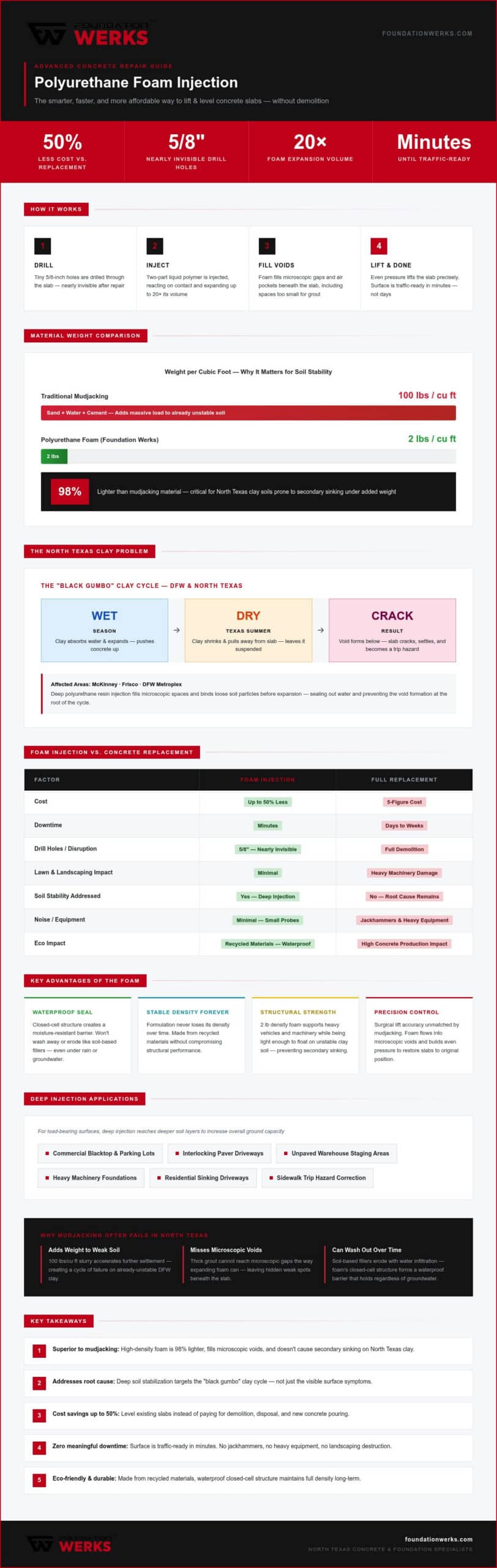
One of the most significant advantages involves the weight of the material itself. Traditional mudjacking uses a mixture of sand, water, and cement that weighs roughly 100 pounds per cubic foot. In contrast, our high-density foam weighs only 2 pounds per cubic foot. This 98% reduction in weight is critical for the North Texas area, where the soil is already prone to shifting. Adding massive amounts of weight on top of unstable soil often causes the concrete to sink again; this creates a cycle of failure that we work to avoid.
We take pride in using formulations made from recycled materials. This eco-friendly approach doesn’t compromise quality. The material remains waterproof and never loses its density over time. It’s a clean, efficient way to restore your property without the mess of grout splatter or the environmental impact of heavy concrete production. The result is a stable surface that is ready for traffic in minutes rather than days.
The Science of Controlled Expansion
The two-part liquid reacts at the injection point, expanding up to 20 times its original volume. As it travels under the slab, it finds and fills even the smallest microscopic voids that a thicker grout might miss. Once the voids are filled, the pressure builds evenly to lift the slab back to its original position. Because the foam is closed-cell, it forms a solid, moisture-resistant barrier that stays in place regardless of rain or groundwater. It won’t wash away or erode like soil-based fillers.
Lightweight Strength for Fragile Soils
When you place a heavy object on soft soil, it sinks. This is why mudjacking often leads to “secondary sinking,” where the weight of the repair material actually accelerates further settlement. By using lightweight foam, we reduce the load on the sub-strata while providing the necessary support. This 2lb density foam provides the structural integrity required to support heavy vehicles and machinery while remaining light enough to float on top of unstable clay.
Soil Stabilization and Deep Foamjection™ in North Texas
North Texas homeowners deal with a unique geological challenge. The region is famous for its “black gumbo” clay, a soil type that acts like a sponge. It expands significantly when wet and shrinks during the brutal Texas summers. This constant movement creates a relentless cycle of soil expansion and contraction that leaves empty pockets, or voids, beneath your concrete. Without proper support, the weight of the slab eventually causes it to crack and sink.
This is where advanced polyurethane foam injection becomes a critical tool for property maintenance. We don’t just lift the concrete; we address the instability of the soil itself. By injecting high-density resins into the sub-grade, we fill those air pockets and bind loose soil particles together. This process creates a more stable foundation that is less susceptible to the seasonal shifts common in the DFW area. It’s a proactive approach to soil management that helps prevent the “secondary sinking” often seen with heavier, traditional repair materials.
Managing the DFW Clay Challenge
Properties in McKinney, Frisco, and surrounding areas are particularly prone to these soil issues. When the clay shrinks, it pulls away from the concrete, leaving the slab suspended over a gap. Our polyurethane resins are designed to flow into these microscopic spaces before expanding. This seals out water and prevents the formation of water pockets that lead to further erosion. To help manage this cycle effectively, we often recommend pairing our stabilization services with French drain installation. Controlling how water enters and leaves the soil around your concrete is the best way to minimize dramatic soil movement.
Deep Polyurethane Injection for Load-Bearing Surfaces
For areas that handle heavy traffic or significant weight, standard surface lifting might not be enough. Our deep polyurethane injection technique allows us to reach deeper soil layers to increase the overall load-bearing capacity of the ground. This technique is especially effective for:
- Commercial blacktop and parking lots
- Interlocking paver driveways
- Unpaved warehouse staging areas
- Heavy machinery foundations
Instead of expensive and invasive soil excavation, we use small injection probes to deliver foam at multiple depths. This strengthens the soil from the bottom up, creating a dense, stable environment for your concrete or asphalt to rest upon. If you’ve noticed recurring sinking in high-traffic areas, consulting with a soil stabilization expert can help you identify if deep injection is the right path for your property.
Foam Injection vs. Concrete Replacement: A Cost-Benefit Analysis
Deciding between repair and replacement is usually a matter of simple math. When you look at the total bill for a new concrete pour, the price of the material is only one part of the story. You also have to pay for the demolition of the old slab and the disposal fees at the landfill. Advanced polyurethane foam injection avoids these hidden expenses entirely. By using the existing slab as the finished surface, you’re looking at a cost that is typically 50% less than a full replacement.
Time is another factor that often gets overlooked. If you pour new concrete, you’re waiting anywhere from 7 to 28 days for a full cure before you can drive a vehicle or heavy machinery over it. Our foam reaches nearly its full strength in about 15 minutes. This means your driveway or loading dock is back in service before our truck even leaves your property. There’s no need for heavy trucks to tear up your grass or for messy “wash-down” areas that can ruin your landscaping.
The ROI of Slab Leveling
For property managers overseeing large facilities, the savings are substantial. Imagine the cost and logistical nightmare of replacing a 5,000 square foot warehouse floor. Between the operational downtime and the construction costs, the budget can spiral quickly. Leveling the existing floor extends the lifecycle of your concrete assets without the disruption of a major construction project. It also allows you to address OSHA trip hazards immediately. Fixing these liabilities in a single afternoon is a much more efficient way to protect your business than a multi-week demolition project.
Environmental and Aesthetic Advantages
We care about the look of your property as much as its stability. Traditional mudjacking requires holes the size of a soda can. We use 5/8-inch drill holes that are nearly invisible once we’re done. While a new concrete pour often results in a bright white patch that clashes with your older, weathered slabs, our nearly invisible patchwork maintains a consistent aesthetic across your property. From an environmental standpoint, advanced polyurethane foam injection uses materials made from recycled components. This significantly reduces the carbon footprint compared to the massive energy requirements of new concrete production and the waste generated by sending old slabs to a landfill.
Commercial and Industrial Applications for Advanced Injection
Industrial environments put immense pressure on concrete slabs. Between heavy forklift traffic and massive stationary machinery, any instability in the sub-soil leads to rapid deterioration. Advanced polyurethane foam injection provides a specialized solution for these high-stress areas. We use it to fill voids that develop under equipment foundations, ensuring that constant vibrations don’t lead to structural cracking or slab displacement. This process is much cleaner than traditional methods, meaning you don’t have to worry about dust or grout splatter near sensitive electronics or production lines.
When a loading dock or warehouse floor begins to sink, it isn’t just an eyesore. It’s a logistical bottleneck. Rocking slabs can damage expensive material handling equipment and slow down operations. For more details on these specific challenges, see our uneven warehouse floor repair Dallas guide. We understand that in a 24/7 facility, every hour of downtime represents lost revenue.
Warehouse Floor Leveling for Logistics Hubs
Modern logistics hubs often rely on automated picking systems that require perfectly level surfaces to operate correctly. Even a minor slope or a “rocking” joint can throw off sensors or cause premature wear on drive motors. We address this by performing warehouse floor joint repair Dallas through precision foam injection. By stabilizing the joint and preventing deflection, we stop the “clack-clack” sound of forklifts crossing slabs. This sound is a primary indicator of sub-slab voids, and addressing it early helps you avoid the much higher cost of a full floor replacement later.
Meeting OSHA Safety Standards
Safety is the top priority for any facility manager. OSHA regulations are strict regarding trip hazards in the workplace. Even a 1/4-inch vertical displacement can result in a violation or a workplace injury. Using advanced polyurethane foam injection allows us to eliminate these hazards in a single shift. Because the material cures so quickly, high-traffic retail entries or office lobbies remain open for use almost immediately after the repair. It’s a quiet, non-invasive process that doesn’t disrupt the professional atmosphere of your business.
If you are managing a property with visible damage, our concrete crack repair commercial guide offers a deeper look at long-term maintenance strategies. We focus on providing solutions that keep your doors open and your employees safe while protecting your capital investment.
The Foundation Werks Process: Precision and Quality
Our approach to concrete repair is built on a specific 5-step “Foam Lifts & Levels” protocol. We designed this workflow to ensure that every property in the DFW area receives the same high standard of care, whether it’s a residential driveway or a massive industrial loading dock. By following a methodical sequence, we eliminate the guesswork often associated with traditional mudjacking. You won’t see heavy cement mixers or massive crews on your lawn. Instead, our process is streamlined, quiet, and exceptionally clean. We take pride in leaving your property exactly as we found it, only with level, stable concrete surfaces.
From Inspection to Injection
The process begins with a detailed assessment. We use non-destructive testing to identify the exact location and size of the voids beneath your slab. This allows us to be surgical in our approach. Once the voids are mapped, we drill 5/8-inch holes in strategic locations. These are the smallest injection holes in the industry, roughly the size of a penny. Because they’re so small, they don’t compromise the structural integrity of the existing concrete.
During the advanced polyurethane foam injection phase, our technicians monitor the lift with millimeter-level accuracy. We don’t just “eyeball” the progress. We use precision levels to ensure the slab returns to its original position without over-lifting, which can cause secondary cracking. After the lift is complete, we remove the injection ports and patch the holes with a custom-color-matched cement. The result is a nearly invisible finish that looks significantly better than the large, unsightly patches left behind by older repair methods.
Why Our Recycled Foam is a Long-Term Solution
We believe in using materials that are as responsible as they are effective. Our patented polyurethane foam is made from recycled materials, addressing a common concern for eco-conscious property owners. This 2lb density foam is specifically engineered for the challenging soil conditions in North Texas. It’s completely resistant to moisture and chemical breakdown. Unlike soil-based grouts, it won’t wash away during a heavy rainstorm or lose its volume as it cures. This durability ensures that the sub-soil remains stabilized against the seasonal “clay cycle” discussed earlier in this guide.
The speed of our process is perhaps its most appreciated feature. While a new concrete pour would leave your property a construction zone for weeks, our repairs provide same-day results. You can walk, drive, or play on the concrete within 15 minutes of the final injection. This minimal downtime is why DFW facility managers and homeowners trust Foundation Werks to deliver high-quality results without the typical construction headaches.
Level Your Concrete and Protect Your Investment
Choosing advanced polyurethane foam injection means you’re prioritizing both your budget and your property’s long-term health. You’ve learned how this method stabilizes the sub-soil to combat the North Texas clay cycle while costing significantly less than a full replacement. It’s a modern approach that solves the root cause of sinking without the destruction of heavy machinery or the mess of grout splatter.
We use a patented eco-friendly foam made from recycled materials that won’t lose density over time. Our nearly invisible 5/8-inch drill holes ensure your curb appeal remains intact while providing same-day usability for your driveway, warehouse floor, or sidewalk. It’s a clean, efficient way to eliminate trip hazards and restore safety to your home or business in just a few hours.
Taking care of your concrete doesn’t have to be a multi-week headache. We’re here to help you get back to your routine with a surface that is stable, level, and ready for whatever the day brings. Your property deserves an expert touch that respects your time and your landscaping.
Frequently Asked Questions
How long does the polyurethane foam injection process take?
A typical residential project like a driveway or sidewalk repair usually takes between one and three hours to complete. Larger commercial jobs or warehouse floors may take longer depending on the total square footage and the volume of voids we need to fill. Because the setup and cleanup are so efficient, our team can often finish the work and have your property back to normal in a single morning.
Is advanced polyurethane foam injection safe for the environment?
Yes, we use a patented, eco-friendly foam made from recycled materials that is specifically designed to be non-toxic. Once the two-part liquid reacts and becomes a solid foam, it’s completely inert and won’t leach chemicals into the surrounding North Texas soil. This makes it a responsible choice for repairs near gardens, lawns, or sensitive water runoff areas where environmental impact is a concern.
Will the foam lose density or shrink over time?
The high-density foam we use is engineered to maintain its structural volume and density indefinitely. Unlike traditional mudjacking slurries that can wash away or erode, this closed-cell material is moisture-resistant and remains stable regardless of groundwater levels. It provides a reliable support structure that won’t compress or break down as the seasons change, even in the harsh Texas heat.
How soon can I drive on my driveway after the injection?
You can drive your vehicle on the repaired surface in approximately 15 minutes after the final injection is finished. The advanced polyurethane foam injection process allows the material to reach about 90% of its full structural strength almost immediately. This is a massive advantage over new concrete, which requires a multi-week curing period before it can support the weight of a standard car.
Can you lift concrete that is severely cracked or crumbled?
We can successfully lift and level slabs with clean cracks, but concrete that is crumbling or “spider-webbed” into small pieces usually needs to be replaced. Our process relies on the structural integrity of the slab to act as a single unit during the lift. If the concrete is too far gone, we’ll discuss our concrete replacement services to ensure you get a reliable result for your property.
What is the difference between polyurethane injection and mudjacking?
The primary differences are the weight of the material and the size of the injection holes. Mudjacking uses a heavy 100lb grout that can cause further soil sinking and requires large 2-inch drill holes. Our advanced polyurethane foam injection uses a lightweight 2lb material and nearly invisible 5/8-inch holes. This approach stabilizes the soil without adding unnecessary weight to the sub-grade.
Do I need to be home for the concrete raising service?
You don’t need to be present for the repair as long as our technicians have clear access to the work area and a power source. Many of our DFW clients prefer to go about their workday while we handle the stabilization. We’ll communicate with you before we arrive and provide a thorough update once the project is finished and the site is cleaned.
Is the repair visible once the job is finished?
The repair is designed to be as discreet as possible, with 5/8-inch injection holes that are roughly the size of a penny. After the lift is complete, we patch these small holes with a cement mixture that’s custom-matched to your existing concrete. While the holes are nearly invisible, you’ll still see your original cracks, though they’ll be level and much easier for you to seal.