

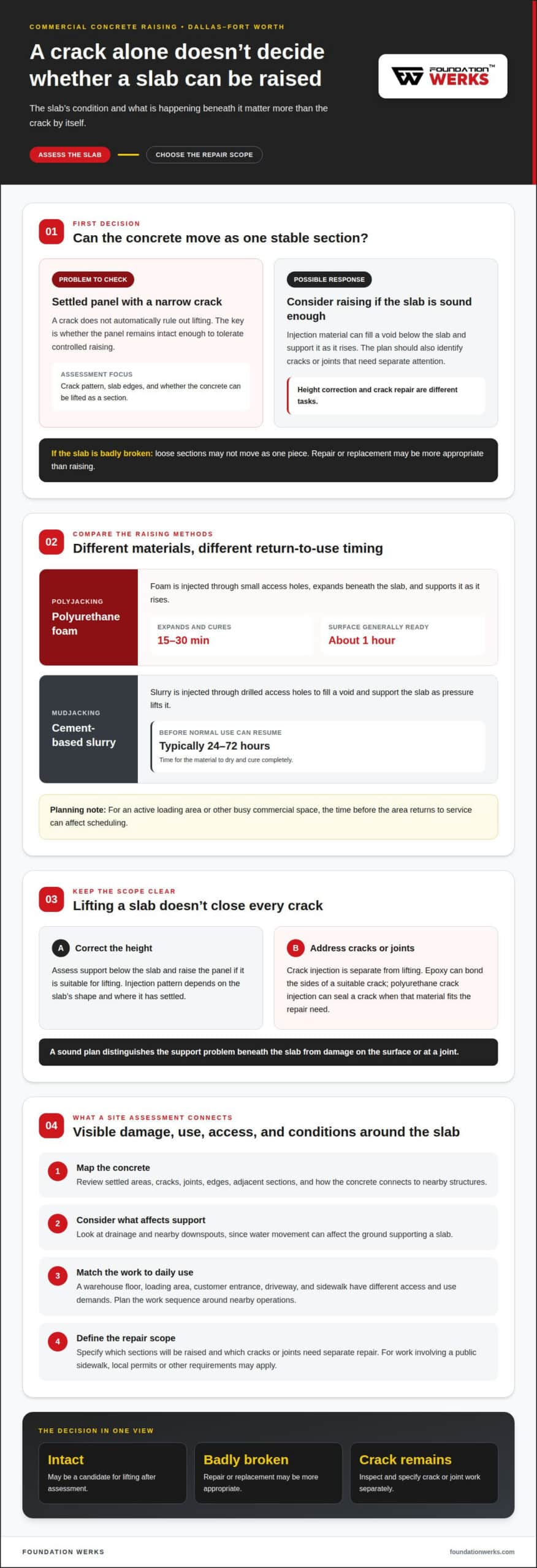
A crack doesn’t automatically rule out mudjacking. For commercial concrete raising across the Dallas-Fort Worth area, a settled slab may be a candidate if it’s intact enough to lift; badly broken concrete may call for repair or replacement instead. The slab’s condition and what’s happening beneath it matter more than the crack alone.
It’s understandable to want a clear answer before planning work around a commercial property. This guide explains how contractors assess cracked concrete, what to expect from a site assessment and estimate, and how local soil can affect concrete movement and ongoing maintenance.
You’ll also see how mudjacking compares with polyurethane raising, why the condition and use of a slab shape the repair approach, and when cracks or joints need separate attention. Polyurethane used for polyjacking cures in approximately 20 minutes, while the best option for a commercial site depends on the slab’s condition and the cause of settlement.
Key Takeaways
- Cracks don’t automatically rule out lifting; the slab’s condition and the cause of settlement help determine whether raising is suitable.
- Polyurethane foam expands and cures in 15 to 30 minutes, but the repair approach depends on the concrete and site conditions.
- A useful site assessment connects visible damage with slab use, access, and what may be happening beneath the surface.
- Garland’s local soil conditions can influence concrete movement, making ongoing maintenance part of commercial property planning.
- Look for contractor reviews that speak to relevant concrete work and clear communication, not just an overall rating.
Can you mudjack cracked concrete?
Yes, cracked concrete can sometimes be raised, but the crack alone does not determine the method. The key question is whether the slab can be lifted and stabilized or needs separate repair.
Polyurethane Foam Injection
Polyurethane foam injection raises a settled slab by filling space beneath it. Small access holes let a crew place foam under the concrete, where it expands and supports the slab as it rises. Polyurethane used for polyjacking expands and cures in 15 to 30 minutes. The surface and nearby joints still need inspection, since lifting doesn’t close every crack.
For example, a commercial walkway with a settled panel and a narrow crack may be a candidate for lifting if the panel remains intact. A slab broken into loose sections may not move as one piece. The assessment should identify the crack pattern, slab edges, and whether the concrete can tolerate controlled lifting. After polyjacking, the surface is generally ready for use after about an hour.
Mudjacking and Injection Leveling
Mudjacking also raises settled concrete through drilled access holes, but it uses cement-based slurry rather than expanding polyurethane foam. The injected material fills a void and supports the slab as pressure lifts it. Foundation Werks uses its Quick Level polyurethane concrete raising and leveling system, which injects foam beneath the slab to lift and stabilize it.
Compare the repair material and the time needed before the area returns to service. Mudjacking typically takes 24 to 72 hours to dry and cure completely before normal use can resume. For an active loading area, that curing period matters to scheduling. Injection leveling can address height differences, but the crew must also assess whether the crack itself needs repair.
Drilling and Injection Ports
For slab raising, small access holes let material reach the void below. Foundation Werks injects its patented, eco-conscious polyurethane foam beneath the slab in a controlled process, monitoring the surface as it lifts. The injection pattern depends on the slab’s shape and settlement. A panel that dips at one edge, for example, may need a different approach from one that has settled across its center.
Crack injection is a separate task from lifting. Polyurethane crack injection can seal a crack where that material fits the repair need. Crack injection, by itself, does not correct a settled slab. A sound plan distinguishes the two steps: assess the support below, raise the panel if appropriate, then address the crack and joints as needed. That separation helps avoid treating a height problem as only a surface defect.
Need a pro for your concrete leveling project in Garland, TX?
A contractor assesses more than the height difference. For a driveway, sidewalk, warehouse floor, or access route in the Dallas-Fort Worth area, the review should consider the slab’s condition, cracks, joints, edges, and how the area is used. A sunken sidewalk panel beside an entrance, for example, raises different access concerns than a low spot in a vehicle staging area.
Concrete leveling contractors serving the Dallas-Fort Worth area should connect the visible problem to the work area beneath and around it. They examine where the slab has settled, how adjacent sections meet, and whether the concrete appears sound enough to lift. They also consider drainage and nearby downspouts, since water movement can affect the ground supporting a slab. These details help distinguish a height correction from a repair that also needs crack or joint work.
Driveways and sidewalks need a plan that accounts for pedestrian and vehicle movement. An assessment can identify uneven panels, raised edges, and transitions where people walk or carts pass. For work involving a public sidewalk, local permits or other requirements may apply. This matters when a project touches the public right-of-way rather than only a private walkway, so the work area should be clearly identified.
Commercial concrete raising also needs to fit the property’s daily use. A warehouse floor, loading area, or customer entrance may require a work sequence that limits disruption to nearby operations. The assessment should identify affected sections, access points, and adjacent cracks or joints that need separate attention. If concrete is too damaged to lift as a stable section, replacement may be more appropriate.
Not every project involves a large commercial slab. A small outbuilding still has a footprint, floor, and surrounding access to consider. A shed floor has different loading and access needs from a driveway or commercial walkway. The assessment should match the proposed work to the slab and its surroundings, rather than treating every low surface alike.
Before work begins, the scope should make clear which sections will be raised and which cracks or joints need separate repair. For example, a settled walkway panel may need lifting, while a damaged joint along its edge may need its own treatment. If you’re planning concrete leveling in the Dallas-Fort Worth area, review the project assessment options and consider how the affected area is used each day.
On-site assessments and project estimates
An on-site review connects visible concrete damage with the conditions around it. A useful estimate then turns those observations into a defined repair scope.
On-Site Project Assessments
The assessment starts with the affected slab and its surroundings. It can map settled areas, cracks, joints, edges, drainage paths, and nearby structures. A low section beside a loading bay, for example, has different use demands from a residential walkway. The reviewer also considers access for equipment and how the work area connects to adjacent concrete.
These observations help distinguish symptoms from repair needs. A height difference may point to a support issue, while a broken edge may need separate concrete work. The assessment should identify which areas need raising, which cracks or joints need separate treatment, and whether replacement belongs in the scope. This gives the estimate a clear basis instead of treating every visible defect as the same repair.
Repair Project Estimates
A repair estimate should describe the work area, proposed method, and key tasks. For example, it might distinguish raising a settled panel from repairing a nearby joint. It should also identify site factors that affect the work, such as access limits, slab condition, and coordination around active commercial operations.
The estimate depends on the affected area, concrete condition, repair method, access, and any related crack or joint work. A useful scope clarifies what the proposed work addresses and what falls outside it. That distinction matters if a warehouse floor has both uneven sections and damaged edges, since those conditions may call for different tasks.
Free Estimates and Warranties
A free estimate describes whether preparing the estimate carries a charge, but it does not explain the repair scope. The document should still state the areas assessed, proposed work, and factors behind the recommendation. For a commercial entrance, for instance, the scope should distinguish the settled approach from adjoining sidewalk sections.
A warranty should be read for its written terms, including what work it covers, its duration, exclusions, and any maintenance conditions. Coverage for a lifting procedure may differ from coverage for crack or joint repairs. Keep the estimate and warranty terms together, so the approved scope can be compared with the completed work. Clear records also help property teams plan future maintenance without confusing separate repair areas.
Before approving a project, match each estimate item to a location and task. If the document lists “leveling” without identifying the slab section, request a clearer written scope before work begins. A marked site plan or labeled photographs can connect the repair description to the actual commercial surface. That record gives managers a practical reference for scheduling, reviewing completed work, and tracking later changes.
Commercial concrete maintenance needs
Commercial concrete maintenance works best as a planned cycle, not a response to one visible crack. Across the Dallas-Fort Worth area, property teams can review warehouse floors, loading areas, sidewalks, entrances, joints, and drainage paths. Age alone doesn’t identify the repair needed. Regular observations help managers notice changes and connect them with how each area serves the property.
Start with a consistent inspection route across the site. Record the location and condition of cracks, uneven transitions, standing water, and damaged edges. For example, a crack beside a warehouse door matters differently if carts or forklifts cross it throughout the workday. Notes tied to specific locations help maintenance teams compare observations during later reviews and communicate which areas need attention.
Temperature and exposure also belong in the maintenance record. Concrete expands as it warms and contracts as it cools, while joints accommodate movement between sections. Teams can note whether joints appear open or damaged and whether cracks change between inspections. For example, a damaged joint at an exposed entrance deserves separate attention from a settled slab section. Distinguishing these conditions helps match the repair to the observed problem.
Water deserves attention alongside surface changes. Observe where roof runoff, downspouts, or surface drainage sends water near slabs. A low area beside a loading bay, for instance, may collect water after rain. Recording that pattern helps identify site conditions that may affect the soil supporting concrete. Maintenance notes can connect water flow, visible changes, and the specific slab area involved.
Commercial upkeep also means matching repair timing to site use. A warehouse floor may need a work sequence that preserves access to operating areas, while a customer entrance needs clear transitions for visitors. Grouping nearby repairs can help managers coordinate access and communicate affected zones. The schedule should identify the work area, nearby operations, and any sections requiring separate attention.
A practical maintenance plan can use three steps:
- Inspect: Review high-use concrete areas and note cracks, joints, settlement, and drainage conditions.
- Track: Record each observation by location so later reviews can identify changes.
- Prioritize: Address areas based on their condition and role, such as a warehouse travel path or public entrance.
This process turns maintenance into a record rather than a series of isolated repairs. The main takeaway is simple: inspect concrete in context. A crack, joint, or low spot means more when considered alongside water flow, exposure, slab use, and nearby site conditions.
Contractor reviews and ratings
Reviews can reveal how customers describe a concrete project, but a rating alone offers limited detail. Garland homeowners gave concrete leveling services an average rating of 4.3 out of 5. For a commercial decision, read beyond that figure and look for comments about work resembling your site, such as a warehouse floor, loading area, or business entrance.
Project relevance matters. A review about a small residential walkway may describe communication well, but it may not address a commercial slab or active work area. Look for specific descriptions of the concrete involved, the concern addressed, and how the work was explained. For example, a review mentioning a settled entry panel gives more context than a general statement that the job went well.
Details about communication can also help you understand the customer experience. Notice whether a reviewer describes a clear assessment, written scope, or updates about the work area. Those details connect directly to decisions a property manager must make, such as coordinating access around warehouse operations. A short review may still be useful if it identifies a concrete task and outcome.
Use these review details as a practical reading guide:
- Project type: Does the review describe raising, leveling, crack repair, or another concrete task?
- Site context: Does it mention a driveway, sidewalk, warehouse, or commercial entrance?
- Communication: Does the writer explain how the scope and work process were discussed?
- Specifics: Does the review describe what changed, rather than relying only on a broad compliment?
Patterns across several comments can add context that one rating cannot. For instance, multiple reviews might mention clear explanations, while another describes how a particular slab issue was addressed. Treat each comment as an account of that person’s project, not proof that every site receives the same result. Concrete condition, access, and project scope vary from property to property.
Reviews are most useful alongside a written estimate and a defined scope. If a comment praises a finished surface but says nothing about the repair method, it may not answer your technical questions. Use the assessment and proposal to understand what work is planned for your property. Then read reviews for examples of how customers experienced similar project communication and service.
For a commercial property in Garland, focus on relevant project descriptions and clear explanations, not the star score alone. That approach helps you weigh customer feedback without treating unlike projects as direct comparisons.
Foundation Werks
Foundation Werks helps commercial property owners understand concrete settlement and choose an approach suited to the slab. If a surface has dropped, cracked, or developed damaged joints, the right next step depends on its condition and how the area is used. Raising may suit concrete that can be stabilized, while severe damage may call for replacement. Cracks and joints can also need separate repair.
For a Garland property, consider how the affected area handles daily traffic, drainage, and nearby operations. Foundation Werks offers polyurethane concrete raising, commercial crack and joint repairs, concrete replacement, and French drain installation. These options address different conditions, so identifying the problem helps clarify which work fits the project.
Contact Foundation Werks to discuss the concrete concerns at your commercial property.
Plan the next step for your concrete
Use an assessment to turn a visible concrete problem into a clear project decision. Identify the area that affects daily operations most, then define what needs attention and how the work can fit around site use. For commercial concrete raising in Garland, TX, a practical plan starts with the slab’s condition and the role it serves, not a preset repair method.
Foundation Werks offers polyurethane concrete raising, commercial concrete crack and joint repairs, and concrete replacement. These options address different conditions, so the project scope should match the concrete and your property’s needs. A clear conversation about the affected area can help move the decision from uncertainty toward a workable plan.
With a well-defined next step, you can approach commercial concrete maintenance with greater clarity and confidence.
Frequently Asked Questions
How long does it take for polyjacking to cure?
Foundation Werks’ polyurethane foam cures in approximately 20 minutes, and the repaired surface is usable immediately after that cure. This helps property managers plan access around a commercial repair. For example, a walkway can return to foot traffic after the cure, while a vehicle area can reopen for use. The work schedule still depends on the project scope and the concrete areas involved.
What commercial concrete raising and slab lifting services are available in Garland, TX?
Relevant services include polyurethane concrete raising, commercial concrete crack and joint repairs, and concrete replacement. Raising can suit a settled slab that remains sound enough to lift. Crack and joint repairs address separate damage, while replacement may suit concrete that cannot be raised as a stable section. For a warehouse floor, the repair plan should account for how the slab is used and where the affected sections lie.
Which contractors provide commercial concrete lifting in Garland, Texas?
Foundation Werks provides commercial concrete raising and lifting, along with commercial crack and joint repairs and concrete replacement. Its service information covers commercial slabs and warehouse floors in the Dallas metropolitan area. For a Garland property, the project discussion should identify the site location, affected slab, and intended use. That helps connect the concrete concern with the appropriate assessment and proposed work.
How does polyurethane foam concrete lifting compare with mudjacking for commercial properties?
Polyurethane lifting injects expanding foam beneath a slab; mudjacking pumps cement-based slurry beneath it. Foundation Werks’ polyurethane foam cures in approximately 20 minutes, and the repaired surface is usable immediately after the cure. The methods also differ in material and injection process. For a commercial site, consider the slab’s condition, the repair area, and how quickly that location needs to return to service.
What types of commercial concrete slabs can be raised, including sidewalks, loading docks, and warehouse floors?
Commercial slabs, walkways, and warehouse floors are among the concrete surfaces addressed by lifting and leveling. A loading dock or sidewalk should be assessed based on its condition, surrounding joints, and daily use. For example, a warehouse floor crossed by material-handling equipment has different operating demands from a pedestrian walkway. Evaluate the slab as a specific surface rather than assuming it is suitable based on its category alone.
How long does commercial concrete lifting take, and when can the area be used again?
Foundation Werks states that its concrete raising process typically takes a few hours from start to finish. Its polyurethane foam cures in approximately 20 minutes, and the repaired surface is usable immediately after the cure. Total project timing depends on the work area and scope. A manager can use the proposed work plan to coordinate access around a loading area, warehouse aisle, or commercial entrance.
What causes commercial concrete slabs to settle in Garland and the Dallas-Fort Worth area?
Slabs can settle because of soil composition, moisture changes, tree roots, drainage issues, or improper soil compaction. For example, poor drainage near a warehouse wall can repeatedly expose supporting soil to water, while tree roots may affect concrete near landscaped edges. These causes can overlap. Identifying site conditions around a settled slab helps explain what the repair plan may need to address beyond the visible surface.
What is the process for getting a commercial concrete raising estimate in Garland, TX?
Start by describing the property location, affected concrete, and how the area is used. An assessment can then examine the slab condition, cracks, joints, drainage, and access. The estimate should identify the work area and proposed tasks, distinguishing raising from separate crack or joint repairs. For example, a warehouse floor with uneven concrete and a damaged joint may need both concerns addressed in the scope.