

A leveled driveway can last five to 10 years or more, depending on the leveling method and whether the cause of settlement is addressed. For driveway leveling in Frisco, TX, soil movement and water around the slab can affect how well the repair holds. Raising a panel can restore its height, but it won’t necessarily correct a drainage problem or repair every crack.
It’s reasonable to want more than a quick lift: you want to understand why the concrete moved and what the repair can address. This article explains how polyurethane foam leveling works, when drainage corrections may help, and how to decide whether to lift or replace cracked concrete. You’ll also learn what to expect during an evaluation, including how the driveway’s condition, surrounding panels, and water flow shape a repair plan.
Key Takeaways
- Concrete leveling can last five to 10 years or more, but soil movement and unresolved causes of settlement can affect how long the repair holds.
- Polyurethane foam expands beneath the slab and cures in minutes, helping raise supported concrete with small injection holes.
- Raising a driveway panel may not correct the water-flow problem that contributed to settlement; drainage and grading may need separate attention.
- Cracks, slab support, neighboring panels, and drainage all help determine whether lifting, crack repair, or replacement is the better approach.
How long does concrete leveling last?
Concrete leveling can last five to 10 years or more when the support remains stable. Its lifespan depends on the lifting method and whether the cause of settlement is addressed. Polyjacking can last 20 years or more, while soil movement can shorten any repair’s service life. In Frisco, North Texas clay expands when wet and shrinks as it dries. Those moisture changes can shift support beneath a driveway, leaving sunken concrete or uneven joints.
Frisco’s rapid buildout continued through the 2000s and into 2017. Fill placed around utility trenches, pools, or changed grades can compact unevenly beneath slabs. Separately placed driveway sections may rest on different base conditions. At a home with a settled garage approach, one panel may drop while the next remains level. Shade, irrigation, compaction, and drainage shape soil conditions at each property.
Leveling typically costs less than replacement because it raises the existing slab instead of replacing it. Replacement may be more appropriate when concrete is extensively deteriorated or cannot be adjusted safely. The project scope depends on factors such as slab count, void depth, access, drainage, and crack condition. A useful comparison considers both the repair target and the work needed beneath the surface.
Most concrete leveling jobs take 1-2 hours; residential projects often take 2-4 hours. Leveled concrete is typically ready for vehicle use the same day. Work time depends on panel count, injection points, access, and the amount of lifting required. Replacement concrete requires a week of curing before use. That difference matters when a driveway is the household’s only vehicle access.
An existing driveway lift often does not require a permit, but requirements vary by jurisdiction. HOA rules are separate: community governing documents may set approval or appearance requirements, especially for replacement.
When evaluating driveway leveling in Frisco, assess more than panel height. The driveway, garage entrance, sidewalk, cracks, joints, edge support, drainage direction, and target elevation all affect the repair plan. These connected areas matter: raising a panel without addressing water flow may leave the underlying cause untouched. Cracked concrete may need crack or joint repair, while badly deteriorated slabs may be better suited to replacement.
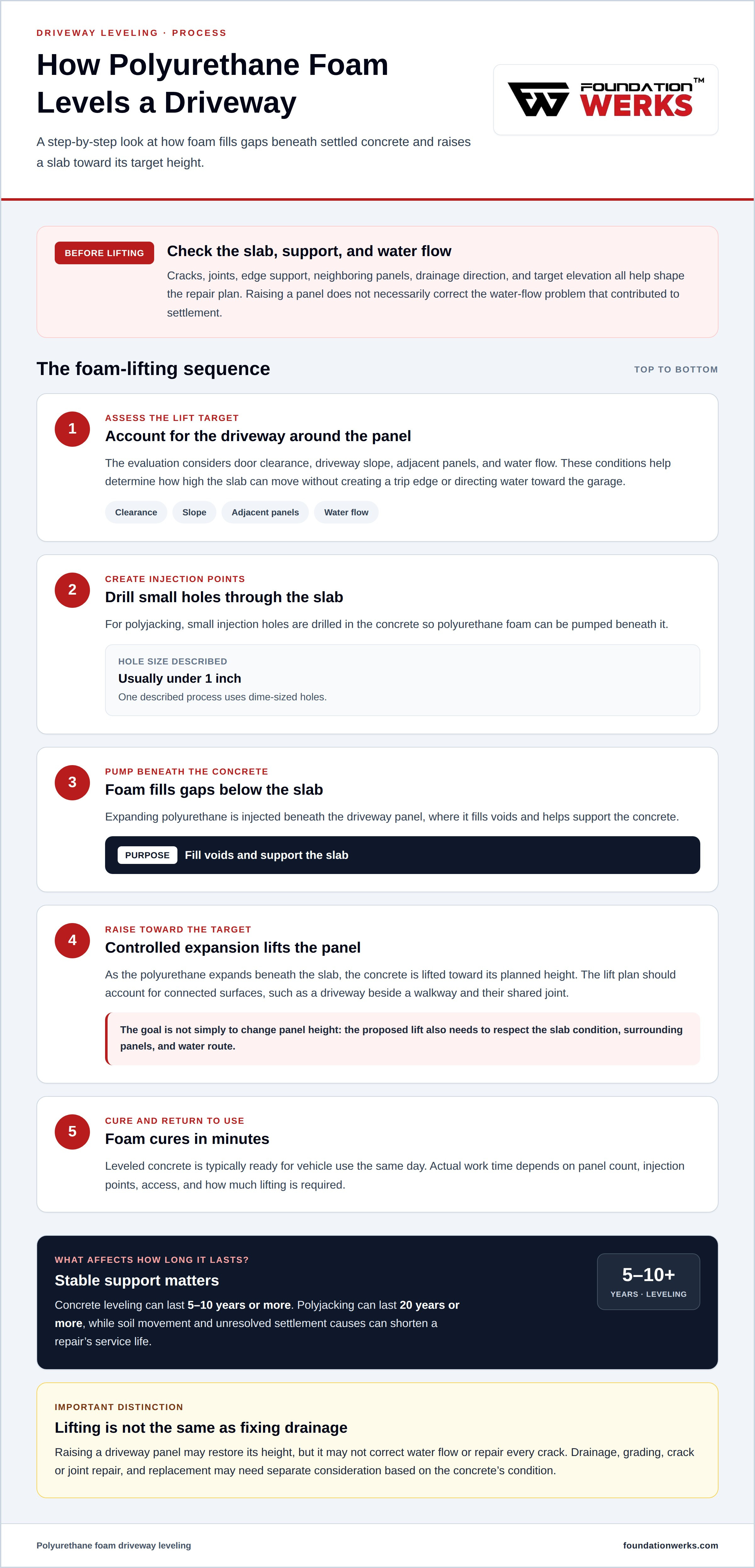
Before setting a lift target, the evaluation considers door clearance, driveway slope, adjacent panels, and water flow. These constraints determine how high a slab can move without creating a trip edge or directing water toward the garage. A sound repair plan accounts for slab condition and soil support, not simply the height difference.
Free estimates
An estimate turns the visible driveway problem into a defined scope of work. For a Frisco property, it should explain what the evaluation covers, what the proposed repair addresses, and which site conditions affect the project.
On-Site Estimate Visits
An on-site evaluation shows how the driveway fits its surroundings. It can include sunken panels, cracks, joints, edge support, access, and the path water takes around the slab. Nearby sidewalks, the garage entrance, and a pool deck may also matter when they connect to the repair area.
A free estimate means the estimate itself carries no charge; it does not define the inspection’s scope. A useful written estimate identifies the area under review and separates the proposed work from related issues. For example, lifting a settled driveway section may not include correcting a drainage route beyond that section.
Cost Factors and Estimates
Concrete repair estimates depend on the slab’s condition, the area requiring work, support beneath it, access, and the intended result. A clear estimate explains how each factor shapes the proposed scope. A cracked panel with stable edges may call for a different plan than a section with visible settlement and poor support.
For a clear comparison, look for a description of the repair method, work area, relevant exclusions, and applicable terms. The estimate should distinguish lifting from replacement and identify any separate drainage or crack work. That detail helps prevent a limited scope from being mistaken for a broader repair plan.
Pricing depends on the case and is provided after a quote request. Slab count, void depth, access, drainage, and concrete condition can affect the scope. A driveway estimate should consider connected areas, not just the lowest panel. The garage threshold, surrounding sidewalk, and water route may influence the target elevation and work required.
Payment plans are separate from the repair estimate. The estimate describes the proposed work; payment terms describe how the agreed amount is handled. Keep those details distinct when reviewing a proposal so the repair scope remains clear.
Before accepting an estimate, make sure it describes the target area and intended outcome. If the proposal addresses only one section, it should not imply that adjacent sidewalk or pool-deck concerns are included. The explanation should connect observed conditions to the recommended work, rather than relying on a single total.
For a driveway repair, a detailed estimate can help distinguish a focused lift from broader concrete work. Driveway concrete raising is relevant when the proposed scope involves lifting an existing slab.
Polyurethane foam driveway leveling
Polyurethane foam raises settled concrete by filling gaps beneath the slab. Lifting damaged concrete or leaving drainage problems unresolved can limit the repair, so slab condition and water flow matter before work begins.
Polyurethane Foam Lifting
For polyjacking, a contractor drills small injection holes and pumps expanding polyurethane beneath the slab. The foam fills voids, then controlled expansion lifts the concrete toward its target height. Injection holes are usually under an inch wide; one described process uses dime-sized holes. For a driveway beside a walkway, the lift plan should account for both surfaces and their joint.
Polyurethane foam expands within minutes and cures in minutes. That quick curing can shorten downtime compared with mudjacking, which can take up to 24 hours to cure. Mudjacking pumps a heavier cement-based slurry beneath the slab. The choice depends on the slab, voids, access, and desired finish, not just the injection material. Both methods aim to support and raise existing concrete.
Foam Durability and Safety
Polyurethane foam is lightweight, waterproof, and does not erode like cement slurry. Its lighter weight also avoids adding the same load beneath the concrete. Polyjacking can last 20 years or more, while soil movement can still affect performance. Mudjacking typically lasts five to 10 years. Those durations are not a guarantee for a particular driveway; soil conditions and ongoing ground movement influence the result.
Before lifting, the evaluation considers cracks, slab thickness, support, and nearby panels. Cracked or deteriorated concrete may not tolerate adjustment as well as intact concrete. Foam expansion must be controlled: raising one panel too far can create an uneven transition at the garage or walkway. The target should preserve adjoining elevations and the driveway’s intended slope.
Leveling Risks and Limitations
Lifting changes slab height, but it does not repair every underlying condition. If water continues flowing beneath the driveway, settlement may recur even after a void is filled. Foam can raise a suitable slab, but it cannot restore concrete that has broken apart or correct a separate drainage defect by itself.
Cracks may remain visible after lifting, and joints may need separate attention. The evaluation should consider whether the panel is intact enough to lift, where water travels, and how neighboring sections will meet the finished surface. Severely damaged concrete may be better suited to replacement. That distinction matters when the garage entrance, walkway, and adjacent panels need to connect smoothly.
Ask the contractor to explain the proposed lift target, injection locations, and how the finish will meet surrounding concrete. A focused driveway concrete raising evaluation considers slab condition and support before choosing a method. The best method is the one that fits the concrete and its site conditions, rather than a blanket preference for foam or mudjacking.
Drainage correction and slab re-pitching
Water can weaken support beneath a driveway and contribute to settlement. In Frisco, gutters, irrigation, patios, pools, and landscape changes can affect where water reaches or leaves concrete edges. Raising a slab restores its height but does not necessarily change the water route. A lasting repair plan considers both the concrete and drainage pattern.
An evaluation follows water from its source to its outlet. It considers roof discharge, yard grading, irrigation, inlets, edging, and downstream outlets. For example, a downspout that empties beside a driveway may send water along the slab edge. A low landscape bed can also hold water near concrete after irrigation or rain.
Slab re-pitching adjusts the concrete’s slope so water moves toward an appropriate drainage path. The target must account for connected surfaces, including the garage entrance, sidewalk, and neighboring driveway panels. A panel raised without regard to the surrounding grade may leave a new low point or redirect runoff toward a structure. The repair method should suit the site’s full water route.
Drainage correction may involve changing how water is collected or carried away, rather than lifting concrete alone. A French drain can provide a route for water when site conditions and the outlet support that approach. Other cases may require changes to roof discharge, grading, or irrigation patterns. The right work depends on where water gathers and whether it can reach a suitable outlet.
Concrete lifting and drainage work address related but different problems. Polyurethane foam can raise a supported slab, while a separate drainage correction addresses water movement. Neither automatically does the other’s job. If water continues to enter a void beneath a sunken section, the slab may settle again. If the drainage route is corrected but the panel remains low, a trip hazard can remain.
A practical evaluation records panel elevations, cracks, joints, edge support, and the direction water travels. The repair plan then sets a target elevation and considers how the driveway meets the garage, sidewalk, and yard. A warehouse loading area illustrates why use matters: water flow and surface transitions must work with repeated vehicle access. Residential driveways also need a smooth connection between sections.
After repair, consider drainage alongside any changes to landscaping or irrigation. New edging, a pool project, or redirected gutter discharge can alter water movement around concrete. The repair plan should identify which conditions the work addresses and which site features remain unchanged. This helps homeowners understand whether lifting alone is suitable or drainage work should also be included.
Driveway leveling and cracked driveway repair
A cracked driveway needs more than a height check. The inspection should connect uneven concrete, visible cracks, and sinking to the slab’s support and drainage. In Frisco, one homeowner described a driveway section that had sunk 2 inches in places. That example shows why repair planning should consider the full driveway, not just its lowest point.
Leveling raises a suitable slab; it does not automatically close cracks or restore damaged concrete. A crack may reflect movement, a joint condition, or deterioration, so its location and pattern matter. The evaluation should record panel differences, rocking, edge support, cracks, joints, and water direction. These observations help determine whether lifting, crack repair, replacement, or combined work fits the driveway.
Separate concrete placements can differ in base preparation, reinforcement, thickness, joints, and service history. A driveway panel beside a garage may therefore respond differently from a sidewalk or patio, even on the same property. The repair plan should consider the garage entrance, sidewalk, approach, and surrounding panels together. This helps set a target that avoids creating a new uneven transition.
At a garage entrance, door clearance and driveway slope limit the lift target. Raising one sunken section without accounting for adjacent concrete can leave a sharp edge or change where water flows. A crack crossing multiple panels also deserves attention before choosing a method. Concrete floors, patios, and driveways each have different uses, so the intended surface performance matters.
Crack repair and leveling address different parts of the problem. Lifting can restore a panel’s position when the slab is suitable, while crack or joint work addresses openings in the concrete. If a slab is badly deteriorated or cannot be adjusted to a workable elevation, replacement may be more appropriate. The recommendation should explain why the selected repair matches the concrete’s condition.
Before proposing work, an evaluation should document access constraints, slab condition, drainage direction, and target elevation. It should also account for neighboring panels and the route water takes past the driveway. For example, a low approach that directs runoff toward the garage needs a different target from one that drains away. These details connect the visible crack to the repair scope.
A clear proposal describes which panels will be lifted, what crack or joint work is included, and whether drainage work is separate. It should explain applicable terms and how site conditions may affect performance. For driveway leveling in Frisco, the useful takeaway is simple: assess the crack and slab together, then choose a repair that addresses both the surface and its support.
Foundation Werks
Foundation Werks helps Frisco property owners assess settled driveway concrete and understand suitable repair options. An evaluation can consider slab condition, support, cracks, drainage, and target elevation together. Depending on the site, the work may involve polyurethane concrete raising, French drain installation, or concrete replacement. These approaches address different conditions, so the repair plan should match the driveway’s needs rather than assume every sunken slab calls for the same method.
If uneven concrete or recurring settlement is affecting your driveway, contact Foundation Werks to discuss the next step.
Plan the Right Next Step
For driveway leveling in Frisco, TX, start by turning visible symptoms into a clear repair scope. Note which panels have shifted, where cracks cross the slab, and whether water moves toward the garage. Those details help match the repair target to the driveway’s condition instead of treating each symptom separately.
Foundation Werks offers polyurethane concrete raising, commercial concrete crack and joint repairs, and concrete replacement. Each addresses a different concrete condition. A useful project discussion clarifies which panels are included, how cracks or joints fit the scope, and whether drainage concerns need separate attention. Changes to irrigation, gutters, or landscaping can also affect water around the slab, so include planned site changes in the discussion.
A clear next step can make a stressful driveway issue easier to assess and address.
With the right repair scope, you can move forward with a clearer understanding of your driveway’s needs.
Frequently Asked Questions
How long does a concrete lifting take?
A typical concrete lifting injection and lift takes 2-4 hours. The total visit depends on the number of panels, access, and how much adjustment the slab needs. For example, a driveway with several connected sections may need more setup and careful elevation checks than one isolated panel. The work plan also accounts for nearby concrete, so the raised surface meets adjoining areas smoothly.
Is it cheaper to raise concrete or replace it?
Raising an intact, settled slab is generally less costly than replacing it because the existing concrete stays in place. Replacement may make more sense if the slab is badly deteriorated or cannot be lifted to a workable height. For example, a cracked panel with stable concrete may be a candidate for raising, while broken or crumbling concrete may need a different repair plan.
What driveway leveling methods are available in Frisco, TX?
Common approaches include polyurethane foam lifting and mudjacking. Both inject material beneath concrete to fill voids and raise a slab, but they use different materials and have different curing characteristics. Replacement is another option when the slab is too damaged to lift. The right approach depends on the concrete’s condition, the space beneath it, access, drainage, and the required surface elevation.
How much does driveway leveling cost in Frisco, TX?
The estimate depends on the driveway and the work required, so it follows an assessment of the project. Slab count, void depth, access, drainage, and concrete condition can affect the scope. A proposal should make clear which panels and repairs it covers. That helps distinguish lifting from separate crack repair, drainage correction, or concrete replacement.
What factors affect the cost of leveling a concrete driveway?
Key factors include the number of slabs, the depth and extent of voids, access for equipment, and the condition of the concrete. Drainage problems or cracks may also call for separate work. For example, a single settled panel with open access differs from several connected panels beside a garage. The estimate should tie each proposed task to the condition it addresses.
How do mudjacking and polyurethane foam lifting compare?
Mudjacking uses a cement-based slurry, while polyurethane foam lifting uses expanding foam injected beneath the slab. Mudjacking can take up to 24 hours to cure; polyurethane foam cures in minutes. Foam is lightweight and waterproof, while slurry is heavier. Soil movement and drainage still affect the concrete after either method, so material choice alone does not resolve every cause of settlement.
How can I find reputable driveway leveling contractors in Frisco?
Look for a written proposal that identifies the affected panels, repair method, target elevation, and any work excluded from the scope. It should explain how cracks, drainage, and adjoining concrete affect the plan. For example, a proposal can separate lifting a driveway panel from repairing a crack or changing a water route. A clear scope makes the recommendation easier to understand.
How long does driveway leveling take, and when can vehicles use the driveway?
Many residential concrete leveling projects take 2-4 hours, and leveled concrete is typically ready for vehicle use the same day. The actual schedule depends on the work area, panel count, and adjustment required. Ask how the proposed work affects your driveway access during the visit, especially if vehicles need to pass over connected slabs or the garage entrance.