

Choosing to demolish and replace a settling warehouse floor isn’t just an operational headache; it’s an outdated approach that ignores the sophisticated engineering available to modern Dallas facility managers. You likely recognize that massive concrete replacement projects create unnecessary waste and costly downtime that your schedule simply can’t afford. More importantly, the liability of trip hazards and OSHA non-compliance requires a solution that’s both rapid and reliable. You need a way to restore structural integrity without compromising your commitment to sustainability.
In this article, you’ll discover how high-performance recycled polyurethane technology provides a superior alternative for eco-friendly commercial foundation repair. We’ll show you how using materials containing up to 49% renewable and recycled content can help your facility align with the Dallas Green Construction Code. You’ll learn how this innovative method achieves long-term stability and a level foundation with zero waste, ensuring your operations remain efficient and environmentally responsible. By choosing a path of precision and innovation, you can secure your facility’s future while respecting the local environment.
Key Takeaways
- Learn why stabilizing your existing slab is a more sustainable and efficient alternative to the massive waste generated by traditional demolition and replacement.
- Understand the engineering behind recycled polyurethane foam and how its closed-cell structure effectively prevents soil erosion and water absorption beneath your facility.
- Discover how eco-friendly commercial foundation repair allows your business to remain fully operational while resolving trip hazards and ensuring safety compliance.
- Explore how modern stabilization methods using materials with significant recycled content help North Texas facilities align with the Dallas Green Construction Code.
What is Eco-Friendly Commercial Foundation Repair?
Eco-friendly commercial foundation repair is the practice of restoring structural integrity through non-invasive stabilization. It prioritizes the use of high-performance, recycled materials over the carbon-intensive process of demolition and pouring new concrete. By focusing on the existing substrate, this method allows facility managers to resolve settlement issues without the massive environmental toll of a full reconstruction. In North Texas, our expansive clay soils constantly shift with moisture changes, requiring a solution that’s both flexible and stable.
Geotechnical engineering has evolved to meet these challenges using advanced materials like Polyurethane Foam. This technology fills voids and lifts slabs with surgical precision, working with the soil rather than just adding heavy weight on top of it. It’s a sophisticated approach that aligns with the Dallas Green Construction Code, which mandates sustainable practices for commercial facilities.
To better understand how these modern techniques apply to industrial settings, watch this helpful video:
The Environmental Cost of Traditional Concrete Replacement
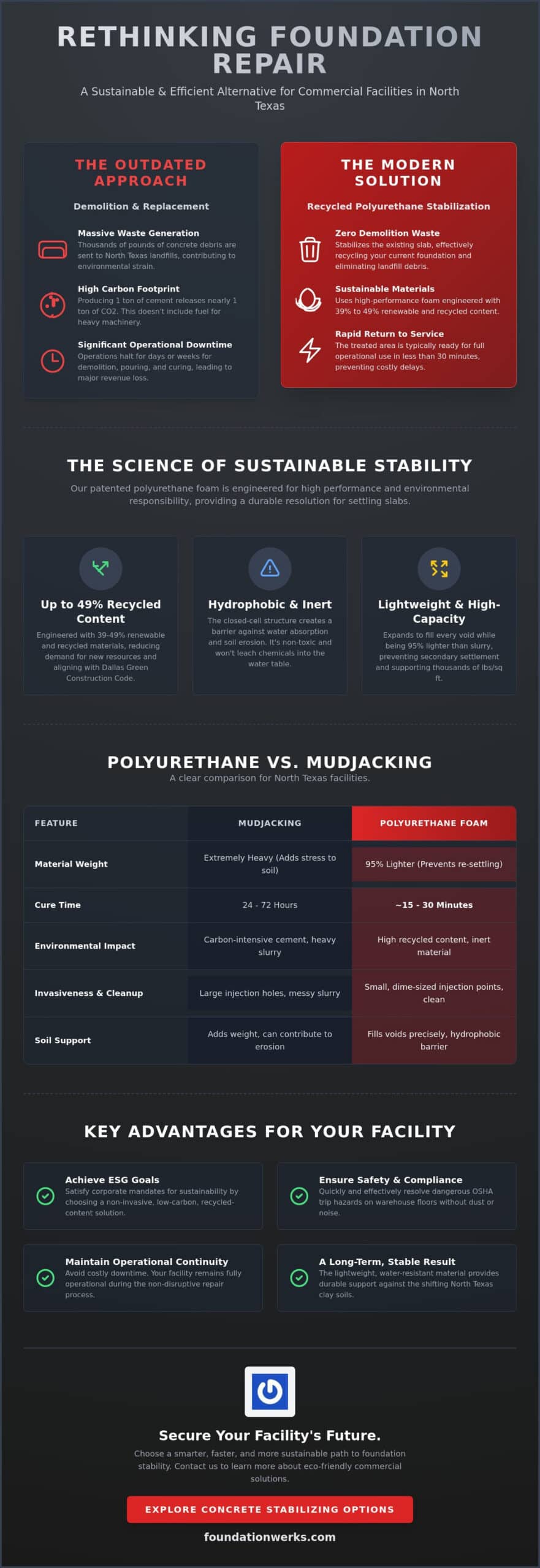
Traditional “rip and replace” methods are environmentally expensive and operationally disruptive. Producing a single ton of cement releases nearly a ton of CO2 into the atmosphere. When you factor in the fuel for heavy machinery and the thousands of pounds of debris sent to North Texas landfills, the footprint of a simple floor repair grows exponentially. Choosing stabilization provides a long-term resolution that keeps original materials in place, effectively “recycling” your existing foundation.
Why Commercial Properties are Shifting to Sustainable Methods
Facility managers now face increasing pressure to meet Environmental, Social, and Governance (ESG) goals. Adopting eco-friendly commercial foundation repair helps satisfy these corporate mandates while maintaining high safety standards. These methods quickly address OSHA trip hazards on warehouse floors without the dust, noise, or messy footprint of traditional mudjacking. It’s a cleaner, faster way to ensure compliance and operational continuity.
Recycled Polyurethane: The Science of Sustainable Stability
Traditional repairs often rely on heavy, raw materials that strain the environment. Our approach uses a patented polyurethane foam engineered with 39% to 49% renewable and recycled materials. This innovation allows these polymers to contribute to sustainability efforts by reducing the demand for new resources. The result is a high-performance material that provides a long-term resolution for settling slabs without the environmental toll of traditional methods.
The material’s closed-cell structure is a critical differentiator. It creates a hydrophobic barrier that prevents water absorption and soil erosion beneath your facility. Unlike older methods, this foam is non-toxic and chemically inert once cured. It won’t leach harmful chemicals into the North Texas water table, making it a responsible choice for eco-friendly commercial foundation repair. Using this technology ensures that your facility remains safe for both workers and the local ecosystem.
Polyurethane vs. Mudjacking: A Green Comparison
Mudjacking uses a heavy slurry of soil and cement that adds significant weight to already stressed North Texas clay. Polyurethane is 95% lighter than traditional slurry, which helps prevent secondary settlement caused by the repair itself. It’s also remarkably fast. Most commercial floors can return to full service in less than 30 minutes, which drastically reduces operational downtime compared to the days required for concrete to cure. This speed makes it a superior option for busy logistics hubs.
Industrial-Grade Performance and Load Bearing
Don’t let the lightweight nature fool you. This industrial-grade foam provides exceptional load-bearing capacity, often supporting thousands of pounds per square foot. It expands with enough force to fill every hidden void, ensuring total slab support for heavy machinery and warehouse traffic. If you’re managing a facility in McKinney or Dallas, exploring concrete stabilizing options can help you maintain a safe, level environment while meeting your green building targets. This eco-friendly commercial foundation repair method delivers the precision required for modern industrial standards.
Implementing Sustainable Foundation Solutions in North Texas
Dallas and McKinney facilities face a unique set of challenges due to the region’s highly expansive clay soils. These soils act like a sponge, swelling during rainy seasons and shrinking during brutal Texas summers. This cycle creates voids beneath heavy commercial slabs, leading to cracks and structural instability. By choosing eco-friendly commercial foundation repair, you’re addressing these issues with a method that respects the local environment while providing the structural strength required for industrial loads.
Our zero-downtime process is designed specifically for the pace of North Texas business. We often integrate French drain installation alongside our stabilization services to manage the primary cause of foundation movement: water. By directing moisture away from the building, we enhance the effectiveness of the void-filling process. This comprehensive approach ensures that your facility remains a high-value asset while maintaining compliance with local green building standards without the mess of traditional demolition.
Case Study: Warehouse Floor Stabilization in Dallas
A logistics hub in Dallas recently experienced significant joint deflection that threatened forklift safety and operational speed. Traditional repair would’ve required closing the bay for several days. Instead, we utilized our specialized injection process. We drilled penny-sized holes and injected recycled polyurethane foam to lift and stabilize the slabs. The entire project was completed between shifts, allowing for an immediate return to traffic. This achieved a long-term resolution for the facility without the carbon footprint of concrete removal.
Choosing a Local Expert in McKinney and North Texas
Contact Foundation Werks for a commercial structural assessment to secure your facility’s stability today.
Securing Your Facility’s Future with Sustainable Engineering
Restoring the stability of your commercial foundation doesn’t have to come at the expense of the environment or your operational schedule. By leveraging patented foam technology made from up to 49% recycled materials, you can achieve a long-term resolution for settling warehouse floors and industrial slabs. This method bypasses the massive carbon footprint of traditional demolition while providing the high-load support necessary for heavy machinery and constant logistics traffic. It’s a sophisticated way to protect your infrastructure without the waste of older techniques.
Choosing eco-friendly commercial foundation repair ensures your facility remains compliant with safety regulations and local green building standards. Our specialized approach provides a zero-downtime solution across the Dallas-Fort Worth metroplex, allowing your business to stay productive while we address structural concerns. You can trust in a process that prioritizes technical precision and environmental stewardship for your most valuable assets.
Schedule your eco-friendly commercial foundation assessment with Foundation Werks to discover how we can stabilize your property with minimal disruption. We look forward to helping you build a more resilient and sustainable future for your facility.
Frequently Asked Questions
Is polyurethane foam environmentally safe for commercial use?
Polyurethane foam is non-toxic and chemically inert once it has fully cured. The specialized foam used in eco-friendly commercial foundation repair contains between 39% and 49% renewable and recycled materials. Because it’s a closed-cell material, it won’t leach chemicals into the North Texas water table or degrade into the surrounding soil. This makes it a responsible choice for facilities following the Dallas Green Construction Code.
How long does eco-friendly polyurethane concrete lifting last?
This method provides a long-term resolution for settling slabs because the material is hydrophobic and dimensionally stable. Unlike traditional mudjacking slurry, polyurethane won’t wash away during heavy rain or shrink during dry North Texas summers. It maintains its structural integrity and lifting power for decades. While no soil-based solution is definitive, this technology offers the most durable stability available for modern industrial facilities.
Can polyurethane foam support the weight of heavy warehouse machinery?
High-density polyurethane is specifically engineered to support the massive loads found in logistics hubs and manufacturing plants. It expands to fill every void beneath a warehouse floor, creating a solid foundation that can support heavy industrial machinery and constant forklift traffic. The material’s high compressive strength ensures that your floor remains level and safe, even under the stress of heavy racking systems and high-volume commercial operations.
How does the cost of eco-friendly repair compare to traditional concrete replacement?
Choosing eco-friendly commercial foundation repair is generally more cost-effective than traditional concrete replacement when you factor in total project expenses. Traditional methods require expensive demolition, debris disposal, and days of curing time that halt your operations. In contrast, stabilization requires minimal labor and allows your facility to remain fully operational. You save on both the direct costs of new materials and the indirect costs of business downtime.