What if the most eco-conscious concrete repair is the one that keeps the slab you already have? Eco friendly concrete leveling can raise and stabilize a suitable existing slab, helping avoid demolition debris and replacement concrete. For homes and commercial properties in the Dallas area, slab reuse is one practical part of the environmental conversation, alongside the repair material and installation process.
Recycled content matters, too, but recycled material in lifting foam does not automatically qualify a project for LEED credit. Eligibility depends on the applicable rating system and project-specific documentation. The foam’s recycled content is one factor to assess, not proof of a credit.
This article explains how leveling can support slab reuse, how raising compares with replacement, and what records can help a project team assess LEED relevance. It also outlines practical questions to consider, including the slab’s condition, the lifting material, the scope of work, and the documentation available for the project.
Key Takeaways
- Eco friendly concrete leveling may help preserve a suitable slab and avoid unnecessary replacement materials.
- Foundation Werks uses patented polyurethane foam made from recycled materials, but recycled content alone does not establish LEED credit eligibility.
- Assess the slab’s condition and the repair scope first. Severe cracking can affect whether raising is appropriate.
- For a LEED review, gather project-specific material documentation and assess it against the applicable rating system’s requirements.
- Foundation Werks’ lifting foam weighs approximately 2 lb per cubic foot, and the process uses drill holes approximately 5/8 inch wide.
What Makes Concrete Leveling an Eco-Friendly Repair Option?
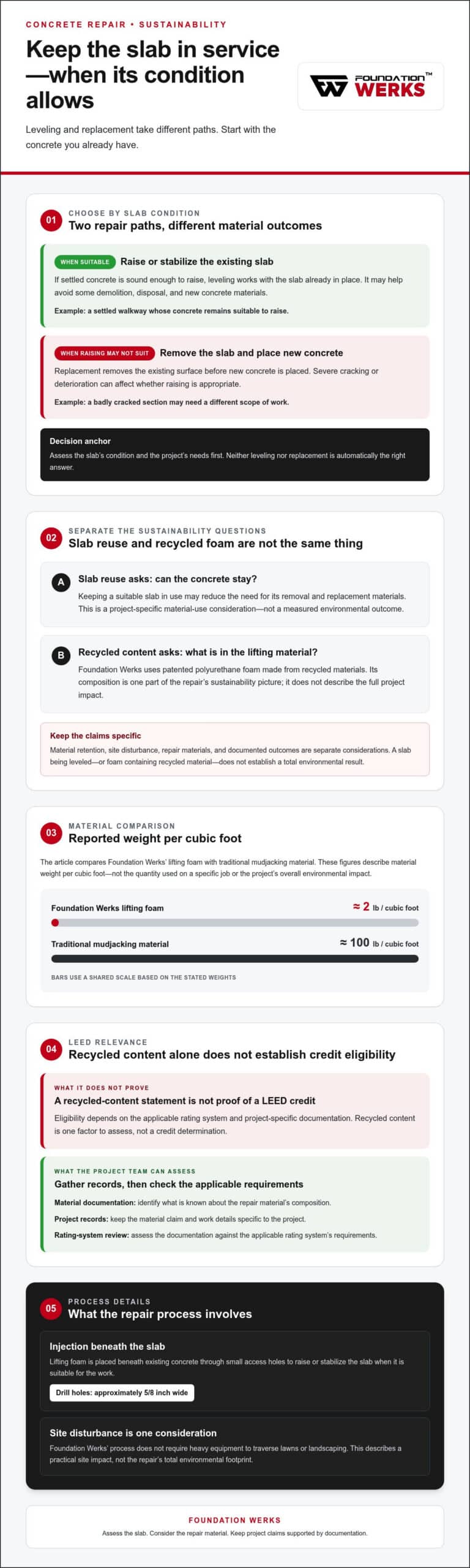
Eco-friendly concrete leveling starts with a practical question: can the existing slab remain in service? If a slab has settled but is sound enough to raise, leveling works with the concrete already in place. Replacement involves removing the existing surface and placing new concrete. The right choice depends on the slab’s condition and the project’s needs, not on an assumption that one method is always greener.
Eco-friendly concrete leveling raises or stabilizes a usable slab to support reuse, rather than replacing it automatically. Recycled content in repair materials is a separate consideration. Keeping usable concrete in place may avoid some demolition and replacement materials. That potential benefit is specific to the project; it does not establish a measured environmental outcome or a LEED credit.
For a broader look at what happens when concrete is broken up and recovered as rubble, Concrete recycling describes common reuse pathways. Recycling demolished material and retaining an intact slab are different approaches: leveling may keep the slab in use, while recycling generally concerns material after demolition.
Here’s a video overview of sustainable concrete solutions and material choices:
How does leveling differ from replacing a concrete slab?
Leveling addresses the position or support of an existing slab. Material is injected beneath the concrete to raise or stabilize it, when the slab is suitable for that work. Replacement follows a different path: the old slab is removed and new concrete is placed. Not every slab is a candidate for lifting. Severe cracking or deterioration can make raising unsuitable, so assess the concrete before selecting a repair method.
For example, a settled walkway with concrete that remains suitable to raise may be a candidate for leveling. A badly cracked section may need a different scope of work. Match the repair to the condition of the slab instead of assuming leveling or replacement is automatically the right answer.
Which environmental benefits are reasonable to discuss?
When a slab can be retained, the project may avoid some demolition, disposal, and new concrete materials. These are practical material-use considerations, not a complete lifecycle assessment. Environmental performance depends on site conditions, repair materials, the work performed, and documented outcomes.
- Material retention: Consider whether usable concrete can stay in place.
- Site disturbance: Foundation Werks’ process does not require heavy equipment to traverse lawns or landscaping. This describes a practical site impact, not the repair’s total environmental footprint.
- Evidence: Keep process details and material documentation distinct from broad claims such as carbon-neutral or zero-impact, which require evidence beyond the fact that a slab was leveled.
These distinctions help keep sustainability claims specific and supportable. Reusing a slab and using recycled-content repair material may both matter, but they describe different parts of a project and should be assessed separately.
How Recycled Foam and Slab Reuse Fit Into the Sustainability Picture
Injection foam is placed beneath an existing slab through small access holes. It supports the concrete as it is raised or stabilized, while the slab remains in place. Foundation Werks uses patented polyurethane foam made from recycled materials, making its composition one part of the repair’s sustainability picture.
Foundation Werks’ foam weighs approximately 2 lb per cubic foot, compared with approximately 100 lb per cubic foot for traditional mudjacking material. These figures describe material weight per cubic foot, not the amount used on a particular job or the project’s overall environmental impact. Recycled content describes what goes into a repair material; it does not, by itself, establish the environmental benefit of the whole project.
What does recycled content tell a project team?
Recycled feedstock helps describe a material’s composition. It does not show how much material a project uses, what would otherwise happen to the slab, or the full effects of manufacturing and installation. These are separate questions, and broader sustainability conclusions need evidence beyond a recycled-content statement.
For a specific material claim, project records and product documentation can help identify the material and support what is known about its composition. A project team assessing LEED relevance also needs to consider the applicable rating system and its requirements. The LEED Green Building Rating System provides the official starting point for understanding that framework. Recycled content alone does not establish credit eligibility.
Why can retaining a slab matter?
Foam and slab reuse address different parts of the work. Foam is the lifting material; retaining the slab means continuing to use the existing concrete. If a driveway, sidewalk, patio, or commercial slab is suitable for raising, keeping it in place may reduce the need for removal and replacement materials. Whether that is possible depends on the slab’s condition and the repair scope.
For a Dallas-area project, this distinction helps frame an eco friendly concrete leveling assessment: first consider whether the slab can be retained, then evaluate the material used to raise it and the available documentation. If damage makes raising unsuitable, the expected material and waste outcomes may change. Neither recycled foam nor a lifting method proves a project-wide environmental result.
For existing concrete that may be suitable for raising, Foundation Werks’ polyurethane concrete raising is one option within the repair plan.
Do Recycled Materials in Concrete Leveling Earn LEED Credits?
No. Recycled content by itself does not prove that a project earns a LEED credit. It describes an attribute of a material. Credit eligibility depends on the project’s selected LEED rating system, its requirements, and the project documentation. Eco friendly concrete leveling may involve recycled-content foam and retention of an existing slab, but those facts alone do not establish that either qualifies for a credit.
Keep three questions separate: What is the lifting material made from? Is the existing slab being retained? Does the project meet an applicable credit’s requirements? The first two help describe the work. The third requires a project-specific review by the team responsible for LEED documentation.
| What you’re assessing | What evidence may show | What it doesn’t establish by itself |
|---|---|---|
| Recycled-content evidence | Material records or product documentation describing composition | That the project earns a LEED credit |
| Slab reuse | Project scope showing an existing slab remains in use | That a particular credit’s criteria are met |
| Verified credit eligibility | The project team’s review against the applicable rating system and requirements | Eligibility based only on a general environmental claim |
What evidence may a project team need to review?
Start with records tied to the actual work. Useful items may include product documentation describing the foam, material records supporting composition claims, and project specifications showing where and how the repair material is used. Keep these with the project scope, including which slab is being raised or stabilized and whether it remains in service.
Documents should match the material and work performed. A general statement about recycled content may not answer project-specific questions if it does not identify the product used or relate to the installation. Treat documentation as evidence for review, not as automatic approval or certification.
Why does the applicable LEED rating system matter?
Project types and rating-system versions can affect how a team interprets credit requirements. Do not assume that a requirement or documentation approach used on one project applies to another. The responsible LEED professional can interpret the requirements for the project’s selected system and decide how repair records fit the submission.
A practical handoff is simple: provide the project scope and relevant material records, then have the project team assess them against the applicable criteria. This keeps claims about recycled foam, slab retention, and credit eligibility clear and appropriately supported.
How to Evaluate Eco-Friendly Concrete Leveling for a Dallas-Area Project
A practical assessment starts with the slab, not a sustainability label. For a driveway in McKinney, a sidewalk in Dallas, or a commercial floor in Frisco, first determine whether the concrete is suitable to raise. Then define what the repair needs to accomplish, compare the work involved in raising and replacement, and keep records that support any environmental claims. Foundation Werks serves the Dallas metropolitan area, including Frisco, McKinney, Dallas, Prosper, Allen, Fairview, Southlake, Irving, North Dallas, and DFW.
Use this sequence to keep the decision grounded in the project:
- Inspect the concrete: Note cracks, uneven areas, and signs of damage. A solid slab may be a candidate for raising, while severe cracking can change the appropriate approach.
- Define the goal: Identify how the surface is used and what needs to improve, such as an uneven walkway or a settled section of a commercial slab.
- Compare repair scopes: Understand whether the proposed work retains the existing slab or involves replacement. Compare the materials and site work each option requires.
- Gather records: Keep the project scope, material information, and a record of whether the existing concrete remained in place.
What should be assessed before choosing a repair approach?
Look at the slab’s overall condition, the location and extent of unevenness, and how the surface will be used. A small level change on a sound slab presents a different repair question from extensive cracking across a heavily used area. Injection can raise or stabilize suitable concrete, but it cannot make every damaged slab appropriate for lifting.
Clarify the objective, too. Is the priority to address a trip hazard, improve how a surface functions, or retain concrete that might otherwise be replaced? Those goals help define the repair scope. A clear assessment also makes it easier to explain why raising, replacement, or another repair path fits the slab’s observed condition.
How can teams keep environmental claims transparent?
Record observable project facts separately from conclusions about environmental performance. A simple project file can identify the work performed, the material used, and whether existing concrete was retained. Any broader claim should be supported by relevant documentation rather than inferred from a single feature, such as recycled content.
For LEED work, the project team should assess available records against the requirements for the project’s selected rating system. Do not treat estimated waste avoidance or potential material savings as measured results unless the project has evidence to support them. This distinction helps keep environmental reporting clear for owners, facility teams, and reviewers.
Foundation Werks provides polyurethane concrete raising in the Dallas metropolitan area. An assessment can help clarify whether the slab’s condition and repair goals align with raising existing concrete.
Foundation Werks’ Recycled-Foam Approach to Raising Existing Concrete
Foundation Werks uses patented polyurethane foam made from recycled materials to raise and stabilize suitable existing concrete. The method is designed for slabs that can remain in use, with the repair focused on adjusting support beneath the surface rather than automatically replacing the concrete. The foam’s recycled content describes the material, while the slab’s condition helps determine whether raising fits the job.
Foundation Werks’ foam weighs approximately 2 lb per cubic foot, and access holes are approximately 5/8 inch wide. These details describe the company’s process. They do not establish a project’s environmental outcome or LEED eligibility, which depends on project-specific documentation and requirements.
Raised concrete can be walked on, driven on, or otherwise used the same day the job is completed. The process typically takes a few hours from start to finish, although the work and results depend on the slab and project. For property owners considering eco friendly concrete leveling, an estimate is a chance to discuss the site, the slab’s condition, and the intended outcome before deciding on a repair scope.
What does the Foundation Werks process involve?
Small access holes allow polyurethane foam to be injected beneath the slab. As the foam expands, it can fill space below the concrete and help lift or stabilize the surface. The crew works with the existing slab, and the process does not require heavy equipment to traverse lawns or landscaping.
The work is tailored to the concrete and its condition, so the amount of lifting and the result can vary by project. An assessment helps establish whether the slab is suitable and what the proposed work is intended to address. This keeps expectations tied to the actual site rather than assuming every slab will respond in the same way.
When is a project estimate a useful next step?
An estimate can help Dallas-area homeowners and commercial property teams understand options for a settled slab. Share where the concrete is uneven, how the surface is used, and what you hope to improve. Those details help frame the discussion around the slab’s condition and the project’s goals.
Foundation Werks offers free estimates. The estimate can help determine whether raising fits the slab or whether another approach better matches its condition. For a driveway, walkway, patio, or commercial surface, understanding the scope first makes it easier to weigh reuse, repair materials, and the documentation a project may need.
Foundation Werks serves McKinney and the Dallas metropolitan area, including communities across Frisco, Dallas, Prosper, Allen, Fairview, Southlake, Irving, North Dallas, and DFW. An estimate provides a practical starting point for assessing the slab and the repair scope, without treating recycled content as a substitute for evaluating the concrete or supporting environmental claims.
Take the Next Step Toward a Thoughtful Slab Repair
A sound repair decision begins with the condition of the concrete and what the space needs to do next. For a Dallas-area home or commercial property, an assessment can turn broad environmental goals into practical questions: can the slab remain in use, what repair scope fits, and what information should be kept for the project record?
That clear, measured approach is central to eco friendly concrete leveling. Customer testimonials praise Foundation Werks crews for their knowledge, professionalism, and scheduling flexibility, offering a sense of the experience property owners have described.
If a settled slab is affecting how you use your property, request a free estimate from Foundation Werks to discuss its condition and possible next steps.
Request a free estimate
A well-informed repair plan can help you move forward with confidence.
Frequently Asked Questions
What is eco-friendly concrete leveling?
Eco friendly concrete leveling means lifting or stabilizing suitable existing concrete instead of automatically replacing it. For example, a settled driveway slab may be a candidate if its condition allows it to remain in use. Retaining concrete may avoid some replacement work, but environmental outcomes depend on the project, materials, and work performed. The term is not a verified lifecycle assessment and does not mean a repair has no environmental impact, including on a Dallas-area property.
Does recycled polyurethane foam automatically earn LEED credits?
No. Recycled content alone does not establish that a project earns LEED credit. The applicable rating system, project scope, credit requirements, and supporting records all matter. A project team should keep material information with the repair scope, then have its LEED professional assess the documents against the applicable criteria. That review is especially important if the repair is one part of a larger renovation or commercial building project.
Is concrete leveling more environmentally friendly than replacement?
It can be, if the existing slab is suitable to retain. Raising a sound section of a driveway or commercial floor may reduce the need for demolition and replacement materials. There is no universal result: the comparison depends on slab condition, repair scope, materials, and which project activities are included. Make a specific environmental claim only when project evidence supports it, rather than assuming leveling always has a lower overall impact.
Can every sunken concrete slab be raised with polyurethane foam?
No. The slab needs to be suitable for lifting and stabilization. Solid slabs may be candidates, while severe cracking can indicate damage that makes lifting unsuitable. A sunken patio and a badly cracked warehouse section, for example, may call for different evaluations. An assessment considers the concrete’s condition and intended use; do not assume a successful lift before the specific slab is reviewed.
How large are the holes used for polyurethane concrete raising?
Foundation Werks uses drill holes approximately 5/8 inch wide. These access points allow foam to be injected beneath the slab, and the process is designed to leave minimal patchwork. The number and placement of holes can vary with the concrete and the work required. For a driveway or sidewalk, the estimate can outline the planned access points and surface patching.
How soon can a raised concrete slab be used?
Concrete can be walked on, driven on, or used the same day the job is completed. This can help property owners plan around a driveway or walkway repair. Practical use expectations depend on the particular slab and project, so discuss them as part of the estimate. Same-day use refers to the period after completed work, not a promised appointment date or a guarantee that every project will follow an identical schedule.
How much recycled material is in the foam used for concrete leveling?
Foundation Werks describes its polyurethane foam as made from recycled materials, but no recycled-content percentage is stated here. Do not infer a percentage from that description. For a LEED-related review, project teams should rely on material records that apply to the foam used and assess them under the requirements for the selected rating system. This keeps a material-composition statement separate from conclusions about credit eligibility or total project impact.