

Polyurethane foam can lift an uneven concrete slab by expanding beneath it and filling the voids that let it settle. For foundation stabilization with polyurethane foam, the key distinction is that foam works where the material can reach beneath the concrete; piering may be the better fit when stable, load-bearing soil lies deeper or a structure continues to move. The faster-looking option isn’t automatically the right one. The source of the movement matters.
It’s understandable to want a clear answer when a slab or foundation starts to shift. This article explains how foam injection works, what it can and can’t address, and how it compares with piering in application and project needs. You’ll also see where foam is used in construction, including slab lifting and filling voids, so you can better understand which approach matches the problem.
Key Takeaways
- Learn how injected polyurethane foam expands beneath concrete to fill voids and help lift uneven slabs.
- Compare foam lifting with piering by considering the depth of stable soil and whether the structure continues to move.
- See where foam can support construction work, from slab lifting to filling voids beneath concrete.
- Understand which signs point to a slab or foundation problem that foam injection may address.
- Find out how Foundation Werks’ polyurethane concrete raising can help with suitable concrete lifting and stabilization projects.
WHAT IS POLYURETHANE FOAM CONCRETE LIFTING?
Polyurethane foam lifting injects expanding material beneath concrete to fill voids and raise settled areas. For foundation stabilization, the key questions are where the supporting soil has weakened and whether foam can reach the affected space.
Foam Injection for Foundation Stabilization
This method places foam beneath a slab or foundation section to fill gaps and support the concrete. As it expands, it can help lift settled concrete and strengthen soil around a void. The repair addresses support beneath the concrete, so the location and extent of the void matter when assessing whether injection fits the problem.
A contractor should have the qualifications and any licenses or permits required for the specific work and location. Requirements vary by jurisdiction and project, so the relevant criteria depend on where the repair takes place.
Small-Hole Injection and Foam Expansion
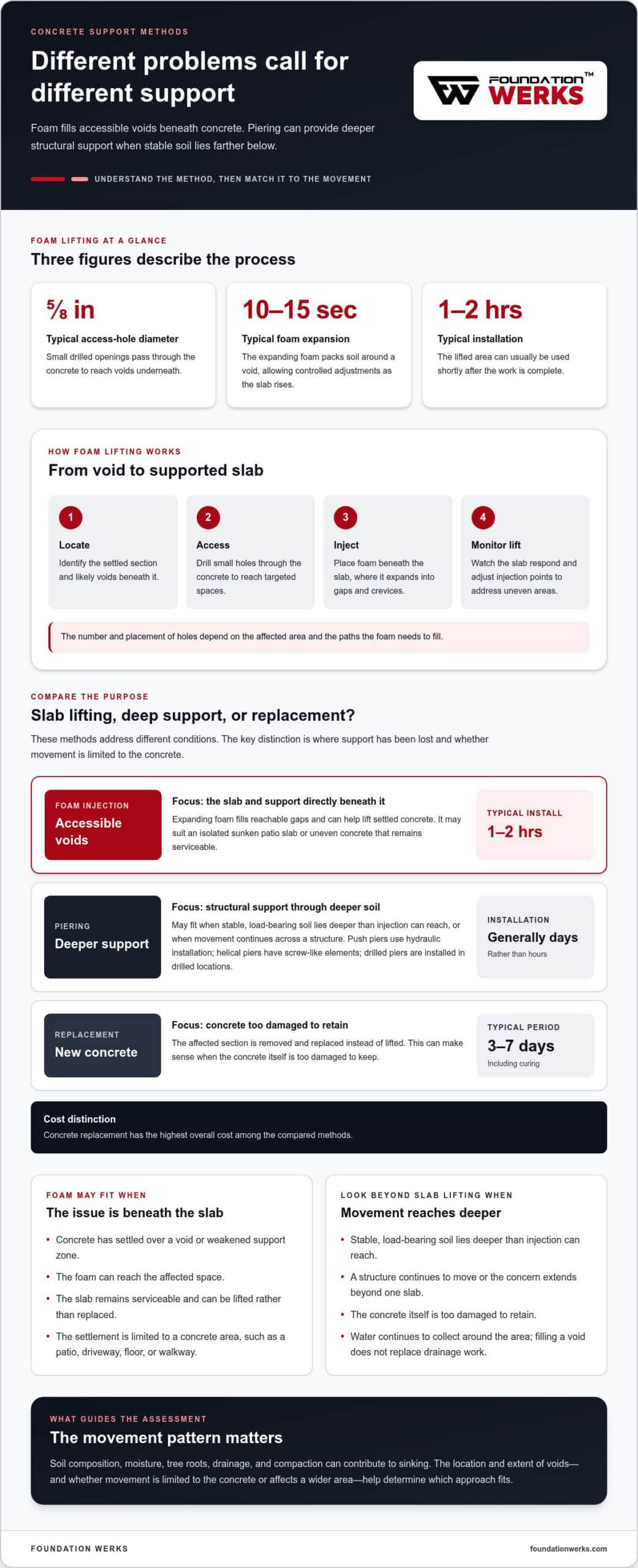
Crews inject polyurethane through small drilled holes, often about 5/8 inch in diameter. The openings pass through the concrete to reach the space below, limiting the size of access points compared with methods that require larger openings. Once placed, the foam expands into crevices and voids, helping fill gaps beneath the slab.
During concrete lifting, polyurethane foam typically expands and packs soil around a void in 10-15 seconds. That quick expansion lets the crew make controlled adjustments as the slab rises. The number and placement of injection holes depend on the affected area and the paths foam needs to fill.
The Polyurethane Injection Process
The process starts by identifying the settled section and locating likely voids beneath it. Next, the crew drills access holes and injects foam into targeted spaces. As the material expands, the slab responds to the added support. The crew monitors the lift and adjusts injection points to address uneven areas without raising the concrete beyond the needed level.
Closed-cell polyurethane foam can expand beneath concrete to fill gaps and support the slab. As it expands beneath concrete, it fills gaps and supports the slab. Filling a void can limit open pathways beneath the concrete, but it does not replace drainage work when water continues to collect around the area.
Foam injection installation typically takes 1-2 hours. The lifted area can usually be used shortly after the work is complete, rather than waiting through a long curing period. The actual work sequence depends on access, the size of the affected slab, and how many voids need filling.
How polyurethane foam lifts uneven concrete slabs
Foam lifting raises settled concrete by adding support beneath the slab. The repair works best when the problem is a void or weakened support zone, rather than movement that extends deeper beneath a structure.
Filling Voids Beneath Concrete
As foam expands beneath a slab, it fills gaps between the concrete and the ground. That added support can lift a settled section and reduce unevenness across a driveway, floor, or walkway. The location of each gap matters: a void beneath one edge can tilt a slab differently than a broader area of lost support.
For example, a sunken warehouse aisle may need support beneath the low section while adjacent concrete remains in place. The aim is to fill the gap contributing to settlement and bring the slab closer to the surrounding level. Soil composition, moisture, tree roots, drainage, and compaction can all contribute to sinking, so the settlement pattern helps guide the repair.
Foam Lifting Compared with Piering
Push, helical, and drilled concrete piers are structural support systems, while foam injection fills accessible voids beneath concrete. Push piers use a hydraulic installation process, helical piers have screw-like elements, and drilled piers are installed in drilled locations. Piering may suit a building when stable, load-bearing soil lies deeper than injection can reach or movement continues.
Foam lifting focuses on the slab and the support directly beneath it. Piering supports a structure through deeper soil, and installation generally takes days rather than hours. The choice depends on whether the issue is a settled concrete panel or broader structural movement. For an isolated sunken patio slab, foam may address the immediate support gap; ongoing movement across a building may call for deeper structural support.
Concrete replacement takes a different route: the affected section is removed and replaced rather than lifted. The installation period is typically 3-7 days, including curing, and replacement has the highest overall cost among the compared methods. It can make sense when the concrete itself is too damaged to retain, while lifting can preserve a slab that remains serviceable.
Foam lifting can preserve a serviceable slab while addressing lost support beneath it. The process uses small access holes, so the existing concrete stays in place during the repair. Replacement, by comparison, involves replacing the concrete itself. Consider the slab’s condition, where support has been lost, and whether settlement is limited to the concrete or affects a wider area.
These methods can also work together on a construction project. Piers may support a building at deeper soil, while foam fills voids beneath interior slabs left during lifting. For a concrete area with settlement but no broader structural movement, concrete lifting can address the uneven slab without replacing sound concrete.
Choosing between foam lifting and piering
Choose an approach based on the concrete’s condition and where support has been lost. Foam injection is designed to fill accessible voids and raise settled slabs. Piering serves a different purpose, providing deeper structural support. The distinction matters because lifting a concrete slab and addressing a broader structural concern are not the same goal.
Start with the visible pattern. A sunken patio panel or settled warehouse floor can point to lost support beneath the concrete. Settlement affecting several parts of a building suggests a broader concern. Note whether the problem appears limited to one slab or extends across the structure. That distinction helps clarify whether concrete raising is the relevant next step.
Foam injection reaches spaces beneath concrete and expands there, helping fill voids and lift settled areas. It is best suited to moderate settling where the affected support zone is accessible. For example, a level change across one concrete section may be addressed by lifting that section. Foam cannot substitute for deep support when stable soil lies beyond injection’s reach.
Piering is a separate structural support approach. It may be considered when a project requires support beneath the building rather than a lift to the concrete slab. Installation generally takes longer than a slab lift and involves additional structural work. These steps reflect the different goal of providing deeper support rather than raising a concrete surface.
Severe foundation failure may require traditional piering or underpinning. Signs that deserve careful assessment include ongoing movement and settlement affecting more than an isolated concrete panel. A crack alone doesn’t establish which system is appropriate; its location, pattern, and relationship to other movement matter. The repair needs to address the underlying support condition, not just the visible symptom.
Some projects use more than one repair method. Structural support and concrete raising address different needs, so they may be coordinated in a single plan. For example, a project may include deeper support for part of a structure and foam lifting for a settled interior slab. The work should distinguish the areas needing structural support from those requiring a level concrete surface.
Use a practical decision sequence: identify the affected area, determine whether movement is ongoing, then establish whether the needed support is shallow or deep. If the issue is an accessible void beneath stable concrete, foam lifting may fit. If the structure continues moving or stable soil lies deeper, piering may be more appropriate. The installation plan should match the problem’s location and depth.
Construction and foundation applications
Polyurethane foam has several construction applications, from raising settled slabs to filling gaps beneath concrete. Its lightweight nature can reduce additional stress on the ground supporting a slab. That can matter where added weight would further load weakened soil. The right application depends on what needs support: a floor panel, an exterior slab, or a void below concrete.
On commercial sites, uneven warehouse floors can disrupt equipment movement and create changes in floor elevation. Foam injection can raise settled areas while leaving serviceable concrete in place. For example, a sunken section along a warehouse aisle may be lifted toward the level of neighboring panels. The settlement’s extent and location guide the injection plan.
Foundation repair projects can also use foam to fill voids beneath concrete. Gaps may form as soil shifts or after other foundation work changes the support below a slab. Filling those spaces can help stabilize the concrete above. In a staged project, foam may be used alongside deeper structural support, with each method addressing a different part of the building.
Project timing can shape construction schedules. Foam foundation repair is commonly completed in 1 day, while installation time depends on access and the work area. Manufacturers of polyurethane concrete lifting products claim lifted slabs can be driven over within 25 minutes after injection. That is a manufacturer claim, and site conditions and the product used matter to the work plan.
Moisture is another factor in selecting an application. Some polyurethane foam formulas are waterproof, but the appropriate formula depends on the project. Expanding foam can fill crevices beneath concrete, helping make the space more water resistant. For example, filling a void below an exterior slab can limit open pathways through that gap, but it does not replace drainage work where water continues to collect.
Construction teams may also use foam to address voids that develop beneath slabs during pier installation. Piers can raise a building’s exterior footers, while foam can help lift interior slabs or fill spaces below them. This combined approach separates structural support from concrete adjustment. The sequence matters: crews need to understand which areas carry the building and which slabs need leveling.
Before choosing a repair, assess the concrete’s condition, the support beneath it, and the site’s moisture patterns. Polyurethane foam offers an alternative to replacing a serviceable slab that has lost support. Foundation Werks provides concrete raising and concrete replacement, so the repair can be matched to the condition of the concrete.
What foundation problems can polyurethane foam injection repair?
Polyurethane foam injection can address settled concrete where lost support or a void lies beneath the slab. It is best suited to moderate settling in residential or light commercial buildings. For example, a sunken garage slab or uneven walkway may be a candidate when the concrete remains serviceable and the issue is localized below it.
The repair targets the space beneath concrete, not every cause of foundation movement. Foam expands into accessible gaps and helps restore support under the slab. A useful first step is identifying whether settlement affects a single slab or several parts of the building. That pattern helps clarify whether the issue is localized to the concrete.
- Settled slabs: A low section of a garage floor or walkway may be lifted when a void contributes to the unevenness.
- Voids beneath concrete: Gaps below a slab can be filled to support the concrete above, including spaces formed during other foundation work.
- Moderate settling: Foam is suited to residential or light commercial buildings where the problem is within injection’s reach.
Cracks can appear alongside settlement, but a crack alone does not show which repair is appropriate. For example, a crack beside a sunken slab may accompany lost support, while movement across multiple areas may point to a broader concern. The crack’s location, changes in nearby surfaces, and the extent of settlement all help describe the problem.
Water also matters. Some polyurethane formulas resist moisture, and expanding foam can fill crevices beneath concrete. But filling a void doesn’t correct a separate drainage issue or stop water from collecting around a foundation. Where moisture contributes to soil movement, managing water around the building can help the repair last longer.
Foam injection is designed for voids and lost support beneath concrete. It does not address every kind of foundation concern. If the visible problem extends beyond a settled slab, the broader structural condition needs to be assessed separately. Distinguishing a sunken concrete surface from movement across a building helps identify the right repair goal.
To assess a site, map the uneven areas, note related cracks, and determine whether movement is continuing. Then identify whether the affected concrete is a slab or part of the building’s structural foundation. These steps clarify whether injection can reach the lost support or whether deeper structural work is needed.
Foundation Werks: Polyurethane Concrete Raising
Foundation Werks provides polyurethane concrete raising for settled slabs and concrete areas that have lost support. Its polyurethane foam is made from recycled materials and used to lift and stabilize concrete. This service may suit a driveway, walkway, warehouse floor, or other slab with an accessible void beneath it.
When concrete replacement is the appropriate option, Foundation Werks provides concrete replacement. The company also performs commercial concrete crack and joint repairs. For drainage concerns, Foundation Werks installs French drains to help manage water around the affected area.
Contact Foundation Werks for a clear estimate and discuss the concrete raising or repair that fits the affected area.
Make the Next Foundation Decision with Confidence
Before planning work, note where the change is visible, which surfaces have shifted, and how the issue affects daily use. Photos and notes about the affected concrete can help organize what you have observed. This gives the repair discussion a practical starting point and keeps attention on the concrete and the result you need.
Foundation stabilization with polyurethane foam can be a practical approach when a settled concrete slab has lost support beneath it. Foundation Werks offers Polyurethane Concrete Raising, commercial concrete crack and joint repairs, and concrete replacement. The right discussion starts with the condition of the affected concrete and the outcome you want.
Share what you have observed with Foundation Werks and discuss the next step. A clear description of the affected concrete helps focus the conversation on the repair that fits.
Thoughtful planning is a strong first step toward addressing concrete concerns with clarity.
Frequently Asked Questions
Can foam repair handle large structural issues?
Foam injection can address void-related settlement, but it doesn’t replace deep structural support when a building continues moving. A localized dip in a concrete floor differs from shifting across several parts of a structure. For example, an isolated sunken slab may need support below its surface, while movement affecting walls and multiple floors can point to a broader foundation problem that requires piering or underpinning.
How long do concrete lifting repairs last?
Polyurethane concrete lifting repairs are estimated to last 25-40 or more years. Their service life depends on site conditions, including what happens to the ground and moisture around the repaired area. For example, ongoing water flow that erodes supporting soil can affect the slab even after lifting. Controlling drainage and moisture helps protect the support beneath the concrete over time.
How does polyurethane foam injection work?
A crew injects polyurethane through small access holes into gaps beneath settled concrete. The foam expands inside those spaces, adds support, and helps raise the slab. The crew monitors the concrete’s response and adjusts placement to address unevenness. For instance, a low corner may need targeted support rather than injection across the whole slab. The access holes are sealed after the work.
Is foam foundation repair a lasting solution?
Polyurethane foam is a closed-cell material that doesn’t break down over time, according to Foundation Werks’ product information. That material property doesn’t remove the influence of site conditions: soil movement, drainage, or moisture can affect concrete support. A repaired slab and its surrounding ground still need suitable water management. The expected service life for lifting repairs is 25-40 or more years, depending on conditions.
Is foam repair suitable for every soil type?
The repair method depends on the concrete and the site conditions. Foam injection works by filling accessible gaps or voids beneath a slab. Soil composition, moisture, tree roots, drainage, and soil compaction can all contribute to sinking. For example, a gap beneath one slab calls for a different assessment than settlement affecting several areas.
How does polyurethane foam help stabilize a foundation?
Foundation stabilization with polyurethane foam involves injecting expanding material into accessible gaps beneath concrete. The foam fills voids and can help strengthen soil around them, supporting the slab above. That process addresses a loss of support below the concrete, not every cause of structural movement. For example, filling a gap beneath an interior slab can support that floor without resolving deeper movement beneath the building.
How does foam compare with mudjacking and helical piers?
Foam and mudjacking both raise concrete by injecting material beneath it, but polyurethane foam is more resistant to moisture and erosion than mudjacking materials. Helical piers serve a different purpose: they provide deeper structural support when stable soil lies below the affected area. The choice turns on the repair target. A settled slab with an accessible void differs from a moving structure requiring deeper support.
What are the steps in polyurethane foam stabilization?
The work generally follows a clear sequence: identify the settled area, locate the likely voids, drill access holes, and inject foam into targeted spaces. The crew monitors how the concrete responds as the material expands, then closes the access holes. For a garage slab, for example, the injection plan focuses on the low section and the support gaps contributing to its unevenness.