

Standing water on your property isn’t just an eyesore. Left unaddressed, it can quietly work against your foundation, erode your landscaping, and turn a manageable problem into a costly repair. If you’ve noticed pooling water after a heavy rain, you’re already asking the right questions, and finding a reliable French drain contractor in North Texas is the right place to start.
You’re not alone in feeling unsure about where to turn. Most homeowners and property managers know something needs to be done, but sorting through contractors, understanding what the installation actually involves, and figuring out what’s a fair scope of work can feel overwhelming. That uncertainty is completely understandable.
This guide is here to clear that up. You’ll learn how French drains work, what makes a drainage contractor worth trusting, and what to look for before you sign anything. By the end, you’ll have a solid foundation of knowledge to make a confident, informed decision for your property.
Key Takeaways
- French drains work by redirecting subsurface water away from vulnerable areas, making them one of the most effective tools for protecting your foundation in North Texas’s unpredictable climate.
- Not every drainage solution fits every property – this guide breaks down how French drains compare to alternatives like sump pumps and surface drains so you can understand which approach fits your situation.
- Knowing what the installation process looks like step by step helps you set realistic expectations and avoid surprises when work begins.
- Finding a qualified French drain contractor in North Texas means looking beyond price – local experience, verifiable reviews, and a clear scope of work all matter.
- By the end of this guide, you’ll have the knowledge to ask the right questions and confidently evaluate any contractor before making a commitment.
Understanding French Drains and Their Importance in North Texas
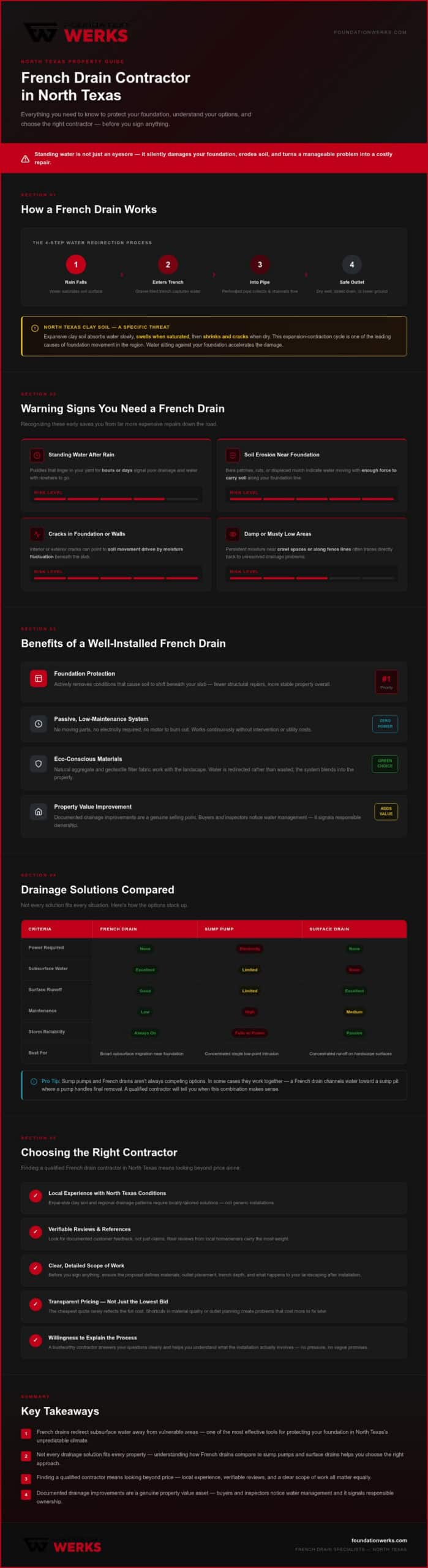
A French drain is a gravel-filled trench containing a perforated pipe that redirects subsurface and surface water away from areas where it causes damage. Water flows into the trench, enters the pipe through small perforations, and gets carried to a designated outlet point – a dry well, a street drain, or a lower area of your property. Simple in concept, highly effective in practice.
North Texas presents a specific set of drainage challenges that make this solution particularly relevant. The region’s expansive clay soil is notorious for absorbing water slowly and swelling under saturation, then shrinking and cracking as it dries out. That cycle of expansion and contraction is one of the leading causes of foundation movement in the area. When water has nowhere to go after a heavy rain, it sits against your foundation and works against it over time.
Working with an experienced French drain contractor in North Texas means getting a solution designed around these local conditions – not a generic installation that ignores the soil composition and drainage patterns specific to this region.
Common Signs You Need a French Drain
Recognizing the warning signs early saves you from more expensive repairs down the road. Watch for any of the following:
- Standing water after rain: Puddles that linger in your yard for hours or days signal poor drainage and water with nowhere to go.
- Soil erosion near your foundation: Bare patches, ruts, or displaced mulch indicate water is moving across your property with enough force to carry soil with it.
- Cracks in your foundation or interior walls: These can point to soil movement driven by moisture fluctuation beneath the slab.
- Damp or musty conditions in low-lying areas: Persistent moisture near crawl spaces or along fence lines often traces back to drainage problems.
Benefits of Installing a French Drain
The value of a well-installed French drain goes beyond keeping your yard dry. It actively protects your foundation by removing the conditions that cause soil to shift. Over time, that protection translates into fewer structural repairs and a more stable property overall.
There’s also a sustainability angle worth noting. Quality French drain installations use eco-conscious materials, including natural aggregate and geotextile filter fabric, that work with the landscape rather than against it. Water gets redirected rather than wasted, and the system blends into the property without disrupting its appearance.
From a property value standpoint, documented drainage improvements are a genuine selling point. Buyers and inspectors notice water management, and a property with a functioning drainage system signals responsible ownership. For commercial properties especially, that kind of infrastructure investment carries real weight.
Comparing French Drains to Other Drainage Solutions
French drains aren’t the only drainage solution on the market, and they’re not always the right fit for every situation. Understanding how they stack up against alternatives helps you have a more informed conversation with any French drain contractor in North Texas and ensures you’re not paying for more than you need, or less than your property requires.
Sump Pumps vs. French Drains
Sump pumps are mechanical systems installed in a pit, typically in a basement or crawl space, that actively pump accumulated water out of the area. They work well when water intrusion is concentrated in a single low point and needs to be removed quickly. The tradeoff is real: sump pumps depend on electricity, require regular maintenance, and can fail during the storms when you need them most. French drains, by contrast, are passive systems. No moving parts, no power requirements, no motor to burn out. For properties dealing with subsurface water migration across a broader area, a French drain handles the load more reliably over time.
That said, sump pumps and French drains aren’t always competing options. In some cases, they work together, with a French drain channeling water toward a sump pit where a pump handles the final removal. A qualified contractor will tell you when that combination makes sense.
Surface Drains and Dry Wells
Surface drains are designed to capture water that pools on top of the ground, typically through a grate-covered inlet connected to an underground pipe. They’re effective for concentrated runoff in paved areas like driveways or patios, but they don’t address subsurface water movement. If your problem is water sitting on hardscape, a surface drain may be sufficient. If the issue is water saturating the soil near your foundation, it won’t solve the underlying problem.
Dry wells offer a different approach: water is directed into an underground chamber where it slowly percolates into the surrounding soil. They work best in areas with sandy or loamy soil that absorbs water readily. In North Texas, where clay soil dominates, dry wells often underperform because the surrounding soil simply can’t accept water fast enough to prevent overflow.
Here’s a quick breakdown to help you compare:
- French drain: Best for subsurface water migration, foundation protection, and broad yard drainage in clay-heavy soil
- Sump pump: Best for concentrated water intrusion in enclosed spaces; requires power and ongoing maintenance
- Surface drain: Best for runoff on paved or hardscaped surfaces; doesn’t address underground saturation
- Dry well: Best in sandy or well-draining soil; limited effectiveness in North Texas clay conditions
If your property is showing the signs covered earlier, including pooling water, soil erosion, or moisture near the foundation, a French drain is typically the most direct solution for North Texas conditions. Explore Foundation Werks’ French drain installation services to see how a properly scoped system is designed for the specific drainage challenges this region presents.
What to Expect During French Drain Installation
Most homeowners go into installation day with more questions than answers. That uncertainty is avoidable. Understanding the process from start to finish helps you set realistic expectations, ask better questions, and recognize whether the crew on your property is doing the job right.
Pre-Installation Assessment
Before any digging starts, a qualified French drain contractor in North Texas will walk your property to evaluate the drainage patterns, soil composition, and the natural grade of the land. This isn’t a formality. In North Texas, where clay soil behaves differently from region to region, the assessment directly shapes how the system gets designed. The contractor is looking for where water enters, where it collects, and where it needs to exit. They’ll also identify any underground utilities that need to be marked before excavation begins.
On your end, preparation is straightforward. Clear the work area of furniture, planters, or anything that would obstruct access to the trench path. If you have irrigation lines or landscaping features near the drainage route, flag them or mention them during the assessment so the crew can work around them.
Installation Day: What Happens?
The installation follows a clear sequence:
- Trenching: The crew excavates a trench along the planned route, typically at a consistent downward slope to allow gravity to move water toward the outlet point.
- Lining: Geotextile filter fabric is laid into the trench to prevent soil from infiltrating the gravel layer over time.
- Pipe placement: A perforated pipe is positioned at the base of the trench, oriented so water enters freely.
- Gravel fill: Clean aggregate is packed around and over the pipe, then the filter fabric is folded over the top to seal it.
- Backfill and cleanup: The trench is covered, the surface is restored as closely as possible to its original condition, and the outlet point is confirmed to be clear and functional.
For a standard residential installation, most projects wrap up within one to two days depending on the length and complexity of the drain run. Larger commercial properties or sites with difficult access may require additional time.
Once the system is in place, maintenance is minimal. Flushing the pipe annually with a garden hose helps clear any sediment that accumulates near the inlet. Keeping the outlet point free of debris ensures water can exit without backing up into the system. A well-installed drain, built with quality materials, handles North Texas weather reliably without constant attention.
Ready to see what a properly scoped installation looks like for your property? Contact Foundation Werks to discuss your French drain installation and get a clear picture of what the process involves from day one.
Choosing the Right French Drain Contractor in North Texas
Knowing you need a French drain is one thing. Finding someone you can actually trust to install it correctly is another. The contractor you choose determines whether the system performs for years or fails after the first heavy rain season. That decision deserves more than a quick Google search and the lowest bid.
Evaluating Contractor Credentials
Start with the basics before anything else. Any legitimate French drain contractor in North Texas should carry current liability insurance and workers’ compensation coverage. If something goes wrong on your property during installation, those policies protect you. Ask for proof directly, not just a verbal confirmation.
Beyond insurance, look at what the contractor stands behind after the job is done. Ask specifically about workmanship coverage and what the process looks like if a problem surfaces months later. A contractor confident in their work will answer that question clearly. One who hedges or deflects is telling you something.
Reviews matter, but read them with intention. Look for patterns across multiple platforms rather than fixating on a single five-star rating. Consistent feedback about punctuality, communication, and whether the finished system actually solved the drainage problem carries more weight than generic praise. Testimonials that mention specific team members or describe the installation process in detail tend to reflect genuine experiences.
Getting the Best Value for Your Investment
Price comparisons between contractors can feel straightforward until you realize the quotes aren’t describing the same scope of work. One contractor might include quality geotextile filter fabric and clean aggregate; another might cut corners on materials that determine how long the system holds up in North Texas clay. Before comparing numbers, compare what’s actually included.
Questions worth asking any contractor before you commit:
- What materials do you use, and why?
- How do you determine where the outlet point will be placed?
- Will you mark utilities before trenching begins?
- What does your workmanship coverage include?
- Have you worked on properties with similar soil and drainage conditions in this area?
Local experience isn’t a bonus – it’s a baseline requirement. North Texas clay behaves in ways that generic drainage contractors aren’t prepared for. Foundation Werks brings focused expertise in concrete and drainage solutions across the North Texas region, with installations built around eco-conscious materials designed to work with the landscape rather than against it.
If you’re ready to move from uncertainty to a clear plan, contact Foundation Werks for a free quote today and find out exactly what a properly scoped French drain installation looks like for your property.
Your Next Step Toward a Drier, More Protected Property
Water problems don’t resolve themselves, and in North Texas, the longer standing water sits against your foundation, the more work it does against you. This guide has walked you through how French drains function in clay-heavy soil, how they compare to other drainage options, what installation actually involves, and what separates a trustworthy contractor from one who’ll leave you with more problems than you started with.
The right French drain contractor in North Texas brings more than a crew and equipment. They bring local knowledge, honest scoping, and materials built to hold up in this region’s conditions. Foundation Werks works with both residential and commercial properties, using eco-conscious materials designed to work with the landscape rather than disrupt it.
You now have the knowledge to ask the right questions and recognize the right answers. The next move is straightforward. Get a free estimate for your French drain installation with Foundation Werks and take the first step toward a property that handles whatever North Texas weather brings.
Frequently Asked Questions About French Drain Installation
What is a French drain and how does it work?
A French drain is a gravel-filled trench containing a perforated pipe that collects subsurface and surface water and redirects it away from problem areas. Water enters the trench, seeps through the pipe’s perforations, and travels by gravity toward a designated outlet point such as a street drain or a lower section of your property. The system is entirely passive, with no moving parts or power requirements.
How much does it cost to install a French drain in North Texas?
We don’t publish pricing here because installation costs vary significantly based on trench length, soil conditions, outlet placement, and site accessibility. What you pay for a straightforward residential run differs considerably from a larger commercial drainage project. The most reliable way to understand your actual cost is to request a site-specific quote. Any contractor who quotes a firm number without walking your property first isn’t giving you an accurate picture.
How long does a French drain last?
A properly installed French drain built with quality materials, including geotextile filter fabric and clean aggregate, can perform reliably for decades. The filter fabric plays a critical role here: it keeps North Texas’s clay-heavy soil from infiltrating the gravel layer over time, which is the most common cause of system failure. Installations that skip quality materials or cut corners on fabric placement tend to underperform well before they should.
Can I install a French drain myself?
DIY installation is possible in theory, but it carries real risk in North Texas. Getting the slope wrong by even a small margin means water won’t move toward the outlet efficiently. Clay soil behaves unpredictably during excavation, and without utility marking, you’re digging blind. A qualified French drain contractor in North Texas brings site assessment experience, proper equipment, and knowledge of local soil conditions that make the difference between a system that works and one that doesn’t.
What maintenance does a French drain require?
French drains are low-maintenance by design. Flushing the pipe annually with a garden hose helps clear any sediment that builds up near the inlet. Keeping the outlet point free of leaves, debris, and soil buildup ensures water can exit without backing up into the system. Beyond that, a well-built drain installed with quality materials handles North Texas weather without requiring constant attention.
What are the signs that my French drain is not working?
The clearest sign is water pooling in the same areas the drain was installed to protect. Other indicators include soggy ground that stays saturated well after rain, visible soil settlement near the trench line, or water backing up near the inlet. These issues typically point to a clogged pipe, a compromised filter fabric layer, or an outlet that’s become blocked. If you’re seeing these signs, it’s worth having a contractor inspect the system before the problem compounds.