

How long should foam beneath a concrete slab last? There isn’t one lifespan that applies to every polyurethane foam product or project. The lifetime of polyurethane foam depends on its application, and for concrete lifting, on more than the material itself.
It’s understandable to feel unsure when lifespan claims conflict. Foundation Werks states that its polyurethane foam does not lose density and is permanent as a material. But the slab’s ongoing support also depends on conditions beneath and around it. Soil movement, water-related erosion, and the concrete’s condition can all affect how a lifting or stabilization project performs over time.
This guide explains why polyurethane foam lifespans vary by application, what to consider when foam is injected beneath concrete, and how to assess a lifting or stabilization project in North Texas. You’ll learn which questions matter when evaluating soil, moisture, and slab damage, including why a severely cracked slab may not be a good candidate for raising. With that context, you can make a more informed decision about concrete in McKinney and the Dallas metropolitan area.
Key Takeaways
- The lifetime of polyurethane foam varies by application, exposure, and operating conditions, so a single lifespan figure can be misleading.
- For concrete, consider installation, slab condition, soil support, water, and applied loads together. Durable foam alone can’t resolve every site issue.
- Polyurethane foam and mudjacking material differ in weight and injection-hole size, which can shape what each method means for a lifting project.
- Renewed unevenness or gaps are reasons to assess a slab, not proof that the foam has failed.
- A project-specific assessment considers the slab, underlying voids, and surrounding site conditions before determining whether lifting or stabilization is suitable.
Polyurethane Foam Lifespan Depends on What the Foam Is Used For
The lifetime of polyurethane foam varies with its type, application, exposure, and operating conditions. A foam cushion that compresses with daily use faces different demands from foam injected beneath a concrete slab to fill a void and support the concrete. That distinction matters when comparing lifespan claims.
Polyurethane foam is a broad material category, not one product with a single expected service life. Its properties and performance depend on how it’s made and where it’s used. A general overview of polyurethane foam describes its range of uses, but a claim about one application shouldn’t automatically be applied to another.
Make sure a lifespan claim refers to the same kind of foam and use you’re considering.
Why cushioning foam and injected concrete foam are different
Cushioning foam is designed for items such as seats and mattresses, where repeated pressure can lead to softening, compression, or sagging. FoamOnline gives a typical estimate of one to two years for the commercial-grade cushioning foam described on its page. That estimate concerns cushioning performance, not foam placed beneath concrete.
Injected foam has a different role: it fills space below a slab and helps support the concrete. Its performance should be considered in that setting, rather than judged by how long a seat cushion keeps its shape.
What does polyurethane foam lifespan mean beneath a slab?
For a concrete-lifting project, useful performance means the foam continues to support the raised or stabilized slab. That outcome involves more than the foam’s material properties. The soil around it and the condition of the concrete also influence whether the slab remains supported and level.
There isn’t a universal number of years that describes every injected-foam project. A lifespan estimate is meaningful only when it applies to the specific foam, installation, and conditions being discussed.
It also helps to separate the condition of the foam from the result you see above ground. If a slab changes position later, that alone doesn’t establish that the foam material broke down. Shifting or eroding soil, water movement, or changes in the slab can affect support independently of the foam’s density.
When you encounter a lifespan claim, check what it measures. Is it about cushioning comfort, the material itself, or how long a concrete slab remains supported? Those are different outcomes. For injected foam, the most useful assessment considers the actual slab-and-soil system rather than borrowing an estimate from a product designed for furniture.
This distinction is a practical starting point for evaluating concrete raising. Next, consider the factors beneath and around the slab that can influence support over time.
What Determines the Lifetime of Polyurethane Foam Under Concrete?
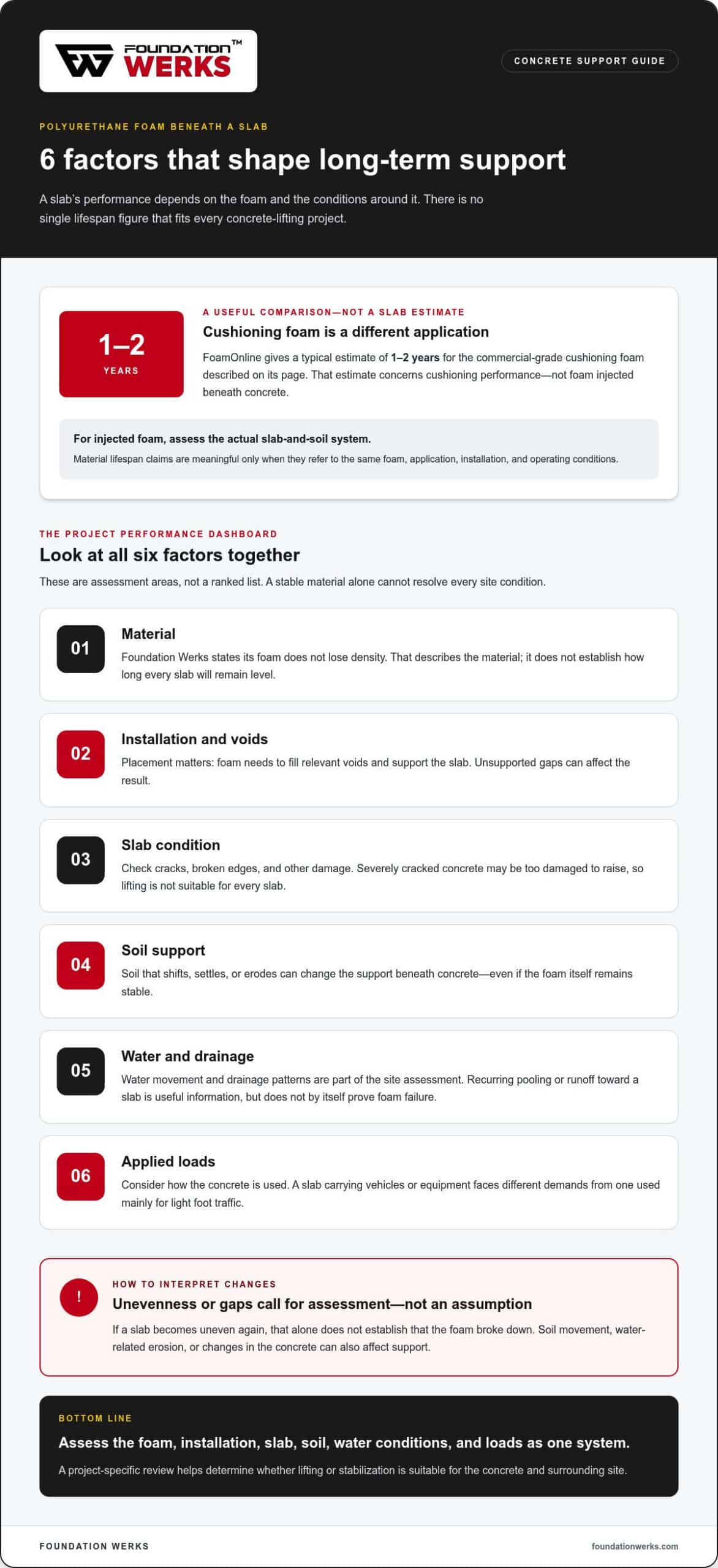
The lifetime of polyurethane foam beneath a slab depends on more than the material. Performance is shaped by how the foam is installed, the slab it supports, the soil beneath it, water and drainage conditions, and the loads the concrete carries. These factors matter in North Texas just as they do elsewhere: assess the site rather than assume one lifespan fits every slab.
Review the main influences together:
- Material: Foundation Werks states that its foam does not lose density and is permanent as a material. That describes the foam, but it doesn’t establish how long every slab will remain level.
- Installation: Foam needs to be placed where it can fill relevant voids and support the slab. Unsupported gaps can affect the result.
- Slab condition: Existing cracks and damage influence whether lifting is suitable. Severely cracked concrete may be too damaged to raise.
- Soil support: Soil that shifts, settles, or erodes can change support beneath a slab, even if the foam itself remains stable.
- Water and drainage: Water movement and drainage patterns are site conditions to assess. They can be relevant to soil support, but their presence alone doesn’t prove foam failure.
- Applied loads: The concrete’s use matters. A slab carrying vehicles or equipment faces different demands from one used mainly for light foot traffic.
Long-term performance depends on the slab and the ground supporting it, not just the material.
How installation and slab condition affect performance
Filling voids helps restore contact and support beneath sections of concrete that have lost it. Placement matters because the goal is to address the space contributing to uneven support, not simply add material without considering the slab’s condition. A sound assessment also considers cracks, broken edges, and other visible damage. Foam can support concrete, but it shouldn’t be treated as a way to repair severe structural damage or as a guarantee of a particular result.
Why soil movement, water, and drainage matter
If the soil supporting a slab changes, the slab’s position may change too. Water can be part of the site picture when it affects the ground or how the area drains, but that doesn’t mean water automatically damages cured foam. Note recurring pooling or runoff toward the slab as useful information for an assessment. When drainage needs attention, a North Texas concrete stabilization assessment can consider the slab and surrounding conditions together, including whether French drain installation is appropriate.
There isn’t a single number of years that accounts for every combination of material, placement, soil, water, slab condition, and use. Foundation Werks provides concrete raising and stabilization in North Texas, considering these site-specific factors as part of the work. The foam is one part of the support system, not a substitute for addressing relevant soil or drainage concerns.
Polyurethane Foam vs. Mudjacking: Compare Durability in Context
Both polyurethane foam and mudjacking are used to raise settled concrete, but the materials differ. Foundation Werks reports that its polyurethane foam has a density of about 2 pounds per cubic foot, compared with about 100 pounds per cubic foot for traditional mudjacking material. The lighter material adds less weight beneath a slab. Density alone, however, doesn’t predict how long a particular slab will stay supported.
The comparison below covers practical differences that may affect a project. Installation details and site conditions still matter.
| Consideration | Polyurethane foam | Mudjacking |
|---|---|---|
| Material weight | About 2 pounds per cubic foot, according to Foundation Werks. | About 100 pounds per cubic foot for traditional mudjacking material, according to Foundation Werks. |
| Injection holes | Foundation Werks reports nearly invisible 5/8-inch injection holes. | Hole size varies by installation; no specific measurement is provided here. |
| Surface cleanup | Small injection holes limit the size of the openings that need attention. | The surface work depends on the access holes and how they are finished. |
| Stated use | Concrete raising, stabilization, and filling voids beneath slabs. | Traditional slab raising using heavier mudjacking material. |
How material weight and placement relate to slab support
A lower-density material adds less weight beneath the concrete, while placement determines whether foam fills the intended voids and supports the slab where needed. Foundation Werks states that its foam does not lose density. That is a material characteristic, not a service-life promise for every project. Soil movement, slab condition, water, and placement can still influence the result. The lifetime of polyurethane foam can’t be inferred from density alone.
What repair-method comparisons can and cannot tell you
Smaller access holes can mean less visible patching on the concrete surface. Foundation Werks describes its 5/8-inch holes as nearly invisible. With either approach, the finish depends on the work and the slab’s condition. A method comparison can clarify material and surface differences, but it can’t determine whether a particular slab is suitable for raising or how it will perform over time.
Foundation Werks also states that concrete raising typically costs about half as much as replacement. That is a general comparison, not a project-specific price; the slab’s condition and scope of work matter. To compare methods for your project, consider the material, installation approach, and how well each fits the concrete issue being addressed.
How to Assess Concrete and Foam Performance Over Time
A slab’s surface can show that something has changed, but it can’t identify the cause on its own. If concrete that was raised or stabilized starts to look uneven again, treat that as a reason to assess the slab and its surroundings, not as proof that the polyurethane foam has failed.
Visible slab movement is not a confirmed diagnosis of the material beneath it.
A simple monitoring routine can help you describe what’s happening clearly:
- Note changes in the slab. Record where the surface looks higher or lower, whether adjoining sections have separated, and whether a trip edge has returned. Photos taken from consistent viewpoints can help show how the area changes over time.
- Look at surrounding conditions. Check for recurring pooling, runoff, gaps near the slab, or changes in nearby concrete. Note whether water appears to collect or flow toward the affected area. These observations can inform an assessment, but they don’t establish a cause.
- Arrange a project-specific assessment. If the slab moves again or you can’t tell what’s driving the change, have the concrete and site conditions evaluated together. Appearance alone can’t determine whether the issue involves soil support, drainage, concrete damage, or another factor.
Which changes should prompt a closer look?
Renewed unevenness is worth documenting, especially if it changes how adjoining slabs meet or creates a recurring trip edge. Gaps that appear or widen are also useful to note. Keep observations factual: where the change is, when you noticed it, and whether it appears to be progressing. These signs warrant a closer look, but they don’t reveal the condition of the foam by themselves.
When does a site assessment help?
An assessment is useful when a slab changes position again, when the source of movement is unclear, or when damage makes its suitability for raising uncertain. Solid slabs may be candidates for concrete raising, while severely cracked concrete may be too damaged to lift. In a warehouse, uneven floor sections can affect how the space is used, so documenting their locations and changes can help focus the evaluation.
The lifetime of polyurethane foam can’t be established by looking at the concrete surface alone. A useful assessment considers the slab’s condition, the areas that may need support, and surrounding site factors such as water patterns. That gives a clearer basis for deciding whether raising or stabilization is appropriate, or whether the concrete’s condition calls for another approach.
Polyurethane Concrete Raising in North Texas: What Foundation Werks Considers
For a sunken concrete slab, Foundation Werks uses polyurethane foam to fill voids beneath the surface and raise or stabilize suitable concrete. The service can help with residential and commercial slabs, including driveways, sidewalks, patios, pool decks, and commercial floors. The right next step depends on the slab and the conditions around it, not simply on the material’s expected durability.
What Foundation Werks’ foam lifting process addresses
Small injection points provide access beneath the slab, where foam is placed to fill space and support the concrete as it is raised. The aim is to improve the slab’s position and support without replacing the entire surface. Foundation Werks reports that the work typically takes a few hours and that raised concrete can be used the same day after the work is completed.
Not every slab is a candidate for lifting. Cracks, broken edges, or extensive damage can affect whether concrete is sound enough to raise. Severely cracked slabs may be too damaged for this approach. An assessment helps distinguish concrete that may be suitable for lifting from concrete whose condition calls for another plan.
What to expect from an assessment and next step
For a project in McKinney or the Dallas metropolitan area, Foundation Werks considers the slab’s condition, where voids may affect support, and relevant conditions around the concrete. The intended use of a warehouse floor, for example, differs from that of a walkway. Nearby water or drainage patterns may also be important context. Considering these details helps shape a project-specific recommendation rather than relying on a general lifespan estimate. Foundation Werks serves property owners and commercial clients in Frisco, McKinney, Dallas, Prosper, Allen, Fairview, Southlake, Irvin, North Dallas, and the wider DFW area.
The lifetime of polyurethane foam isn’t a stand-alone measure of how long a slab will perform well. The foam supports the concrete, while the slab’s condition and surrounding site factors also influence the result. A clear assessment can help set realistic expectations about what raising or stabilization may address and whether the concrete is suitable for the work.
If you’re considering concrete raising in McKinney or the Dallas area, request a free estimate from Foundation Werks to discuss your slab and the site conditions that may affect the project.
Choose Your Next Step With Confidence
A useful concrete decision starts with the outcome you need from the space. Is the priority a more even walking surface, reliable access across a driveway, or a floor that works for daily operations? Defining that goal helps keep the conversation focused on the project rather than on a lifespan claim that may not reflect your slab’s conditions.
The lifetime of polyurethane foam alone can’t tell you whether raising is the right choice for your concrete. Consider what you want the work to improve, then use a project-specific estimate to understand the proposed scope and whether it fits those priorities. You don’t need to diagnose the cause of a slab’s movement before taking that step. A clear description of what you’ve noticed is a practical starting point.
With a better understanding of the project, you can weigh your options without relying on a one-size-fits-all promise. Start with a conversation about the concrete and the result you’re hoping to achieve.
Frequently Asked Questions
How long does polyurethane foam last under concrete?
There’s no single lifespan figure that applies to every concrete-lifting project. Foundation Werks states that its foam doesn’t lose density and is permanent as a material, but that isn’t a set number of years for every slab. When comparing estimates, focus on the conditions they account for, including installation, slab condition, soil support, and water management. That context is more useful than applying one general figure to a different property or project.
Does polyurethane foam break down or lose density over time?
Foundation Werks states that its concrete-raising foam doesn’t lose density. That describes the foam, not whether a slab will stay at exactly the same level indefinitely. If a surface changes, the cause could relate to the concrete or its support conditions rather than a confirmed change in the foam. Cushioning foam serves a different purpose, so its wear or sagging shouldn’t be used to judge injected foam beneath a slab.
Is polyurethane foam under concrete better than mudjacking for longevity?
Material weight alone can’t show which method will last longer at a specific site. Foundation Werks reports its foam at about 2 pounds per cubic foot and traditional mudjacking material at about 100 pounds per cubic foot. Those figures help compare the materials, but they don’t predict a project’s service life. Consider the slab’s condition, where support is needed, and water management before drawing conclusions about durability.
Can water or drainage affect polyurethane concrete lifting?
Water and drainage are relevant because they can affect the soil supporting a slab. Their presence doesn’t prove the injected foam has failed. Note where water collects or flows, especially if slab movement also returns, and include those observations in a site assessment. Conditions vary among North Texas communities such as Frisco, McKinney, Dallas, Prosper, Allen, Fairview, Southlake, Irvin, North Dallas, and the wider DFW area.
How can I tell if polyurethane foam beneath a slab is no longer supporting it?
You can’t confirm the foam’s condition from the surface alone. A renewed height difference, a gap where slabs meet, or an uneven edge that returns may signal that the area needs a closer look. Record where the change appears and whether it progresses. A project-specific assessment can consider the slab and its surroundings before identifying possible causes. Don’t treat a visible symptom as proof that the foam itself is responsible.
Can every concrete slab be raised with polyurethane foam?
No. A slab’s condition affects whether it can be raised. Solid concrete may be suitable for lifting and stabilization, while severe cracking can leave a slab too damaged for this approach. For example, a cracked corner or broken section may need a different solution from an intact slab that has settled. An assessment can help determine whether the existing concrete is suitable, rather than assuming foam can address every kind of damage.
For concrete raising or stabilization in Frisco, McKinney, Dallas, Prosper, Allen, Fairview, Southlake, Irvin, North Dallas, or the wider DFW area, call Foundation Werks at 800-464-9684 to request a free estimate.