

What if an uneven warehouse joint signals slab movement rather than just worn concrete? That distinction matters when forklifts and other equipment cross the transition every day. If you’re researching how to fix uneven concrete joints in warehouse settings, start by identifying what’s happening at the joint and whether the adjoining slabs sit at different heights. Choosing a surface repair before understanding the condition can leave the underlying issue unaddressed.
A rough, chipped, or raised joint can interfere with equipment movement and warehouse operations. But the visible seam may not show whether its edges have deteriorated, a slab has settled, or both conditions are present. Each calls for a different repair approach, and lifting may not be suitable for every slab.
This guide explains how to distinguish joint damage from slab displacement, compare repair options, and prepare useful information before requesting an assessment. Site details such as the affected area, joint condition, equipment routes, and access needs can help a commercial concrete professional evaluate the issue. For facilities in Frisco, McKinney, Dallas, Prosper, Allen, Fairview, Southlake, Irvin, North Dallas, and across DFW, confirm service availability for your specific location.
Key Takeaways
- To decide how to fix uneven concrete joints in warehouse settings, first identify whether the joint edges are damaged, the slab has shifted, or both.
- Visible signs and site observations can help guide an assessment, but they don’t confirm what is happening beneath the slab.
- Compare joint repair, polyurethane raising or stabilization, and replacement according to the condition each addresses and your operation’s needs.
- Document affected areas, equipment routes, and access or scheduling constraints before discussing the repair scope.
- Evaluate a Dallas-Fort Worth repair partner by how clearly they explain the diagnosis, proposed work, and suitability for your site.
How to Diagnose Uneven Concrete Joints in a Warehouse
An uneven concrete joint is a transition where the edges of adjoining slab sections no longer meet evenly. The joint may have crumbling edges, missing filler or sealant, or a visible gap. One slab edge may also sit higher or lower than the other. A practical answer to how to fix uneven concrete joints in warehouse settings starts with separating surface damage from a change in slab height.
Inspect and document what you can see, but treat your observations as clues rather than a diagnosis. A visual check can’t establish whether the slab has lost support below. For background on how settlement can relate to the ground beneath a slab, see this overview of concrete leveling.
Watch this warehouse joint repair video for a visual example of joint work:
Is the joint damaged, or has one slab moved?
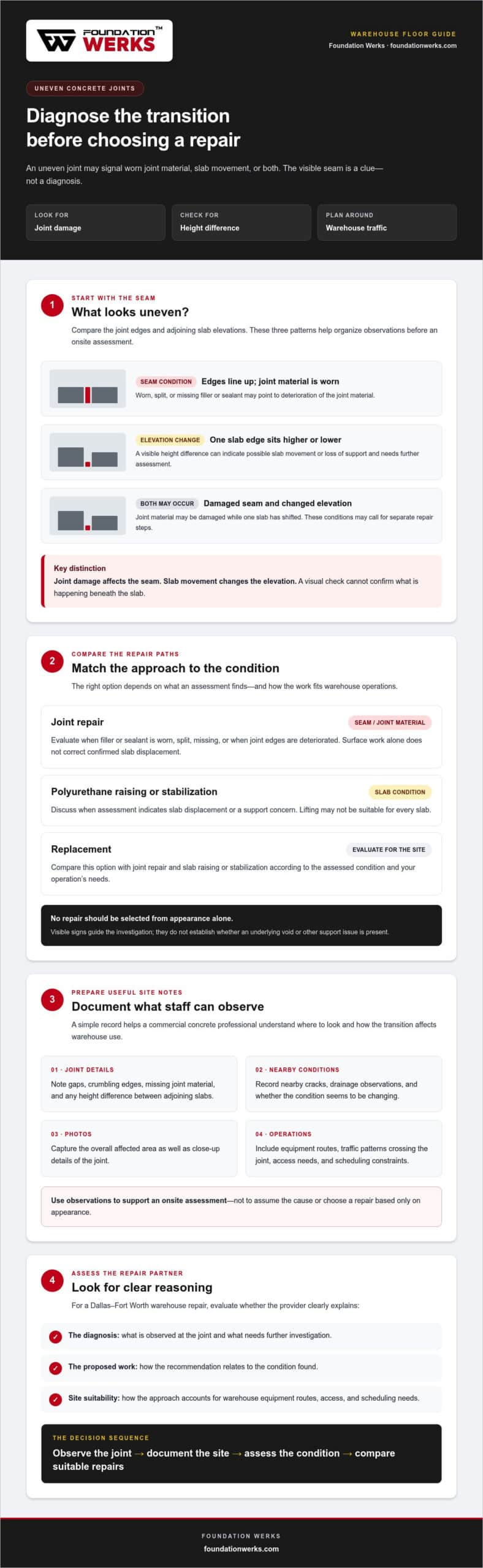
If filler or sealant is worn, split, or missing but the adjoining slab edges still line up, the visible issue may be deterioration of the joint material. A clear height difference between the edges points to possible slab movement or loss of support and needs further assessment. Both conditions can occur together: the joint material may be damaged while one slab has shifted. Joint damage affects the seam; slab movement changes the elevation. They may need separate repair steps.
What should warehouse staff document before assessment?
Make a simple record of each affected location. Note the joint’s condition and nearby features, then take photos that show both the overall area and close-up details. Include:
- Visible gaps, crumbling edges, missing joint material, and any height difference between adjoining slabs.
- Nearby cracks, drainage observations, and whether the condition seems to be changing.
- Equipment routes and traffic patterns that cross the joint, plus access or scheduling constraints.
These notes help a contractor understand where to look and how the uneven transition affects warehouse use. They won’t establish what’s happening below the slab, so use them to support an onsite assessment rather than choosing a repair based on appearance alone.
What Causes Uneven Warehouse Concrete Joints?
An uneven joint can develop for more than one reason. Joint edges may wear or chip, filler or sealant may deteriorate, or adjoining slab sections may move relative to each other. These conditions can look similar from above, so a gap or damaged edge alone isn’t enough to identify the cause. The right approach to how to fix uneven concrete joints in warehouse settings depends on what an assessment finds.
Construction and site conditions can also be relevant. The ACI Guide to Concrete Floor and Slab Construction covers slab and joint construction practices and can help frame questions about a joint’s history and condition. Water movement or drainage concerns may also warrant investigation. They are factors to assess, not proof of what caused a particular warehouse floor problem.
How slab movement can change a warehouse joint
When one slab section settles, rises, or otherwise shifts relative to its neighbor, the joint can develop a height difference. A qualified assessment may investigate whether support beneath the slab has changed, including whether a void is present. A damaged joint, however, doesn’t confirm an underlying void. The visible condition is a reason to investigate, not a remote diagnosis.
Note whether the height difference appears localized or continues along the joint, and share any drainage concerns with the assessor. These details help guide the investigation without assuming a cause.
When joint material or edges are the main concern
Worn or missing joint material can leave the seam exposed and may call for joint repair or resealing. Crumbling concrete edges also need evaluation because their condition can affect which repair approach is suitable. Repairing the joint surface may address deteriorated material, but it won’t correct confirmed slab displacement on its own.
If both the joint and slab are affected, the scope may need to address each condition. Joint work and slab stabilization solve different problems, so an assessment should clarify whether one or both are needed. This helps avoid choosing a surface treatment when an underlying issue still needs attention.
For a commercial assessment, review Foundation Werks’ concrete joint repair services and confirm service availability for your warehouse location. Share what you’ve observed, including drainage concerns, so the condition can be evaluated before a repair approach is selected.
Compare Warehouse Joint Repair, Slab Lifting, and Replacement
The right repair depends on what’s damaged or out of position. Joint repair addresses deteriorated joint material or concrete edges. Raising targets slab position, while stabilization may address a concern about support beneath the slab. One surface treatment can’t correct every uneven joint. If the joint and slab are both affected, more than one approach may be needed.
| Approach | Condition it addresses | Assessment and operational considerations |
|---|---|---|
| Joint repair or sealing | Worn or missing joint material and damaged joint edges, when adjoining slabs remain acceptably aligned. | Assess the joint and edge condition, and consider warehouse use. Plan access around the affected area and nearby equipment routes. |
| Polyurethane raising or stabilization | A slab that has settled or may have a support issue beneath it. | Assess slab condition and whether raising is suitable. Plan for access to the work area and any operational constraints. |
| Concrete replacement | A slab section that is too damaged or unsuitable for lifting. | Confirm the extent of damage and proposed scope onsite. Consider how work in the area will affect warehouse access and operations. |
When joint sealing or mastic repair may fit
If slab edges remain aligned but filler or sealant is worn or missing, joint repair or resealing may be appropriate. The joint’s condition and intended warehouse use should guide the repair selection. Sealing alone won’t correct confirmed slab displacement or restore concrete edges that need repair. If there’s a height difference, have it assessed before choosing joint work alone.
When lifting, stabilization, or replacement needs assessment
If a slab has settled or its support is in question, an assessment can determine whether polyurethane raising or stabilization is suitable. Foundation Werks uses lightweight polyurethane foam, approximately 2 pounds per cubic foot, compared with traditional mudjacking material at about 100 pounds per cubic foot. The foam is injected through approximately 5/8-inch drill holes, which are nearly invisible. These details describe the process, not a guarantee that a particular slab can be lifted.
The foam material does not lose density and is permanent. Raising or stabilizing concrete is typically about half the cost of full replacement, though the right option depends on the slab’s condition and the work required. Severely cracked or otherwise unsuitable slabs may need a different approach, such as replacement. Have the slab condition and repair scope confirmed onsite. For anyone researching how to fix uneven concrete joints in warehouse facilities, the key decision is whether the problem is confined to the joint, involves slab movement, or calls for both joint work and stabilization.
How to Plan a Warehouse Concrete Joint Repair Step by Step
A clear plan helps coordinate the assessment, repair scope, and warehouse access before work begins. If you’re deciding how to fix uneven concrete joints in warehouse operations, keep diagnosis separate from method selection. The visible joint is a starting point, not a complete work plan.
Prepare the site information for a repair assessment
Share photos and approximate locations of the affected joints. Describe what you see at the edges and whether adjoining slabs appear aligned. Include nearby cracks, drainage observations, and any changes you’ve noticed. This gives the contractor useful context, but an onsite assessment is still needed to determine the cause and suitable scope.
Flag operational needs early. Identify access routes, equipment traffic, areas that must stay open, and preferred work windows. Ask whether the assessment will consider drainage, slab support, and the condition of joint material, so the proposed work addresses the relevant conditions.
Confirm repair scope, sequencing, and return to use
Before scheduling, ask the contractor to explain what each part of the work is intended to address. If the plan includes both slab stabilization and joint repair, confirm which step addresses movement and which addresses joint material or edges. Then review the work sequence, site access plan, and any operational limitations.
Timing and access depend on the site assessment and agreed scope. Foundation Werks states that raised concrete can be walked on or driven on the same day the work is completed. Confirm whether that applies to your project and what conditions must be met before equipment returns to the area.
Before requesting an assessment, gather:
- Photos and approximate locations of affected joints.
- Notes on joint edges, material condition, slab alignment, nearby cracks, and drainage observations.
- Equipment routes, access needs, and preferred work windows.
- Questions about whether the assessment will check slab support and whether joint repair is needed alongside stabilization.
Once the condition and site constraints are understood, ask for a written scope explaining the proposed repair steps and access plan. This gives your team a practical basis for coordinating the work and confirming when the affected area can return to use.
Choose a Dallas-Fort Worth Warehouse Repair Partner and Next Step
Choosing a contractor is about more than finding someone who repairs concrete. Look for a clear diagnosis, a scope that connects each repair step to a specific condition, and experience working in commercial spaces. A useful proposal should explain whether the joint, slab position, or both need attention, along with what the assessment can and can’t confirm.
Questions to ask before approving warehouse joint work
Before approving the work, ask how the contractor determined what needs repair and what observations support the recommendation. Request a clear explanation of the proposed work, site access needs, and any exclusions. Also ask how the repaired area will be checked and what conditions must be met before warehouse operations resume.
Customer testimonials can offer feedback about a company’s communication, crews, or scheduling. Treat them as individual experiences, not a promise that your project will have the same outcome. Your warehouse’s slab condition, repair scope, and operating needs are specific to your site.
How Foundation Werks can assess uneven warehouse joints
Foundation Werks is based in McKinney and serves commercial properties in the Dallas metropolitan area. Its relevant services include commercial concrete joint and crack repairs, joint seal or mastic installation, polyurethane concrete raising, and void filling and stabilization. Confirm service availability for your specific warehouse location in Frisco, McKinney, Dallas, Prosper, Allen, Fairview, Southlake, Irvin, or North Dallas and elsewhere in DFW.
An assessment can help determine whether the site calls for joint work, slab work, or both. Joint repair addresses damaged joint material or edges, while raising and stabilization are options to assess when slab position or support is a concern. No repair method suits every slab, so ask the contractor to explain the basis for the recommendation and how it fits your operational requirements.
As you consider how to fix uneven concrete joints in warehouse facilities, bring photos, affected locations, and access or scheduling constraints to the discussion. A site-specific conversation can clarify the proposed scope and what your team should plan for before work is scheduled.
Start With the Cause, Then Plan the Repair
Start by understanding what’s behind the uneven transition. Damaged joint material or edges may call for joint repair, while a height difference may point to slab movement or a support issue that needs assessment. In some warehouses, both conditions need attention. That’s the key to deciding how to fix uneven concrete joints in warehouse settings without relying on a surface treatment to address every problem.
Before requesting an assessment, document affected locations, take photos, and note nearby cracks, drainage observations, equipment routes, and site access needs. Ask the contractor to explain the diagnosis, proposed scope, and how work will be coordinated with warehouse operations.
Foundation Werks provides commercial concrete joint repair, polyurethane raising, stabilization, and void filling. Customer testimonials describe knowledgeable, professional crews and flexible scheduling. These are individual experiences, and your project’s scope and timing depend on its conditions.
A clear assessment can help your team plan the work. Request a free estimate from Foundation Werks at foundationwerks.com or call 800-464-9684.
Frequently Asked Questions
How do you fix uneven concrete joints in a warehouse?
First determine whether the problem is damaged joint material, shifted slab edges, or both. Joint repair can address deteriorated material or edges when the slabs remain suitably aligned. If a slab has settled or support beneath it is in question, a contractor may assess polyurethane raising or stabilization. Severely cracked or unsuitable slabs may need replacement. The right approach to how to fix uneven concrete joints in warehouse settings depends on an onsite assessment.
Can you repair an uneven warehouse joint without replacing the slab?
Yes, some uneven joints can be addressed without replacing the slab, depending on the slab’s condition and the cause of the unevenness. Joint material may need repair or resealing, while a settled slab may be considered for raising or stabilization if it’s suitable. These approaches address different issues. A contractor should inspect the concrete and explain why the proposed method fits before work is approved.
Is the joint itself always the cause of an uneven warehouse floor?
No. A joint may have worn filler, sealant, or damaged edges, but a height difference between adjoining slabs can indicate movement. Loss of support beneath a slab is one possibility for an assessor to investigate, not something a photo can confirm. Water or drainage observations may also be useful context. An onsite assessment can help distinguish joint deterioration from slab movement and determine whether both need attention.
How can I tell if a warehouse slab has settled at a joint?
A visible height difference between adjoining slab edges can suggest that one section has moved relative to the other. Look for a raised or sunken edge, nearby cracks, gaps, and changes you’ve observed over time. These clues help document the condition, but they can’t confirm settlement or reveal what’s happening below the concrete. Photograph the joint, note its location and nearby drainage conditions, then share those observations with a qualified contractor.
How long does warehouse concrete joint repair take?
Repair time depends on the site assessment, the type and extent of damage, and the agreed work scope. Joint material repair, slab stabilization, and replacement involve different work, so there isn’t one reliable timeline for every warehouse. Before scheduling, ask the contractor to outline the work sequence, expected access needs, and any limits on using the area. Confirm timing for your facility rather than relying on a general estimate.
Can warehouse operations resume the same day after concrete lifting?
Foundation Werks states that raised concrete can be walked on or driven on the same day the work is completed. Whether that timing applies to a particular warehouse area depends on the project and site conditions, so confirm it with the contractor before planning equipment routes or reopening access. Ask what checks are needed before operations resume and whether any parts of the area must remain restricted.
When is warehouse concrete replacement necessary instead of repair?
Replacement may be considered when a slab is too severely cracked or damaged to be a suitable candidate for lifting or stabilization. The extent and condition of the concrete need to be assessed onsite before choosing that route. Ask the contractor to explain why repair or raising may not fit, what replacement work is proposed, and how the scope will affect warehouse access and operations. Suitability depends on the specific slab.