

Neglected saw-cut joints can chip, spall, and leave uneven transitions that disrupt warehouse operations and damage forklifts. A practical way to improve warehouse floor durability is to maintain joints, repair surface damage early, and match floor flatness to traffic patterns. ACI 302.1 addresses acceptable flatness and levelness ranges: very narrow aisle vehicles following a defined path require Class 9 Super Flat floors with a minimum FF of 100, while random traffic typically requires an FF of 50.
Joint neglect can go unnoticed until it affects vehicle movement, slab edges, or daily operations. This guide explains how wear, repairs, maintenance, chemical exposure, and floor flatness influence durability, and how prevention compares with repair when damage appears.
It also covers practical inspection and maintenance steps, the effects of deteriorating joints, and how operating demands shape repair decisions. Use these points to identify where routine care may help and where damaged concrete needs attention.
Key Takeaways
- Distinguish surface dusting from deeper concrete damage so you can choose between routine care, sealing, and repair.
- Build regular inspections and prompt spill or damage reporting into maintenance to catch developing problems early.
- Compare floor protection options by chemical exposure, traffic, and upkeep needs, not lifespan alone.
- Use the warehouse’s vehicle routes and operating demands to guide floor flatness decisions and prioritize problem areas.
- Learn when concrete raising, crack and joint repairs, or replacement may suit the condition of the floor.
What causes concrete floor surface wear and dusting?
Concrete dusting often starts when the surface is weak, poorly finished, or exposed to wear before it has cured. If left untreated, concrete may take 60-90 days to cure. Forklift traffic, abrasive debris, and repeated impacts can then wear the surface and release dust that settles on stock and equipment.
Water, finishing, and curing conditions affect surface strength. Excess mix water or finishing while bleed water remains can weaken the top layer. Keep curing conditions consistent and protect fresh slabs from premature traffic. On an existing floor, note where dust appears, whether it follows vehicle routes, and whether cracks or flaking are present.
Match the repair to the damage. A penetrating sealer can reduce dust and harden the surface, while a coating adds a protective layer. To patch spalls, remove loose concrete, prepare the area, and apply suitable repair material. Resurfacing can address broader surface wear, but it will not correct movement or an unstable base.
Concrete cracks can result from shrinkage, settlement, changing loads, or restrained movement. Cracks roughly greater than 0.2 mm wide tend to widen or chip over time, depending on traffic. Record their width, location, and change; crack type affects whether repair or monitoring is appropriate.
For forklifts and heavy traffic, compare epoxy, cementitious urethane, MMA, and polished concrete against site demands. With proper care, epoxy and MMA flooring have stated lifespans of 10-15 years; cementitious urethane, 15-20 years; and polished concrete, 20+ years. Polished concrete needs sealers for chemical resistance.
| Option | Useful for | Maintenance or limitation |
|---|---|---|
| Penetrating sealer | Dust control and surface hardening | Reapply every 5-10 years |
| Epoxy | Coated warehouse surfaces | May need recoating every 5-10 years |
| Cementitious urethane | Floor protection where its properties suit the operation | Check exposure and upkeep needs |
| Polished concrete | General warehouse use | Use sealer for chemical resistance |
Choose based on traffic, chemical exposure, existing damage, and planned upkeep, not lifespan alone.
For OSHA and building-code concerns, assess floor condition and slip resistance against applicable workplace and locally adopted requirements. Criteria depend on the building’s use and location. Document hazards such as spills, damaged areas, and uneven transitions.
Polishing, sealing, and epoxy coating costs depend on floor area, preparation, existing damage, materials, and site conditions. Request a quote for project-specific pricing.
There is no single concrete thickness suited to every heavy-load warehouse. Design depends on subsoil support, storage-rack loads, handling vehicles, and support systems. Calculate operating loads before selecting a slab design.
Concrete mix and reinforcement also depend on intended use and site conditions. Test and compact subsoil before pouring; test results can help determine whether rebar or post-tensioning cables are needed.
Floor damage prevention and repair
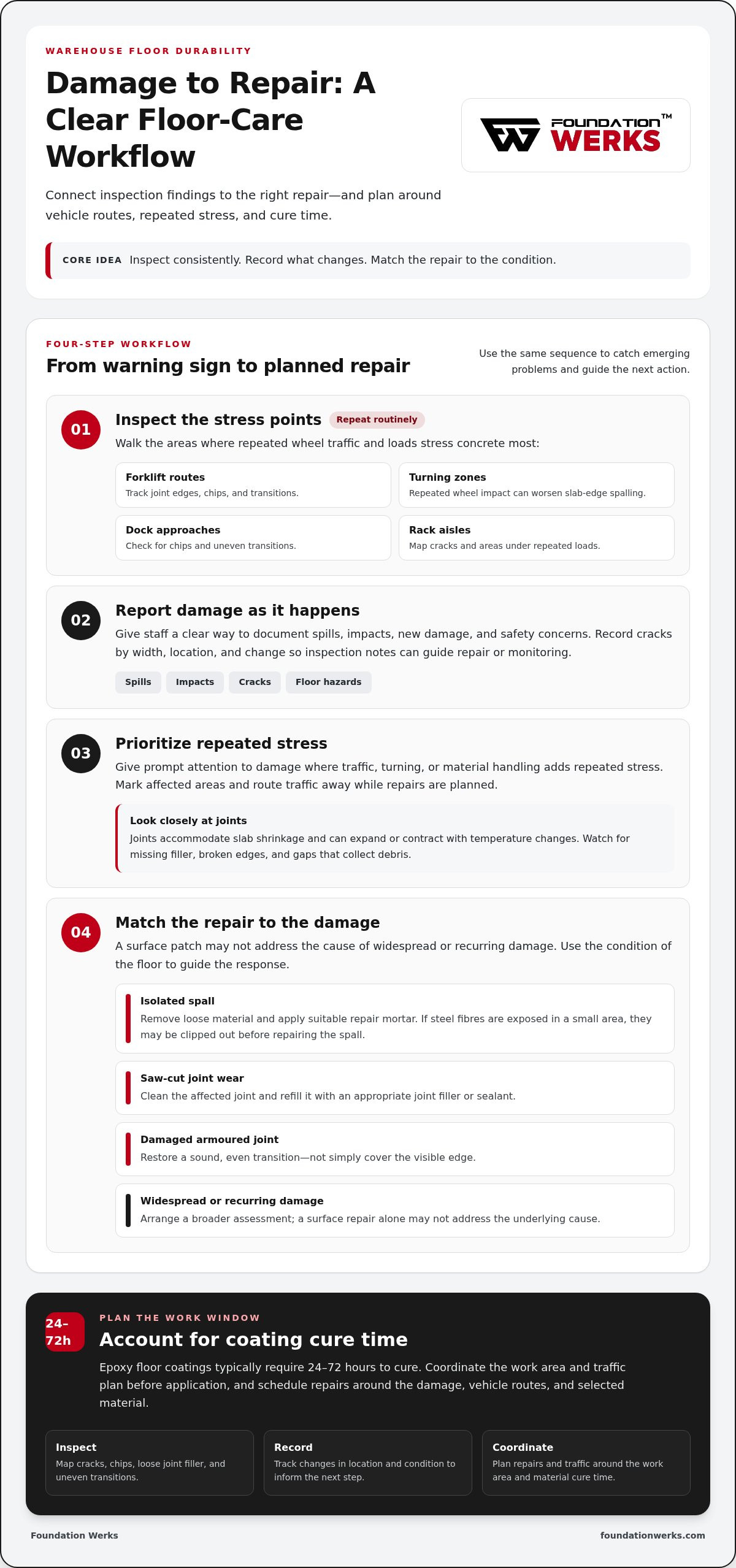
To improve warehouse floor durability, start with a repeatable inspection routine. Walk forklift routes, dock approaches, turning zones, and rack aisles, where repeated wheel traffic and loads stress concrete. Map cracks, chips, loose joint filler, and uneven transitions. Regular inspections and maintenance help identify problems early and may reduce the need for extensive repairs.
Pair inspections with clear reporting procedures. Ask staff to report spills, impacts, new damage, and safety concerns as they occur. For example, a damaged joint near a turning area needs prompt attention because repeated wheel impact can worsen slab-edge spalling. Regular safety audits also help identify hazards and address emerging issues.
Concrete joints accommodate slab shrinkage, but they remain vulnerable areas that need maintenance. Temperature changes can also make joints expand and contract. Watch for missing filler, broken edges, and gaps that collect debris. Damaged armoured joints can create uneven transitions, interrupt operations, and affect forklifts. Mark affected areas so crews can route traffic away while repairs are planned.
- Inspect: Track joint edges, surface chips, and transitions along active vehicle routes.
- Report: Give staff a simple process for documenting spills, impacts, and floor hazards.
- Prioritize: Address damage where traffic, turning, or material handling adds repeated stress.
Match repairs to the damage. For an isolated spall, remove loose material and apply suitable repair mortar. If steel fibres are exposed in a small area, they may be clipped out before repairing the spall. Widespread or recurring damage calls for a broader assessment, since a surface patch alone may not address the cause.
Joint maintenance can start with cleaning the affected saw-cut and refilling it with an appropriate joint filler or sealant. Repairs to damaged armoured joints should restore a sound, even transition rather than simply cover the visible edge. Different cracks may need different repairs or monitoring, so keep inspection notes to track changes in location or condition and guide the next step.
A practical way to improve warehouse floor durability is to connect inspection findings with assigned repairs. Epoxy floor coatings typically require 24-72 hours to cure, so coordinate the work area and traffic plan before application. Schedule repairs based on damage, vehicle routes, and the time needed for the selected material.
For recurring joint or slab-edge damage, review joint repair options as part of a focused maintenance plan. Prompt, targeted repairs help limit disruption and keep small defects from spreading across busy routes.
Flooring lifespan and lifecycle maintenance
A floor’s service life depends on its material, traffic, chemical exposure, and upkeep. Treat each warehouse zone as a separate maintenance area. A forklift aisle may show wheel wear first, while a staging bay may sustain damage from dropped loads. Record the surface type, installation date, repairs, and observed changes for each zone.
Use those records to create a lifecycle plan rather than waiting for visible failure. Mark inspection findings on a floor map and compare them during later inspections. For example, address a joint that starts losing filler before the opening spreads or collects debris. Note whether the defect lies under racking, near a dock, or along a turning route.
Maintenance should match the floor system. Saw-cut joints need cleaning and refilling with an appropriate joint filler or sealant. Penetrating sealers should be reapplied every 5-10 years, while warehouse epoxy coatings may need recoating every 5-10 years. Track the last application and watch for wear, rather than treating the calendar as the only indicator.
Different surfaces call for different upkeep decisions. Epoxy and MMA flooring have stated lifespans of 10-15 years with proper care; cementitious urethane has a stated lifespan of 15-20 years. Polished concrete can last 20+ years, but needs sealers for chemical resistance. These figures provide planning context, not a reason to ignore changing surface condition or operating demands.
- Log each task: Record the zone, material, date, work completed, and visible result.
- Compare conditions: Note whether cracks, joint wear, or coating damage have changed since the prior inspection.
- Plan access: Schedule cleaning, sealing, or coating work around stored goods and vehicle routes.
- Review exposure: Record spills, cleaning methods, and traffic patterns that may affect the surface.
After any repair or coating, update the maintenance record and keep the affected area clear for the material’s required curing period. Epoxy floor coatings typically require 24-72 hours to cure, so include that downtime when planning work. Record the product system and care instructions used, so future maintenance follows the same requirements.
Use inspection notes to decide whether routine maintenance is still appropriate or a larger intervention is needed. Repeated damage in the same aisle, continuing joint deterioration, or broad coating failure may signal more than routine wear. Compare the floor’s condition with its intended use, then prioritize work by traffic, exposure, and operational disruption. A clear maintenance record helps teams plan repairs before defects interfere with warehouse activity.
Chemical and spill resistance
Chemical exposure can vary across warehouse zones. A loading bay may encounter oil drips, while a washdown area sees cleaning solutions. Map substances by location and record whether contact is occasional, repeated, or prolonged. This inventory helps identify where bare concrete needs protection and where existing sealers or coatings need closer inspection.
Choose a surface system suited to the substances and operating conditions. Review product technical information for chemical compatibility, application limits, and maintenance requirements. Consider concentration, contact time, temperature, cleaning method, and vehicle traffic together. A coating suitable for occasional spills may not suit an area where liquid pools or is repeatedly tracked across the floor.
Polished concrete can suit general warehouse use, but it needs sealers for chemical resistance. The sealer is part of the protection system, not a reason to ignore spills. Track the application area and inspect for worn, dull, or damaged spots, especially near dispensing stations and equipment maintenance bays. Reapply protection according to the system’s care guidance.
Build a spill response routine around the actual materials stored onsite:
- Identify: Keep a current list of substances used or stored in each work zone.
- Report: Give staff a clear way to log the spill location, substance, and affected floor area.
- Respond: Follow the substance’s handling instructions and use the cleanup method suited to that material.
- Inspect: After cleanup, record discoloration, softening, peeling, or changes in surface texture.
Spill records can reveal patterns a single walkthrough misses. For example, repeated staining beside a charging or maintenance station may indicate recurring exposure. Compare the floor condition before and after cleanup. Note whether damage remains on the surface or reaches a joint, crack, or patch edge. These records help prioritize maintenance and identify zones that need a different protection approach.
Abrasion, impacts, cleaning, and chemical contact can reduce the effectiveness of coatings and sealers. Inspect high-use routes and spill-prone areas on the same schedule, but record findings separately. A coating that looks sound in an aisle may be worn near a drain or workbench. Check edges, joints, and transitions too, since liquid can collect or travel through damaged areas.
Before recoating, identify the existing surface system and prepare the floor according to its instructions. A new layer applied over contamination or damaged material may leave the underlying issue unresolved. Use the exposure map, spill log, and inspection notes together to decide whether targeted maintenance or broader surface work is appropriate for each warehouse zone.
Warehouse floor flatness and levelness
A warehouse floor can look smooth yet still disrupt vehicle movement. Flatness describes surface variation over short distances; levelness concerns broader elevation changes. The American Concrete Institute’s ACI 302.1 guide addresses acceptable flatness and levelness ranges. The right target depends on vehicle type and travel pattern, not one universal figure.
For very narrow aisle vehicles following a defined path, the stated requirement is a Class 9 Super Flat floor with a minimum FF of 100. Facilities with more random vehicle traffic typically require an FF value of 50. These benchmarks show why warehouse layout matters: a floor designed around guided travel has different demands from one serving changing routes.
Uneven surfaces can affect forklift movement, load handling, and vehicle wear. A raised joint or sudden dip in a narrow aisle can cause repeated impacts at the same point. Map floor concerns against rack aisles, dock approaches, and turning areas to distinguish an isolated defect from a broader flatness concern.
- Map the routes: Mark defined-path aisles separately from open areas with random vehicle travel.
- Record problem spots: Note dips, raised transitions, and visible changes along vehicle paths.
- Compare use: Relate each concern to nearby racks, handling equipment, and support systems.
- Prioritize: Start with uneven areas that intersect frequent travel or load movement.
Before pouring a new slab, test and properly compact the subsoil. Test results may indicate whether rebar or post-tensioning cables are needed for the facility’s intended use. Load calculations should account for material handling vehicles, storage racking, and support systems. These steps tie floor design to operating conditions, not appearance alone.
For an existing floor, document the location and pattern of unevenness, then relate it to how vehicles move through that zone. A defined-path aisle with repeated changes deserves attention against the Class 9 Super Flat benchmark; a random-traffic area has a different reference point. Use the ACI 302.1 guidance alongside the floor’s use when setting priorities. This is the key takeaway: choose flatness targets around traffic patterns, and investigate unevenness where it interferes with operations.
Foundation Werks: Polyurethane Concrete Raising
Foundation Werks provides Polyurethane Concrete Raising for warehouse slabs that have settled or become uneven. Raising can address slab elevation and support problems that routine surface coatings cannot correct. Consider it when floor changes affect vehicle routes, dock approaches, or material handling.
For damaged cracks or joints, Foundation Werks provides Commercial Concrete Crack and Joint Repairs to address defects that can worsen under repeated traffic. When deterioration is too extensive for localized repairs, Concrete Replacement may be more suitable. The right option depends on the floor’s condition and the problem affecting operations.
Contact Foundation Werks to discuss your warehouse floor concerns and possible next steps.
Make floor care part of warehouse planning
A practical next step in improving warehouse floor durability is turning inspection records into a working plan. Assign responsibility for reviewing floor conditions, recording recurring concerns, and coordinating maintenance with warehouse operations. Clear ownership makes it easier to act on findings instead of letting them sit in separate logs.
Use the plan to guide decisions about equipment routes, storage layouts, and floor work. For example, recurring issues in a high-use zone can inform how teams manage that area during daily operations. Update the plan as workflows change rather than treating it as a one-time document. When the floor needs concrete lifting, crack and joint repairs, or replacement, Foundation Werks can discuss options suited to the issue.
Steady planning helps your team make informed choices and keep warehouse operations moving with confidence.
Frequently Asked Questions
What are the consequences of neglected saw-cut joints?
Neglected saw-cut joints can lose filler, collect debris, and develop damaged edges. Repeated forklift crossings may worsen chipping and create rough transitions. These defects can interrupt material movement and increase impact on vehicles. For example, a joint across a busy aisle may deteriorate faster than one in a seldom-used area. Log joint condition by location to spot recurring damage and plan repairs around traffic.
What causes cracks in warehouse floors?
Warehouse floor cracks can result from concrete shrinkage, settlement, changing loads, or restrained movement. A crack near a heavily loaded rack may reflect different stresses than one near a doorway. Note its location, direction, and whether its edges change over time. This record helps distinguish a stable surface crack from a developing problem and supports decisions about repair or monitoring.
What is the consequence of a worn floor surface?
A worn surface can create dust that settles on stored goods and warehouse equipment. Rough or damaged areas may also make cleaning less effective by trapping debris. In a packing zone, dust can make it harder to keep cartons and work surfaces clean. Map worn patches against product storage and daily work, then prioritize areas where surface condition affects operations.
How should a warehouse concrete floor be prepared and sealed?
Before applying a sealer, identify floor damage and contamination. Remove dirt, grease, and loose material using methods suited to the concrete and selected product. Repair defects that could compromise coverage, then follow the sealer maker’s directions for surface condition, application, and curing. For a McKinney or Dallas facility, plan the work area so stored goods and vehicle traffic stay clear during application.
Which warehouse floor coatings resist abrasion, chemicals, and impact best?
No single coating suits every warehouse because abrasion, chemical contact, and impact vary by zone. Compare epoxy, MMA, and cementitious urethane based on the substances handled, vehicle traffic, and cleaning methods. Check documented resistance and application requirements against actual exposure. For example, a maintenance bay with repeated fluid spills needs different protection priorities from a dry storage aisle.
How often should warehouse floors be cleaned, inspected, and resealed?
Set cleaning and inspection schedules around traffic, spill risk, and the floor’s condition. Busy aisles and work areas with frequent spills need closer attention than low-use storage zones. Inspect during routine walkthroughs and after reported impacts or spills. Penetrating sealers should be reapplied every 5-10 years; signs of wear and the sealer’s care guidance can help plan maintenance between applications.
What are the best ways to prevent cracks, spalling, and joint damage in warehouse floors?
Reduce avoidable stress by keeping vehicle routes clear of debris and addressing spills or damage promptly. Include joints, rack aisles, dock approaches, and turning areas in inspections. For example, prioritize a damaged joint where forklifts repeatedly turn over a similar defect in an inactive corner. Track each repair and review the area afterward to see whether damage returns or spreads.
How do forklift tires, loads, and traffic patterns affect floor wear?
Forklift tires repeatedly contact travel routes, while heavy loads add stress where vehicles stop, turn, or pass beneath storage racks. A defined aisle may develop localized wear, while random traffic can spread wear over a wider area. Map vehicle paths and load-handling zones, then compare them with cracks, worn patches, and joint damage. This pattern helps focus inspections on the areas under the greatest operational demand.