

If you’re wondering how to maintain a level concrete floor, start with routine cleaning and consistent inspections. These steps help keep sound concrete usable and make changes easier to spot, but they can’t lift a slab that has settled.
Cracks, sloping areas, or an uneven surface don’t always mean major work is needed. Still, changes are worth tracking. Note where they appear, whether they grow, and how the area handles water. Those details can help distinguish surface wear from a change in the slab’s position.
This guide covers practical ways to care for concrete, signs to watch for, and when maintenance may not be enough. It also explains how an assessment can determine whether polyurethane concrete raising is suitable for a slab. The goal is to help you choose a next step based on what you can observe, rather than assuming every crack has the same cause.
Key Takeaways
- Learn how to maintain a level concrete floor with a routine for inspecting, cleaning, and tracking changes.
- Observe water flow and drainage around the slab, and record changes that may deserve closer attention.
- Use persistent unevenness, a changing level, or reduced usability as signs that routine upkeep may not be enough.
- Understand how an assessment can determine whether polyurethane concrete raising is suitable for an eligible slab.
- Know that some slabs may be candidates for raising, while severe cracking can affect whether that approach is appropriate.
How to Maintain a Level Concrete Floor: Start With What You Can Control
Routine care helps keep sound concrete clean and makes changes easier to notice. It can’t correct a slab that has already settled. Washing away dirt may improve visibility and everyday use, but it won’t raise a low area or restore the slab’s elevation.
Concrete floor maintenance means cleaning, inspecting, and observing nearby conditions so you can track the slab over time. These steps help you spot changes, but they can’t prevent every cause of settlement or lift sunken concrete.
What regular concrete floor maintenance can and cannot do
To understand how to maintain a level concrete floor, focus on what you can observe and care for: the surface, joints, and water movement around it. Remove ordinary dirt with products used according to their labels. Keep the area clear enough to see cracks, joints, and uneven edges. Notice whether water pools or repeatedly flows toward the slab. These checks provide useful information, but they don’t diagnose the cause of movement or guarantee that cracking and settlement won’t occur.
If a section is already out of level, it may need assessment rather than more cleaning. Concrete leveling describes methods for raising a settled slab, which is a different task from routine floor care.
A simple inspection routine for floors, patios, and walkways
Check the same areas regularly so you can compare them over time. Look across the surface and along joints for new cracks, edges at different heights, standing water, or gaps that appear to be changing. On floors and walkways, note changes that affect access or everyday use. Outdoors, observe where water flows after rain. Pooling is worth recording, but it doesn’t identify the cause on its own.
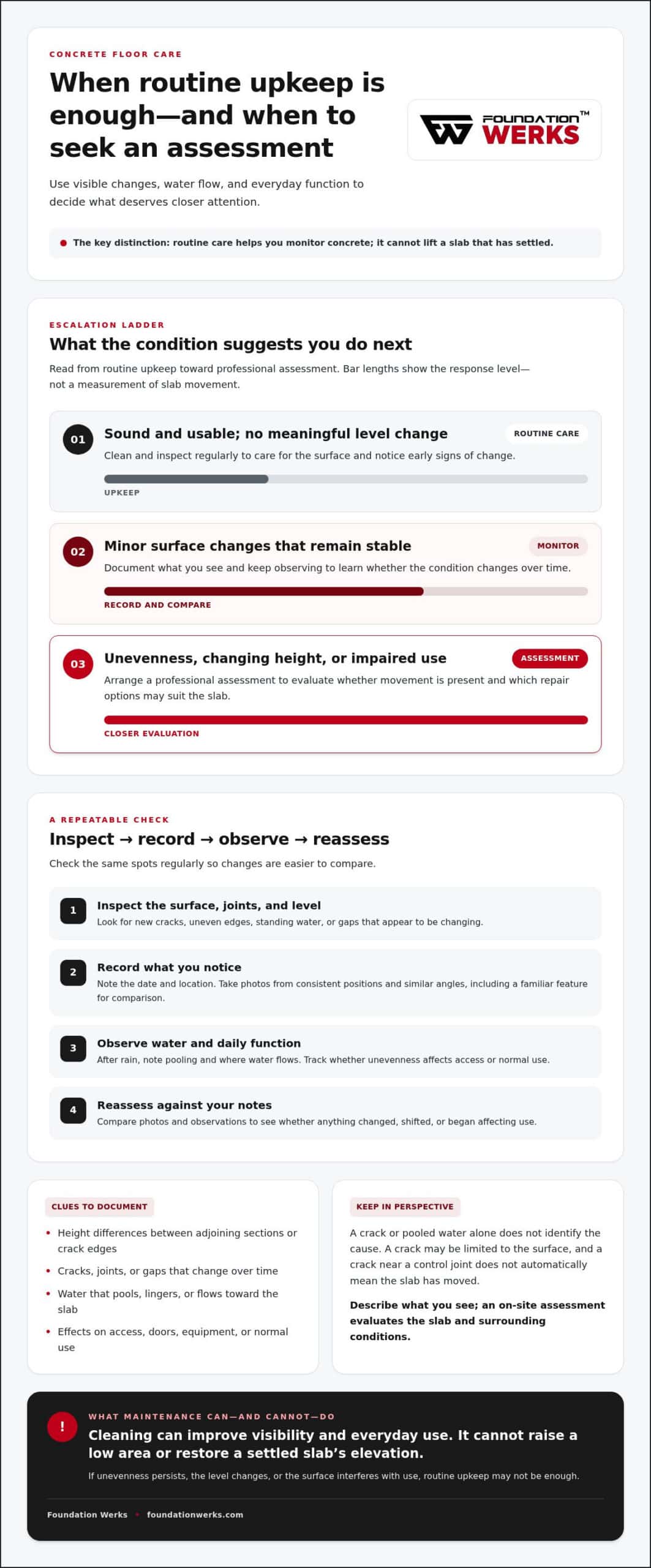
- Inspect: Look for changes in the surface, joints, and level.
- Record: Note the date and take photos from consistent positions.
- Observe: Track pooling or changes in water flow near the slab.
- Reassess: Compare your notes and photos to see whether anything has changed or begun affecting use.
A dated photo can reveal gradual change more clearly than memory alone. Keep notes factual: where you noticed the change, what it looks like, and whether it affects drainage, access, or normal use. Photograph the same spot from a similar angle each time, and include a familiar feature in the frame for comparison. If unevenness persists or changes, your records can help explain the concern during an assessment. Maintenance makes the concrete’s condition easier to monitor, but it doesn’t address slab movement.
Why Concrete Floors Become Uneven, and What to Inspect First
A slab can become uneven if it settles or loses support beneath it, but that possibility doesn’t diagnose every property. A crack may be limited to the surface, while a visible height difference between adjoining sections may indicate a change in the slab’s position. Neither clue alone tells you exactly what caused the condition.
Some cracks form as concrete shrinks. Control joints are designed to guide where cracking may occur, and the Portland Cement Association explains the purpose of properly placed control joints. A crack near a joint doesn’t automatically mean the slab has moved. Look for height differences, edges that no longer meet evenly, or a pattern that changes over time. These observations help describe the issue, but an on-site assessment is needed to evaluate the slab and surrounding conditions.
Signs the slab may have moved
Compare adjoining slabs, floor transitions, and the edges of cracks. A raised or lowered edge is different from a surface line with no noticeable height change. Note practical effects too: a door that no longer moves freely, equipment that sits unevenly, or a walkway that’s harder to use. Record where each change appears and whether it grows, shifts, or affects daily activity. This helps clarify whether the concern is cosmetic, functional, or changing over time.
Check water flow and the area around the concrete
Observe the area after rain. Does water collect on the slab, run along its edge, or flow toward nearby drainage routes? Note blocked or altered paths and where water lingers. These details can help frame an assessment, but standing water alone doesn’t prove why a slab is uneven. Other site and slab conditions may also matter.
For homes and commercial properties across Dallas-Fort Worth, document what you can see, note how the floor or walkway functions, and avoid treating one crack as a complete diagnosis. Knowing how to maintain a level concrete floor includes recognizing when observation has reached its limit. If a changing level creates a safety concern or interferes with normal use, arrange a professional assessment. Foundation Werks provides polyurethane concrete raising for eligible slabs.
Maintenance or Concrete Leveling: Know When Upkeep Is Not Enough
Cleaning and inspection help care for concrete that remains level and usable. They don’t correct a height difference caused by slab movement. The next step depends on what you observe: a stable surface change may call for continued monitoring, while a changing level or persistent unevenness may warrant an assessment.
| Condition | Useful next step | What it can address |
|---|---|---|
| Sound, usable slab with no meaningful level change | Clean and inspect regularly | Surface condition and early signs of change |
| Minor surface changes that remain stable | Document and continue observing | Whether the condition changes over time |
| Unevenness, changing height, or impaired use | Arrange a professional assessment | Whether movement is present and what repair options may suit the slab |
| Severe cracking or extensive damage | Have the slab assessed for repair or replacement options | Whether raising is suitable or another approach is needed |
When routine care is a reasonable next step
If concrete is intact, works as intended, and shows no meaningful change in level, routine care is a sensible focus. Keep the surface clean enough to monitor, and check for changes in joints, cracks, and nearby conditions. Minor marks or cracks that appear stable can be documented and observed. Cleaning, sealing, or patching may address specific surface concerns, but none of these actions raises a sunken slab or restores its elevation.
When to consider raising, stabilization, or replacement
An assessment can help determine whether unevenness reflects slab movement and whether the concrete is suitable for raising. Foundation Werks uses polyurethane concrete raising to lift and stabilize eligible slabs. When the existing concrete is suitable, raising may offer an alternative to replacement. Severely cracked slabs may be too damaged to lift, and replacement may be considered when raising isn’t appropriate.
The distinction is straightforward: maintenance helps care for and monitor the surface; leveling addresses a change in slab height. If you’re deciding how to maintain a level concrete floor, use cleaning and observation for sound, stable concrete, and seek an assessment when the level changes or everyday use is affected. For more context on the options, read this concrete lifting versus replacement guide.
A Practical Concrete Floor Care Plan for Homes and Commercial Properties
A repeatable routine makes it easier to spot changes before they become harder to assess. How often to inspect depends on how the area is used and what you’ve observed. Check more often if a crack, joint, or uneven area appears to be changing. This plan helps you care for the surface and keep useful records; it won’t prevent every cause of slab movement.
A repeatable inspection and documentation checklist
- Inspect: Check the surface, joints, and edges for new cracks, height differences, or other visible changes.
- Clean appropriately: Follow the product label for any cleaner you use. A stronger product or specialized equipment isn’t automatically necessary.
- Observe water flow: Notice whether water collects on or beside the concrete, or whether its usual path appears to have changed.
- Document: Photograph the same locations from similar angles. Add the date and a short note about cracks, level changes, pooling, or effects on access and use.
- Reassess: Compare your latest notes with earlier photos. If a change is progressing or affecting safe access or normal operations, arrange an assessment.
Consistent records make it easier to describe what changed and when. Keep observations factual. For cracks and joints in a business setting, see the commercial concrete crack repair guide.
Care considerations for residential and commercial floors
At home, include driveways, patios, garage slabs, and walkways in your checks. Notice whether a change makes a path harder to use, creates an uneven transition, or affects where water collects. Clean according to the instructions for the products you choose, and don’t treat surface cleaning as a way to correct a sunken section.
Commercial floors may have different traffic and operational demands. Pay attention to high-use routes, transitions, and areas where unevenness could interfere with access, equipment, or normal work. Record the location and practical effect of each change. If a floor condition disrupts operations or makes access unsafe, don’t rely on routine upkeep alone.
Knowing how to maintain a level concrete floor means keeping the surface observable and responding appropriately to changes. A care routine is useful for monitoring sound concrete, while an assessment can help determine whether a change in level calls for raising or another repair approach.
When a Dallas-Fort Worth Concrete Floor Needs Professional Leveling
Routine care can keep a sound slab easier to monitor, but it can’t correct a changing level. Consider an assessment if unevenness persists, the height difference appears to be growing, or the floor affects safe access and normal use. A walkway that’s difficult to cross, a garage slab that no longer drains as before, or a commercial floor that interferes with operations are reasons to look beyond cleaning and inspection.
What polyurethane concrete raising involves
For eligible residential and commercial slabs, Foundation Werks raises and stabilizes concrete by injecting lightweight polyurethane foam beneath it. The foam weighs approximately 2 pounds per cubic foot. Whether raising is appropriate depends on the slab’s condition. Severe cracking or extensive damage may make a slab unsuitable, so an assessment helps determine whether raising or another approach is a better fit.
What to expect from an assessment and repair
Share which area is affected, what changes you’ve noticed, and any relevant photos. This information gives context for the assessment. If raising is suitable, the process uses drill holes approximately 5/8 inch wide, described by Foundation Werks as nearly invisible. The company uses a lightweight foam process without heavy equipment traversing lawns or landscaping. The result depends on the specific slab and project.
Many jobs take a few hours, though the time required varies with the work involved. Foundation Werks reports that concrete can be used the same day after raising work is complete. Use that information for planning, and follow the guidance provided for the specific project.
Knowing how to maintain a level concrete floor also means recognizing when maintenance has reached its limit. Foundation Werks serves the Dallas metropolitan area, including McKinney, Frisco, Dallas, Prosper, Allen, Fairview, Southlake, Irving, and North Dallas. If your concrete is changing or affecting use, an assessment can help clarify the next step.
Keep your concrete easier to monitor. Clean sound concrete, inspect cracks, joints, and water flow, and record changes with dated photos. These steps can help you spot developing concerns, but they won’t prevent every cause of settlement or raise a slab that has already moved. Polyurethane concrete raising can lift eligible residential and commercial slabs, while the slab’s condition determines whether raising is suitable. Learn more about Foundation Werks concrete services.
With consistent observation and the right next step, you can approach concrete changes with greater confidence.
Frequently Asked Questions
How often should you inspect a concrete floor?
Inspect at an interval that fits how the area is used and what you’ve observed. A lightly used patio may need less frequent checks than a busy commercial floor or walkway. Look for new cracks, changes in level, shifting joints, and water that collects nearby. If you notice a change, document it and check again to see whether it remains stable or progresses. This is a practical part of how to maintain a level concrete floor.
Can cleaning keep a concrete floor level?
No. Cleaning removes dirt and can make cracks, joints, and other changes easier to see, but it doesn’t lift a settled slab or restore its elevation. Use cleaning products according to their labels, and treat cleaning as surface care rather than a repair for unevenness. If the floor remains usable and level, routine cleaning and observation can help you monitor it. A changing height or persistent unevenness may call for an assessment.
What causes a concrete floor to become uneven?
Settlement or a loss of support beneath a slab can contribute to unevenness, but those aren’t the only possible factors. A visible crack alone doesn’t identify the cause. Water flow and drainage conditions around the concrete are useful details to note during an assessment. In the Dallas-Fort Worth area, inspect the slab and its surroundings rather than assuming a particular cause. A professional can evaluate the specific property and concrete condition.
Can you level concrete without replacing it?
Eligible concrete can often be raised without replacing the slab. Foundation Werks uses polyurethane concrete raising to lift and stabilize suitable residential and commercial slabs, which may be an alternative to full replacement. The concrete’s condition matters, and severely cracked slabs may be too damaged to raise. An assessment can help determine whether raising is appropriate or whether another repair option should be considered.
How soon can you use concrete after polyurethane raising?
Foundation Werks reports that concrete can be used the same day after polyurethane raising work is complete. This can help with planning access to a driveway, walkway, or commercial area. Timing applies after the work is complete, and project details vary. If the surface is part of a busy route or work area, plan access around the project and follow the guidance provided for that slab.
Are the drill holes from concrete raising noticeable?
The drill holes used in Foundation Werks’ polyurethane raising process are approximately 5/8 inch wide and described as nearly invisible. The holes allow foam to be injected beneath the slab. Their appearance may depend on the concrete and the project, so don’t assume every surface will look identical afterward. An assessment can explain what to expect for the affected area.
When should you consider professional concrete leveling?
Consider an assessment if the floor’s level is changing, unevenness persists, or the condition affects safe access or normal use. Examples include a walkway that’s difficult to cross, an uneven transition between slabs, or a commercial floor that disrupts operations. Foundation Werks serves the Dallas metropolitan area, including McKinney, Frisco, Dallas, Prosper, Allen, Fairview, Southlake, Irving, and North Dallas. An assessment can help determine whether polyurethane raising is suitable for the slab.