

What if the biggest risk to a new concrete slab isn’t heat alone, but how quickly its surface loses moisture? In Texas, high temperatures, direct sun, low humidity, and wind can make fresh concrete dry faster than it can gain strength. Knowing how to prevent concrete cracking in Texas heat starts with managing moisture, timing, and slab movement together.
This guide explains how hot-weather conditions affect fresh concrete and why existing slabs can crack for other reasons, including settlement or drainage problems. You’ll find practical steps for planning a pour, preparing the site, following the specified curing process, and considering joints. You’ll also learn how crack patterns and uneven slab edges can help distinguish surface cracking from possible movement beneath a slab. These precautions can reduce risk, but no single step can prevent every crack.
Key Takeaways
- Heat, wind, sun, and moisture loss can increase cracking risk, but cracks aren’t inevitable.
- Reducing cracking risk in Texas heat means coordinating pour timing, site preparation, curing, and joints.
- Practical steps before, during, and after a pour can support more reliable curing in hot weather.
- A crack’s pattern and any uneven slab edges can offer clues about settlement or surface shrinkage.
- Drainage concerns, concrete stabilization, or a professional assessment may be relevant for an existing slab.
How Texas heat contributes to concrete cracking
Hot weather raises the risk of concrete cracking, but it doesn’t determine the outcome. Heat is one of several conditions that influence how quickly fresh concrete loses moisture and gains strength. Understanding the other factors helps you focus on practical risk reduction rather than expecting one step to prevent every crack.
Early heat-related cracking can occur when the surface dries and shrinks faster than the concrete beneath it can settle and harden. The American Concrete Institute’s hot-weather guidance considers air and concrete temperature, humidity, and wind. Sun exposure, finishing, and curing also matter. In short, cracking risk depends on heat, drying conditions, timing, curing, and movement.
For a basic overview of how concrete responds to temperature changes and shrinking, see this explanation of thermal expansion and shrinkage.
To see how hot, low-humidity conditions can affect concrete, watch this video:
Why fresh concrete is vulnerable in hot, dry, or windy conditions
Fresh concrete contains water needed for cement to hydrate and harden. When moisture evaporates quickly from the surface, that layer can shrink while the concrete below is still settling. The result may be early, often fine surface cracks. Temperature isn’t the only factor: dry air, direct sun, and wind can all speed moisture loss. A breezy day can pose a challenge even when it doesn’t feel exceptionally hot.
This early surface drying differs from movement beneath an existing slab. Curing practices for a new pour won’t address a crack caused by settlement or changing support. The cause matters, and a crack’s appearance alone can’t confirm it.
Which cracks can hot-weather planning help reduce?
Weather-aware scheduling and prompt, appropriate curing can reduce the risk of early-age shrinkage cracking. They can’t guarantee a crack-free slab: concrete naturally changes as it hardens and responds to temperature and moisture. That’s why how to prevent concrete cracking in Texas heat is a matter of reducing risk through coordinated planning, not eliminating every possibility.
Existing cracks, visible sinking, uneven slab edges, or signs of structural movement need separate assessment. Some cracks are minor, while others may point to a support or drainage issue. If a crack is changing or appears alongside unevenness, consider conditions beyond the weather at the time of the pour.
How concrete curing and slab design affect cracking in Texas
Weather is only one part of crack prevention. The way a slab is prepared, placed, cured, and divided into sections also affects how it responds as it hardens and moves. Good planning can reduce risk, but it can’t guarantee that concrete won’t crack.
How curing helps concrete retain moisture
Curing is the managed early-age process of maintaining suitable moisture and temperature so concrete can develop strength. The American Concrete Institute describes curing as supporting the conditions needed for cement hydration. It isn’t simply a matter of leaving the slab to dry. Moisture loss too soon can interfere with strength development and increase the chance of surface problems.
For a new pour, the curing approach should match the project specifications, concrete mix, weather, and instructions for any curing product. Timing matters, especially in hot or windy conditions. Follow the care directions for the specific slab instead of improvising with water or a curing product. The right steps depend on the placement and conditions.
Why joints, base preparation, and slab movement matter
Concrete changes volume as it hardens and responds to temperature and moisture. Contraction joints, often made by saw-cutting or forming a weakened line, create planned locations where a crack is more likely to occur. They help manage cracking but don’t prevent every crack. Their placement and timing should suit the slab and project.
Preparation below the slab matters too. A stable, well-prepared base helps support the concrete, while drainage planning can help limit unwanted water movement around the area. The appropriate design depends on site conditions; there isn’t one base or joint layout that fits every project.
Keep the causes distinct. Early surface shrinkage relates to moisture loss during initial hardening. A slab that later shifts, sinks, or loses support may crack because of movement underneath it. Curing can’t correct an underlying support problem, and joints aren’t a substitute for addressing drainage or settlement concerns.
Understanding these factors makes how to prevent concrete cracking in Texas heat a practical planning question: coordinate preparation, joint design, and curing instead of relying on one step. For an existing slab with signs of settlement, concrete stabilization services can address the support issue.
Before, during, and after a hot-weather concrete pour
A hot-weather pour takes more than choosing a clear day. Planning the schedule, preparing the site, and agreeing on a curing approach help the project team manage conditions that can change over the course of a pour. Use this sequence to prepare and understand what to follow once the concrete is in place.
Before the pour: schedule and prepare the site
Review the forecast with the concrete project team well before placement. Discuss how heat, wind, sun, and humidity may affect the schedule and the crew’s ability to place, finish, and cure the slab. The best timing depends on the project and conditions, so don’t rely on a single temperature cutoff.
Before concrete arrives, make sure practical site details are settled:
- Access: Keep the route to the pour area clear so placement can proceed without avoidable delays.
- Preparation: Confirm that the area is ready according to the project plan, including the base and forms.
- Drainage: Plan how water will move around the slab so runoff doesn’t undermine the prepared area or collect where it shouldn’t.
- Curing plan: Know which curing method is specified, when it should begin, and what materials or protection are needed.
These details are especially useful in hot weather, when delays or uncertainty can make it harder to maintain consistent placement and curing.
During placement: keep the plan consistent
Stay coordinated with the project team as conditions evolve. Concrete temperature, wind, direct sun, and the pace of placement can affect how quickly the surface dries and how much time the crew has to work. If the weather shifts or placement slows, raise the concern with the team so any adjustments follow the project requirements.
Don’t add water to the concrete or change the mix on your own. Extra water or unapproved changes can affect the concrete’s properties. Any adjustment should be handled by the project team in line with the mix and project specifications.
After placement: follow the curing instructions
Once placement is complete, follow the specified curing plan consistently. Curing helps maintain conditions that support concrete hardening; it isn’t simply a matter of leaving the slab to dry. Follow the project’s instructions for timing, curing materials, and protection from premature moisture loss. Don’t add water or change curing procedures unless the project-specific guidance calls for it.
Careful preparation and curing can reduce early cracking risk, but they can’t guarantee a crack-free slab. If an existing slab later shows signs of settlement, concrete stabilization services address a different issue than hot-weather curing. A coordinated approach is the practical answer to how to prevent concrete cracking in Texas heat.
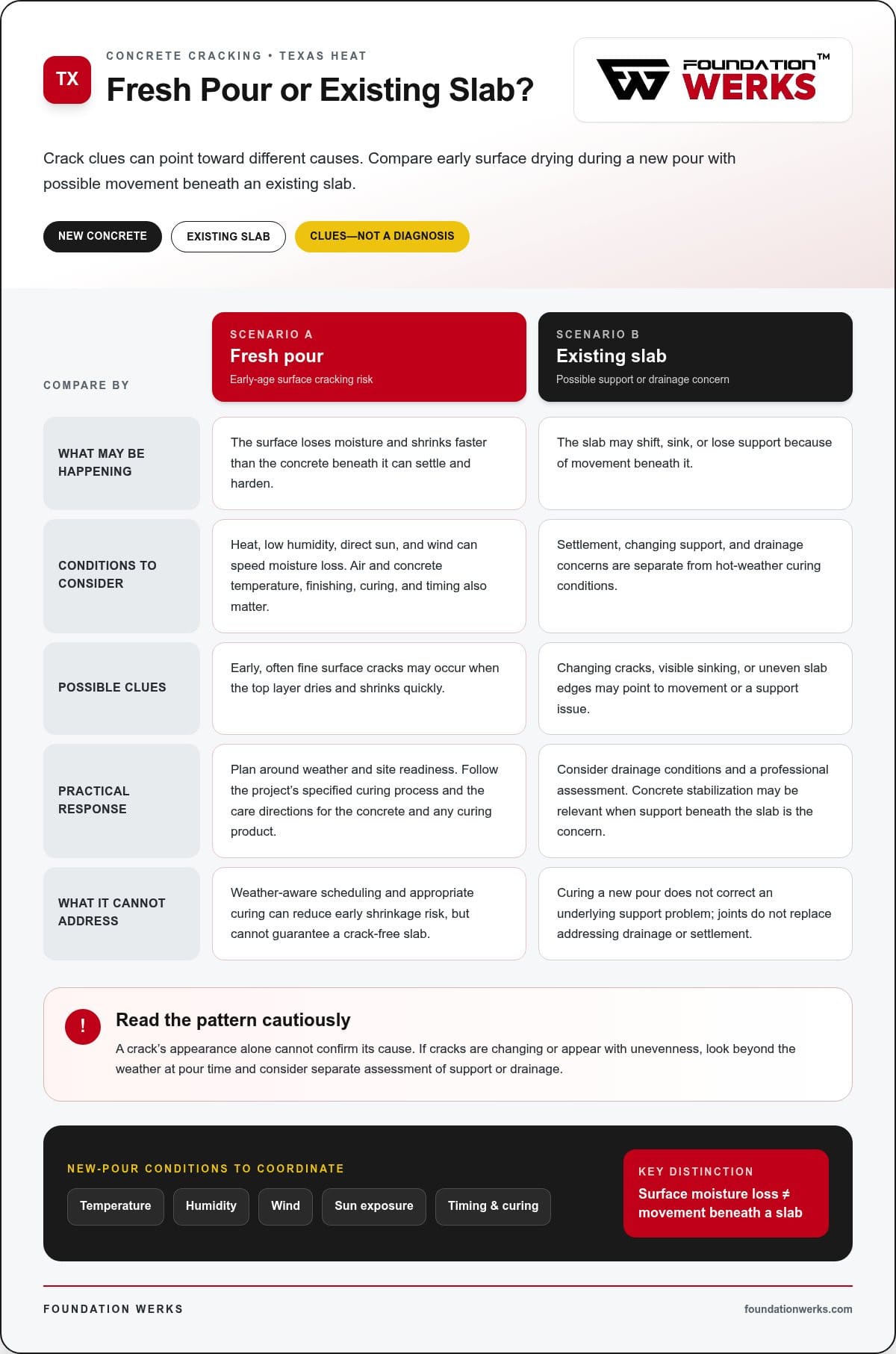
How to tell heat-related cracking from settlement or other concrete problems
A crack’s appearance can offer clues, but it can’t confirm the cause on its own. Timing, surface texture, slab level, and changes over time all help build a clearer picture. Heat-related shrinkage often begins near the surface of fresh concrete. Cracks tied to settlement or loss of support may come with visible movement in the slab.
Signs that may point to early-age cracking
Fine, shallow cracks that appear in the first hours or days after placement may be consistent with early surface drying. They can look irregular or form a loose web pattern. These features are clues, not proof: crack patterns can overlap, and conditions during placement and curing matter. Note when the cracks appeared, what the weather was like, and whether the concrete was protected and cured as planned.
Take photos and track any changes in length, width, or appearance. If cracks worsen or you can’t tell whether the slab is moving, arrange an assessment rather than relying on appearance alone.
When settlement, drainage, or slab support deserves attention
Look beyond the crack itself. A slab that appears to be sinking, adjoining sections at different heights, or one side of a crack sitting higher than the other can suggest movement or uneven support. Water that repeatedly drains toward or collects near a slab may also warrant a closer look, since changing moisture conditions or erosion can affect support. These signs don’t establish a diagnosis, but they’re reasons to investigate.
Cracks with slab displacement call for assessment beyond curing advice. Curing guidance applies to fresh concrete. It won’t address an existing slab that has settled or lost support. Filling a crack alone may improve its appearance, but it won’t necessarily resolve the condition causing movement. Commercial facilities may also need to consider how cracks and joints affect the use of warehouse floors and other concrete surfaces.
For suitable settled slabs, concrete raising and stabilization can address voids or inadequate support beneath the concrete. Foundation Werks also handles commercial concrete crack and joint repairs. These services respond to different conditions, rather than preventing every heat-related crack. Understanding the difference helps with how to prevent concrete cracking in Texas heat and recognizing when prevention isn’t the issue.
A realistic Texas concrete care plan, and when to consider repair
Protecting concrete in Texas heat isn’t about one product or treatment. It takes coordinated planning before a pour, curing that follows project requirements, attention to drainage, and regular observation afterward. These steps can lower cracking risk, but no care plan can prevent every crack.
A simple checklist for homeowners and property managers
Use this routine to stay organized:
- Before placement: Review forecast conditions with the project team, prepare the site, and settle access and drainage details.
- During and after placement: Follow the project-specific placement and curing plan. Don’t add water or change procedures without project-specific guidance.
- As the slab ages: Watch for changes in crack appearance, slab level, or adjoining sections.
- Keep a record: Take photos and note dates so you can compare changes and share a clear history if an assessment is needed.
For commercial facilities, cracks and joints can affect how people and equipment move across a floor. Track recurring damage and changes in joint condition. Commercial concrete crack and joint repairs can help address applicable repair needs.
When concrete raising or repair may be relevant
A crack without slab movement may call for a different response than a slab that has settled. If concrete looks uneven, has sunk, or appears to have lost support, an assessment can help identify whether the concern relates to settlement, drainage, or another condition. Simply filling a crack may not address the cause of movement beneath the slab.
Polyurethane concrete raising may suit some settled slabs, depending on their condition. It can lift and stabilize an existing slab where appropriate, but it isn’t a method for preventing every new heat-related crack in fresh concrete. Commercial concrete crack and joint repairs address other applicable repair needs. The right response depends on what’s happening with the slab.
Foundation Werks serves the Dallas metropolitan area, including Frisco, McKinney, Dallas, Prosper, Allen, Fairview, Southlake, Irvin, North Dallas, and DFW. Services include concrete raising and stabilization, void filling, commercial crack and joint repairs, and French drain installation. If an existing slab is cracked, uneven, or settled, a free estimate can help clarify the next step. The practical approach to how to prevent concrete cracking in Texas heat is to prepare carefully, follow curing guidance, pay attention to water movement, and monitor changes over time.
Protect your concrete with a plan that fits the conditions
Reducing crack risk in Texas heat comes down to a few connected choices: plan the pour around weather and site conditions, follow the specified curing approach, and pay attention to drainage and slab movement over time. These steps can help limit early-age cracking, but they can’t prevent every crack. When considering how to prevent concrete cracking in Texas heat, remember that cracks with sinking or uneven slab sections may need a different response than surface shrinkage.
For an existing slab, the cracking pattern and any changes in level can help guide the next step. Foundation Werks serves the Dallas metropolitan area from McKinney, Texas, with polyurethane concrete raising, stabilization, and commercial crack and joint repair. Concrete raising may be appropriate for some settled slabs, depending on their condition.
For a cracked, uneven, or settled slab in the Dallas area, request a free estimate from Foundation Werks to discuss concrete raising, stabilization, or repair.
Frequently Asked Questions
Can Texas heat make new concrete crack?
Yes. Hot conditions can speed moisture loss from fresh concrete and raise the risk of early cracking, especially if placement and curing aren’t managed carefully. Heat is one factor among several; wind, humidity, sun exposure, preparation, and slab movement also matter. Cracking isn’t inevitable. Plan with the concrete project team around the actual forecast and follow curing guidance for the specific project rather than relying on a universal temperature cutoff.
How do you keep concrete from cracking in hot weather?
Plan around the forecast, prepare the site, coordinate placement with the project team, follow the specified curing plan, and monitor the slab afterward. These steps are central to reducing cracking risk in Texas heat because they help manage moisture loss and other project risks. They can reduce risk, but they can’t guarantee a crack-free result. Don’t make unapproved changes to the mix or curing process.
Should you pour concrete in Texas during the summer?
Summer alone doesn’t determine whether a concrete project should proceed. The forecast, site conditions, preparation, schedule, and planned curing approach all matter. Coordinate with the project team so they can consider actual conditions and project requirements together. A summer pour isn’t automatically unsuitable, and one temperature cutoff won’t account for every job. Discuss timing and curing before placement so the team can prepare for expected heat, wind, and sun.
Does watering concrete prevent cracks in hot weather?
Curing is important, but casually spraying a slab or adding water isn’t a substitute for its specified curing method. The appropriate approach depends on the project, concrete, and conditions. Follow the agreed instructions for curing and protection, and don’t change the procedure or add water unless project-specific guidance directs you to. Consistent, appropriate curing can reduce early cracking risk, but it can’t guarantee that no cracks will form.
Are cracks in concrete always caused by Texas heat?
No. Heat can contribute to early cracking, but cracks may also relate to moisture loss, joint layout, preparation, slab movement, drainage, or loss of support. Appearance alone can’t establish the cause. A fine crack soon after placement may offer different clues than a crack beside a sunken or uneven section. If the slab has changed level or shows displacement, seek an assessment rather than relying only on hot-weather prevention advice.
Can an existing cracked concrete slab be raised?
Some solid, settled slabs can be raised and stabilized, while a severely cracked slab may be too damaged to lift. Foundation Werks provides polyurethane concrete raising and stabilization for suitable projects. The company serves the Dallas metropolitan area from McKinney, including Frisco, Dallas, Prosper, Allen, Fairview, Southlake, Irvin, North Dallas, and DFW. Whether a specific slab is suitable depends on its condition and requires assessment.
When should I have a concrete crack assessed?
Arrange an assessment if a crack changes, returns, or appears with sinking, uneven adjoining sections, or other visible movement. These signs may warrant investigating slab support or drainage rather than treating only the surface. They don’t prove a specific cause, so note changes with dated photos if possible. An assessment can help clarify whether the concern is surface cracking, movement, or another condition and what response may be appropriate.