

If you’re looking for how to prevent soil erosion around foundation areas, start by finding where the water comes from and where it goes. Bare or sunken patches beside a home can be unsettling, but they don’t automatically mean the foundation is damaged. In North Texas, moisture changes can affect expansive clay soil, so paying attention to runoff is an important part of caring for the ground around your home.
Replacing washed-away soil without addressing the water route can leave the same patch vulnerable to erosion again. This guide explains how to check runoff, grading, gutters, and downspouts, and how to choose practical next steps. You’ll also learn when a recurring drainage pattern or changes in nearby concrete may warrant a closer look.
Key Takeaways
- Look for signs that water has carried soil away, and note whether the loss returns after rain.
- Trace runoff from roofs and paved areas to see whether it gathers near the foundation or flows across a wider part of the yard.
- Address the water route before replacing soil that keeps washing away.
- Use photos and notes to track drainage patterns and changes around the home before choosing a response.
- Recurring erosion, standing water, or changes in nearby concrete may call for separate drainage or concrete evaluations.
How soil erosion around a foundation starts and what to look for
Soil erosion occurs when moving water carries soil away and deposits it elsewhere. Ordinary settling is different: soil can compress or shift over time without a visible runoff trail. A useful distinction is this: erosion is visible soil loss associated with water movement, while settling is a change in ground level that may happen without soil being washed along a clear path. The broader process and its causes are outlined in Soil erosion.
Repeated runoff beside a foundation deserves attention because water may keep removing soil from the same area. That pattern alone does not show that the foundation is damaged or moving. To understand how to prevent soil erosion around foundation areas, note where water travels and what changes after rain instead of treating one visible symptom as a complete diagnosis.
This short video shows how grading can direct water near a home:
What does foundation-side soil erosion look like?
Look for shallow channels that follow a water route, new depressions, exposed roots, or mulch washed out of a planting bed. Soil or sediment collecting at the bottom of a slope or beside a walkway can also indicate that water has carried it from another spot. No single clue confirms the cause or establishes whether there is structural damage.
Compare the same areas after rainfall. Taking a photo from a safe, dry location makes it easier to see whether a channel deepens or sediment reappears. Do not enter a flooded, unstable, or otherwise unsafe area to inspect it.
Why is water collecting or flowing beside the foundation?
Water may come from roof runoff, downspout discharge, the yard’s surface slope, or paved areas that channel flow toward the home. Several sources can affect the same patch. For example, roof water may land there while runoff from a nearby path also crosses it. If it is safe, watch the area during or after rain and note where the flow begins, where it pools, and where it goes next.
Erosion symptoms alone cannot diagnose foundation movement. If you notice changes to the foundation or nearby concrete, seek a qualified evaluation. Repeated soil loss or water that regularly collects near the home is also a reason to review the drainage pattern.
How runoff and drainage move soil near DFW foundations
Water can reach soil near a foundation from several directions. Rain lands on the roof, travels through gutters and downspouts, and exits at a discharge point. Runoff can also move off a driveway, patio, or walkway and cross the yard toward the house. A downspout can send a concentrated stream to one spot, while a slope or paved surface may carry water over a wider area.
Repeated, concentrated flow can loosen and carry surface soil, leaving a visible trail or depositing sediment farther along its route. Not all water movement is visible, though. Rain can soak into the ground and move through soil below the surface. A soft patch or depression by itself cannot confirm what is happening underground. Look for patterns rather than assuming that visible erosion proves a hidden drainage problem. If concerns continue, seek a qualified evaluation.
How gutters, downspouts, and hard surfaces affect runoff
Gutters collect roof water, and downspouts direct it to the ground. A blocked or leaking gutter may spill water along the roof edge. A downspout outlet beside an eroded patch may repeatedly wet the same soil. Hard surfaces create another possible route. Depending on their slope and layout, driveways, patios, and walkways can direct runoff toward a garden bed or away from the home.
Check from a safe location whether gutters appear blocked or leak during rain, and note where each downspout releases water. Also look for runoff from nearby paving that converges on the affected area. Do not climb or handle drainage components in unsafe conditions.
What DFW homeowners should assess on their property
Conditions vary from one property to another across the Dallas metropolitan area. Soil, slope, landscaping, and drainage routes all influence where water travels. Rather than assuming a regional soil profile explains the problem, observe your own yard during and after rain from a safe location. Note where runoff speeds up, spreads out, slows, or pools, and whether the same route appears after more than one rain event.
- Note which downspouts and paved surfaces drain toward the affected area.
- Record visible channels, damp spots, or sediment deposits and when they appear.
- Document changes in the soil, slope, or nearby concrete to share during a qualified site evaluation.
These observations help you investigate how to prevent soil erosion around foundation areas without guessing at the cause. If runoff repeatedly collects near the house or the route is difficult to trace, a drainage evaluation may help clarify possible next steps. Foundation Werks serves the Dallas metropolitan area, including Frisco, McKinney, Dallas, Prosper, Allen, Fairview, Southlake, Irving, North Dallas, and DFW, and offers French drain installation when it suits the site’s drainage needs.
Will adding soil or mulch stop erosion around the foundation?
Replacing washed-away soil can improve the appearance of a bare patch, but it may not stop the water that carried the soil away. If runoff follows the same route, new soil may wash out again. First, observe where water comes from and where it goes. A surface cover may help protect exposed soil after the flow is controlled, but it does not replace addressing a recurring runoff path.
The right response depends on what you observe. A small exposed area without continuing flow may need a different approach from a spot where a downspout repeatedly cuts a channel or water pools beside the home. Ask whether soil loss returns after rain and whether the affected area is changing, rather than focusing only on the bare patch.
When can mulch, ground cover, or replacement soil help?
Surface cover can help shield exposed soil when water flow is already under control. Replenishing soil may restore a shallow, isolated area, but repeated concentrated runoff can wash it away again. Avoid choosing materials or adding layers based on a general rule because site conditions matter. If you are unsure whether water is still moving through the area, observe it after rain before covering the signs.
When is drainage evaluation more useful than another surface patch?
Look beyond the bare spot if erosion keeps returning, water remains pooled near the home, or runoff visibly travels toward the foundation. These are reasons to investigate the drainage route, not proof that the foundation is damaged. Changes in adjacent concrete also deserve attention, but erosion alone cannot explain what caused them. Seek qualified review if the source is unclear or you are unsure how to redirect water safely.
Use this comparison to decide what to observe next:
- Observed issue: A small bare patch with no recurring runoff. Possible response: Consider suitable surface cover or soil replacement. Seek assessment: If the area grows or reappears after rain.
- Observed issue: Repeated washout or water pooling near the home. Possible response: Trace the runoff source before adding cover. Seek assessment: If the flow persists or a safe correction is not clear.
- Observed issue: Visible changes in nearby concrete alongside erosion. Possible response: Record what changes and when. Seek assessment: Have the concrete concern evaluated instead of assuming erosion is the cause.
For how to prevent soil erosion around foundation areas, think of surface cover as one possible part of the solution, not the answer to every washout. Following the water’s route helps distinguish a small surface issue from a drainage concern that needs closer review.
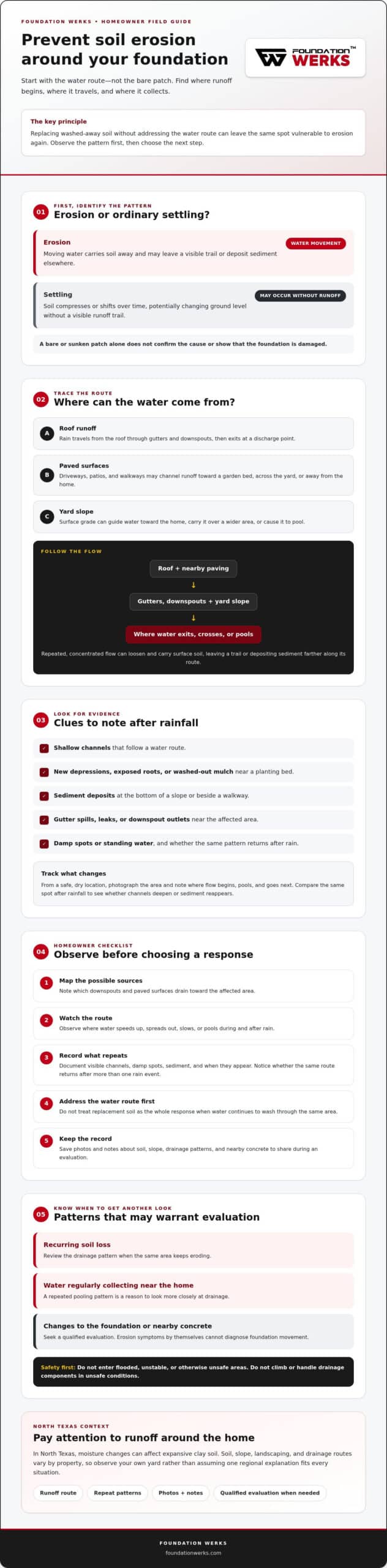
How to reduce soil erosion around your foundation: a homeowner checklist
A careful look after rainfall can help you identify where water is coming from before choosing a response. Follow these steps to move from observation to action. Stay on safe, stable ground, and do not make major grading or drainage changes based on a single wet spot.
- Observe the area. From a safe location, note where water flows, pools, or slows, and whether soil or mulch appears to move.
- Inspect gutters. Look for overflowing sections, visible leaks, or separated joints that could spill roof water near the affected ground. Do not climb to inspect them in unsafe conditions.
- Trace downspout discharge. Check whether an outlet releases water beside eroded soil or sends it toward the home. Note any nearby pavement that may guide runoff into the same area.
- Monitor and document changes. Take photos from the same safe vantage point after rainfall. Record whether channels deepen, sediment returns, or pooling continues.
What should you inspect after rainfall?
Look for gutter overflow, leaking joints, and downspouts discharging beside washed soil. Follow visible water paths across the yard, noting where flow gathers, leaves sediment, or pools. Compare what you see after separate rain events to find out whether the pattern repeats. Photos and brief notes can help explain the issue later, but do not enter flooded or unstable areas for a closer view.
Which prevention steps should you take first?
Address an obvious gutter or downspout problem before replacing soil that keeps washing away. Where it is safe and suitable, use an appropriate, securely installed measure to direct roof runoff away from the eroding spot. Do not route water toward the foundation, another structure, or neighboring property. If changing the grade or adding drainage infrastructure seems necessary, get qualified advice first because the right approach depends on the site.
Surface adjustments can change where water travels beyond the spot you are trying to protect. A slope change is not necessarily a solution just because water no longer crosses one patch. If you are researching how to prevent soil erosion around foundation areas, observing the route and documenting recurring symptoms are sensible first steps. Repeated washout, persistent pooling, or uncertainty about a safe correction are good reasons to seek an on-site evaluation.
When to call a Dallas area drainage or concrete professional
Consider a professional evaluation if soil keeps washing away, water regularly remains near the home, or nearby concrete develops new gaps, cracks, or unevenness. These signs do not confirm foundation damage, but recurring patterns can be difficult to understand from surface clues alone. Photos and notes from different rain events can help explain what you have observed.
Drainage and concrete concerns may need separate evaluations. A drainage review focuses on where water comes from and how it moves across the property. Concrete settlement or damage calls for an evaluation of the concrete itself. One concern may be present without the other, so ask what an evaluation covers rather than assuming one solution will address both.
What should you ask during a drainage assessment?
Ask the professional to identify the likely water source and explain the proposed route for directing it. Clarify what work is included and how it relates to the symptoms you recorded. If a French drain is suggested, ask why it suits the site and whether other approaches were considered. Confirm that the provider serves your location before arranging a visit.
How can Foundation Werks help with related drainage or concrete concerns?
Foundation Werks is based in McKinney and serves the Dallas metropolitan area, including Frisco, McKinney, Dallas, Prosper, Allen, Fairview, Southlake, Irving, North Dallas, and DFW. The company offers French drain installation, along with concrete stabilization and repair services. A French drain may be appropriate when site conditions support it, but recurring erosion does not automatically call for one. If nearby concrete has also changed, raise that concern separately so the relevant service can be considered.
Understanding how to prevent soil erosion around foundation areas starts with identifying the water pattern and choosing a response that fits the property. Foundation Werks offers a free estimate to discuss relevant drainage or concrete concerns. You can also visit Foundation Werks online to learn more about its services.
Protect your foundation by following the water
Soil loss beside the house is a reason to observe, not to assume the foundation is damaged. Track whether runoff repeatedly crosses the same area, and address its source before replacing soil that may wash away again. Surface cover can help when water flow is controlled, while recurring pooling or visible changes in nearby concrete may call for a closer evaluation.
Knowing how to prevent soil erosion around foundation areas begins with noticing patterns and choosing steps that suit your property. If the cause or a safe next step is unclear, professional guidance can help you make an informed decision. Foundation Werks serves the Dallas metropolitan area and offers French drain installation when site conditions indicate it may be appropriate. Call 800-464-9684 to request a free estimate.
Start with what you can observe, then take the next step with confidence. Protecting the ground around your home begins with a careful look at where the water goes.
Frequently Asked Questions
How can I prevent soil erosion around my foundation?
Start by observing where water flows during and after rain, then check gutters and downspouts for leaks, overflow, or discharge beside exposed soil. Avoid directing runoff toward the home, and consider surface cover only after identifying the water source. If washout keeps returning or you cannot trace the drainage route, ask a qualified professional to evaluate the property and explain suitable next steps.
Can mulch stop soil erosion around a foundation?
Mulch or other ground cover may help protect exposed soil when runoff is already controlled. It may not address the cause if water repeatedly crosses the same area or pours from a nearby downspout. Before adding more material, observe how water reaches the spot during rain. If soil continues to wash away, seek site-specific guidance instead of repeatedly covering the same patch.
What causes soil to wash away beside a house?
Roof runoff, overflowing or leaking gutters, nearby downspout discharge, and surface water crossing the yard can all contribute to soil loss. Driveways, patios, and walkways may also redirect runoff toward a particular area. More than one source can affect the same patch. Observe the property during rainfall, if it is safe, instead of assuming one visible channel shows the full cause.
How far should downspouts discharge from a foundation?
There is no single distance that suits every property. The goal is to avoid concentrating roof runoff beside the foundation or sending it toward another structure or neighboring property. The appropriate route depends on the site’s layout, slope, and drainage conditions. If water keeps collecting or causing erosion, ask a qualified professional to evaluate the property and explain a safe way to manage the discharge.
Can soil erosion cause foundation problems?
Erosion shows that water is moving soil, but it does not prove that the foundation has been damaged. Repeated runoff deserves attention, especially if water pools persistently or nearby concrete changes. Document what you observe and when it occurs. A qualified professional can evaluate the conditions. Do not rely on soil loss alone to diagnose foundation movement or determine what repair, if any, may be appropriate.
When should I call a professional about erosion near my foundation?
Consider an evaluation if soil loss keeps returning, water regularly pools near the home, or you cannot identify the runoff source. Professional guidance is also useful before changing grades or adding drainage infrastructure, since alterations can affect where water flows. A qualified provider can review the site and distinguish drainage observations from concerns about adjacent concrete. Foundation Werks serves the Dallas metropolitan area from McKinney.
Can a French drain prevent soil erosion around a foundation?
A French drain may suit some drainage conditions, but it is not the right choice for every property. The water source, site layout, and intended discharge route should be evaluated first. Ask why a drain is being proposed, where it will carry water, and whether other measures should be considered. Foundation Werks offers French drain installation in the Dallas metropolitan area. Confirm service availability for your location.