

Mudjacking lifts settled concrete by pumping a heavy slurry beneath it, but that added weight can put more pressure on weak soil. The disadvantages of mudjacking also include larger drilled holes, potential utility risks, and a longer wait before the slab can handle traffic: typically 24 to 48 hours for heavy vehicles.
It’s understandable to weigh those drawbacks against mudjacking’s ability to raise existing concrete without replacing the slab. Foam lifting also raises concrete, but uses a different material and has a shorter traffic delay in many cases.
This comparison covers differences in material weight, disruption, cure time, soil and drainage conditions, and potential risks to underground utilities. It also explains when replacement may be a better fit, helping you choose an approach based on the slab and the ground beneath it.
Key Takeaways
- Compare the added slurry weight with the lighter material used in foam lifting when considering pressure on the soil beneath a slab.
- Mudjacking typically needs 24 to 48 hours before the concrete can handle heavy vehicle traffic; foam lifting can allow vehicle traffic in about 15 to 30 minutes after repair.
- Consider whether ongoing soil movement or water erosion could affect how well a lift holds, since raising concrete doesn’t address every underlying cause of settlement.
- Understand how drilling and injection pressure may affect surface finishes and nearby underground utilities.
- Use the slab’s condition, soil stability, traffic needs, and repair disruption to guide your choice between lifting methods and concrete replacement.
Added slurry weight and continued soil settlement
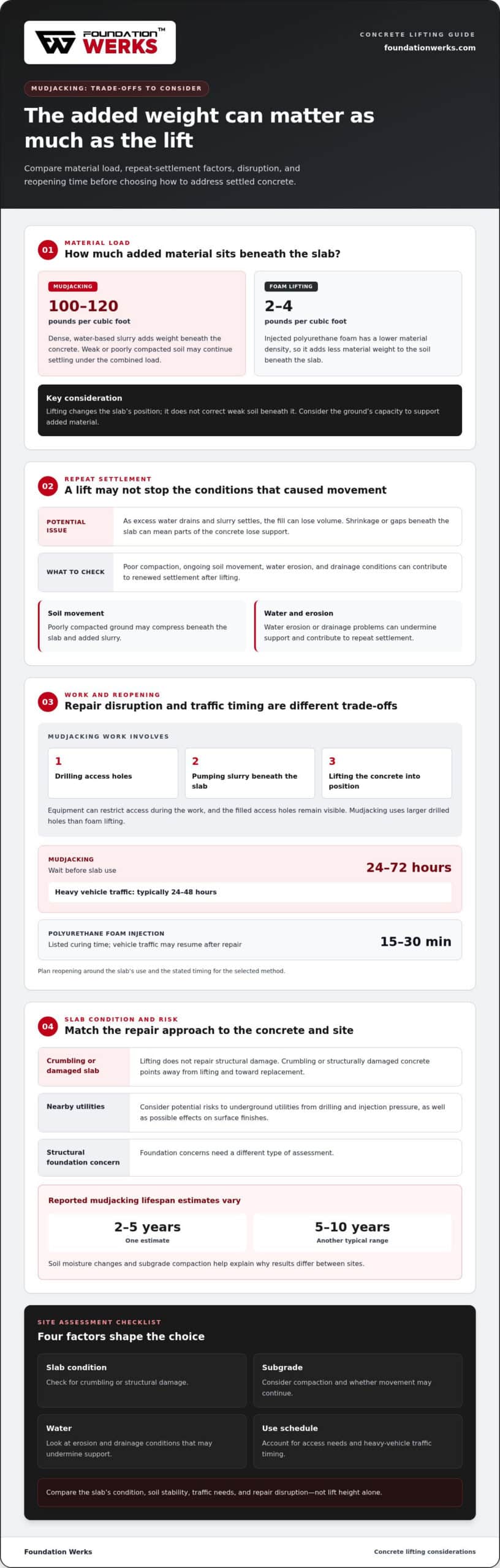
Mudjacking raises sunken concrete by pumping a dense slurry beneath the slab, but that added material also increases the load on the soil below. Traditional slurry weighs 100 to 120 pounds per cubic foot, so weak or poorly compacted ground may continue settling under the combined weight.
Watch this video to see how the lifting methods compare:
Mudjacking permit requirements vary by local rules and project scope, so there is no single answer for every location. Project cost also depends on factors such as slab size, access, and the amount of slurry needed. The final amount is determined through a project quote.
Slurry Weight and Soil Load
The added load is one key difference between mudjacking and foam lifting. Mudjacking slurry weighs 100 to 120 pounds per cubic foot, while injected polyurethane foam has a density of 2 to 4 pounds per cubic foot. That difference matters when soil already struggles to support a concrete slab.
When a large area needs lifting, the slurry can add substantial weight. That load may compress poorly compacted soil and contribute to renewed unevenness. Lifting raises the concrete, but it does not correct weak soil beneath it.
Slurry Shrinkage and Repeat Settling
Mudjacking uses a water-based mixture. As excess water drains and the slurry settles, the material can lose volume. If the fill shrinks or gaps form beneath a slab, parts of the concrete may lose support and sink again.
A slab may also settle again if the original soil problem remains. For example, concrete raised over poorly compacted ground may move as the soil compresses under the slab and added slurry. The lift changes the surface position, but may not address the conditions behind the movement.
Slurry Injection and Composition
Mudjacking involves drilling access holes through the slab and pumping slurry into the voids below. The mixture typically contains water, soil, sand, and Portland cement. As the material fills the space, hydraulic pressure raises the slab.
Slurry is heavier and bulkier than polyurethane foam, so the amount injected affects the added load on the soil. The installer must direct the mixture beneath the settled concrete and control the lift to avoid an uneven result.
| Option | Material density | Effect on soil load | Key consideration |
|---|---|---|---|
| Mudjacking | 100 to 120 pounds per cubic foot | Adds substantial weight | Soil may compress further |
| Foam lifting | 2 to 4 pounds per cubic foot | Adds less material weight | Uses injected polyurethane foam |
| Concrete replacement | Not compared here | Depends on the project | Replaces rather than lifts the slab |
Compare the slab’s condition and the soil’s capacity to support added material, rather than choosing based on lift height alone.
Repair disruption and concrete reuse time
Mudjacking can raise a serviceable slab without replacing it, but the work affects access and use. The right method depends on the concrete’s condition, the soil beneath it, and how soon the area needs to reopen.
Crumbling or structurally damaged concrete may not be suitable for mudjacking because lifting does not repair that damage. Structural foundation concerns also need a different type of assessment.
Repair Disruption and Slab Reuse
Mudjacking requires access holes to be drilled, slurry to be pumped beneath the slab, and the concrete to be lifted into position. Equipment can restrict access during the work, and the filled holes remain visible.
After mudjacking, users should wait 24 to 72 hours before using the slab. Heavy vehicle traffic may require 24 to 48 hours of waiting, so a driveway used by cars or a work area used by trucks needs a planned reopening time.
For comparison, polyurethane foam injection has a listed curing time of 15 to 30 minutes. That shorter interval can matter when a concrete slab serves as a busy access route, though the slab’s condition still matters more than the schedule alone.
Temporary Repairs and Typical Lifespan
Mudjacking raises concrete but does not address every cause of movement beneath it. If weak soil, water erosion, or poor compaction continues, the slab may settle again. The repair can prove temporary in practice, even if the initial lift looks even.
Estimates for mudjacking lifespan vary: one estimate puts repairs at about 2 to 5 years, while another gives a typical range of 5 to 10 years. Soil moisture changes and subgrade compaction help explain why results differ between sites.
Start by assessing the concrete’s condition, not just the area that has sunk. A practical assessment considers:
- Slab condition: Crumbling or structurally damaged concrete points away from lifting and toward replacement.
- Subgrade: Poor compaction can allow movement to continue after the lift.
- Water: Erosion or drainage problems can undermine support and contribute to repeat settlement.
- Use schedule: A driveway needed for heavy vehicles may favor a method with a shorter stated reuse interval.
Mudjacking does not have one fixed price per square foot for every project. Cost depends on slab size, access, and how much material is needed to fill the voids. The project quote reflects those factors.
Compare lifting with replacement after examining cracks, surface stability, and the ground below. For a project-specific look at concrete repair options, consider how the slab’s use and condition affect the choice.
Curing time and traffic restrictions
Concrete lifting has two different timelines: when the material cures and when the surface can safely return to use. For a driveway, warehouse lane, or walkway, that difference affects access planning. Mudjacking’s water-based slurry requires a longer waiting period, while polyurethane foam allows a quicker return to traffic.
Polyurethane foam injection has a listed curing time of 15 to 30 minutes. Concrete driveways lifted with foam can handle full vehicle traffic in about 15 to 30 minutes after the repair is complete. That short window can help keep a driveway or access route out of service for less time.
Curing and strength are related, but they describe different stages. Polyurethane foam reaches 90% of its ultimate structural strength within 15 minutes after injection. The stated traffic window still matters: reopening a sunken slab depends on the repair being complete, not merely on the first foam setting.
For homeowners and facility managers comparing polyurethane foam with mudjacking, focus on the stated curing and traffic window. The key practical point is that foam lifting can return a repaired driveway to vehicle use sooner. The underlying slab condition and the intended traffic still shape the repair plan.
Full concrete replacement follows a different schedule because new concrete needs time to cure. Its listed curing time is 7 to 28 days. That longer period can affect driveways, loading areas, and other surfaces that need regular vehicle access, so timing belongs in the repair decision.
Plan for the heaviest expected use, not just foot traffic. A driveway used by cars has different demands from a warehouse route used by forklifts. Before work begins, map access routes, note when vehicles need to pass, and consider whether temporary restrictions fit the site’s schedule.
- For a sunken driveway: Compare the foam traffic window with the time available to keep vehicles off the surface.
- For a warehouse lane: Identify forklift routes and delivery access that may need to remain open.
- For replacement: Account for the longer curing period before scheduling normal use.
- For any lifting method: Separate material curing time from the point when the repair is ready for its intended traffic.
The main scheduling trade-off is clear: polyurethane foam can support a faster return to vehicle use, while replacement requires a longer curing period. Mudjacking’s longer wait can disrupt access, so match the method to the slab’s condition and the site’s traffic needs.
Mudjacking’s effect on unstable soil
Mudjacking can raise concrete above a void, but it does not stop soil movement. Moisture changes, erosion, and washout can continue beneath the slab and affect its support after leveling.
Consider a driveway where rainwater repeatedly collects beside a sunken section. Water may carry soil away or soften poorly compacted ground, leaving gaps beneath the concrete. Pumping slurry into those gaps can lift the surface, but continued water movement may create new voids nearby. The surface looks more level while the cause of settlement remains.
Soil moisture affects how well the ground supports a slab. Repeated wetting and drying can disturb soil, particularly when drainage directs water toward the concrete. For example, a patio beside a downspout may experience recurring washout if runoff continues beneath its edge. Mudjacking changes the concrete’s position, not the path water takes through the soil.
Water management matters before and after concrete leveling. Trace where rainwater flows around the affected area. Look for pooling beside the slab, washed-out soil at its edges, or a downspout discharging near the settled section. These signs can help distinguish a simple void from ongoing erosion. Addressing drainage problems helps protect the support beneath a lifted slab.
Polyurethane foam can lift concrete through injection beneath the slab, but lifting material alone doesn’t stop water erosion either. The advantage of foam is its lightweight composition compared with cement-based slurry; the soil and drainage conditions still matter. Neither method should be mistaken for a solution to a continuing source of washout.
Before choosing a repair, connect visible symptoms with their likely causes:
- Pooling water: Follow the runoff path and note where water collects beside the slab.
- Washed-out edges: Check whether soil has been carried away beneath or around the concrete.
- Recurring settlement: Compare the affected area with nearby drainage patterns and signs of soil movement.
- Stable, dry ground: If no active erosion is visible, lifting may address the immediate level difference more directly.
A walkway that settles again after rain, for example, needs attention to both the slab and the runoff route. Raising it again without changing how water reaches the soil may leave the same cycle in place. A sunken slab above stable, dry soil may be a better candidate for lifting without the same ongoing erosion concern.
First identify the underlying soil or drainage issue, then match the repair to the concrete. Mudjacking can work when a slab is suitable for lifting, but active moisture and washout can undermine the result. Correcting water movement helps protect the ground beneath either lifting method.
Potential damage to underground utilities
Mudjacking uses injection pressure to move slurry beneath settled concrete. If a water pipe or electrical line runs through the injection area, the pressure may damage it. Locating utilities is therefore an important part of planning, especially for driveways with buried services nearby.
Injection holes pass through the concrete slab, then material travels into voids below. Mudjacking holes are typically 1.5 to 2.0 inches in diameter. The hole position and slurry path matter because underground utilities may cross beneath the slab or run near its edges. A utility-related issue can turn concrete lifting into a more involved repair.
Pressure is not the only concern. A line may be vulnerable if it lies in the area receiving injected material as the installer raises the slab. For instance, slurry filling a void beneath a driveway can put pressure on a water pipe. Electrical lines may also be at risk.
Decorative finishes can create another limitation. Mudjacking may damage tile or another cosmetic treatment on concrete. A tiled patio, for example, may crack or separate as the slab is lifted. Even if the concrete becomes more level, damage to the visible surface can affect its appearance and require separate repair.
Before choosing a repair method, map the features around and beneath the slab, including:
- Utility routes: Identify known water pipes and electrical lines near the concrete.
- Injection area: Compare planned hole locations with the utility paths and slab edges.
- Surface finish: Record tile, coatings, or other decorative treatments that lifting could disturb.
- Slab condition: Separate a lifting issue from structural concrete damage that needs another approach.
These details help distinguish a straightforward driveway lift from a project with added utility or finish risks. A tiled surface may be more vulnerable during movement than plain concrete, while a utility beneath an injection zone raises another concern. A different repair method may better suit the surface and subsurface conditions.
Concrete lifting raises a settled slab, but the features above and below it still matter. Consider the concrete’s condition, buried utilities, and surface finish together before deciding. This helps prevent a level surface from becoming a larger repair problem.
Foundation Werks: Polyurethane Concrete Raising
Foundation Werks provides Polyurethane Concrete Raising for settled concrete that remains suitable for lifting. This method uses polyurethane foam rather than heavy cement slurry, which can matter when added material weight is a concern.
This may be worth discussing when a driveway, walkway, or other slab has settled. If the concrete is structurally damaged, Concrete Replacement may be a better fit. Where recurring water problems affect a slab, Foundation Werks also installs French drains as part of a broader repair approach.
Share what you have noticed, such as repeat settlement, visible cracks, or water pooling near the concrete. These details can help guide a discussion about repair options for the site.
Contact Foundation Werks to discuss your concrete repair needs.
Choose the repair that fits your concrete
The next step is to match the repair to the slab’s condition and the reason it moved. Understanding the disadvantages of mudjacking helps you compare methods against your priorities, including surface condition, access, and how the area is used. The right choice should address the concrete and the conditions beneath it, not just restore its level.
Foundation Werks offers Polyurethane Concrete Raising for settled slabs, Commercial Concrete Crack and Joint Repairs, and Concrete Replacement when lifting is not the right approach. These services provide a practical starting point for discussing a project’s needs.
Bring your observations about settlement, visible damage, drainage, and traffic needs into the conversation. A clear picture of the site helps focus the assessment on a suitable repair.
Contact Foundation Werks for an assessment
With the concrete’s condition guiding the decision, you can move forward with a clearer plan and greater confidence.
Frequently Asked Questions
What is mudjacking?
Mudjacking is a concrete lifting method that pumps cement-based slurry beneath a settled slab. The injected mixture fills voids and pushes the concrete upward. For example, it may be used to raise a sunken driveway section without replacing the whole surface. The method is intended for concrete that can be lifted, rather than slabs with severe structural damage that prevents a stable repair.
What are the main disadvantages of mudjacking concrete?
The disadvantages of mudjacking include the added weight of slurry, drilled access holes, and a longer wait before the surface can be used. The process can also pose risks to buried utilities and decorative finishes. Another concern is renewed movement if water erosion or unstable soil continues beneath the slab. The practical question is whether lifting addresses the site’s conditions or only changes the concrete’s position.
How long does mudjacked concrete typically last?
Published estimates vary: some place mudjacking repairs at about 2 to 5 years, while others give a typical range of 5 to 10 years. Soil compaction, moisture changes, and erosion can influence how long a lift holds. For example, a slab beside a recurring runoff path faces different conditions from one over stable, dry ground. Lifespan estimates are useful context, not a schedule for every property.
What drainage or soil problems can make mudjacking ineffective?
Ongoing erosion, washout, and poorly compacted soil can undermine a lifted slab. If runoff from a downspout repeatedly carries soil away beneath a walkway, filling the void may not prevent new gaps from forming. Look for pooling water, washed-out soil at slab edges, or settlement after rain. Addressing the water route helps tackle the cause rather than repeatedly correcting the surface level.
How does mudjacking compare with polyurethane foam injection?
Both methods lift existing concrete by injecting material beneath it. Traditional mudjacking uses a dense slurry, while polyurethane foam is much lighter, at 2 to 4 pounds per cubic foot. Foam can also return a repaired driveway to vehicle traffic in about 15 to 30 minutes after the work is complete. Foundation Werks provides polyurethane concrete raising for Dallas-area concrete projects.
How does mudjacking compare with replacing concrete?
Mudjacking raises a slab that remains suitable for lifting; replacement removes the damaged concrete and installs a new slab. Replacement is more appropriate for concrete that is crumbling or structurally damaged, since lifting doesn’t repair that damage. New concrete has a longer curing period, listed as 7 to 28 days. The decision turns on whether the existing slab can still serve its intended use.
Can mudjacking damage pipes, landscaping, or nearby structures?
Injection pressure may damage underground water pipes or electrical lines near the work area. Mudjacking can also harm tile or another decorative treatment on the concrete. Before choosing this method, consider where utilities run and whether the slab has a delicate finish, such as patio tile. These risks depend on the site layout and should be considered when planning the work.
How long does mudjacking take, and when can the concrete be used again?
Work time depends on the slab and the amount of lifting required. After mudjacking, users should wait 24 to 72 hours before using the slab; heavy vehicle traffic typically requires 24 to 48 hours. For comparison, Foundation Werks’ polyurethane foam cures in 20 minutes, and the surface is usable immediately after that cure. Plan access around the method and the traffic the concrete must support.