

Adding 100 pounds of heavy cement slurry to unstable North Texas soil is often the very thing that causes a warehouse floor to sink a second time. Traditional methods were the standard for decades. However, the choice between polyurethane vs mudjacking for warehouse floors now comes down to weight and speed. If your facility is battling uneven joints that rattle forklifts or trip hazards that risk OSHA compliance, you know that downtime translates to lost revenue. You need a resolution that stabilizes your slab without overloading the fragile clay beneath it.
We agree that keeping your facility operational is the top priority. This guide will show you how modern polyurethane foam outperforms mudjacking to provide a durable result with minimal interruption. We’ll break down the differences in cure times, material weight, and long-term performance to help you make an informed decision for your facility.
Key Takeaways
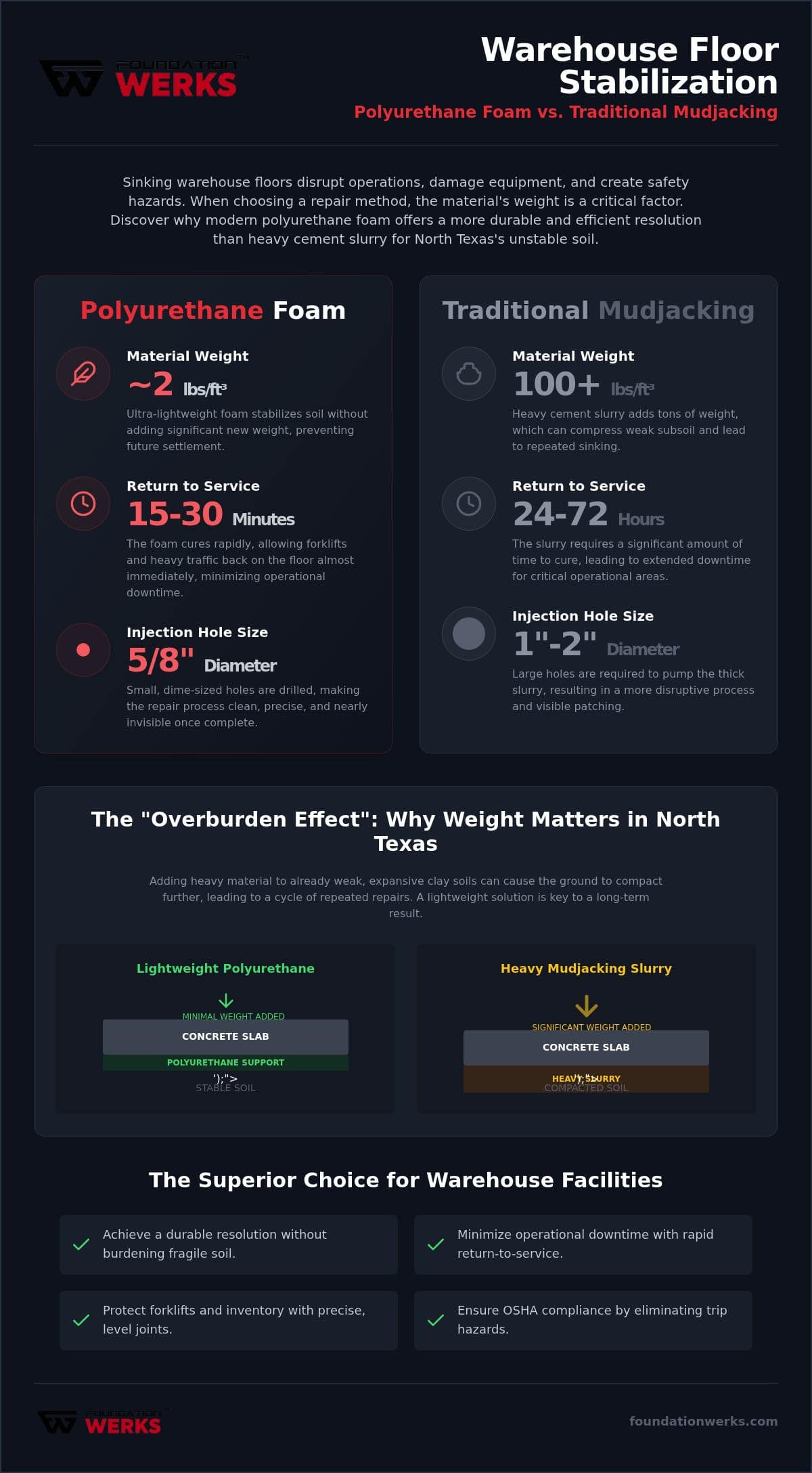
- Compare the 2 lbs per cubic foot density of polyurethane against the 100 lbs weight of mudjacking to prevent the “overburden” effect that sinks heavy slabs further into North Texas soil.
- Discover how to minimize operational downtime with rapid cure times that allow forklifts and heavy traffic back on the floor in as little as 15 to 30 minutes.
- Understand the critical differences of polyurethane vs mudjacking for warehouse floors when dealing with the expansive clay and moisture fluctuations common in Dallas and McKinney.
- Identify the specific criteria for choosing high-load stabilization to protect your facility’s structural integrity and maintain OSHA compliance regarding trip hazards.
Understanding Warehouse Slab Leveling: Polyurethane vs. Mudjacking
Warehouse floors are the foundation of your logistics. Unlike a standard residential driveway, a warehouse slab must withstand the constant vibration of forklifts and the massive point loads of loaded pallet racks. When the soil beneath the concrete fails, the slab loses its structural support. This leads to rocking joints and cracks that disrupt daily operations. The primary goal of any intervention is to restore subgrade support to prevent the concrete from failing entirely. When comparing polyurethane vs mudjacking for warehouse floors, the difference lies in the material weight and how it interacts with the underlying soil.
Stabilizing an industrial floor involves more than just lifting the concrete. To ensure a durable resolution, the process must address several critical factors:
- Eliminating forklift jarring and tire damage at uneven joints
- Filling hidden voids created by soil erosion or compaction
- Restoring a level surface for high-bay racking safety
- Preventing slab cracking under extreme point loads
The Traditional Mudjacking Process
Mudjacking is a mechanical process that relies on volume and pressure. Technicians pump a heavy grout slurry, typically a mixture of sand, water, and cement, into the voids beneath the slab. Because the material is so thick, it requires large injection holes that are usually 1 to 2 inches wide. This method was the industry standard for decades because it was a cost-effective way to move large volumes of material under concrete. However, the slurry itself is incredibly heavy, weighing over 100 pounds per cubic foot. In many North Texas industrial settings, adding this much weight can actually accelerate soil compaction and lead to more settling in the future.
The Modern Polyurethane Alternative
Polyurethane raising is a high-density, closed-cell foam solution for industrial stabilization. Instead of a heavy sand-mix, this method uses a two-part polymer that expands chemically. As the liquids mix, they create a reaction that fills every micro-void and expands with enough force to lift heavy industrial slabs. At Foundation Werks, we use a patented, eco-conscious foam made from recycled materials that provides the high compressive strength needed for heavy-duty traffic.
The process is remarkably precise. We use 5/8-inch drill holes that are nearly invisible once the job is finished. This allows for incremental leveling, ensuring that joints are perfectly flush to protect forklift equipment and prevent OSHA trip hazards. Since the foam weighs only 2 pounds per cubic foot, it won’t overload the fragile clay soils common in the Dallas area. It’s a modern approach that prioritizes the structural integrity of the facility while minimizing the physical footprint of the repair.
Material Weight and Compressive Strength: Why Polyurethane Wins
The physical weight of repair materials is the most overlooked factor in industrial slab stabilization. When comparing polyurethane vs mudjacking for warehouse floors, the difference in density is staggering. Traditional mudjacking slurry weighs approximately 100 pounds per cubic foot. In contrast, the structural-grade polyurethane foam used by Foundation Werks weighs only about 2 pounds per cubic foot. This 50-to-1 ratio fundamentally changes how the repaired floor interacts with the ground beneath it. By choosing the lighter material, you’re not just lifting the concrete; you’re protecting the soil from unnecessary stress.
Preventing Secondary Settlement
Adding tons of heavy grout to a sinking slab often creates a cycle of failure known as the overburden effect. North Texas is famous for its expansive clay soils, which already struggle to support the weight of industrial structures. When you inject 100 pounds of sand and cement per cubic foot under a slab, you’re effectively pre-loading the soil for future settlement. This extra weight compresses the weak subsoil further, often causing the concrete to sink again within a few years. It’s a common reason why traditional repairs don’t last as long as facility managers hope.
Lightweight foam eliminates this risk. Because it’s 98% lighter than mudjacking slurry, it fills the voids without adding significant stress to the subgrade. This is particularly vital in areas with high water tables or volatile soil moisture. By choosing a material that doesn’t fight against the earth, you achieve a more reliable resolution for your facility’s foundation. If your floor has reached a point where lifting is no longer viable, you might eventually need to consider concrete replacement, but catching settlement early with foam can often prevent that outcome.
Load Bearing Capacity for Heavy Machinery
A common misconception is that lightweight means weak. In reality, the high-density polymers we use are engineered specifically for industrial point loads. While mudjacking grout is rigid and prone to cracking under constant vibration, industrial polyurethane is designed to distribute weight evenly across the entire footprint of the repair. It creates a unified support structure that mimics the original subgrade but with better resistance to moisture.
Warehouse racking systems create intense pressure at the base of each upright. Our structural foam meets rigorous ASTM standards for compressive strength, ensuring it can withstand the weight of high-density shelving and heavy forklift traffic. The material maintains its integrity even under constant industrial use. It doesn’t wash away like traditional slurry or shrink over time. Instead, it creates a stable, high-PSI environment that supports your equipment and your personnel safely without the risk of the material itself failing under pressure.
Minimizing Operational Downtime: Return-to-Service Timelines
Time is your most expensive commodity in a high-volume warehouse. When evaluating polyurethane vs mudjacking for warehouse floors, the most immediate metric of success is how quickly your team can get back to work. Traditional mudjacking requires a significant waiting period. The cement-based slurry needs anywhere from 24 to 72 hours to cure before it can support heavy forklift traffic or pallet racking loads. In a 24/7 operation, losing a bay or a section of the floor for three days is rarely an option.
Polyurethane foam offers a same-day resolution. The high-density polymers reach 90% of their full compressive strength within 15 to 30 minutes of injection. This means you can walk, drive, and resume full operations almost immediately after technicians finish. Beyond speed, the process is significantly cleaner. Mudjacking involves pumping wet, abrasive slurry that can splash and create dust. For facilities housing sensitive inventory, electronics, or food products, the self-contained nature of foam injection prevents contamination risks.
The Cost of Facility Shutdowns
The real price of a repair isn’t just the contractor’s invoice. In a Dallas logistics hub, every hour of lost productivity impacts your bottom line. If a section of your floor is out of commission for two days due to mudjacking cure times, you face the logistical nightmare of rerouting shipments or paying for third-party storage. While mudjacking might appear cheaper upfront, the hidden costs of a multi-day work stoppage often make it the more expensive commercial choice. Polyurethane allows you to maintain your flow without the heavy burden of operational delays.
Drill Hole Size and Aesthetic Integrity
Preserving the structural integrity of your slab is crucial for long-term durability. Mudjacking requires large injection holes, often between 1 and 2 inches in diameter, to accommodate the thick grout. Drilling numerous large holes can actually weaken the concrete, creating potential points of failure under heavy loads. Polyurethane uses 5/8-inch holes, which are roughly the size of a penny. These smaller access points are nearly invisible once patched. This keeps your facility looking professional and maintains the strength of the slab in client-facing areas or high-traffic zones. If you’re managing a facility where appearance and precision matter, the smaller footprint is a clear advantage.
Addressing the North Texas Soil Factor: Longevity in Dallas/McKinney
North Texas warehouse managers face a unique adversary: the soil. The expansive clay common in Frisco, McKinney, and Dallas is notorious for shifting. This soil shrinks significantly during dry Texas summers and swells with force when the rains return. When evaluating polyurethane vs mudjacking for warehouse floors, you have to consider how these materials handle that constant movement. Traditional mudjacking slurry is essentially a mixture of sand and cement. It’s porous and heavy. As the underlying clay shifts, the rigid slurry can crack or even erode if water finds a path beneath the slab. This often leaves the concrete unsupported once again.
Hydrophobic Benefits in High-Moisture Environments
Polyurethane foam is naturally hydrophobic. This means it repels water rather than absorbing it. In the high-moisture environments often found beneath large concrete slabs, this property is a game changer. While mudjacking material is susceptible to underground water flow and can eventually wash away, polyurethane remains intact. It acts as a moisture barrier that prevents the formation of new voids. By filling every crevice with a water-resistant polymer, we provide a more stable environment for your warehouse floor. This is a critical distinction for facilities in areas with high water tables or poor drainage.
To further protect your investment, we often recommend integrating French drain installation. Managing the water around your facility is just as important as fixing the floor itself. By diverting water away from the foundation, you reduce the hydrostatic pressure that causes the clay to swell and lift the slab in the first place. It’s a comprehensive approach to site stability that addresses the root cause of the problem.
Stabilizing the DFW Subgrade
Sometimes the problem starts much deeper than the immediate subgrade. For facilities facing severe settlement, Foundation Werks utilizes specialized deep foam injection to reach deep soil layers that traditional methods can’t touch. This process injects high-density foam at multiple depths to consolidate loose soil and address erosion before it leads to a total slab failure. The foam expands to fill the gaps between soil particles, creating a stabilized “raft” that better supports the weight of the slab. North Texas climate cycles demand a resilient, moisture-resistant leveling material. This method ensures that the soil itself is reinforced, providing a solid foundation for your logistics operations and reducing the risk of future trip hazards or forklift damage.
Request a commercial concrete stabilization quote
Selecting a Durable Resolution for Your Warehouse Facility
Choosing the right method for your facility depends on the current state of your concrete and your specific operational goals. While the debate of polyurethane vs mudjacking for warehouse floors often focuses on upfront costs, the real value lies in the lifespan of the repair. A professional site evaluation is the first step. We look for signs of subgrade erosion, joint instability, and the overall structural health of the concrete. In some cases, if the slab is severely cracked or has crumbled beyond the point of stabilization, concrete replacement is the only responsible path forward. We believe in providing honest assessments rather than offering a solution that won’t hold up to your daily demands.
When to Choose Polyurethane Over Mudjacking
Polyurethane is the clear choice for high-traffic industrial zones where forklift vibrations and heavy point loads are constant. Mudjacking’s rigid, heavy nature makes it prone to cracking under these intense conditions. If your facility prioritizes environmental sustainability, our foam is a better fit. We use a patented material made from recycled components that minimizes the carbon footprint of your repair. Choosing foam is a commitment to facility longevity. It provides a lightweight, water-resistant support structure that doesn’t add to the soil problems common in North Texas.
Consider these factors when making your final decision:
- The weight-bearing requirements of your racking systems
- The amount of forklift traffic at your facility
- The history of soil movement on your property
- Your tolerance for operational downtime during the repair
The Foundation Werks Advantage
We take pride in our role as educators for the North Texas industrial community. Our team specializes in uneven warehouse floor repair in Dallas, bringing years of local experience to every job site. We don’t rely on hype or promise solutions that ignore the reality of shifting Texas clay. Instead, we offer a durable resolution based on structural science and honest expectations.
Our process is designed to respect your time and your budget. By using nearly invisible drill holes and rapid-cure polymers, we ensure your logistics remain fluid. We’re a company of real people who understand that a stable floor is essential for the safety of your personnel and the protection of your equipment. When you’re ready to move away from traditional, heavy-handed repairs, we’re here to deliver a modern, reliable update to your facility’s foundation.
Secure Your Facility’s Future with Modern Stabilization
Choosing between polyurethane vs mudjacking for warehouse floors determines how your facility will handle the next decade of traffic and soil movement. Lightweight foam avoids the heavy “overburden” effect that often sinks slabs further into North Texas clay. With our patented recycled foam technology, we provide an eco-conscious resolution that reaches full strength in minutes, not days.
We serve the entire DFW Metroplex with a focus on immediate return-to-service for industrial hubs. This modern approach keeps your forklifts moving and your personnel safe from trip hazards. You don’t have to sacrifice productivity for a stable foundation. It’s about making a choice that respects your operational timeline and your structural integrity.
Let’s work together to restore the efficiency of your facility. Our team is standing by to provide the technical expertise and honest guidance you need for a reliable result.
Frequently Asked Questions
Is polyurethane foam strong enough for heavy warehouse forklifts?
Yes, the structural-grade foam we use is specifically engineered to handle the extreme point loads of high-capacity forklifts. It meets rigorous ASTM standards for compressive strength and density. Unlike traditional grout, which can be brittle, industrial polymers provide a resilient support system that withstands constant vibration. This makes it an ideal choice for high-traffic logistics centers that require reliable, long-term floor stability.
How much does polyurethane foam vs mudjacking cost for commercial floors?
While the initial material price for mudjacking is often lower, the total project value tells a different story. When you factor in the 24 to 72 hour downtime required for mudjacking, the “cheaper” option often costs more in lost productivity. Polyurethane offers a more efficient resolution by preventing the secondary settlement that often occurs when adding heavy slurry to fragile North Texas soils.
Can I use my warehouse floor immediately after polyurethane injection?
You can resume full operations almost immediately. The foam reaches 90% of its full compressive strength within 15 to 30 minutes of injection. This speed is one of the biggest differentiators when comparing polyurethane vs mudjacking for warehouse floors. You don’t have to shut down bays for days at a time. Your team can walk, drive, and load the slab shortly after we finish the work.
Will polyurethane foam wash away if my warehouse has drainage issues?
No, industrial-grade polyurethane is completely hydrophobic. It repels water rather than absorbing it. Traditional mudjacking slurry is made from sand and cement, which can erode or wash away if water finds a path under your slab. Because our foam is a closed-cell material, it stays in place and maintains its volume regardless of moisture levels or drainage issues in the subgrade.
What size are the drill holes for industrial polyurethane leveling?
We use 5/8-inch injection holes, which are roughly the size of a penny. Mudjacking requires much larger holes, often between 1.5 and 2 inches, to pump the thick slurry. Our smaller access points are nearly invisible once patched. This keeps your facility looking professional and prevents the structural weakening that can occur when drilling numerous large-diameter holes into your concrete slab.
How long do the results of polyurethane concrete raising typically last?
Polyurethane is an inert material that does not break down or lose its volume over time. The results typically last as long as the underlying soil remains stable. Unlike mudjacking grout, which can shrink as it cures or wash away over time, foam provides a consistent support structure. It offers a durable resolution that addresses the root cause of the settlement without degrading under heavy industrial use.
Does mudjacking add too much weight to unstable North Texas soils?
Yes, the weight of mudjacking material is a major concern in our region. Adding 100 pounds per cubic foot can cause the “overburden” effect, where the repair material itself causes the soil to sink further. Our foam weighs only 2 pounds per cubic foot. This lightweight profile is much safer for the expansive clay soils found in Dallas and McKinney, as it doesn’t overload the subgrade.
Can polyurethane foam be used to fill large voids under warehouse slabs?
Polyurethane is highly effective for void filling and stabilization. Its chemical expansion allows it to reach into micro-voids and deep crevices that thick mudjacking slurry simply cannot penetrate. The foam expands in all directions, creating a unified support “raft” beneath the concrete. This ensures that every inch of the slab is supported, preventing the future cracking that occurs when heavy loads hit unsupported sections of the floor.