

What if the first step toward addressing a foundation concern isn’t repairing a crack, but finding out where the water is coming from? Poor drainage around foundation walls can leave puddles after rain, keep soil damp, and contribute to concrete concerns. A crack or damp patch can have more than one cause, so start by observing where and when water appears.
If water collects near your home, look at whether it returns after rainfall, whether downspouts release water nearby, and whether the ground slopes toward the building. These clues help narrow down the source before you decide whether to address roof runoff, grading, or drainage.
This guide covers common drainage warning signs, likely causes, and what to investigate first. You’ll learn how to trace surface water, document nearby concrete changes, and decide when a French drain or concrete assessment may be worth considering. The goal is to understand the water path before choosing a response.
Key Takeaways
- Standing water is a reason to investigate, not proof of foundation damage. Watch for recurring pooling, water flowing toward the building, damp lower walls, and washed-away soil.
- Trace runoff from the roof, downspouts, and ground surface to see where water is collecting.
- Compare the pattern with possible sources such as downspout discharge, low spots, surface runoff, or persistent subsurface water before choosing a response.
- Keep notes on rainfall, pooling locations, downspout discharge, and how long wet areas remain.
- Address poor drainage around foundation walls by identifying the water source first. If nearby concrete has moved, consider a separate concrete assessment.
Poor Drainage Around a Foundation: Warning Signs to Notice First
Standing water beside your home is concerning, but it doesn’t prove the foundation is damaged. A puddle may point to a runoff or grading issue, while a crack or uneven slab can have several possible causes. Look for patterns such as repeated pooling, water flowing toward the building, damp lower walls, or soil washout, and document what you see.
Pay attention to what happens after rainfall and where the water travels. Does it collect in the same low area, follow a visible channel, or leave soil saturated longer than nearby ground? These observations can help trace a water path, but they can’t confirm hidden damage on their own.
This video offers another perspective on drainage and foundation movement:
What does poor drainage around a foundation look like?
Look beyond a single puddle. Note whether water repeatedly gathers beside the building, runs toward it, or leaves an erosion channel through the soil. A persistently wet patch may show where water collects or moves, especially if nearby ground dries sooner. Record the location and conditions rather than assuming the wet spot reveals the full source.
Drainage means directing surface water away from the building without trapping it elsewhere. A French drain is one system used to collect and redirect water. A visible wet area alone doesn’t show whether that system is appropriate or whether the issue is surface runoff.
Which concrete changes should you document?
Drainage clues and concrete symptoms are related observations, not the same diagnosis. Near walks, patios, or driveways, photograph cracks, slab edges, gaps, and trip edges where adjoining sections sit at different heights. Note whether a slab seems newly uneven or a gap appears to be changing.
- Take photos from consistent viewpoints so changes are easier to compare.
- Record when you notice a change and whether the area was wet after rainfall.
- Keep drainage observations separate from concrete observations.
A single crack or isolated damp spot isn’t enough to diagnose foundation movement. If poor drainage around foundation walls appears alongside changing concrete conditions, document both. Careful records help clarify what has changed without assuming drainage is the sole cause.
How Water Reaches the Foundation and Can Affect Nearby Concrete
Drainage directs surface water away from a building without simply shifting the problem elsewhere. To understand poor drainage around foundation walls, trace water from where it lands to where it collects. Roof runoff, downspout discharge, ground slope, and concentrated surface flow can all shape its path.
Start at the roof. Rain enters the gutters and exits through downspouts. If an outlet releases water beside the building, or a gutter overflows in one spot, runoff may repeatedly soak the same patch of ground. Then consider the yard. A low area near the wall or ground that slopes toward the building can collect water instead of carrying it away.
How can roof runoff and grading concentrate water?
Watch during rain, then look again as the area drains. Note whether water spills from a gutter, pools below a downspout, or travels in a narrow stream across the yard. A dry-day inspection can reveal the ground’s shape, but not how water moves. Observing runoff in wet conditions helps distinguish a gutter or outlet issue from a low spot or broader surface flow.
Notice where water goes after it leaves the immediate area. Directing it away from one wall is not enough if it then collects beside a patio, walk, or another part of the building. Trace the whole route, not just the first puddle.
How can water and soil movement affect concrete slabs?
Repeated water flow can wash soil from around or beneath a slab in some conditions. If supporting soil is lost, a void may form below the concrete, and the slab may settle or become uneven. Persistent moisture may also affect the ground under nearby walks, patios, or driveways. These are possibilities to assess, not outcomes that can be confirmed from a puddle or crack alone.
Runoff patterns help identify where to investigate, but only a site-specific assessment can connect drainage conditions to observed concrete movement. A drainage concern is not, by itself, proof of foundation or structural damage. Addressing water also won’t automatically correct concrete that has already shifted. Consider both the water path and the slab’s condition when deciding what needs attention.
For Dallas-area property owners seeing recurring runoff alongside concrete changes, a drainage and concrete assessment can help clarify which concerns should be addressed together.
Compare Drainage Causes Before Choosing a Foundation Fix
Similar wet spots can come from different sources. Match the pattern with a likely pathway, then investigate before choosing a response. These observations are starting points, not guaranteed diagnoses.
| Observed pattern | Possible source | First check |
|---|---|---|
| Water gathers below a gutter or downspout | Overflow or concentrated roof discharge | Look for a visible overflow point and trace where the outlet releases water. |
| Pooling returns in the same low area | A ground depression that collects runoff | Observe the surrounding contours and note where water enters and leaves the spot. |
| Water crosses the yard toward the building | Surface runoff following the ground’s shape | Watch its route during rainfall and identify where flow becomes concentrated. |
| An area stays wet after nearby ground dries | Persistent subsurface water or another ongoing source | Record how long it remains wet and compare conditions after rainfall. |
When might gutters, downspouts, or grading be the first focus?
If water spills from a gutter or repeatedly collects where a downspout discharges, start by tracing roof runoff and the outlet path. A recurring pool in a low spot calls for a closer look at ground contours and the direction water travels. Watch the area during and after rain, since dry conditions can hide the route. Any grading changes should suit the site rather than follow a generic slope measurement.
These checks help distinguish a localized roof-water issue from runoff moving across a wider part of the property. Addressing the wrong pathway may leave the original pooling pattern unchanged.
When might a French drain or concrete assessment be relevant?
A French drain may be an option when site observations indicate that collecting and redirecting water suits the conditions. It isn’t the automatic answer to every wet area. Foundation Werks installs French drains and gutters as part of its drainage services.
Uneven or settled concrete is a separate observation and may need its own assessment, even if runoff is also present. Foundation Werks provides concrete raising and stabilization using polyurethane foam. Drainage work alone should not be assumed to correct concrete that has already moved. Identifying both concerns helps clarify whether water management, concrete work, or both belong in the plan.
For a site-specific review of drainage and concrete concerns, explore Foundation Werks drainage services.
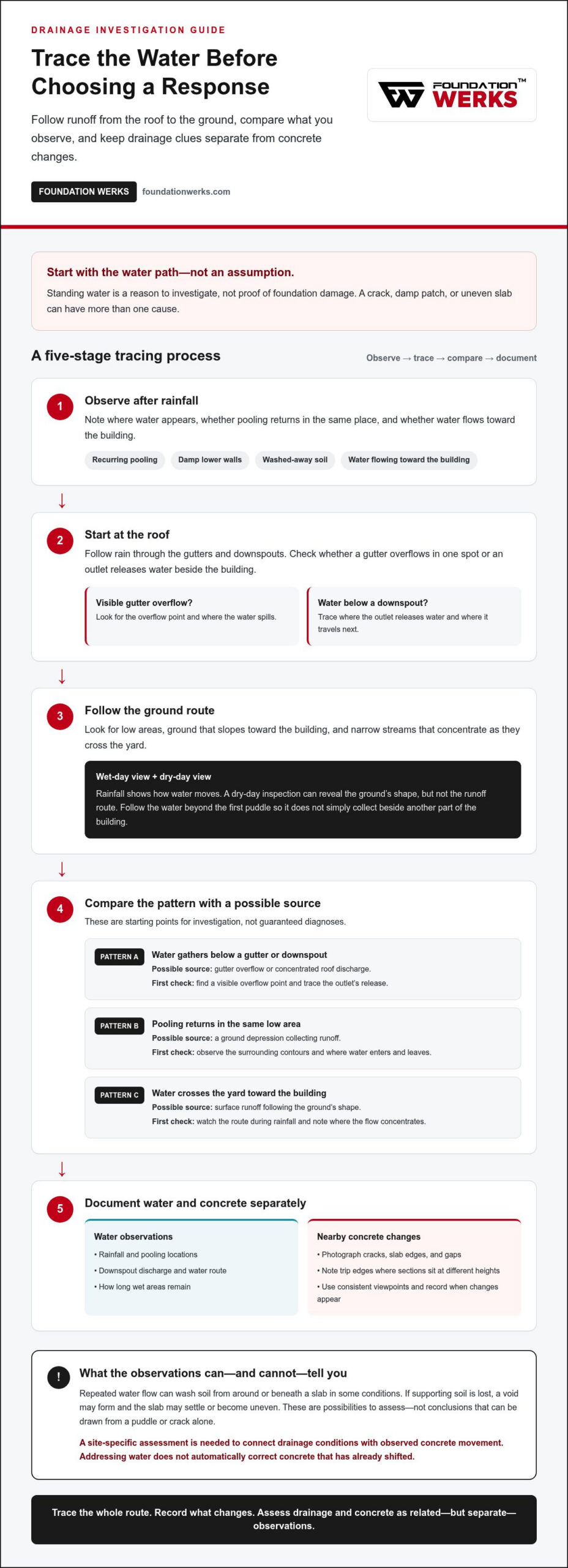
A Practical Checklist for Investigating Drainage Around Your Foundation
A consistent record can help you investigate poor drainage around foundation walls without guessing at the cause. After rainfall, observe the water, document its pattern, trace the runoff, check nearby concrete, and decide whether an assessment would help.
What should you check after rainfall?
- Observe the area. Note the weather and where water collects. Look for visible flow toward the building, erosion, and patches of wet soil.
- Document what you see. Take photos from consistent viewpoints. Record pooling locations and how long wet areas remain compared with nearby ground.
- Trace the runoff. From a safe spot, follow the visible path from gutters to downspout outlets and across the ground. Note whether discharge collects beside the building or flows toward it.
- Compare rain events. Check the same areas after more than one rainfall before deciding a pattern is recurring. Changes in where or how long water remains can offer useful clues.
- Check nearby concrete. Photograph cracks, gaps, slab edges, or uneven sections near walks, patios, and driveways. Keep these observations separate from drainage notes.
Keep checks visual. Don’t dig to look for a drain or suspected void, since underground utilities may be present. Avoid changing the ground or redirecting water blindly. A change that moves runoff away from one spot could concentrate it elsewhere.
When is professional assessment a sensible next step?
Consider an assessment if water repeatedly collects close to the building, wet areas persist, or nearby concrete appears to change over time. Your notes and photographs can show where water travels and whether the same conditions return, though they don’t establish the cause on their own.
The right response depends on the site and the observed water path. A gutter or downspout concern, a recurring low spot, and persistently wet ground may call for different approaches. If concrete has settled or become uneven, that condition may need separate evaluation. Foundation Werks serves the Dallas metropolitan area, including Frisco, McKinney, Dallas, Prosper, Allen, Fairview, Southlake, Irving, North Dallas, and the DFW area. Local property owners can request a free estimate for drainage or concrete work.
Address Poor Drainage and Concrete Concerns with a Site-Specific Plan
A sound plan follows a clear order: identify where water comes from, decide how runoff should be managed, then assess any separate concrete movement. This keeps a drainage symptom from being mistaken for a confirmed foundation problem and avoids assuming one repair will address every concern.
How can drainage work and concrete repair fit together?
Drainage and concrete condition can be connected, but they call for different evaluations. A French drain may be appropriate when site conditions support collecting and redirecting water. It won’t, by itself, lift or stabilize a slab that has already settled. Likewise, raising concrete doesn’t identify or manage the source of recurring runoff.
Foundation Werks installs French drains and can assess concrete concerns. If a slab is uneven or settled, polyurethane concrete raising or stabilization may be relevant depending on its condition. Severely cracked slabs may be too damaged to lift, so the slab needs an assessment rather than an assumption that one method will work. The goal is to match each part of the plan to what the site shows.
For poor drainage around foundation areas, note where water pools, how it travels, and whether nearby concrete has changed. Photos taken after rainfall may show details that are harder to see when the ground is dry.
What should a North Texas property owner do next?
If you’re in Foundation Werks’ Dallas-area service region, gather your notes and photos before requesting an estimate. Include where water collects, which way it flows, where downspouts discharge, and how long wet areas remain. If nearby concrete looks uneven or has changed, document that separately. These details help focus the discussion on the conditions you’ve observed.
A free estimate is a practical way to discuss the property and consider whether drainage work, concrete raising, or both may be appropriate. The next step should reflect the water path and the concrete’s condition, not a one-size-fits-all assumption.
Start with the Water, Then Choose Your Next Step
Recurring pooling is a reason to investigate, not proof of foundation damage. Trace where runoff begins and travels, and keep drainage observations separate from signs of concrete movement. That evidence can help clarify whether the first concern is a gutter outlet, ground runoff, or a slab that needs its own assessment.
Addressing poor drainage around foundation walls starts with understanding the site. Drainage work may help manage water, while settled or uneven concrete may call for separate evaluation. Foundation Werks serves the Dallas metropolitan area from McKinney, with French drain installation, gutter installation, and polyurethane concrete raising and stabilization among its services.
If you’re in the Dallas area, request a free estimate to discuss what you’ve observed and appropriate next steps.
A clear picture of the water path is a useful place to begin. Careful observations and a site-specific plan can help you move forward with greater confidence.
Frequently Asked Questions
What are the signs of poor drainage around a foundation?
Repeated pooling, water flowing toward the building, soil erosion, and areas that stay wet after nearby ground dries can point to a drainage concern. Damp lower walls or musty indoor spaces may also deserve attention. These signs don’t identify the source by themselves. Note where water starts and collects, how long it remains, and whether nearby walks, patios, or driveway slabs show changes such as new gaps or uneven edges.
Can poor drainage cause a foundation to crack?
Persistent water and soil movement may contribute to conditions associated with cracking or settlement, but a crack alone doesn’t prove drainage caused it. Note its location and whether it appears to change, and record whether water collects nearby. A site-specific assessment can help distinguish a drainage pattern from other possible causes and determine whether the concrete or foundation needs evaluation. Don’t treat one crack as a diagnosis.
How do I keep water away from my foundation?
Start by observing roof runoff, downspout discharge, low spots, and the direction water travels after rain. Keep visible gutters and outlets clear, and note whether discharge repeatedly gathers beside the building. Don’t redirect water blindly toward another structure or neighboring property. Depending on the site, runoff management, grading adjustments, or a drainage system may be relevant. Identify the water path first so the response fits the conditions you’ve observed.
Is a French drain always the right solution for poor drainage?
No. A French drain may suit a property when its conditions and water path support collecting and redirecting water, but pooling alone doesn’t establish that it’s the right choice. Roof runoff or surface flow may call for different attention. Identify where water begins, where it travels, and where it collects before selecting a system. A site-specific review can help clarify whether a French drain or another drainage measure is appropriate.
Can poor drainage make a concrete driveway or sidewalk sink?
Water movement can contribute to soil erosion or voids beneath concrete, which may be associated with a settling slab. But an uneven driveway or sidewalk can have more than one cause, and surface observations don’t confirm what is happening below it. Document pooling alongside changes in slab height, edges, or gaps. A concrete assessment can help determine whether polyurethane raising, stabilization, or another response fits the slab’s condition.
Should I worry if water pools near my foundation after heavy rain?
A brief puddle after heavy rain doesn’t automatically mean the foundation is damaged, but recurring pooling deserves attention. Observe how long the water remains, whether it flows toward the building, and whether the same area stays saturated after other rain events. Also note erosion, indoor dampness, or changing concrete nearby. Photos and simple observations can help reveal a pattern and make a later site assessment more useful.
When should I get professional help for drainage around my foundation?
Consider an assessment if water repeatedly collects beside the building, soil is washing away, or nearby concrete appears to be settling or changing. Photos taken after rain can show the water path and related slab conditions. Foundation Werks serves the Dallas metropolitan area from McKinney, including Frisco, McKinney, Dallas, Prosper, Allen, Fairview, Southlake, Irving, North Dallas, and the DFW area. Services include French drain installation, gutter installation, and concrete raising or stabilization, depending on site conditions.