

What if the most telling clue isn’t one crack, but a change in how the whole slab sits? The signs of concrete slab settlement can be easy to mistake for an isolated flaw. An uneven spot may also be getting worse or creating a trip hazard. One crack alone doesn’t confirm settlement, but a pattern of changes gives you more useful clues.
This guide explains how to spot possible settlement, distinguish movement from a localized concrete defect, and decide what to do next. You’ll learn what to look for in cracks, slab edges, and drainage, and how to record changes so you can compare them over time.
We’ll also cover when a sunken slab may be suitable for raising and stabilization. A solid slab may be a candidate for polyurethane concrete raising, while severe cracking can affect whether lifting is appropriate. The goal is to help you describe what you’re seeing without jumping to conclusions.
Key Takeaways
- Look for several developing signs of concrete slab settlement instead of treating one unchanged mark as a diagnosis.
- After rain, note where runoff flows and whether water pools near the concrete.
- Track changes with dated photos taken from the same position, plus notes about pooling and how you use the surface.
- Polyurethane concrete raising may suit a sunken slab when its condition allows it to be lifted and stabilized.
- Severe cracking can affect whether a slab is suitable for raising, so assess its condition before choosing a repair.
What Are the Signs of Concrete Slab Settlement?
Concrete slab settlement happens when the slab changes position because the support beneath it shifts, compresses, or erodes. One area may sink evenly, or the slab may move unevenly and leave part of the surface lower than the rest. A crack can have several explanations, so treat it as a clue to investigate rather than proof of settlement.
Common signs include a developing dip or slope, cracks that widen or become offset, new gaps at slab edges, and water pooling in a low area.
These changes can show up on driveways, sidewalks, patios, pool decks, porches, and garage floors. The signs of concrete slab settlement are more informative when several appear together or change over time. For background on how concrete leveling relates to underlying movement, see this overview of the causes of concrete slab settlement.
The video below shows an example of concrete floor settlement near adjacent walls. Notice how a change in one surface may relate to nearby areas, while remembering that a video cannot determine the cause at your property.
Uneven concrete, low spots, and sloping surfaces
Look for a dip that wasn’t there before, a surface that now slopes toward a building, or an edge that no longer meets the next section evenly. A sidewalk panel may sit higher than its neighbor, for example, or a patio may have a low corner. A change in slope can redirect runoff or make the surface harder to walk on, roll a bin across, or use for outdoor furniture.
Elevation changes can also create a trip concern, especially along a walkway. Note where the height difference starts and ends, and whether it appears to be growing. Pay particular attention to transitions people cross often, such as a driveway meeting a sidewalk or a patio meeting a step.
Cracks, gaps, and water pooling
Cracks offer more useful clues when they widen, develop a height difference across them, or appear alongside other changes. A new gap between a slab and a step, wall, or neighboring section is also worth recording. After rain, check whether water collects in a newly low spot or remains where it used to drain away.
Cracks can form for reasons other than settlement, and pooling may reflect how water reaches or drains from the area. Neither sign confirms movement by itself. Compare the affected area with nearby surfaces and earlier observations. A single unchanged hairline crack tells you less than a crack that changes while the slab also dips or develops an edge gap.
- Compare the concrete’s height with the surface beside it.
- Look for new gaps or a height difference across cracks.
- After rain, note whether water collects where the surface appears to have changed slope.
Treat these observations as clues, not a final assessment. The pattern and progression help clarify whether the surface may be moving and what next step could be useful.
How Concrete Slab Settlement Can Affect North Texas Properties
In the Dallas Fort Worth area, the slab’s support and the way water moves around it are useful parts of the picture, but neither reveals the cause on its own. Ground beneath concrete can shift or lose support, and drainage patterns can show where water travels or collects. Conditions vary by property, so use your observations to guide an assessment rather than treating them as a diagnosis.
Similar surface signs can have different underlying causes. A crack, low spot, or puddle alone can’t identify what is happening beneath the slab. The more useful question is whether the concrete’s position is changing and what else is changing nearby.
What drainage patterns may tell you
After rain, follow the route runoff takes across a driveway, patio, or walkway. Does it flow toward the slab, pass beside an edge, or collect in a spot that seems newly low? Record whether water remains beside the slab, along one edge, or in a dip, and whether that pattern differs from earlier observations.
Pooling shows where water remains, not that water caused settlement. Surface shape, nearby drainage, and other site conditions may also matter. If drainage is part of your concern, the French Drain Contractor in North Texas guide provides related information about drainage options.
When a slab sign may point beyond the concrete
A change in an exterior slab may be limited to that area. Take a wider view if you also notice changes inside the building, such as doors that stick, new gaps near walls, or uneven interior floors. These observations can have different explanations, but several developing changes in separate areas are more useful to assess together than in isolation.
Record each location and when the change appeared. For example, note whether a driveway edge has changed while an interior door has also begun sticking, or whether an indoor floor feels different near a visible wall gap. That connection doesn’t prove a shared cause, but it gives an evaluator more context than a list of symptoms without locations.
If multiple areas show changing symptoms, a structural evaluation can help determine whether the concern extends beyond an exterior slab. A sticking door or a particular crack does not, by itself, confirm a foundation problem. A careful assessment considers the overall pattern before identifying a next step.
For drainage topics, the French Drain Contractor in North Texas guide can be a useful starting point alongside your observations. If the issue is a sunken concrete surface, Foundation Werks’ polyurethane concrete raising and stabilization can lift and stabilize suitable slabs.
Which Signs Matter Most? Read Changes as a Pattern
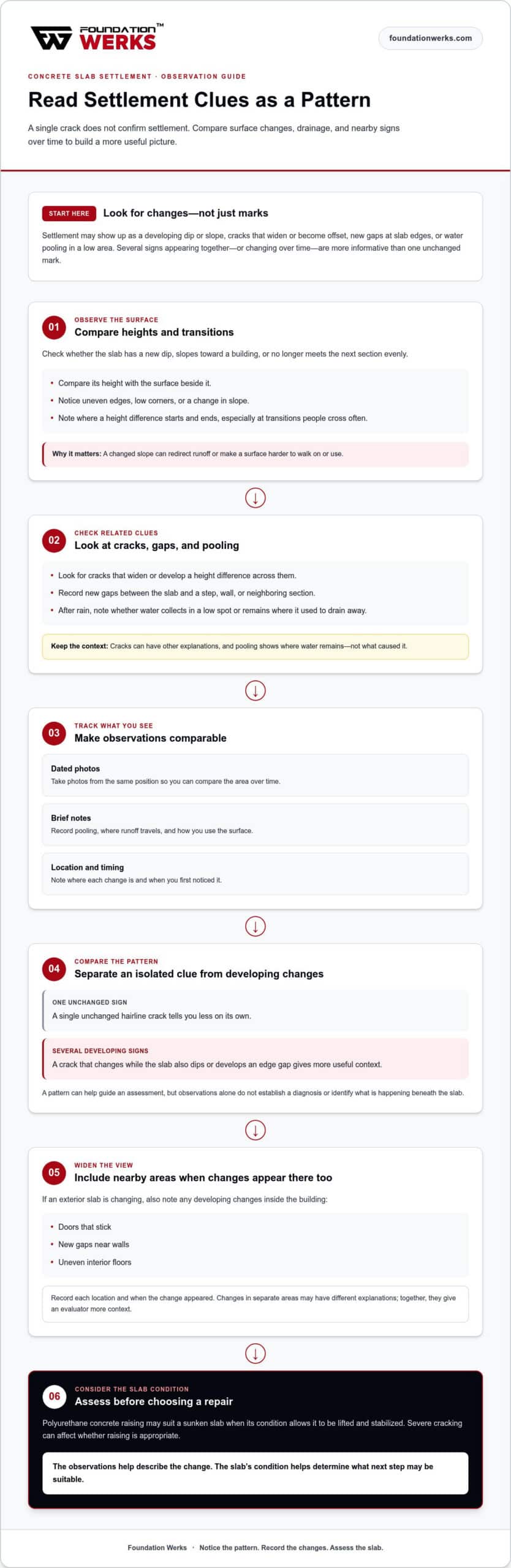
To assess possible slab movement, compare observations over time and note what else appears nearby. A mark that stays the same tells you something different from several changes developing together. This pattern doesn’t establish a diagnosis, but it helps you describe the issue and decide whether a closer assessment makes sense.
Use a simple record like the one below. Add dates and brief notes so you can compare observations instead of relying on memory.
| Observation | Is it changing? | What else appears nearby? |
|---|---|---|
| Hairline crack | Appears unchanged in repeat observations | No new dip, edge gap, or drainage change |
| Crack with an offset | Looks wider or the sides sit at different heights | A nearby low spot or separation at the slab edge |
| Water pooling | Appears in a spot that previously drained | A changed slope or uneven transition to adjacent concrete |
A single mark versus several changing clues
One stable hairline crack may be an isolated flaw. If it appears to widen while a new dip or edge gap develops nearby, the combination warrants closer attention. The same applies if water starts collecting where the surface seems to have changed slope. Together, these clues strengthen the case for further assessment, but they still don’t establish why the concrete changed.
There’s no universal crack-width cutoff that determines settlement in every situation. Instead, compare the same area over time. Look for changes in the crack itself, a height difference across it, or another clue close by. The signs of concrete slab settlement are most useful as a developing pattern, not as a checklist that gives a definite answer.
Concrete slab movement versus broader foundation symptoms
A driveway or patio can move without proving that the building foundation has settled. Keep locations distinct in your notes: an exterior slab change is one observation, while new symptoms inside the building are another. If both interior and exterior areas show changes, a broader evaluation can help determine whether they are connected or separate concerns.
For commercial properties, the Commercial Concrete Crack Repair: The 2026 Facility Manager’s Guide offers related context on concrete cracks in facility settings.
A visual checklist helps organize observations, but it can’t confirm the cause or diagnose a structural issue. Use it to communicate what changed, where it changed, and what else appeared nearby. A clear record gives an evaluator a better starting point than one photograph or a general impression that the slab looks different.
What to Do When You Notice Concrete Slab Settlement Signs
When you notice a possible change, keep a simple record to compare the slab over time and explain the concern clearly. You don’t need special tools or an exact measurement to get started. Focus on what changed, where it happened, and whether other signs appeared nearby.
Document cracks, slopes, and drainage changes
Take repeat photos from the same position and at a similar angle. Include a familiar object, such as a shoe or household item, for context, but don’t treat it as a measurement. Add the date and identify the location, such as the garage entrance or the patio’s back edge.
Record whether the same crack, slope, or gap looks different from an earlier observation. After rain, note where water flows and whether it pools in a new spot. Include any new gaps beside a step, wall, or neighboring slab.
- 1. Photograph. Capture the affected area and nearby surfaces from a repeatable viewpoint.
- 2. Date. Add the date to each photo or observation.
- 3. Describe. Note the location, visible change, water behavior, and any effect on how you use the surface.
- 4. Compare. Review earlier records for changes in the same area and clues appearing nearby.
- 5. Choose an evaluation. If changes are developing together, arrange an assessment to understand the slab’s condition and suitable next steps.
An unchanged mark may call for a different response than a changing slope accompanied by a widening crack, new edge gap, or altered drainage. If changes create a trip concern or affect how you use the surface, prioritize an evaluation. That is a practical response, not a reason to assume the cause or outcome.
Prepare for an informed slab assessment
Before an assessment, identify the affected slab, how you use it, and any visible damage. A driveway, patio, walkway, or garage floor may have different everyday demands. Share dated photos and notes about pooling, surface use, and changes you have noticed. This gives the assessment useful context without requiring you to diagnose the issue yourself.
The concrete’s condition matters when considering lifting. A solid, sunken slab may be suitable for raising and stabilization, while severely cracked concrete may be too damaged to lift. A free estimate from Foundation Werks can help assess the slab and discuss an appropriate next step, including whether polyurethane concrete raising is suitable.
Foundation Werks serves property owners in Frisco, McKinney, Dallas, Prosper, Allen, Fairview, Southlake, Irvin, North Dallas, and the wider DFW area. An estimate can help clarify the condition of a settled concrete surface and the options for addressing it.