

A sunken pool deck doesn’t always need to be torn out. Whether the existing slab is solid enough to lift may matter more than how far it has settled. If you’re researching sunken pool deck repair Dallas, an uneven surface can raise concerns about trips, drainage, and how disruptive repairs will be.
Water movement and shifting soil can contribute to settling around a pool. A repair plan should consider both the slab’s condition and where water flows. Polyurethane concrete raising may suit a solid, settled slab, while concrete broken into many pieces may not be suitable for lifting.
This article explains common signs of sinking, what an assessment can reveal, and what to expect if raising the concrete is an option. You’ll also learn why drainage matters, how the repair can affect pool-deck use, and what to check when comparing Dallas-area providers. Foundation Werks serves the Dallas metropolitan area with polyurethane concrete raising. An assessment is needed to determine whether a specific deck is suitable.
Key Takeaways
- Uneven joints, tilted sections, and gaps can signal settlement, but appearance alone can’t confirm the cause or the right repair.
- For sunken pool deck repair Dallas, the slab’s condition is a key factor in deciding whether raising or replacement is worth considering.
- Polyurethane foam raising lifts suitable existing concrete through small injection holes. Replacement involves a broader scope of work.
- A contractor should assess the slab, settlement, access, support beneath the concrete, and water movement.
- Ask specific questions about the recommendation, drainage observations, project scope, and when you can use the deck after work.
Sunken Pool Deck Repair in Dallas: Recognize the Signs and Possible Causes
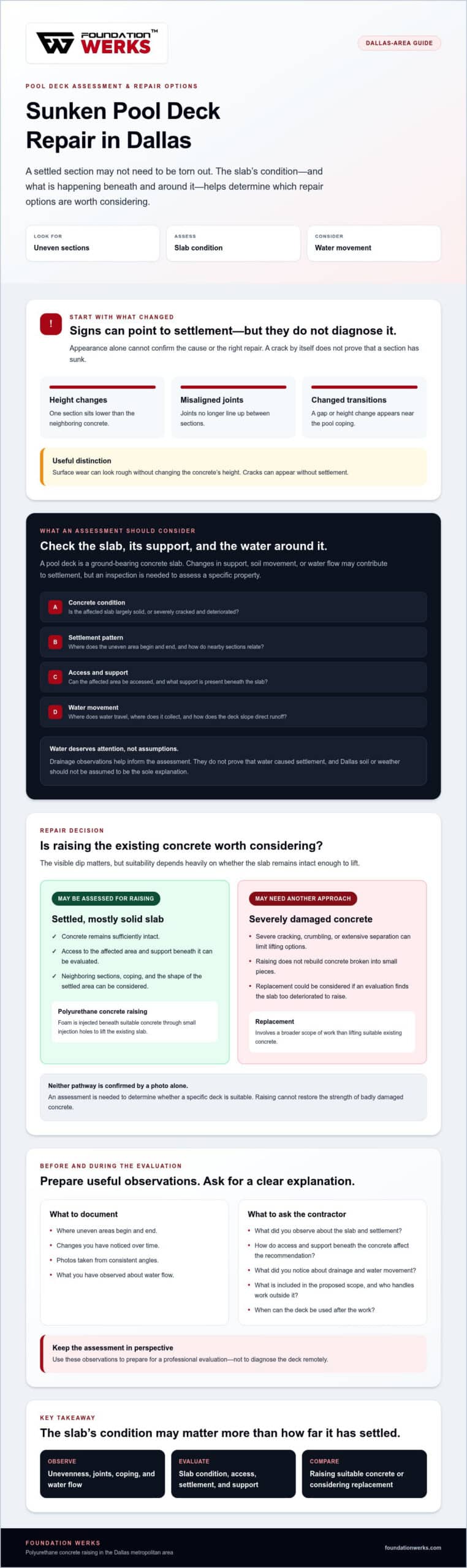
A sunken section doesn’t automatically mean the entire pool deck needs replacement. First, identify what has changed and assess whether the affected concrete is still in suitable condition for repair.
Look for a height difference between neighboring sections, joints that no longer line up, or a gap where the deck meets the pool coping. These signs can point to settlement, but appearance alone can’t confirm the cause or identify the right solution. A crack by itself also doesn’t prove that a section has sunk.
This video shows sinking pool-deck pavers. Pavers are assembled differently from a poured concrete slab, but the example can help illustrate how an uneven surface may appear.
What does a sunken pool deck look like?
Check whether one section sits lower than the next, whether joints have shifted out of alignment, and whether the transition near the coping has changed. Surface wear can make concrete look rough without changing its height, and cracks can appear without the slab settling. Note where uneven areas begin and end, and take photos from consistent angles. Recording changes over time can help a contractor assess the affected sections.
A pool deck is a ground-bearing concrete slab. If its support changes, part of the surface may settle. Soil movement, water flow, or a loss of support beneath the slab may contribute, but an inspection is needed to determine what is happening at a specific property.
How can water movement affect a Dallas pool deck?
Water movement deserves attention when planning sunken pool deck repair Dallas. A contractor can look at where water travels, whether it pools near the deck, and how the surface slope directs runoff around the pool. These observations help assess drainage alongside the slab. They don’t prove that water caused the settlement, and Dallas soil or weather shouldn’t be assumed to be the sole explanation.
Before an assessment, document visible changes and share what you’ve noticed about water flow. If site conditions point to a drainage concern, Foundation Werks also offers French drain installation. An evaluation can help determine whether that service is appropriate for the property.
Can a Sunken Pool Deck Be Raised? Start With the Slab’s Condition
A solid slab that has settled may be a candidate for concrete raising. A slab with severe cracking or extensive deterioration may not be. The visible dip matters, but it’s only one part of the decision. Before recommending a repair, a contractor should assess the concrete, settlement pattern, access to the affected area, and support beneath the slab.
Raising lifts existing concrete; it doesn’t rebuild sections that have broken into small pieces. With polyurethane concrete raising, foam is injected beneath suitable concrete to lift it. This may address a settled section when the slab remains sufficiently intact. It can’t restore the strength of badly damaged concrete, and a photo or description alone can’t confirm whether a particular deck is suitable.
Which pool decks may be candidates for concrete raising?
A section that has settled but remains largely solid may be worth assessing. The contractor also needs to consider whether injection points can be accessed and whether neighboring sections should be addressed as part of the repair. Pool coping, nearby features, and the shape of the settled area can affect the assessment. These are factors to evaluate, not a guarantee of suitability.
When might a slab need a different repair approach?
Severe cracking, crumbling, or extensive separation can limit lifting options because the slab may not behave as one stable piece. Replacement could be considered if an evaluation finds that the concrete is too deteriorated to raise. Ask the contractor to explain what they observed and why they recommend one approach over another. Clarify who would handle work outside the proposed scope.
Preliminary checklist: Use these points to prepare for an assessment, not to diagnose the deck remotely.
- Is the settled area mostly intact, or is it broken into many pieces?
- Are nearby sections also uneven or damaged?
- Can the affected area be accessed for the proposed repair?
- Has the settlement changed, or are there other conditions that need evaluation?
Foundation Werks offers polyurethane concrete raising for pool decks in the Dallas metropolitan area. An assessment is needed to determine whether a specific slab is suitable. Confirm service availability for your address and whether the residential project meets eligibility requirements. To discuss your options, ask Foundation Werks about pool deck concrete raising.
Pool Deck Repair Options in Dallas: Raising Concrete or Replacing the Slab
For sunken pool deck repair Dallas, the choice between raising and replacement should follow the condition of the concrete, not just the size of the dip. Raising works with existing concrete, so a solid slab that has settled may be assessed for lifting. Replacement may be worth considering if the slab is severely cracked or extensively deteriorated. An on-site evaluation helps clarify which option fits the damage and the work involved.
How does polyurethane concrete raising work for pool decks?
A contractor drills small injection holes in the slab, places polyurethane foam beneath it, then uses the foam’s expansion to lift the concrete in a controlled way. Foundation Werks uses holes approximately 5/8 inch wide and describes them as nearly invisible after the work. The foam weighs about 2 pounds per cubic foot, compared with an average of 100 pounds per cubic foot for traditional mudjacking material. No heavy equipment is required, so machinery doesn’t need to traverse landscaping. The slab’s suitability and site access still need to be assessed first.
How do you decide between raising and replacement?
Raising may be worth considering when concrete has settled but remains sufficiently solid. Replacement may enter the conversation if severe cracking or broader deterioration means the slab can’t be lifted as a stable section. Raising or stabilizing concrete typically costs about half as much as full replacement, but the appropriate option and cost depend on the assessment and proposed work. Ask what replacement includes and who is responsible for each part. The comparison below is a starting point, not a diagnosis or individual estimate.
| Consideration | Concrete raising | Slab replacement |
|---|---|---|
| Slab condition | May suit a settled, relatively solid slab. | May be considered when damage limits lifting options. |
| Work scope | Lifts existing concrete by placing foam beneath it. | Replaces the existing slab; confirm the proposed scope. |
| Disruption | Uses small injection holes and avoids heavy equipment traversing landscaping. | May involve a broader work area. Ask how the plan affects the pool area and access. |
| Suitability | Depends on slab condition, settlement, support, and access. | Depends on the extent of damage and assessment findings. |
Neither option should be recommended from a photograph alone. Ask the contractor to explain what they observed, whether the slab can be raised, and why they favor that approach over replacement. Clarify whether the proposed scope covers only raising or includes other work. Foundation Werks offers polyurethane concrete raising for pool decks in the Dallas metropolitan area. Confirm service availability for your address and whether the residential project meets eligibility requirements. An assessment can help determine if pool deck concrete raising is appropriate for your slab.
What to Expect During Sunken Pool Deck Repair in the Dallas Area
A clear process helps you plan around the pool and understand what the repair includes. For sunken pool deck repair Dallas, the contractor should evaluate settlement, slab condition, access, and water movement before recommending work. If concrete raising is appropriate, the job typically takes a few hours, and the surface can be used the same day after completion. Confirm the timing and any use instructions for your specific project.
How should homeowners prepare for an assessment?
Before the visit, identify the sections that appear settled and note when you first noticed changes. Share observations about water pooling or drainage, but leave the cause to the assessment. Make affected areas accessible and prepare questions about the proposed work, timing, access needs, and what to do before and after the repair. Ask whether any pool-area preparation is needed.
What happens during and after concrete raising?
If the slab is suitable, polyurethane raising generally involves placing foam beneath the concrete through small injection holes, then lifting the section in a controlled way. Foundation Werks uses holes approximately 5/8 inch wide. They’re nearly invisible, though the final appearance can vary, so ask what patching to expect. After lifting, the contractor should inspect the repaired section and explain any project-specific guidance.
A typical process moves through these stages:
- 1. Assessment: Review the settled area, slab condition, access, and water movement. Discuss whether raising is suitable and confirm the work scope.
- 2. Site preparation: Confirm how to prepare the pool area and keep the repair location accessible.
- 3. Foam injection and lifting: Place foam beneath the slab and raise it carefully toward the planned position.
- 4. Completion and guidance: Inspect the work, explain any site-specific instructions, and confirm when the surface can be used.
Foundation Werks says completed concrete can be walked on or played on the same day. Confirm access requirements and any directions for your pool area with the contractor. The schedule and preparation can depend on the site and repair scope, so ask what to expect before work begins.
Choosing a Dallas Pool Deck Repair Contractor and Planning Your Next Step
A useful assessment should give you more than a suggested repair. For sunken pool deck repair Dallas, look for a contractor who explains what they observed, which sections may be suitable for raising, and what could change that recommendation. You should understand the proposed scope, access needs, expected timing, and how water movement or drainage observations factor into the plan.
What should you ask before approving pool deck work?
Use these questions to compare recommendations and clarify expectations before work begins:
- Which sections appear suitable for raising, and what slab conditions might make lifting unsuitable?
- What does the assessment cover, and what additional evaluation might be needed?
- Where will the crew need access, and should anything around the pool area be moved or prepared?
- What timing should I plan for, and when can the repaired area be used?
- Did you observe water movement or drainage concerns, and are they included in the proposed scope?
Ask the contractor to explain why raising or another approach is recommended for your specific deck. A clear explanation should connect the slab’s condition and site observations to the proposed work. If something falls outside that scope, ask who would be responsible for addressing it.
How can Foundation Werks assess a sunken pool deck?
Foundation Werks is based in McKinney and serves the Dallas metropolitan area, offering polyurethane concrete raising for pool decks and patios. The process uses injection holes approximately 5/8 inch wide, which the company describes as nearly invisible. Completed concrete can be used the same day after work is finished. Confirm instructions and timing for your property, and ask for an assessment to determine whether the slab is suitable and whether service is available at your address.
Foundation Werks offers free estimates. Before arranging one, confirm that your residential project meets the company’s eligibility requirements. You can also ask what information to provide and whether an on-site assessment is needed to evaluate the deck.
Choose Your Pool Deck Repair With Confidence
The right repair depends on the slab, not just the visible dip. A settled section that remains solid may be suitable for concrete raising, while severe cracking or deterioration can call for another approach. An assessment should also consider access, underlying support, and water movement before a contractor recommends work.
As you compare options for sunken pool deck repair Dallas, ask what the inspection found, which sections can be addressed, and what the work and follow-up guidance include. A clear explanation helps you understand why raising or another option fits your deck.
Foundation Werks is based in McKinney and serves the Dallas metropolitan area with concrete raising for pool decks and patios. The company offers free estimates by phone at 800-464-9684. Confirm service availability for your address and whether your residential project meets eligibility requirements.
A thoughtful assessment is a practical first step toward a safer, more usable pool area. Contact Foundation Werks to request a free estimate and discuss whether polyurethane concrete raising may suit your deck.
Frequently Asked Questions
Can a sunken pool deck be raised without replacing the concrete?
Yes, a settled pool deck may be raised without replacing the concrete if the slab is solid enough for lifting. Polyurethane concrete raising places foam beneath the existing slab to lift it. It isn’t suitable for every deck, especially if the concrete is severely cracked or broken into many pieces. For sunken pool deck repair Dallas homeowners should arrange an assessment to check slab condition, settlement, access, and support before choosing a repair.
How do I know if my pool deck is too cracked to raise?
You can’t reliably determine that from a crack’s appearance alone. A few cracks don’t automatically rule out raising, but severe cracking, crumbling, or a slab divided into many small pieces may limit the option. A contractor should assess whether the concrete can be lifted as a stable section and inspect nearby areas. Share photos and note any changes, but treat them as background information, not a remote diagnosis.
How does polyurethane foam lift a sunken pool deck?
A contractor makes small injection holes in the slab, then injects polyurethane foam beneath the concrete. As the foam expands, it can fill space below the slab and lift suitable sections in a controlled way. The contractor monitors the lift and checks the repaired area. The process works with existing concrete, so the slab’s condition and the space beneath it need to be assessed before a recommendation is made.
How large are the holes used to raise a pool deck?
Foundation Werks uses injection holes approximately 5/8 inch wide for its polyurethane concrete raising process. The company describes these holes as nearly invisible after the work, though the final appearance can vary. Ask where holes will be placed and what patching to expect on your specific deck. Small holes don’t mean every slab is suitable for raising, so slab condition still needs to be evaluated.
How soon can I use my pool deck after concrete raising?
Foundation Werks says completed concrete can be walked on or played on the same day the work is completed. Confirm the appropriate timing and instructions for your pool deck with the contractor. Ask about access during the work and whether any part of the deck or nearby pool area should remain clear afterward. Follow the project-specific guidance.
Can water or poor drainage contribute to a sunken pool deck?
Water movement or drainage conditions may contribute to settlement by affecting soil support beneath concrete, but they aren’t the only possible causes. A contractor should observe where water flows, whether it pools near the deck, and how the surface directs runoff. These observations help inform the assessment without proving a cause on their own. Share any drainage changes you’ve noticed and ask whether they affect the proposed repair scope.
Does Foundation Werks provide sunken pool deck repair in Dallas?
Foundation Werks offers polyurethane concrete raising for pool decks and patios and serves the Dallas metropolitan area from McKinney. Its local service area includes Frisco, McKinney, Dallas, Prosper, Allen, Fairview, Southlake, Irvin, North Dallas, and DFW. Confirm service availability for your address and whether your residential project meets eligibility requirements. An assessment is needed to determine whether your slab is suitable. Foundation Werks offers free estimates by phone at 800-464-9684.