

Replacing your warehouse floor isn’t just expensive; it’s often entirely unnecessary. You’ve likely watched your concrete slabs sink as the North Texas clay soil shifts, creating OSHA trip hazards and slowing down your daily operations. It’s frustrating to deal with the mess of traditional repairs only to see the same cracks return a year later. You deserve a sophisticated, long-term resolution through Polyurethane Concrete Raising, a method that stabilizes your property without the heavy equipment or weeks of operational downtime.
In this guide, you’ll discover how this non-invasive and eco-conscious technology restores your surfaces with surgical precision. This modern approach uses high-density, closed-cell foam that weighs only 2 to 6 pounds per cubic foot, putting far less stress on our volatile local soil than traditional slurry. We’ll walk you through the technical requirements of the process, including mandatory Texas 811 safety protocols and the rapid 15-minute cure times that keep your business moving. From warehouse floors to commercial parking lots, learn why this innovative technology is the gold standard for structural restoration in 2026.
Key Takeaways
- Learn why the injection process uses tiny 5/8-inch holes to lift slabs, so you don’t have to worry about extensive damage to your property.
- Discover how eco-friendly, high-density recycled foam provides superior stabilization when compared to traditional low-density alternatives.
- Understand how Polyurethane Concrete Raising offers a faster return on investment with immediate traffic readiness and significantly less weight on North Texas clay.
- Identify how to resolve OSHA trip hazards and stabilize warehouse floors without disrupting your daily operations.
- See how local expertise in the Dallas-Fort Worth area ensures your structural restoration is tailored to the unique challenges of regional soil conditions.
Understanding Polyurethane Concrete Raising: A Modern Solution for Sunken Slabs
Polyurethane Concrete Raising is a sophisticated engineering method that addresses the root cause of uneven pavement without the destruction of traditional demolition. Often referred to as polyjacking, this process involves injecting high-density polymers beneath a slab to fill voids and restore its original elevation. For a broader context, you can explore this overview of concrete leveling techniques. Unlike the old-fashioned “rip and replace” method, which is both expensive and environmentally wasteful, this approach preserves your existing infrastructure while providing a long-term resolution for instability.
The Mechanics of the Lift
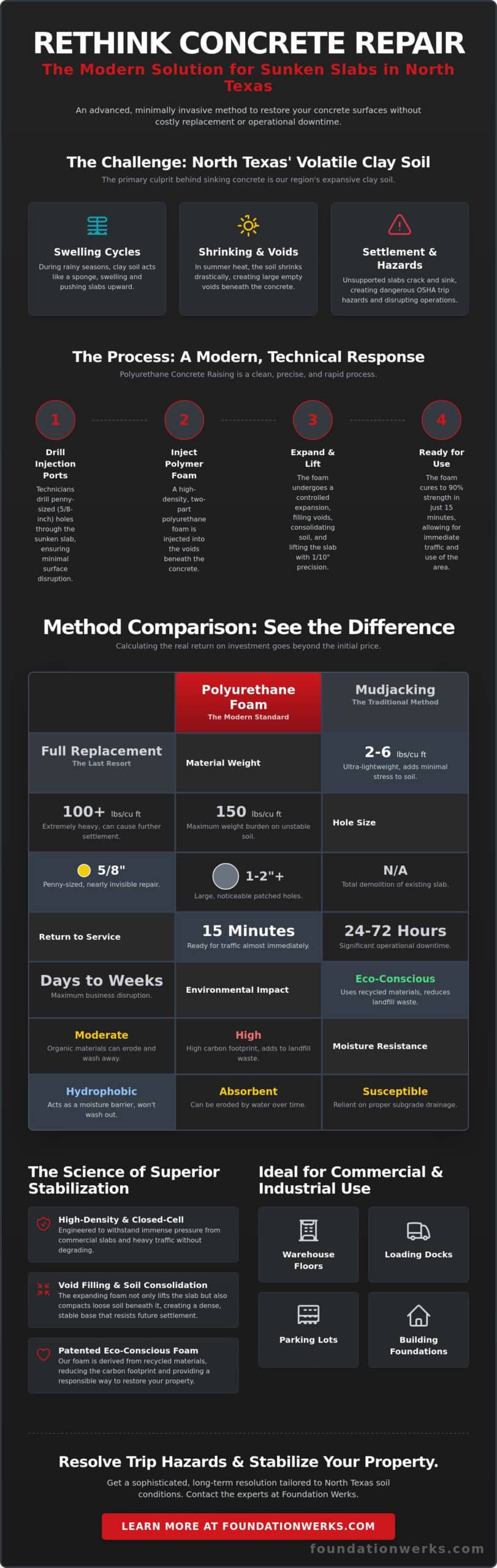
The process begins with technicians drilling small 5/8-inch holes, roughly the size of a penny, through the concrete surface. A two-part chemical reaction occurs inside the injection equipment, creating a rapid expansion as the liquid polymer enters the void. This expansion is incredibly powerful yet highly controllable; our specialists can adjust the lift to within 1/10th of an inch. Polyjacking is a minimally invasive structural repair method that utilizes the expansive force of the foam to stabilize the foundation from beneath.
Why Concrete Sinks in Dallas and McKinney
The primary culprit for settling in North Texas is our notorious expansive clay soil. This earth acts like a sponge, swelling during rainy seasons and shrinking drastically during extreme Texas summer heat. These cycles create massive voids and lead to soil erosion and concrete settling. When poor drainage is added to the mix, water washes away the supporting sub-base, leaving heavy concrete slabs suspended over empty air. Without proper stabilization, the weight of the slab eventually causes it to crack and drop, creating hazards for pedestrians and equipment alike. It’s a common issue, but one that requires a modern, technical response to ensure the safety and value of your property.
The Science of Stabilization: Why Eco-Friendly Recycled Foam Outperforms
The efficacy of Polyurethane Concrete Raising depends entirely on the quality of the polymer injected. While some market alternatives use generic, low-density materials, professional-grade restoration requires high-density, closed-cell foam. These advanced formulations are engineered to withstand the immense pressure of commercial slabs and heavy vehicle traffic. Professional-grade foams typically meet or exceed a minimum compressive strength of 50 psi, ensuring they can support thousands of pounds without deforming. Unlike mudjacking slurry, which can weigh over 100 pounds per cubic foot, our specialized foam weighs between 2.0 to 6.0 pounds per cubic foot. This prevents the cycle where the weight of the repair material actually causes the soil to sink further.
Sustainability in Concrete Repair
Choosing a modern solution doesn’t mean compromising on environmental values. Our process utilizes patented foam derived from recycled materials, significantly reducing the carbon footprint compared to producing new concrete. This long-term resolution outlasts organic fill materials that eventually rot or wash away. If you are looking for eco-friendly concrete repair in Dallas, this technology offers a responsible way to restore your property without contributing to landfill waste.
Void Filling and Soil Consolidation
One of the most critical advantages of this technology is its hydrophobic nature. In North Texas, where groundwater levels fluctuate, it’s essential that repair materials don’t degrade when exposed to moisture. The foam acts as a moisture barrier, maintaining its structural integrity even in saturated conditions. As the foam expands, it performs a dual role: it fills hidden cavities and consolidates loose soil. This process of stabilizing the subgrade ensures that the slab is supported by a dense, uniform base rather than just sitting on a few points of contact. By addressing the voids first, we create a stable foundation that resists future settlement.
Polyurethane vs. Mudjacking vs. Replacement: Calculating the Real ROI
When evaluating the cost of structural repairs, savvy property owners look beyond the initial estimate to consider long-term value. Traditional methods often fail to address the underlying causes of instability in North Texas. Polyurethane Concrete Raising offers a superior return on investment by providing a high-quality resolution that avoids the hidden costs of downtime and secondary settlement. While mudjacking might appear cheaper on paper, its reliance on heavy materials often leads to a cycle of recurring failure that costs more over a ten-year period.
The physical differences between these methods are stark. High-density foam weighs only 2.0 to 6.0 pounds per cubic foot, whereas mudjacking slurry typically weighs between 100 and 150 pounds. This weight difference is crucial; adding massive amounts of heavy cement to already burdened soil often triggers further sinking. Additionally, the aesthetic impact is minimal with polyurethane. Technicians use 5/8-inch injection holes, which are easily patched and nearly invisible, compared to the intrusive 2-inch holes required for mudjacking equipment.
Why Mudjacking Often Fails in Texas
In the Dallas-Fort Worth region, our expansive clay is the primary challenge. Adding heavy cement slurry to unstable clay is counterproductive, as the added mass accelerates soil compression. You can read more about Polyurethane vs Mudjacking: Why Modern Foam Wins to understand why the lighter, modern alternative is preferred. Beyond the weight issue, mudjacking material is susceptible to the elements. During intense North Texas rainstorms, the organic and cementitious components of mudjacking slurry can wash away, leaving the slab unsupported once again.
The High Cost of Concrete Replacement
Many owners consider tearing out and pouring new concrete, but this is often the most wasteful and expensive path. You must factor in the costs of demolition, hauling fees, and the environmental impact of sending old slabs to local landfills. The most significant cost, however, is often operational downtime. While new concrete typically requires a 7-day cure time before it can handle heavy loads, our specialized foam achieves 90% of its ultimate compressive strength within just 15 minutes of injection. This rapid turnaround allows your business to stay productive while ensuring a stable, effective result for your infrastructure.
Commercial Applications: From Warehouse Floors to Industrial Loading Docks
Industrial facilities in North Texas face unique structural demands that residential solutions simply cannot meet. When heavy machinery and high-volume logistics are involved; even a minor slab failure can halt production. Polyurethane Concrete Raising provides the precision and strength necessary to maintain these high-traffic environments without the need for total reconstruction. Whether it is a distribution center in Fort Worth or a manufacturing plant in Plano, stabilizing your concrete is essential for both safety and efficiency.
Warehouse Floor Stabilization
Heavy forklift traffic often causes “rocking” slabs when voids form underneath the concrete. This movement doesn’t just damage the slab; it puts incredible strain on vehicle axles and operator safety. Our Warehouse Floor Stabilization guide details how high-density foam fills these hidden cavities to create a solid, non-yielding base. This level of precision is especially critical for facilities using automated racking systems, where even a fraction of an inch of tilt can cause significant mechanical errors.
Maintaining Safety Standards
Safety is a primary concern for any facility manager. OSHA regulations are strict regarding floor surfaces, often identifying a vertical displacement as small as 1/4-inch as a trip hazard. These violations can lead to costly fines and increased liability. We understand that you can’t afford to close your doors for repairs. That’s why we offer off-hour and overnight services to resolve these hazards while your team is away. In one recent project, we restored a North Texas logistics hub in a single shift, allowing them to resume full operations by morning.
Beyond the floors, we also specialize in leveling industrial loading docks. Misaligned docks create dangerous gaps for pallet jacks and forklifts, slowing down your supply chain. By combining lifting with commercial concrete crack and joint repairs, we prevent edge spalling and ensure a seamless transition for every load. If your facility is struggling with uneven surfaces, schedule a commercial concrete evaluation to protect your team and your bottom line.
Restoring Structural Integrity with Foundation Werks: Your North Texas Experts
Choosing a partner for structural restoration requires more than just finding a contractor with a pump. It demands a team that understands the specific geological challenges of McKinney, Dallas, and the surrounding North Texas communities. At Foundation Werks, we combine local insight with patented, eco-conscious technology to address the unique ways our regional soil impacts your infrastructure. Our approach to Polyurethane Concrete Raising is rooted in a commitment to environmental responsibility and technical excellence, ensuring that every project contributes to the long-term value of your property.
We provide a holistic view of property health that goes beyond the surface. Often, a sunken slab is a symptom of a larger drainage issue. To provide a truly effective resolution, our experts may recommend a combination of services, such as French Drain Installation to divert water from your foundation or specialized joint sealing to prevent future erosion. This comprehensive strategy ensures that once your concrete is restored, the underlying causes of settlement are managed with professional care.
A Relentless Dedication to Quality
Our fleet is equipped with specialized, high-capacity machinery designed specifically for large-scale commercial and industrial projects. We don’t believe in high-pressure sales; instead, we prioritize education and transparency. Every quote we provide includes a detailed explanation of the “why” behind our methods. We take pride in our meticulous process, which includes a thorough assessment, precise injection, and a cleanup so thorough you will hardly know we were there. This dedication provides the peace of mind that comes from a high-quality, long-term resolution for your facility’s safety.
Getting Started with Your Concrete Restoration
Taking the first step toward a safer property is straightforward. When you schedule a professional evaluation, one of our experts will conduct a thorough on-site visit to map out voids and identify the best injection points for your specific slabs. We will walk you through the technical requirements, including safety coordination and the rapid 15-minute cure times that minimize your operational downtime. Don’t let settling concrete become a liability for your business. Request your commercial concrete lifting assessment today and partner with the innovative experts dedicated to North Texas’ structural health.
Secure Your Property’s Structural Future
Maintaining a safe and level facility in the Dallas-Fort Worth area requires a strategy that respects the unique behavior of our regional soil. You have learned how Polyurethane Concrete Raising provides a high-quality, long-term resolution for sunken slabs by utilizing high-density, eco-friendly foam. This modern technology doesn’t just lift your surfaces; it stabilizes the subgrade to prevent the recurring settling often seen with traditional mudjacking. By choosing a solution that achieves 90% strength in just 15 minutes, you protect your operational efficiency while eliminating OSHA trip hazards.
As local McKinney-based experts, Foundation Werks is dedicated to providing specialized commercial and industrial stabilization for businesses across North Texas. Our use of patented foam made from recycled materials ensures your restoration is as environmentally responsible as it is technically sound. It’s time to move beyond temporary patches and invest in a sophisticated approach that enhances the value and safety of your warehouse floors and loading docks. Restore your concrete today with a free Foundation Werks evaluation. We look forward to partnering with you to restore the stability and peace of mind your property deserves.
Frequently Asked Questions
Is polyurethane concrete raising permanent?
This method provides a highly durable, long-term resolution for sunken slabs. The high-density foam is an inert material that won’t biodegrade or wash away even when exposed to North Texas groundwater. While it effectively stabilizes the immediate area, it’s important to remember that the surrounding clay soil may still shift over time due to extreme weather cycles. We focus on creating a stable sub-base that resists future settlement more effectively than traditional organic fill materials.
How much does polyurethane concrete lifting cost in Dallas?
The cost of your project depends on several technical variables, including the size of the concrete slab, the depth of the voids beneath it, and the amount of material required for stabilization. Every property presents unique challenges, so we provide custom assessments rather than generic estimates. Factors like the thickness of the concrete and the precision required for leveling industrial equipment will influence the final scope of the restoration work.
Can polyurethane foam lift a heavy warehouse floor?
Yes, high-density polyurethane is specifically engineered to handle the immense weight of industrial environments. The foam possesses a high compressive strength, typically exceeding 50 psi, which allows it to support thousands of pounds per square foot. It’s a preferred solution for warehouse floors where heavy forklift traffic and automated racking systems require a perfectly level and stable foundation to operate safely and efficiently.
Is the foam used in concrete raising environmentally friendly?
We prioritize sustainability by using patented, eco-conscious foam made from recycled materials. This modern approach to Polyurethane Concrete Raising reduces the carbon footprint of your repair by avoiding the energy-intensive process of manufacturing and transporting new concrete. The material is non-toxic and doesn’t leach harmful chemicals into the surrounding soil, making it a responsible choice for both commercial and residential property owners in North Texas.
How soon can I drive on my concrete after it is lifted?
You can typically return your surfaces to full service within 15 to 30 minutes of the injection. The polymer sets rapidly, achieving 90% of its ultimate compressive strength almost immediately after the expansion process is complete. This speed is a significant advantage for businesses that can’t afford the multi-day downtime required for traditional concrete replacement or mudjacking, which often needs 24 to 72 hours to cure.
What is the difference between polyjacking and mudjacking?
The primary difference lies in the weight and precision of the materials used. Polyjacking utilizes lightweight foam weighing only 2 to 6 pounds per cubic foot, while mudjacking uses a heavy cement slurry that can weigh over 100 pounds. The lighter weight of polyurethane prevents secondary sinking in unstable North Texas clay. Additionally, polyjacking requires much smaller 5/8-inch injection holes, resulting in a cleaner and more aesthetically pleasing finish.
Will polyurethane foam work on very large voids under a slab?
The expansive nature of the foam makes it an ideal solution for significant void filling and stabilization. As the liquid polymer is injected, it expands up to 20 to 30 times its volume, flowing into every hidden cavity to create a uniform, supportive base. This ensures the entire slab is supported by a dense structure rather than just resting on a few points of contact, which helps prevent future cracking.
Does polyurethane concrete raising require a permit in McKinney, TX?
Texas law requires a mandatory call to Texas 811 at least two business days before any drilling or injection begins to locate underground utilities. While many standard residential repairs don’t require a specific municipal permit, larger commercial projects or work on public right-of-way sidewalks may have local requirements. We guide you through the technical compliance and safety protocols necessary to ensure your project meets all regional regulations.