

If your forklifts jar every time they cross a seam, you aren’t just losing productivity. You’re likely looking at an OSHA violation under the revised 2026 National Emphasis Program for Warehousing. We understand the frustration of seeing equipment take a beating from uneven floors while trying to avoid the expensive downtime of traditional construction. Professional warehouse floor joint repair shouldn’t mean shutting down your North Texas facility for a week. It should mean getting your operations back to full speed quickly.
In this guide, we’ll help you diagnose why your joints are failing and show you how to prevent trip hazards before they lead to fines. You’ll learn about long-term stabilization strategies that restore floor flatness and protect your goods from damage. We’ll also cover how modern polyurethane injection can save you up to 50 percent compared to concrete replacement. This method allows your crew to drive on the floor the same day. Let’s look at how to secure your facility’s structural stability and keep your DFW warehouse running smoothly.
Key Takeaways
- Understand how North Texas clay soils and temperature swings contribute to slab movement and joint deterioration.
- Learn why rocking slabs shear joint filler and how to identify voids so you don’t miss hidden structural issues.
- Discover why lightweight polyurethane injection is a superior alternative for warehouse floor joint repair compared to heavy, traditional mudjacking.
- Review the 2026 OSHA standards for floor safety and use our checklist to catch trip hazards before they lead to costly fines.
- Find out how you’ll achieve durable restoration and 50 percent cost savings while keeping your facility operational on the same day.
Understanding Warehouse Floor Joint Failure in North Texas
Warehouse floor joint repair is the process of restoring the structural and surface integrity at the junctions where concrete slabs meet. In an industrial facility, these joints are the most vulnerable points of the floor system. When they fail, the entire operation slows down. Understanding Warehouse Floor Joint Failure starts with recognizing that joints aren’t just gaps; they’re engineered transitions designed to handle slab movement. If that transition isn’t smooth, your equipment and your profits pay the price.
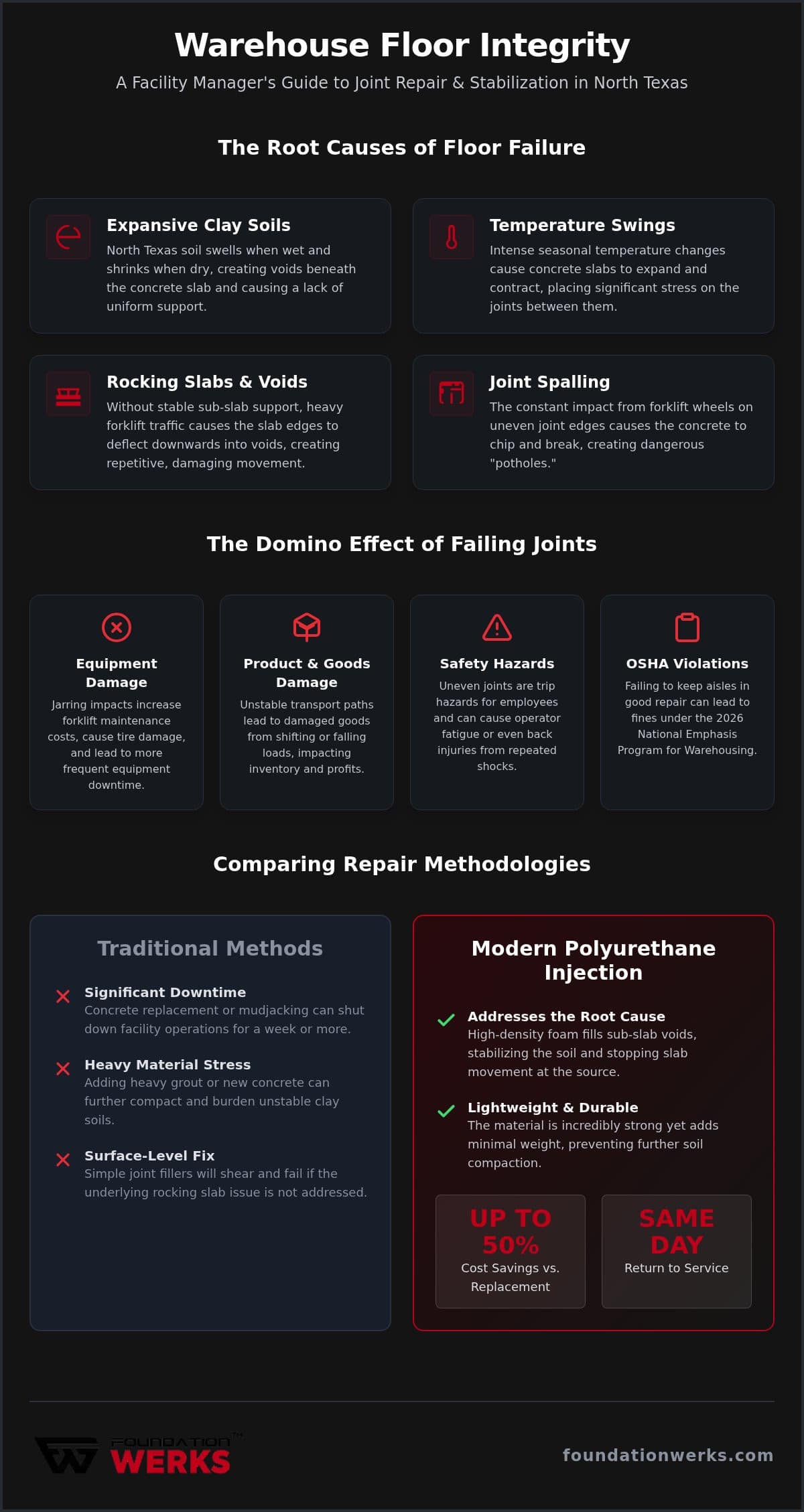
The DFW Metroplex presents a unique set of challenges for concrete. Our region is famous for its expansive clay soil. This soil acts like a sponge, swelling when it’s wet and shrinking during our intense Texas summers. These constant volume changes create voids beneath the slab. When temperature swings cause the concrete to expand and contract, the lack of uniform support leads to rocking slabs. This movement creates an “Impact Gap” where forklift wheels strike the edge of an uneven joint. The result is rapid concrete spalling and structural degradation that only gets worse over time.
Why Traditional Joint Fillers Often Fail
Many facility managers try to solve the problem by simply pouring more filler into the gap. This rarely works because most fillers are designed for static loads, not the dynamic forces of a moving forklift. If the slab underneath is rocking, the filler will eventually shear or pop out. Durable warehouse floor joint repair requires addressing the sub-slab support. Without stabilizing the base, surface-level patches are just temporary bandages on a structural wound. You need a solution that stops the movement before you seal the surface.
The High Cost of Neglecting Joint Maintenance
Ignoring a failing joint is an expensive decision. Every time a forklift “jumps” a joint, the impact damages the tires and puts immense stress on the axles. You’ll see higher maintenance costs for your fleet and more frequent equipment downtime. Beyond the machinery, uneven joints lead to damaged goods and increased operator fatigue. In some cases, the jarring impact can even cause back injuries for drivers. For a deeper look at how this affects your building, read our guide on Uneven Warehouse Floor Repair in Dallas.
The Mechanics of Joint Spalling and Rocking Slabs
While surface damage is visible, the real trouble usually hides beneath the concrete. Voids form under warehouse slabs when the soil shrinks or if the initial site compaction wasn’t sufficient. In North Texas, our clay soils are notorious for this behavior. When a slab loses its sub-grade support, it no longer sits flush against the earth. As a heavy forklift travels across the floor, the slab edge deflects downward into that empty space. Rocking slabs are the primary mechanical driver of joint degradation. This repetitive movement acts like a pair of giant scissors, shearing the joint filler and grinding the concrete edges against each other.
The progression happens faster than most managers realize. It starts as a hairline separation between the concrete and the joint filler. Once that seal is broken, debris and moisture enter the gap. Each time a load passes, the vertical movement widens the crack. Eventually, the edges of the concrete begin to chip away, leaving large, jagged voids that threaten both equipment and safety.
Identifying Sub-Slab Voids
You can often spot the signs of a void before a major failure occurs. Look for visible vertical movement as a forklift crosses a joint. You might also hear a distinct hollow sound, which can be confirmed by a simple chain-drag test. In some cases, water may even seep up through the joints during wet seasons. These voids compromise load transfer, meaning the weight of the forklift isn’t distributed evenly across the floor. This leads to non-compliance with OSHA Hazards regulations, which require aisles and passageways to be kept in good repair. Restoring slab-to-soil contact through professional void filling is the first step in any warehouse floor joint repair project.
Spalling: The Forklift’s Worst Enemy
Joint spalling is the chipping and breaking of concrete at the joint edges. These jagged edges create a “pothole” effect that is especially hard on small-diameter forklift wheels. The impact causes the wheel to drop and then slam into the opposite edge of the slab. This force accelerates the chipping, making the hole larger with every pass. Many facilities try to use shallow epoxy patches to smooth things over. However, if the slab is still rocking, those patches will pop out within weeks. Effective repair requires proper joint preparation, including cleaning out old debris and stabilizing the slab base. If you’re noticing these issues, a professional void filling and stabilization assessment can identify the root cause before the damage spreads.
Polyurethane Injection vs. Traditional Joint Repair Methods
Choosing the right method for warehouse floor joint repair depends on balancing operational speed with structural integrity. Traditional mudjacking uses a heavy slurry of sand, cement, and soil. This mixture weighs about 100 lbs per cubic foot. In contrast, our polyurethane foam weighs only 2 lbs per cubic foot. This 98 percent weight reduction is crucial for the delicate soil balance in North Texas. Adding massive weight to already unstable clay often leads to further sinking. Our patented foam, crafted from recycled materials, provides the necessary lift without the burden of excess weight on the subgrade.
While some contractors suggest full concrete replacement for rocking slabs, it’s often an unnecessary expense. Polyurethane injection offers a durable restoration that addresses the root cause of movement at a fraction of the cost. It fills the voids and stabilizes the soil, creating a solid foundation for the joint. This approach avoids the massive disruption of demolition and pouring new slabs, which can take a facility offline for a week or more. By stabilizing what you already have, you achieve a long-term solution without the high price tag of new construction.
Speed of Implementation: Immediate Usability
Logistics hubs in North Dallas and Irving don’t have time for 24-hour epoxy cure cycles or multi-day concrete setting times. While traditional joint fillers or replacements might keep a lane closed for days, polyurethane injection allows for immediate “drive-on” capability. Research into The Mechanics of Joint Spalling shows that delays in stabilization lead to more severe edge failure. By choosing foam, you can have your crew back on the floor the same day the job is completed. This minimal disruption is essential for facilities that operate 24/7 and cannot afford to lose a single shipping lane.
Drill Hole Comparison and Aesthetics
The physical footprint of the repair matters for the floor’s long-term health and appearance. Mudjacking requires large, unsightly holes that are often 1 to 2 inches in diameter. These large penetrations can actually weaken the slab further. We use 5/8-inch drill holes that are nearly invisible once patched. These small injection points preserve the floor’s aesthetics while delivering high-density stabilization. Unlike traditional soil-based mixtures that can wash away or settle over time, polyurethane maintains its density indefinitely. It doesn’t lose volume or shrink, ensuring your slabs remain supported against the dynamic loads of high-speed forklift traffic for years to come.
Preventing OSHA Hazards: A Facility Manager’s Maintenance Checklist
OSHA’s revised National Emphasis Program for Warehousing, effective July 31, 2026, has intensified the focus on floor safety. Inspectors are specifically looking for trip hazards and conditions that could lead to forklift accidents. In the first 18 months of the previous program, OSHA identified over 1,700 violations. Many of these stemmed from poorly maintained aisles and passageways. Identifying the need for warehouse floor joint repair early is the best way to avoid these penalties. It demands a systematic approach to identifying structural instability before it becomes a liability.
- Check for spalling: Look for chipped or jagged concrete edges at every joint.
- Monitor vertical displacement: Identify slabs that are no longer flush with their neighbors.
- Inspect joint filler: Look for separation, cracking, or missing sections of sealant.
- Test for movement: Observe slabs as heavy equipment passes to detect rocking or deflection.
- Clean debris: Ensure joints aren’t filled with hard materials like gravel or metal shards that prevent slab expansion.
The 1/4-Inch Rule: When to Call a Specialist
Vertical displacement of 1/4 inch or more is generally considered a critical safety violation. In a high-traffic environment, this small lip creates a massive impact for small-diameter forklift wheels. You can measure this easily. Place a straightedge across the joint and use a ruler to check for gaps. If the slab deflects under the weight of a forklift, the problem is likely a sub-slab void. Proactive warehouse floor joint repair is essential here. Addressing the issue while it’s still a minor displacement is often 50 percent cheaper than a full concrete replacement once the slab eventually cracks under the stress.
Mastic and Joint Seal Maintenance
Surface protection is your first defense against structural failure. Proper joint sealing and mastic installation act as a buffer. They protect the fragile concrete edges from direct impact and prevent debris infiltration. When hard debris gets trapped in a joint, it prevents the concrete from expanding during North Texas temperature swings, which leads to further spalling. Additionally, intact seals prevent water from reaching the sub-grade clay. As we’ve noted, moisture causes the soil to swell and destabilize the floor. Scheduling recurring maintenance ensures the durable restoration of your facility’s safety. For more information on managing structural gaps, see our guide on Commercial Concrete Crack Repair.
Industrial Stabilization and Joint Repair with Foundation Werks
Foundation Werks serves as the premier authority for warehouse floor joint repair throughout the DFW Metroplex. From the high-traffic logistics centers in Dallas to the growing industrial parks in McKinney, Frisco, and Prosper, we understand how local soil conditions impact your operations. We don’t just patch the surface; we provide a durable restoration by addressing the root cause of slab movement. Our approach combines technical expertise with a commitment to the community we call home.
Sustainability is a core part of our mission. We use a patented polyurethane foam made from recycled materials. This eco-conscious formulation provides the lifting power needed for heavy industrial loads while remaining lightweight enough to prevent further soil compression. By choosing this modern method, you’re investing in a long-term solution that respects both your facility’s budget and the environment. Our process is designed to be efficient, transparent, and minimally invasive.
Our Proven Polyurethane Process
Every warehouse floor joint repair follows a methodical three-step lifecycle: Diagnose, Stabilize, and Seal. We begin with a thorough evaluation to locate sub-slab voids and measure vertical displacement. Once the plan is set, we use minimal 5/8-inch drill holes to inject our stabilizing foam. There is no grout splatter, no heavy concrete trucks, and no massive demolition mess. We pride ourselves on maintaining a clean work environment that won’t disrupt your internal logistics.
The most significant advantage for our commercial clients is the same-day usability. While traditional concrete work can sideline a warehouse for days, our polyurethane reaches 90 percent of its full strength within minutes. You can have forklifts back on the floor and goods moving through the repaired lanes the same day we finish. We respect your time and your production schedule.
Why DFW Businesses Trust Foundation Werks
Local business owners and facility managers consistently choose us because we deliver on our promises. Clients like Kevin C. and Dan W. have noted our professionalism and the quality of our durable restoration work. We position our polyurethane stabilization as a strategic financial choice. It typically costs 50 percent less than full concrete replacement, allowing you to reallocate those savings to other facility improvements.
You don’t have to settle for rocking slabs and OSHA hazards. We’re here to help you restore floor flatness and protect your equipment. If you’re ready to see the difference a stabilized floor makes, contact us for a free estimate in the Dallas area. Let’s keep your North Texas warehouse moving safely and efficiently.
Secure Your Facility’s Future Efficiency
Maintaining a safe and productive industrial environment in North Texas requires more than just filling surface gaps. It requires understanding the mechanics of your slab and the expansive clay soil beneath it. By identifying voids early and utilizing polyurethane injection, you can achieve a durable restoration that protects your equipment and your employees. This modern approach to warehouse floor joint repair is 50 percent more cost-effective than full replacement and keeps your facility running without long operational closures.
Foundation Werks uses a patented eco-friendly recycled foam that allows your concrete to be driven on the same day. We take pride in serving the entire DFW Metroplex with professional stabilization services that respect your time and your budget. You can restore floor flatness and meet OSHA standards without the mess of traditional construction. We are ready to help you strengthen your infrastructure with reliable, long-term solutions.
We look forward to helping you stabilize your facility and keep your North Texas operations moving forward with confidence.
Frequently Asked Questions
How long does warehouse floor joint repair take to cure?
Polyurethane injection cures almost instantly, reaching 90 percent of its full structural strength within 15 to 30 minutes. This rapid set time is why warehouse floor joint repair with foam is the preferred choice for high-traffic facilities. Unlike traditional epoxy or concrete replacement that requires 24 to 48 hours of downtime, our process allows your forklifts and heavy machinery to resume full operations on the same day the work is completed.
Will polyurethane foam lose density or settle over time?
High-density polyurethane foam is hydro-insensitive and won’t lose density or shrink after it has cured. It maintains its structural volume regardless of moisture levels in the North Texas clay soil. This stability ensures that the sub-slab support remains consistent under heavy dynamic loads. This method provides a durable restoration and a long-term solution that resists settling far better than traditional soil-based mudjacking or surface-only patches.
Can you fix rocking slabs without replacing the entire floor?
Yes, rocking slabs can be stabilized without the expense and massive disruption of full concrete replacement. We use specialized void filling and stabilization techniques to inject foam into the empty spaces beneath your concrete. This process restores slab-to-soil contact and stops the vertical movement that causes joint damage. It is a strategic alternative that typically saves facility managers 50 percent of the cost compared to pouring new slabs.
How large are the holes drilled for polyurethane injection?
We use minimal 5/8-inch drill holes for our injection process, which are roughly the size of a dime. These small penetrations are far less invasive than the 1 to 2-inch holes required for traditional mudjacking. Once the stabilization is complete, we patch the holes with a color-matched material. This ensures the floor’s aesthetic remains professional while maintaining the structural integrity required for a successful warehouse floor joint repair project.
Is polyurethane foam lifting safe for food-grade warehouse environments?
Yes, our polyurethane foam is safe for use in food-grade warehouse environments. Once cured, the material is completely inert and won’t leach chemicals or emit harmful vapors. We use a patented eco-conscious foam made from recycled materials, making it a sustainable choice for sensitive facilities. The clean injection process also prevents the dust and debris associated with concrete demolition, which is critical for maintaining strict sanitation standards.
What is the cost difference between joint repair and concrete replacement?
Polyurethane stabilization and joint repair generally cost about 50 percent less than full concrete replacement. The savings come from reduced material costs and the elimination of expensive demolition and disposal fees. Additionally, the immediate usability of the floor prevents the high cost of facility downtime. By choosing repair over replacement, DFW businesses can address structural issues while keeping their operational budget focused on growth and equipment maintenance.
Do you provide joint repair services in McKinney and Frisco?
We provide comprehensive joint repair and stabilization services across the entire DFW Metroplex, including McKinney, Frisco, Dallas, and Prosper. Our team is familiar with the specific challenges posed by the expansive clay soils in these North Texas communities. Whether you manage a small local distribution center or a massive regional logistics hub, we have the equipment and expertise to handle your industrial concrete needs with professional care.
How do I know if my warehouse floor joints are an OSHA violation?
A warehouse floor joint is often considered an OSHA violation if it presents a vertical displacement of 1/4 inch or more. These trip hazards are a primary focus of the 2026 National Emphasis Program for Warehousing. You should look for visible chipping, rocking slabs, or any uneven edge that jars a forklift as it passes. Proactive maintenance helps you avoid heavy fines and ensures your facility remains compliant with federal safety standards.