

An uneven warehouse floor may point to a support problem beneath the slab, not damage on its surface. That distinction matters. Warehouse floor void filling addresses empty space under concrete, while cracks and joints need different repair work. Identifying the issue helps facility teams plan a targeted response without disrupting more of the floor than necessary.
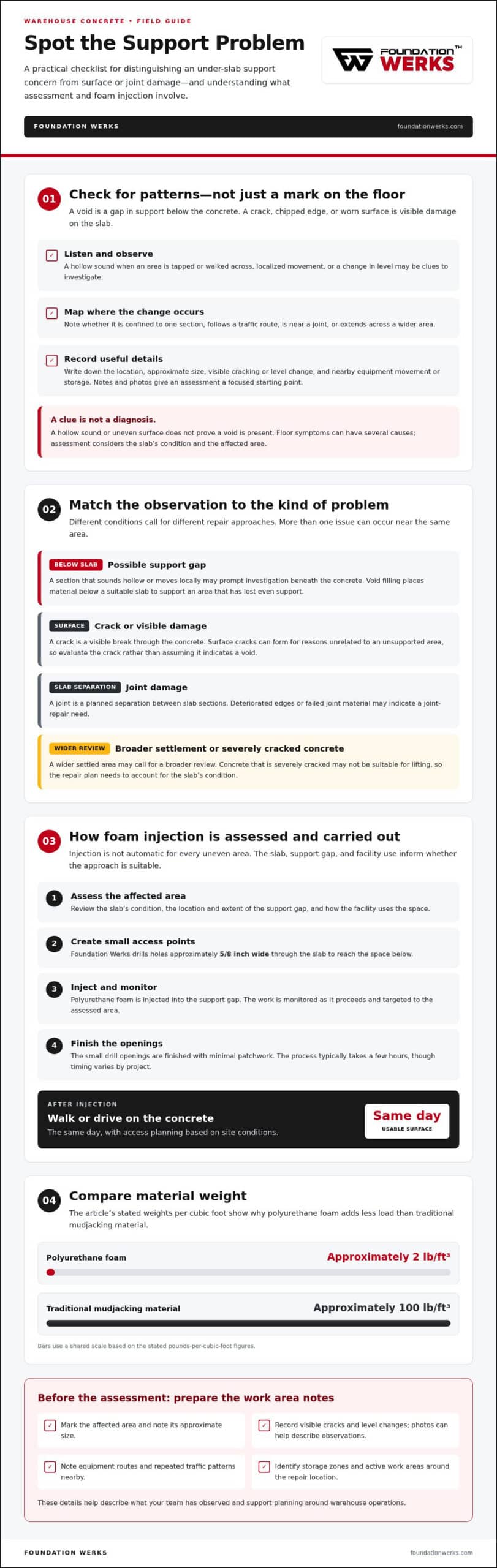
Forklift traffic, trip hazards, and downtime are understandable concerns when a slab settles or feels uneven. Polyurethane foam injection can support suitable concrete through small drill holes, with minimal patchwork. The foam weighs approximately 2 pounds per cubic foot, compared with approximately 100 pounds per cubic foot for traditional mudjacking material. After the work is completed, the concrete can be walked or driven on the same day.
This guide covers signs of a possible void, how assessment and injection work, and how void filling differs from crack or joint repair. It also explains what to consider when planning around active operations. Foundation Werks serves commercial properties across the Dallas metropolitan area, helping North Texas facility teams address concrete support needs and plan a practical next step.
Key Takeaways
- Look for patterns that may point to lost support beneath a slab, rather than assuming every uneven spot is a surface defect.
- Warehouse floor void filling starts with assessing the slab and affected area. Injection is not automatically right for every condition.
- Match the repair to the problem: fill support voids beneath suitable concrete, address damaged joints separately, and consider replacement when the slab is too compromised.
- Prepare for an assessment by mapping the affected area and noting nearby equipment routes, storage zones, and active work areas.
- North Texas facility teams can explore polyurethane void filling and concrete stabilization from Foundation Werks for commercial slabs.
Warehouse Floor Void Filling: How to Recognize a Support Problem
Warehouse floor void filling places material beneath a concrete slab to support an area where the underlying ground no longer supports the concrete evenly. A void is below the slab, unlike a visible crack, chipped edge, or worn surface. The term “void” generally describes an empty space within a material or structure; What is a Void? offers a broader materials-science example. For a warehouse floor, the practical question is whether the concrete has lost support underneath, not simply whether its surface looks damaged.
That distinction matters in an active facility. Forklifts, pallet jacks, stored goods, and repeated traffic routes place regular demands on the slab. A localized change in support may affect how equipment crosses an area or how nearby loads are handled. But floor symptoms can have several causes, so appearance alone cannot show exactly what is happening below.
What signs may point to a void beneath a warehouse slab?
A hollow sound when an area is tapped or walked across can be a clue, as can localized movement or a change in level. Neither proves that a void is present. A surface crack may form for reasons unrelated to an unsupported area, while a small support gap may not be obvious from a quick visual check.
Look at the pattern and setting. Is the change confined to one section, following a traffic route, near a joint, or spread across a wider floor area? Record the location, approximate size, visible cracking or level change, and nearby activity such as equipment movement or storage. Notes and photos help describe what your team has observed and give an assessment a focused starting point.
Take recurring changes seriously, but avoid diagnosing the cause from a single clue. An assessment considers the slab’s condition and the extent of the affected area. This helps distinguish a support concern from surface wear or broader settlement, and determine whether the concrete is suitable for injection.
How is a void different from a crack or failed joint?
A crack is a visible break through the concrete surface. A joint is a planned separation between sections of slab, and damage may appear as deteriorated edges or failed joint material. A void, by contrast, is a gap in support below the concrete. These problems can occur near one another, but they call for different repair approaches.
Notice where the symptom appears. Damage concentrated along a joint may point to a joint-repair need; a surface crack needs evaluation as a crack. A section that sounds hollow or moves locally may prompt investigation below the slab. A wider settled area may call for a broader review, and severely cracked concrete may not be suitable for lifting. If joint damage is the main concern, consult the published guide to warehouse floor joint repair alongside an assessment of the floor.
Clear observations help facility teams describe the problem without assuming its cause. That gives the assessment a useful starting point and helps match the repair to the actual condition.
How Polyurethane Foam Fills Voids Beneath Warehouse Floors
Warehouse floor void filling should begin with an assessment, not the assumption that every uneven area needs injection. The slab’s condition, the location and extent of the support gap, and how the facility uses the area all inform whether foam injection is suitable. Concrete that is severely cracked may be too damaged to lift, so the repair plan must account for the slab’s condition.
Polyurethane foam weighs approximately 2 pounds per cubic foot. Its low weight means it adds less load than traditional mudjacking material, which weighs approximately 100 pounds per cubic foot. Iowa State University research has discussed high-density polyurethane foam in slab stabilization; its research on HDP foam for slab stabilization provides broader context for this application.
What happens during foam injection?
After the affected area has been assessed, small holes are drilled through the slab to provide access beneath it. Foundation Werks uses holes approximately 5/8 inch wide. Polyurethane foam is injected through these openings into the space below the concrete, where it fills the support gap and can help raise or stabilize suitable sections of the slab.
The work is monitored as it proceeds so the crew can respond to how the concrete behaves. Injection is targeted to the assessed area rather than applied across the floor indiscriminately. This measured approach matters in a warehouse, where the repair needs to address the support concern while accounting for the surrounding slab.
What happens after the void is filled?
After injection, the small drill openings are finished with minimal patchwork. The aim is to leave the work area orderly while restoring support beneath the treated concrete. The repair depends on the assessed scope and facility conditions, including the affected area and how the site is being used. Foundation Werks’ process typically takes a few hours from start to finish, though the timing can vary by project.
Completed concrete can be walked or driven on the same day. For facility teams, that can help with planning access around the repaired area, but the work plan should still reflect site conditions. Mapping equipment routes, storage, and active work zones before the visit helps coordinate the repair with warehouse operations.
An assessment can clarify whether foam injection fits the slab’s condition and the facility’s needs. Teams planning a repair can learn more about Foundation Werks’ polyurethane void filling and outline affected locations and operational priorities for the project.
Warehouse Void Filling Compared With Joint Repair and Slab Replacement
These repairs address different conditions, even when they appear in the same part of a warehouse floor. Void filling targets a loss of support beneath suitable concrete. Joint repair addresses deterioration at the surface, while slab replacement may be considered when the concrete is too damaged for a lifting approach. The right choice depends on the condition and location of the damage, not simply on how uneven the floor looks.
Separating the options helps facility teams make an assessment more productive. Note whether the concern is beneath a slab area, along a joint, or across concrete that appears broadly cracked or deteriorated. More than one issue can occur in the same zone, so the assessment should identify which condition each repair would address.
- Void filling: Injection places material below suitable concrete to fill a support gap and help stabilize or raise the slab.
- Joint repair: Repair or sealing addresses worn, damaged, or separated material at a visible joint.
- Slab replacement: Replacement may be considered when the concrete’s condition makes an injection-based approach unsuitable.
When does a warehouse floor need void filling rather than joint repair?
A suspected support gap beneath a slab calls for a void-filling assessment. Clues such as localized movement or a hollow sound can help identify where to investigate, but they do not establish the cause. A visible crack or uneven spot also does not automatically mean there is a void below it.
By contrast, deterioration focused at a joint, such as damaged or separated joint material, points toward evaluating the joint itself. The two conditions may be close together, but treating a surface joint does not fill a gap beneath the slab, and injecting below a slab does not repair damaged joint material. If joint damage is the main concern, the published guide to warehouse floor joint repair covers that separate repair category.
When might slab replacement need consideration?
Injection is intended for suitable concrete. Severely cracked slabs may be too damaged to lift, so replacement can enter the discussion when the concrete’s condition limits the usefulness of support work beneath it. That does not make replacement the default for every uneven or cracked floor. An assessment should consider the extent of cracking, the slab’s overall condition, and whether the issue is localized or spread across a larger area.
Before settling on an approach, connect the observed damage to the repair that can address it. Warehouse floor void filling supports suitable concrete where support is missing. It is not a substitute for repairing every crack, joint, or settled area. Matching the repair to the condition helps facility teams plan the next step with greater clarity.
Plan Warehouse Floor Void Filling Around Facility Operations
A good repair plan accounts for both the slab and the work happening around it. Warehouse floor void filling can avoid replacing suitable concrete, but the affected area still needs to be coordinated with equipment routes, storage, and active work. Start with what your team can observe, then use an assessment to clarify the repair scope and discuss how the work can fit the facility’s priorities.
A simple planning sequence helps organize that conversation:
- Map the affected area. Mark the location and approximate extent of the concern on a floor plan or site map.
- Note nearby activity. Identify forklift and pallet-jack routes, storage zones, loading areas, and workstations that may affect access.
- Arrange an assessment. Share your observations and discuss access, sequencing, and operational priorities as part of the project-specific estimate.
What should facility teams document before an assessment?
Record where the floor seems unsupported and how that section is used during a typical shift. Note nearby joints, cracks, slab edges, and changes in elevation, along with any hollow sound or localized movement your team has observed. These details describe the pattern without assuming its cause. Include access limits, storage that may affect the work area, and operational priorities that could shape the project plan.
For example, a concern beside a frequently used equipment route may need different coordination from one in a storage zone with limited movement. Photos and marked locations can help the project team understand where the issue appears and which surrounding areas need attention during planning.
How can a repair be coordinated with warehouse activity?
Discuss site access and work sequencing with the project team before scheduling. Identify which routes need to remain available, whether nearby materials or equipment affect access, and how the work area fits into ongoing activity. Foundation Werks’ process typically takes a few hours from start to finish, but that is planning context, not a promised schedule for every site. The assessed scope and facility conditions matter.
Completed concrete can be walked or driven on the same day. That does not mean the entire warehouse will operate without interruption. Plan around the specific repair area and coordinate access adjustments with the people who use it. A broader review of uneven warehouse floor repair can also help facilities consider floor-leveling concerns beyond a single suspected void.
Clear notes, an accurate site map, and an early discussion of workflows give the assessment a practical starting point. They also help align the repair plan with how the facility needs to function.
Warehouse Floor Void Filling in Dallas and North Texas
For North Texas facility teams, a floor concern raises practical questions: Is support missing beneath the slab? Which repair fits the concrete’s condition? How can the work be coordinated with warehouse activity? Foundation Werks is a McKinney-based concrete repair company serving commercial properties across the Dallas metropolitan area. Its polyurethane Void Fill service supports assessment-led warehouse floor void filling and stabilization for suitable commercial slabs.
The repair uses small access holes, approximately 5/8 inch wide, to inject foam beneath the slab. The foam weighs approximately 2 pounds per cubic foot. After the work, the holes need minimal patchwork, and completed concrete can be walked or driven on the same day. These details can help teams plan access, but they do not mean every facility will experience no disruption. The affected area and site conditions still shape the work plan.
What Foundation Werks brings to a warehouse void-filling project
Foundation Werks provides polyurethane concrete raising and void filling for commercial concrete. The process is targeted: an assessment helps determine whether the slab is suitable for support beneath it, rather than treating every surface crack or joint as a void. Severely cracked concrete may be too damaged to lift, so the slab’s condition matters when selecting a repair approach.
Small drill holes and minimal patchwork limit visible work at the surface. Facility teams can also discuss how the work area will be accessed and coordinated to keep the site orderly. That is a practical planning conversation, not a promise of zero disruption or uninterrupted operations. Share nearby equipment routes, storage areas, and work priorities so the project plan reflects how the warehouse is used.
How to take the next step for a North Texas facility
Before reaching out, note the affected slab area, visible changes, and how the location is used. Include access constraints or operational priorities that could shape the assessment and work sequence. A project-specific estimate gives the facility team a starting point for understanding the proposed scope and coordinating next steps.
For broader context on floor-leveling concerns, Foundation Werks’ guide to uneven warehouse floor repair in Dallas may help teams consider the condition of the surrounding floor. Each area should be assessed on its own, since visible unevenness does not by itself establish what is happening below the slab.
Foundation Werks offers a free estimate for commercial concrete work. Call 800-464-9684 to discuss a warehouse floor assessment and describe the area of concern, your facility’s workflows, and any access needs.
Give Your Warehouse Floor a Clear Next Step
Uncertainty about a floor can make it difficult to decide what to do next. Start with a focused question: does the concern appear to come from the slab’s surface, a joint, or a loss of support below the concrete? That distinction turns an uneven area into a practical assessment conversation without assuming the repair before the condition is understood.
For warehouse floor void filling, identify the area that concerns your team and explain how it affects daily operations. Note nearby routes, work zones, or storage, then bring those details into a project discussion. A clear picture of the facility’s needs helps shape an appropriate plan for the slab and the people who rely on it.
Foundation Werks works with commercial properties across the Dallas metropolitan area, including facilities in Frisco, McKinney, Dallas, Prosper, Allen, Fairview, Southlake, Irvin, and North Dallas, as well as the wider DFW area. To discuss your warehouse floor and operational priorities, request a free estimate and plan a project-specific next step.
A focused assessment is a practical way to move ahead with the facility’s needs at the center of the decision.
Frequently Asked Questions
Can every warehouse concrete slab be lifted after void filling?
No. A solid slab may be suitable for raising and stabilization, while severe cracking can leave concrete too damaged to lift. A crack by itself does not determine the answer. A narrow surface crack and a slab broken across a large area are different conditions to assess. The extent and overall state of the concrete help determine whether support work beneath it is appropriate or another approach should be considered.
How soon can warehouse staff use concrete after void filling?
Completed concrete can be walked or driven on the same day the work is finished. That does not mean a facility should assume every route will stay open throughout the project. The process typically takes a few hours, but the work area and site conditions affect planning. Before the project, identify routes staff or equipment need to use and coordinate access around the specific repair area.
Will polyurethane foam lose density beneath a warehouse floor?
Foundation Werks’ polyurethane foam does not lose density over time. This describes a characteristic of the foam, not a guarantee about how every slab or site will perform. The concrete’s condition and the support issue still matter when assessing a repair. If a floor changes after work is completed, record where and how it has changed so the condition can be reviewed in context.
How large are the holes used for warehouse void filling?
Foundation Werks uses drill holes approximately 5/8 inch in diameter for its polyurethane concrete raising process. The small openings need minimal patchwork after injection. Hole size can differ between methods, so this measurement applies to Foundation Werks’ process rather than every void-filling project. For facility planning, mark nearby equipment paths and storage that could affect access to the repair area.
Why can a void form beneath a warehouse floor?
A void forms when an area beneath concrete no longer provides the support the slab needs. The reason is site-specific, so a hollow sound, visible crack, or uneven area does not identify the cause by itself. For warehouse floor void filling, document where symptoms appear and whether they seem localized or extend across a larger area. That record helps an assessment distinguish what is observable from what still needs investigation below the slab.
Does warehouse void filling repair cracks and expansion joints too?
No. Void filling targets support beneath the slab; cracks and damaged expansion joints are surface conditions that may need separate repair work. A floor can have both types of concerns, so do not assume injection addresses every nearby defect. If joint separation or worn joint material is the main issue, use the warehouse floor joint repair guide for that topic. For visible cracking, the commercial concrete crack repair guide covers the separate repair concern.