

What if the problem beneath a shifting driveway isn’t the concrete, but the soil supporting it? If you’re asking “what is deep foam injection,” the key distinction is that it targets soil stabilization rather than simply lifting a slab. Knowing which surface is affected helps you ask the right questions and compare repair options.
It’s reasonable to want clarity before choosing a repair. Soil stabilization may not address a slab that has settled, and the right recommendation depends on the surface and conditions below it. In the Dallas area, expansive clay can swell and shrink as moisture levels change, making a site-specific assessment important.
This guide explains deep foam injection at a high level, where Foundation Werks may be considered for gravel areas, blacktop, and pavers, and how it differs from polyurethane concrete raising and void filling. You’ll also find a checklist for documenting visible changes and questions to ask a local contractor in the Dallas area.
Key Takeaways
- Learn what is deep foam injection and how it differs from lifting a concrete slab.
- See which surface types Foundation Werks identifies for Deep Foamjection™, and why suitability depends on a site assessment.
- Compare soil stabilization with concrete raising and void filling to better identify the issue you may need assessed.
- Use a simple checklist to document visible changes and prepare useful questions for a contractor.
- Understand what to ask about the recommended service, site limitations, and next steps in the Dallas area.
What Is Deep Foam Injection and What Does It Stabilize?
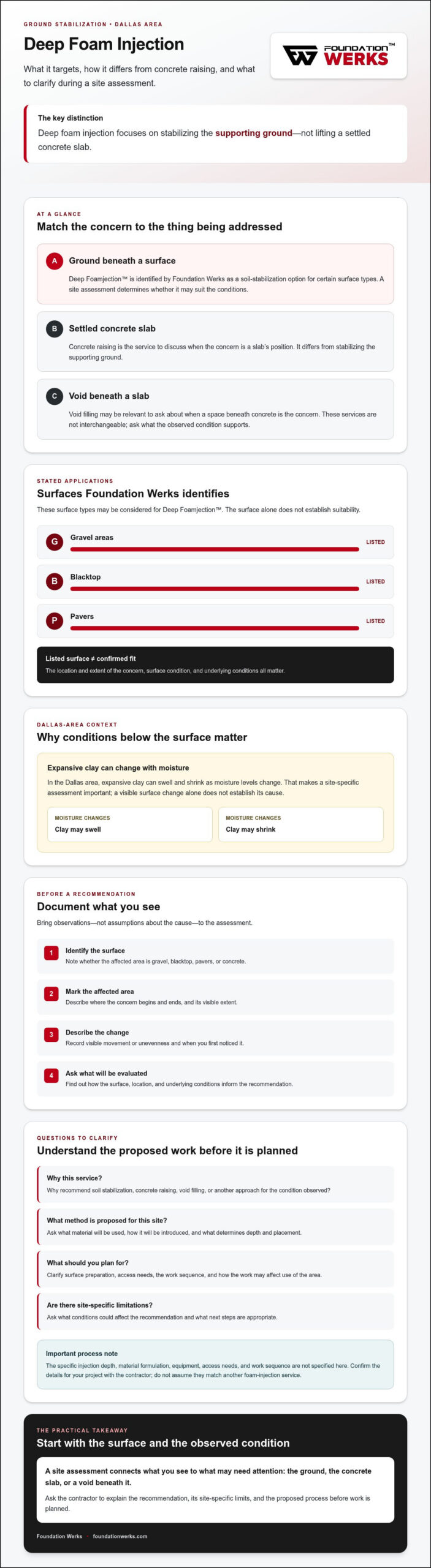
Deep foam injection is a ground-stabilization method that introduces foam into underlying ground to address soil conditions. Unlike concrete lifting, its focus is stabilizing the supporting ground, not raising a settled concrete slab. If you’re asking what is deep foam injection, the practical answer is that it may be considered when the concern involves ground beneath certain surfaces. A site assessment is needed to determine whether it suits a particular property.
Foundation Werks identifies Deep Foamjection™ as a soil-stabilization option for gravel areas, blacktop, and pavers. These are the stated applications, not a guarantee that every area with one of these surfaces is suitable. The location and extent of the concern, the surface condition, and the underlying conditions all need to be considered.
For a visual overview of the general topic, watch this video:
What does deep foam injection mean in plain language?
In plain language, the method applies foam into the ground with the aim of stabilizing it. “Ground stabilization” means addressing the supporting ground, rather than correcting the position of a concrete surface itself. The broader concept of injecting material into ground to improve soil or rock is described as pressure grouting. That general reference doesn’t confirm the specific materials, depth, or process used for Deep Foamjection™.
The distinction helps frame your assessment. If the concern involves movement in the ground beneath a gravel, blacktop, or paver area, ask a specialist whether this approach may fit. If a concrete slab has settled or has a void beneath it, concrete raising or void filling may be more relevant services to discuss.
Which surfaces does Deep Foamjection™ address?
Foundation Werks lists these applications for Deep Foamjection™:
- Gravel areas
- Blacktop
- Pavers
A surface type alone doesn’t establish suitability. Note where the affected area begins and ends, what changes you can see, and when you first noticed them. Ask the contractor what they’ll assess, why they recommend a particular service, and whether any site-specific limitations could affect that recommendation.
How Deep Foam Injection Works: What to Confirm About the Process
Knowing what is deep foam injection doesn’t tell you exactly how a particular project will be carried out. Foundation Werks identifies Deep Foamjection™ as a soil-stabilization option for gravel areas, blacktop, and pavers. Its injection depth, material formulation, equipment, access needs, and work sequence aren’t specified here. Ask the contractor to explain which details apply to your site before work is planned.
Separate the site assessment from the product-specific method. First, the contractor needs to understand the surface and the issue you’re seeing. Then they can explain whether Deep Foamjection™ may be appropriate and describe the proposed work. Don’t assume that details from another foam-injection service, including concrete raising, also apply to this method.
What happens during an initial site assessment?
Use the assessment to clarify the problem, not just to discuss a product. Show the affected area and describe what has changed, such as unevenness or movement, without assuming what caused it. Share the surface type, the location and extent of the concern, and when you first noticed visible changes. Ask what the contractor will evaluate and how those findings inform the recommendation.
Similar surface symptoms can have different underlying causes. Ask the contractor to explain why they recommend soil stabilization, concrete raising, void filling, or another approach. A useful recommendation should connect the observed condition to the proposed service, rather than treating those services as interchangeable.
What should readers know about injection details?
Before agreeing to work, ask for a clear explanation of the proposed method. Confirm what material is being used, how it will be introduced into the ground, and what determines the depth and placement. Also ask whether the surface needs preparation, what access the crew will need, and how the work may affect use of the area. These are project-specific details, not facts to infer from the term “foam injection.”
Research on polyurethane injection for railway infrastructure offers context on a different application, but it doesn’t establish the method or suitability of Deep Foamjection™ for your property. Review the research on railway substructure remediation as separate background, and ask the contractor to explain what evidence and limitations are relevant to your project.
Confirm project timing and access requirements as well. Ask what preparation is expected, whether anything should be moved or kept clear, and when the area can be used again. The estimate discussion should distinguish confirmed details from items that depend on site findings. To discuss a site-specific assessment, you can learn about Foundation Werks’ services.
Deep Foam Injection vs. Concrete Raising and Void Filling
These services address different concerns, even though each involves ground or concrete. Deep Foamjection™ is Foundation Werks’ soil-stabilization option for gravel areas, blacktop, and pavers. Polyurethane concrete raising addresses a settled concrete slab, while void filling and stabilization addresses an empty space beneath concrete. The surface and visible symptom can help guide the discussion, but they can’t confirm what’s happening below.
| Service | Problem addressed | Surface and questions for assessment |
|---|---|---|
| Deep Foamjection™ | Soil stabilization in the stated applications. | Gravel areas, blacktop, and pavers. Ask whether the ground conditions and affected area are suitable for this approach. |
| Polyurethane concrete raising | A settled concrete slab that may need lifting or leveling. | Concrete. Ask whether the slab’s movement points to a raising need and what the assessment found. |
| Void filling and stabilization | A void, or open space, beneath a concrete slab. | Concrete over a suspected void. Ask how the contractor determined a void is present and whether filling it is the recommended service. |
When is the concern about ground versus a concrete slab?
If a gravel area, blacktop, or pavers show changes, ask whether the underlying ground may need stabilization and whether Deep Foamjection™ fits the site. If a solid concrete walkway, driveway, or other slab has sunk, ask about concrete raising instead. These examples can help you identify which service to discuss, but they don’t diagnose the cause. A contractor needs to assess the specific area before recommending work.
How does void filling differ from soil stabilization?
Void filling focuses on space beneath a slab. Soil stabilization, by contrast, addresses ground conditions for its stated surface applications. They aren’t interchangeable descriptions for the same repair. Ask what condition the contractor observed, which service they recommend, and why that service fits better than the alternatives.
For a commercial floor example, the related guide Uneven Warehouse Floor Repair in Dallas: The 2026 Guide to Industrial Stabilization explores a different setting. The guide’s title doesn’t determine which service a particular floor needs. An assessment should connect the observed problem to the proposed work.
How to Assess Whether Deep Foam Injection May Fit Your Property
Before deciding whether to explore deep foam injection, collect a few clear details about the affected area. This won’t diagnose the cause, but it can help a contractor understand what you’re seeing and assess whether the service may fit. Since suitability depends on site conditions, ask for a reasoned recommendation rather than assuming the service is suitable based on the surface type alone.
What information should you gather before requesting an assessment?
Make a short record of the surface and changes you’ve noticed. Photos can help show the location and extent of the concern. Note whether the area is gravel, blacktop, pavers, or concrete, and include:
- Location: Identify where the affected area is on the property.
- Timing: Record when unevenness or movement became noticeable, if known.
- Site details: Mention access constraints and whether the property is residential or commercial.
These observations give the contractor useful context without asking you to determine what’s happening underground. If your property is in North Texas, ask whether the contractor can assess its specific location. Don’t assume availability or suitability based on a broad regional label.
What questions should you ask the contractor?
Ask what condition the proposed service is intended to address and what findings support that recommendation. If you’re still asking “what is deep foam injection, and could it suit my site?”, request a plain-language explanation of how the proposed work relates to the surface and the concern you reported.
Before approving a scope, clarify which project details remain uncertain. Ask what the assessment includes, what process is being proposed, whether access or preparation requirements apply, and how those points will appear in the estimate. If another service may be more appropriate, ask why. These answers help you compare the recommendation with the issue you described.
Assessment checklist: Record the surface, location, visible changes, timing, property type, and access constraints. A contractor must assess the site before confirming whether Deep Foamjection™ is suitable or recommending another service.
Deep Foam Injection in the Dallas Area: Understand Your Next Step
If you’ve learned what is deep foam injection, the next question is whether it matches the condition on your property. Foundation Werks offers Deep Foamjection™ for soil stabilization in gravel areas, blacktop, and pavers. A settled concrete slab or a suspected space beneath concrete may call for a different service, such as polyurethane concrete raising or void filling. The right recommendation depends on an assessment, not just the surface or visible symptom.
Foundation Werks is based in McKinney and serves the Dallas metropolitan area. The company’s local markets include Frisco, McKinney, Dallas, Prosper, Allen, Fairview, Southlake, Irvin, North Dallas, and DFW. Coverage can depend on the property’s location, so confirm availability for your address when you get in touch.
What can a Foundation Werks estimate help clarify?
An estimate is an opportunity to describe the affected surface, where the issue is, and what changes you’ve noticed. You can ask whether Deep Foamjection™ may fit the site or whether another offered service is more relevant. Before work is proposed, ask for an explanation of the recommended service, its scope, and any project details that still need to be confirmed.
To make the conversation useful, have the property location and surface type ready. If you have photos or notes about when movement or unevenness became noticeable, share those too. They can provide context, but a contractor still needs to assess the site to determine what may be appropriate.
How can you choose a practical next step?
Start by documenting the area and contacting a relevant local provider to ask about an assessment. During the estimate discussion, make sure you understand what condition the proposed work is meant to address, what the scope includes, and what happens next. If anything remains unclear, ask before deciding how to proceed.
Foundation Werks offers free estimates by phone at 800-464-9684. Describe the surface and concern, then confirm whether the property’s location and conditions may fit the service. An estimate can help clarify the recommendation, but it doesn’t guarantee a particular result.
Take the Next Step With a Clearer Picture
Understanding what is deep foam injection starts with knowing what it targets: underlying ground conditions, not simply a settled concrete slab. Foundation Werks lists Deep Foamjection™ for soil stabilization in gravel areas, blacktop, and pavers. Concrete raising or void filling may be more relevant for other concerns, so the surface and visible symptoms are only a starting point for assessment.
Before proceeding, note where changes appear and ask what condition the recommended service addresses, what the assessment found, and which project details still need confirmation. Foundation Werks is based in McKinney and serves the Dallas metropolitan area, including Frisco, McKinney, Dallas, Prosper, Allen, Fairview, Southlake, Irvin, North Dallas, and DFW. Contact the team to confirm whether your property is within its service area and discuss the affected surface.
Request a free estimate from Foundation Werks
A clear assessment can help you understand your options and choose a practical next step with greater confidence.
Frequently Asked Questions
What is deep foam injection?
Deep foam injection is a ground-stabilization method that introduces foam into underlying ground to address soil conditions, rather than simply lifting a concrete slab. Foundation Werks offers Deep Foamjection™ for soil stabilization in gravel areas, blacktop, and pavers. Whether it suits a particular property depends on an assessment of the site and the concern. The name alone doesn’t establish the injection depth, material formulation, or project method.
How does deep foam injection work?
Deep foam injection involves introducing foam into the ground as a soil-stabilization approach. The exact method, depth, materials, access needs, and work sequence can depend on the project, so confirm these details with the contractor rather than assuming they’re the same for every job. Ask what condition the proposed work is meant to address, what the assessment found, and which process details will be included in the estimate.
Is deep foam injection the same as concrete lifting?
No. Deep Foamjection™ is identified as a soil-stabilization option for gravel areas, blacktop, and pavers. Polyurethane concrete raising, also called concrete lifting, addresses settled concrete slabs. Void filling is another distinct service, intended for spaces beneath slabs. These methods aren’t interchangeable. If you’re unsure which issue you have, describe the surface and visible changes, then ask the contractor to assess the condition and explain the recommended service.
Can deep foam injection be used under pavers or blacktop?
Foundation Werks lists pavers and blacktop among the stated applications for Deep Foamjection™, along with gravel areas. That doesn’t mean every paver or blacktop project is suitable. Site conditions and the issue being addressed matter. Share where the movement or unevenness appears and ask the contractor to assess the area. Confirm why the method is being recommended and whether any site-specific limitations affect the proposed work.
How do I know whether I need soil stabilization or concrete void filling?
A contractor’s site assessment can help determine which service may fit. Soil stabilization addresses underlying ground conditions in the stated applications for Deep Foamjection™. Void filling addresses a space beneath a concrete slab. Visible movement alone can’t confirm what lies beneath a surface. Describe what you see, identify whether the surface is concrete or another material, and ask what condition the contractor found and why they recommend a particular service.
How long does a deep foam injection project take?
The project duration for Deep Foamjection™ isn’t specified here, so ask the contractor for a site-specific timeline. The time needed may depend on the project details, and concrete-raising timelines shouldn’t be treated as specifications for soil stabilization. Before work is scheduled, ask what preparation or access is needed, how long the planned work is expected to take, and when the affected area can be used again.
Does Foundation Werks offer deep foam injection near Dallas?
Foundation Werks is based in McKinney and serves the Dallas metropolitan area. Its Deep Foamjection™ service is listed for soil stabilization in gravel areas, blacktop, and pavers. Coverage can depend on the property’s location, so confirm availability for your address. If you’re in Frisco, McKinney, Dallas, Prosper, Allen, Fairview, Southlake, Irvin, North Dallas, or the wider DFW area, ask whether your specific property is within the service area.