

What if that jagged trip hazard on your driveway isn’t a demolition project, but a fifteen-minute science solution? For many McKinney homeowners, the sight of sinking concrete brings an immediate fear of expensive replacement and weeks of construction mess. You might have heard about foam lifting as an alternative, but you’re likely wondering: what is polyurethane foam and how long does it last McKinney? It’s a fair question. It is important to distinguish between the soft insulation in your walls and the high-density, structural material required to support a heavy slab.
We know how stressful it is to watch your property shift along with North Texas’s notorious clay soil. This article explains the science behind polyurethane concrete raising and why its lightweight, moisture-resistant properties make it a durable choice for our local environment. You’ll learn how this eco-friendly material stabilizes the ground beneath your feet and why it often lasts as long as the concrete itself. We will help you determine if your concrete can be saved by a local expert or if a full replacement is your only path forward.
Key Takeaways
- Understand the structural science of geotechnical polymers and get a clear answer to what is polyurethane foam and how long does it last McKinney when applied to local clay soils.
- Learn why high-density foam’s lightweight profile prevents the secondary sinking often caused by the massive weight of traditional mudjacking slurry.
- Discover how hydrophobic properties ensure your concrete stabilization remains intact and won’t wash away during heavy North Texas rainstorms.
- Identify the specific signs of sunken slabs and trip hazards to determine if your concrete is a candidate for a lift rather than an expensive replacement.
- See how the non-invasive injection process utilizes nearly invisible holes and allows for full property use on the same day the repair is finished.
What is Polyurethane Foam in the Context of Concrete Repair?
Geotechnical polyurethane foam isn’t the stuff in your couch cushions or the soft insulation found in an attic. It’s a high-density, closed-cell polymer engineered specifically for structural support. Many homeowners ask, what is polyurethane foam and how long does it last McKinney? In our local environment, it’s a structural solution that fills voids and lifts heavy slabs without adding the crushing weight of traditional materials. It’s a precision tool for a specific job.
The lifting process works through a controlled chemical reaction. Our technicians inject two separate liquid components through a tiny 5/8-inch hole. As these liquids mix at the injection tip, they expand rapidly. This expansion is incredibly powerful, allowing us to lift driveways, pool decks, and garage floors with pinpoint accuracy. Unlike spray foam insulation, which is designed to be airy to trap heat, lifting foam is rigid. It’s built to withstand the compressive forces of heavy vehicles and shifting soil without losing its shape.
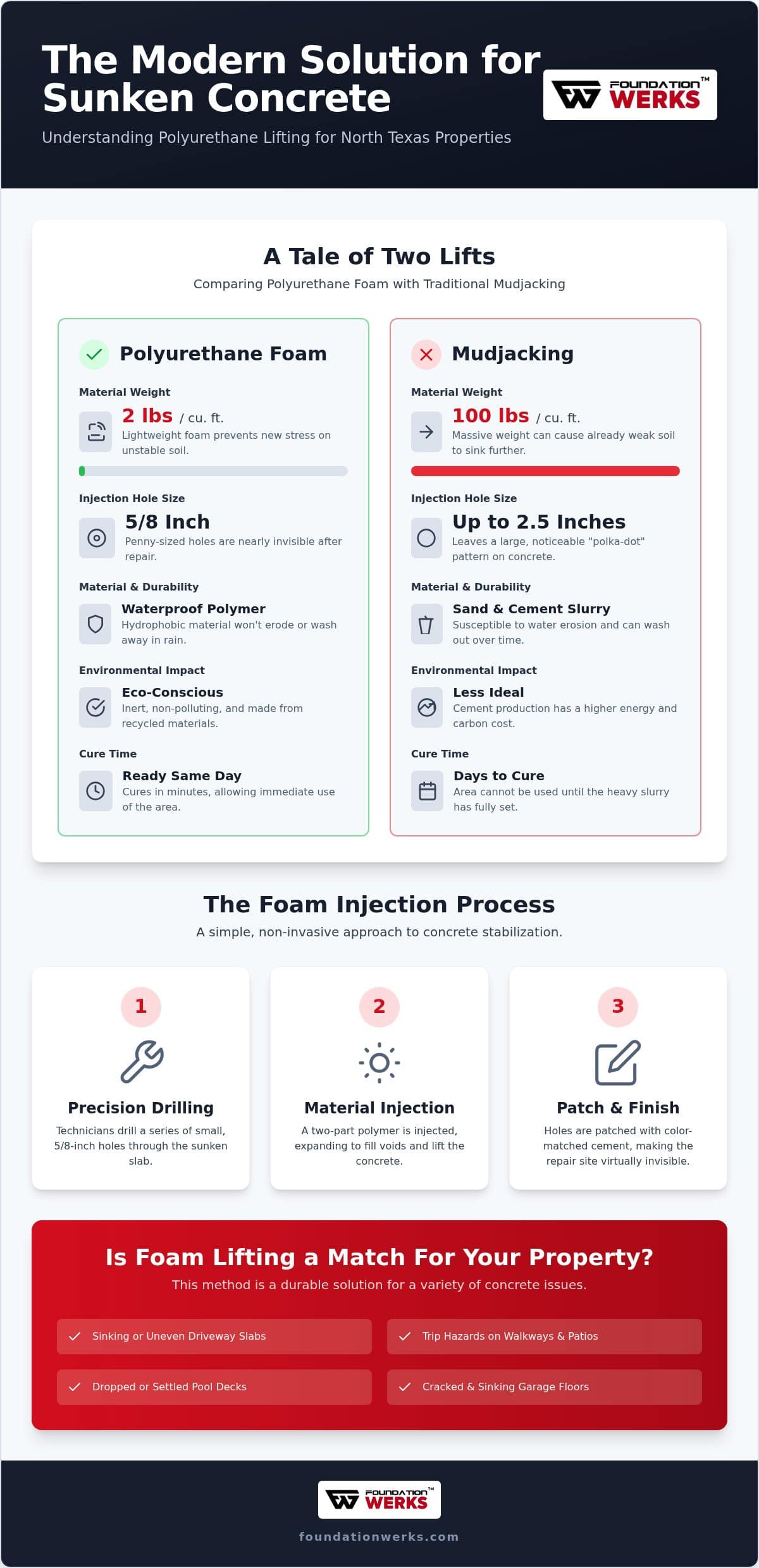
Weight is the most critical factor for properties in North Texas. Traditional mudjacking uses a slurry of sand, dirt, and cement that weighs about 100 pounds per cubic foot. Our high-density foam weighs only 2 pounds per cubic foot. This difference matters because adding massive weight to unstable clay soil usually causes the concrete to sink even further. Foam gives you the lift you need without the heavy burden that triggers future settlement.
The Difference Between Open-Cell and Closed-Cell Foam
You’ll often hear about open-cell foam for home comfort projects. It’s spongy and porous, which is great for trapping air but terrible for structural support. For concrete raising, closed-cell foam is the only choice. The cells are tightly sealed, creating a material that is completely waterproof. It won’t wick moisture from the damp Texas ground, and it won’t soften when the water table rises. This moisture-resistant structure ensures the foam remains stable beneath your slab for years to come.
Eco-Friendly Composition and Recycled Materials
We take pride in using a patented, eco-conscious foam made from recycled materials. This material is chemically inert once it cures, which means it doesn’t leach pollutants into the McKinney soil or local water table. It’s a clean process that respects the environment. By choosing a foam lift, you’re also reducing your carbon footprint. You’re opting to restore what you already have rather than paying for the massive energy costs and waste associated with a full concrete tear-out and replacement.
The Science of High-Density Foam: Why it Outperforms Mudjacking
Understanding the physics behind concrete settlement is the first step in choosing the right solution. Traditional mudjacking relies on a heavy slurry made of sand and cement. This mixture weighs approximately 100 pounds per cubic foot. In McKinney, where our expansive clay soil already struggles to support the weight of a concrete slab, adding thousands of pounds of heavy grout often backfires. The new weight can actually accelerate soil compression. High-density polyurethane foam offers a smarter path by providing structural lift at only 2 pounds per cubic foot.
This lightweight profile is why many property owners ask, what is polyurethane foam and how long does it last McKinney? Unlike mudjacking material, which is susceptible to erosion, polyurethane is hydrophobic. It doesn’t absorb water and it won’t wash away during the intense rainstorms common in North Texas. This resistance to moisture ensures the support remains consistent regardless of the season. For deeper issues, we utilize Deep Foamjection™ to reach unstable soil layers far below the surface, providing a level of stabilization that traditional methods simply can’t match.
The physical footprint of the repair is also much smaller. Mudjacking requires drilling holes up to 2.5 inches in diameter, which leaves a visible "polka-dot" pattern on your concrete. Our process uses 5/8-inch holes, which are about the size of a penny. These tiny entry points are nearly invisible once we patch them with color-matched cement, preserving the aesthetic value of your property.
Soil Stabilization and Void Filling
Concrete rarely cracks because it’s weak; it cracks because the ground beneath it has moved. As foam expands, it flows into the "hidden" voids that air and water have carved out over time. This expansion doesn’t just fill the empty space. It actively compacts the surrounding loose sub-base soils, creating a more solid foundation for the slab. Void filling is a targeted method used to eliminate air pockets and prevent future slab failure by restoring uniform support across the entire surface.
Non-Invasive Application and Speed
We prioritize a clean work environment for every project. There is no grout splatter, no heavy equipment tearing up your lawn, and no need for a massive wash-down after we’re done. This speed is especially vital for commercial clients. You can drive on a foam-lifted driveway or warehouse floor immediately after the injection is complete. This quick turnaround is why our method is a preferred choice for warehouse floor joint repair Dallas. If you’re ready to see if your concrete is a candidate for this process, you can schedule a professional assessment with our team today.
Longevity Factors: How Long Does Polyurethane Concrete Raising Last in North Texas?
The lifespan of a concrete repair depends entirely on the material’s ability to withstand the elements. When homeowners ask what is polyurethane foam and how long does it last McKinney, the answer lies in the material’s chemical stability. Geotechnical polyurethane is a closed-cell polymer that is completely inert once it cures. It doesn’t react with the surrounding environment. It doesn’t leach chemicals into the ground. Most importantly, it never loses its density or structural integrity over time. It’s a long-term solution designed to endure for as long as the concrete slab itself remains intact.
Biological factors often destroy traditional repair methods. Organic materials can rot, and mudjacking slurries can become breeding grounds for fungal growth or root systems that eventually break the bond. Polyurethane is different. It’s a synthetic material that offers zero nutritional value to pests, bacteria, or fungi. It won’t decompose or break down in the dark, damp environment beneath your driveway or pool deck. This resistance to decay is a primary reason why foam lifting remains effective decades after the initial application.
McKinney Soil Conditions: The Clay Challenge
McKinney sits on a foundation of Blackland Prairie clay. This soil is notoriously "active," meaning it expands significantly when wet and shrinks when dry. This constant movement creates a cycle of stress that snaps concrete and washes away loose fill dirt. Polyurethane foam addresses this by acting as a moisture barrier. Because it’s hydrophobic, it doesn’t absorb water or change volume during a drought. While no repair can stop the earth from moving, foam provides a stable, lightweight base that helps your concrete ride out these seasonal shifts without the secondary sinking caused by heavy grout.
Environmental Resistance to Heat and Chemicals
Texas summers are brutal, but they don’t affect the foam beneath your slab. Polyurethane is an incredible insulator. Since it’s buried under several inches of concrete and earth, it stays at a relatively consistent temperature year-round. It won’t melt, warp, or become brittle in the heat. It’s also highly resistant to common household and automotive chemicals. If you have a minor oil leak or gasoline spill on your driveway, you don’t have to worry about it dissolving the support structure below. The bond between the foam and the concrete is exceptionally tight, creating a seal that prevents surface fluids from reaching the sub-base and causing further erosion.
Identifying Concrete Issues: When to Choose Foam Lifting for Your McKinney Property
Identifying the early signs of concrete settlement can save property owners thousands in future replacement costs. In McKinney, the most common symptom is the emergence of trip hazards on sidewalks, patios, or pool decks. A vertical offset of just half an inch is enough to cause a fall and create a significant liability. For many residents evaluating their options, the question of what is polyurethane foam and how long does it last McKinney becomes urgent when they notice driveways pulling away from garage floors or large gaps forming beneath stoops. These gaps indicate that the soil has either washed away or compressed under the weight of the slab.
Sunken slabs aren’t always immediately obvious. You might notice your garage floor feels "hollow" when you drive over it, or you may see a slope developing that causes water to pool against your foundation. However, there is a limit to what foam lifting can achieve. If your concrete is severely cracked into multiple small pieces, often called "spiderwebbing," the slab may lack the structural integrity needed to be lifted as a single unit. In these cases, we’ll be honest with you about whether your concrete is a candidate for a lift or if replacement is the better path forward.
Commercial vs. Residential Applications
Business owners face unique challenges, particularly regarding OSHA compliance. An uneven floor in a high-traffic area is a safety violation that can lead to costly fines. We specialize in uneven warehouse floor repair Dallas to ensure forklift paths remain smooth and safe. For residential properties, we focus on restoring the utility of exterior spaces like patios and entry stoops. Whether it’s a commercial loading dock or a backyard pool deck, the goal is the same: providing a stable surface that stands up to daily use.
The Cost-Benefit Analysis
Choosing to raise your concrete is typically a much faster and more affordable decision than a full tear-out. On average, polyurethane concrete raising costs about half of what you’d pay for a total replacement. You also avoid the "hidden" costs of traditional construction. There are no heavy jackhammers, no dumpsters in your driveway, and no damage to your landscaping from heavy machinery. The 5/8-inch injection holes we use are nearly invisible once patched. This preserves your curb appeal and allows you to use the area the same day the work is performed.
Professional Concrete Stabilization: The Foundation Werks Approach
Foundation Werks operates with a simple philosophy: we treat your property like it’s our own. Serving McKinney, Frisco, and the wider DFW area, we understand that concrete issues are more than just an eyesore. They’re a source of stress and a potential liability. Our team acts as educators first, ensuring you understand exactly how the process works before any work begins. When homeowners ask us, what is polyurethane foam and how long does it last McKinney, we provide honest answers backed by years of local experience. We don’t just lift slabs; we provide a reliable service that respects your time and your property.
Our approach starts with a free estimate where we evaluate the root cause of the settlement. Once we begin, most residential projects are completed the same day. We use specialized equipment designed to have a minimal footprint. This means we don’t need to drive heavy trucks across your lawn or tear up your flower beds to reach a sunken patio or walkway. We take pride in being a company of real people who deliver on their promises, from punctuality to the final quality of the lift.
Our Minimal-Impact Installation Process
The technical precision of our work is what sets us apart. We drill a series of small, 5/8-inch holes in a strategic pattern across the affected slab. These holes are roughly the size of a penny and are much less invasive than the large ports used in older repair methods. We then inject the polymer with surgical precision, monitoring the lift in real-time to ensure a perfectly level finish. This controlled expansion allows us to stabilize the soil and lift the concrete without the guesswork.
Once the injection is complete, we patch the holes with a custom-mixed cement grout that blends with your existing concrete. Our final cleanup is thorough. We leave the job site exactly as we found it, but with level concrete. Since the foam reaches 90% strength within 15 minutes, your surfaces are "ready to play" or drive on almost immediately after we pack up our tools. It’s a clean, fast, and highly effective way to restore your property’s value.
Preserving Structural Integrity
A successful lift is often just one part of a comprehensive solution. To ensure the longevity of the work, we often recommend concrete crack repair commercial services to seal any gaps that allowed water to infiltrate the sub-base in the first place. Sealing joints with professional-grade mastic is a critical step. It prevents North Texas rain from reaching the soil and undermining the new support structure. By combining precision lifting with proactive maintenance, we help you get the most out of your existing concrete.
Restore Your Property’s Value and Safety
You’ve now got a clear understanding of why geotechnical polymers are the standard for modern concrete repair. By choosing a solution that works with McKinney’s active clay rather than against it, you protect your property from the cycle of sinking and settlement. Knowing what is polyurethane foam and how long does it last McKinney allows you to invest in your property with confidence.
Our expert crews serve McKinney, Frisco, and the entire DFW metroplex with a focus on precision and reliability. We use a patented, eco-friendly foam made from recycled materials that reaches 90% strength within 15 minutes. This means you get same-day usability for your driveway, pool deck, or warehouse floor without the mess of a full replacement. It’s a clean, efficient way to restore the structural integrity of your slabs.
Get Your Free Concrete Lifting Estimate Today
We look forward to helping you stabilize your concrete and reclaim your property’s safety and curb appeal.
Frequently Asked Questions
Is polyurethane foam for concrete the same as spray foam insulation?
Geotechnical polyurethane foam is not the same as the spray foam used in attics or walls. While both are polymers, the foam we use for concrete raising is a high-density, closed-cell material specifically engineered for structural weight-bearing. Insulation foam is designed to be lightweight and airy to trap heat. In contrast, our lifting foam is rigid and strong enough to support heavy slabs and vehicles without compressing or losing its shape.
How long does it take for the foam to cure before I can drive on it?
You can typically drive on your concrete just 15 minutes after the injection is complete. The polyurethane foam reaches approximately 90% of its full structural strength in this short window. This immediate usability is a major advantage over traditional concrete replacement, which requires days of curing time. Whether it’s a residential driveway or a commercial warehouse floor, our process ensures your daily routine is barely interrupted by the repair work.
Will the polyurethane foam wash away during a heavy North Texas rainstorm?
The foam will not wash away because it is hydrophobic, meaning it naturally repels water. Once the material cures beneath your slab, it becomes a solid, moisture-resistant barrier that stays in place regardless of the weather. Unlike mudjacking slurry, which can erode or soften during intense North Texas rainstorms, polyurethane remains structurally sound. It effectively seals the underside of the concrete and prevents water from further undermining the soil or causing additional erosion.
How long can I expect a polyurethane concrete lift to last in McKinney?
When people ask what is polyurethane foam and how long does it last McKinney, we explain that it is designed to last for the life of the concrete slab itself. Under ideal conditions, the material remains stable for decades because it is chemically inert and does not decompose. While no repair can stop future soil movement entirely, the foam provides a durable, lightweight foundation that outlasts traditional mudjacking by many years.
Is the foam used by Foundation Werks environmentally safe for my lawn?
Yes, our foam is environmentally safe and won’t harm your lawn or landscaping. We use a patented, eco-conscious polyurethane made from recycled materials. Once the foam has cured, it becomes chemically inert, meaning it does not leach harmful chemicals or pollutants into the surrounding soil or the local water table. It is a clean, non-toxic solution that provides structural stabilization without compromising the health of your property’s ecosystem or the local environment.
Can polyurethane foam lifting fix a foundation that is sinking?
Polyurethane foam lifting is designed for concrete slabs like driveways, sidewalks, and pool decks rather than structural foundation repair. While we offer residential and commercial foundation repair services, lifting a heavy perimeter foundation wall usually requires different methods. However, we do use foam for void filling and soil stabilization around foundations to prevent further erosion. We recommend a professional inspection to determine the best approach for your specific structural needs and soil conditions.
How big are the holes drilled into my concrete for the foam injection?
We only need to drill tiny 5/8-inch holes for the injection process. These holes are roughly the size of a penny, making them significantly smaller and less invasive than the 2-inch holes required for mudjacking. Once the lift is complete, we fill these entry points with a color-matched cement grout. This ensures the repair is nearly invisible, preserving the aesthetic appeal of your patio, driveway, or garage floor while providing the necessary structural lift.
Is polyurethane concrete raising cheaper than replacing the whole slab?
Yes, polyurethane concrete raising is typically much more cost-effective than a full replacement. In most cases, lifting your existing slab costs roughly half of what you would pay to tear out and pour new concrete. You also save money by avoiding the hidden costs of replacement, such as landscaping repairs and extended downtime. It is an efficient, budget-friendly way to remove trip hazards and restore the utility of your property without the massive expense.