

How much is a quarter-inch gap in your concrete actually costing your Dallas operation every day? You’ve likely seen the signs: forklifts jarring over uneven joints, workers navigating OSHA trip hazards, and the constant, expensive cycle of reapplying fillers that just won’t stay put. It’s frustrating to watch your floor fail while your 24/7 schedule leaves no room for major construction. You’re looking for a way to maintain momentum without sacrificing safety or structural integrity.
This guide helps you determine when to choose high-tech polyurethane concrete raising over a full slab replacement to restore smooth load transfers and protect your equipment. We’ll explore how addressing sub-slab voids in North Texas clay can provide a stable, long-term resolution for warehouse floor joint repair Dallas without the weeks of downtime required for a new pour. By understanding the root cause of settlement, you can move away from temporary patches and toward a more sophisticated, efficient maintenance strategy that keeps your facility moving forward.
Key Takeaways
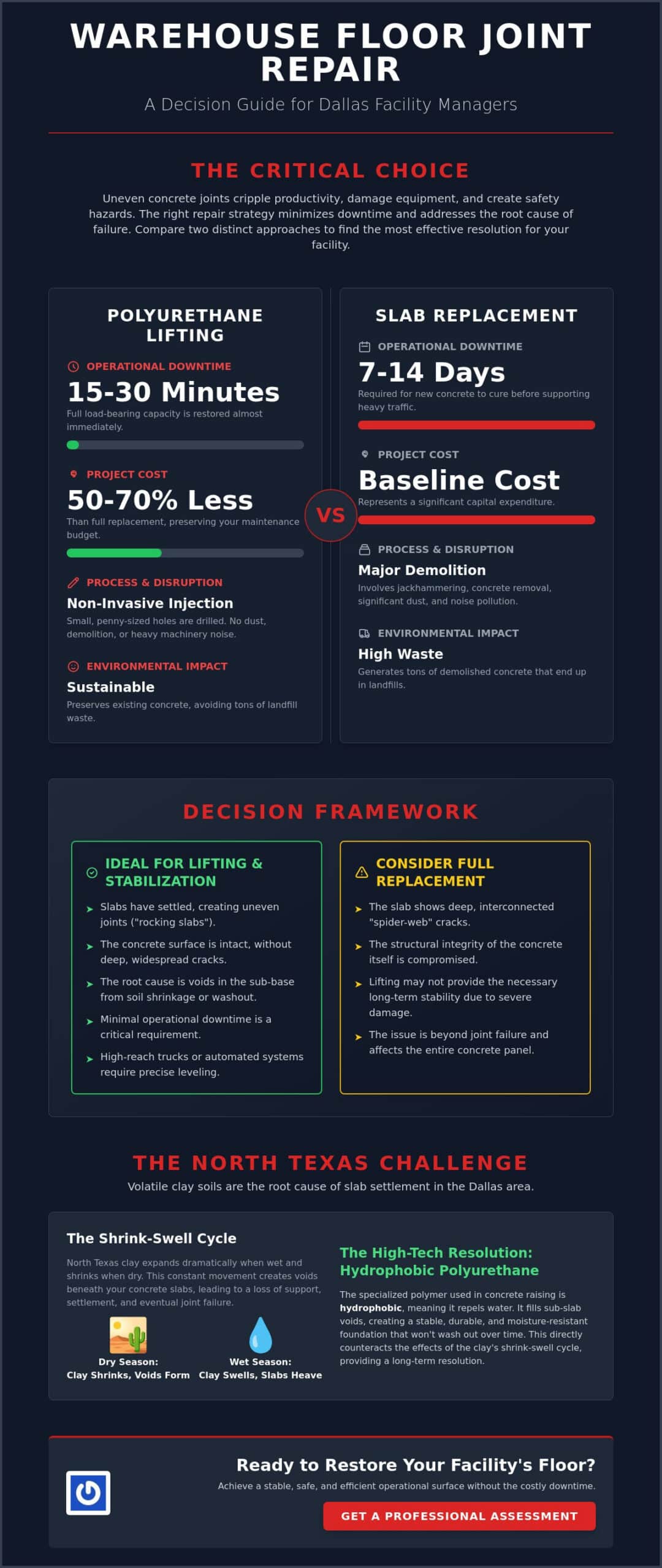
- Compare the drastic downtime differences between traditional replacement, which requires up to 14 days of curing, and polyurethane raising that supports heavy loads in under 30 minutes.
- Learn why the volatile shrink-swell cycles of North Texas clay require a specialized approach to warehouse floor joint repair Dallas to maintain slab alignment.
- Identify the visual cues that dictate your repair strategy, from surface-level joint spalling that favors lifting to deep structural cracks that may necessitate a full replacement.
- Discover the technical advantages of using hydrophobic polyurethane, a modern material that resists moisture and provides a stable foundation without washing out over time.
- Protect your equipment and bottom line by restoring smooth load transfers between concrete slabs, which significantly reduces forklift damage and maintenance expenses.
Concrete Raising vs. Replacement for Warehouse Joints
Choosing between tearing out a slab and opting for a modern restoration method is a pivotal decision for any facility manager. Traditional concrete replacement is often viewed as the default, yet it carries a heavy operational price. A new pour typically requires 7 to 14 days of curing before it can safely support heavy forklift traffic. In a high-volume environment, two weeks of restricted access can cripple productivity and disrupt supply chains. Modern concrete leveling techniques offer a more agile alternative.
By contrast, polyurethane concrete raising allows your facility to resume full load-bearing operations within 15 to 30 minutes of application. This speed is essential for warehouse floor joint repair Dallas projects where every minute of downtime impacts the bottom line. Beyond speed, raising is an environmentally conscious choice. It utilizes specialized polymers and avoids sending tons of demolished concrete to Texas landfills, aligning your maintenance needs with corporate sustainability goals.
To better understand how these modern methods stabilize your facility, watch this helpful video:
The Problem with “Filler-Only” Repairs
Many facilities fall into a cycle of repeatedly patching joints with semi-rigid epoxy or polyurea fillers. While these materials are industry standards for surface protection, they aren’t designed to be structural. If there’s a void beneath the slab, the concrete will shift vertically when a heavy load passes over it. This phenomenon, known as “rocking slabs,” causes even the highest-quality fillers to crack or pull away from the joint edges. These uneven transitions damage forklift tires and can even cause errors in sensitive automated picking systems that require a perfectly level surface. Facilities dealing with these jarring transitions should explore professional uneven warehouse floor repair Dallas services to address the root cause before equipment damage compounds the cost.
The Efficiency of Polyurethane Stabilization
Instead of a messy demolition, polyurethane stabilization uses a non-invasive injection process. Technicians drill small, penny-sized holes through the slab to reach the underlying voids. Once injected, the industrial-grade foam expands to fill the empty space and lift the concrete back to its original position. This material offers high compressive strength, ensuring it can support the massive weight of heavy warehouse racking and constant machinery movement. It’s a precise, high-tech method that addresses the root cause of joint failure by providing a stable, long-term resolution without the chaos of a construction zone.
Decision Framework: When to Lift and When to Replace
Determining the right course of action requires a clear understanding of the slab’s current condition and the underlying causes of failure. For most facilities, polyurethane raising provides a highly effective resolution that typically costs 50% to 70% less than a full demolition and repour. This financial advantage, combined with the lack of operational downtime, makes lifting the preferred choice for many warehouse floor joint repair Dallas projects. You should look for specific indicators of stability before finalizing your strategy. Consulting resources like the TxDOT Concrete Repair Manual can help you align your facility’s maintenance with established regional standards for structural integrity.
The condition of the sub-base is often the deciding factor. If the North Texas clay has shrunk or washed away, creating a significant void, concrete lifting is a logical and cost-effective choice. However, if the slab itself shows deep “spider-web” cracks throughout the center of the panel, it usually signals that the structural capacity of the concrete has been compromised beyond the joint. In these cases, lifting might not provide the long-term stability you need, and a full replacement becomes the more prudent choice. Before committing to a costly tear-out, it’s worth exploring concrete stabilization before replacement as a strategic first step that can prevent new concrete from sinking into the same unstable subgrade.
Ideal Candidates for Warehouse Floor Stabilization
Slabs experiencing differential settlement, where one side of a joint has dropped lower than the other, are perfect candidates for professional warehouse floor stabilization. This is particularly critical for facilities utilizing high-reach trucks or automated systems, where even a slight tilt at the floor level can translate into significant sway at the top of a racking system. If your slab is intact but simply unlevel, lifting restores the smooth transition required for safe, high-speed operations. If you’re noticing these uneven transitions, it’s often wise to request a professional evaluation of your sub-slab conditions.
Signs Replacement is Necessary
There are instances where the concrete has reached the end of its functional life. If joint spalling has become so severe that the gap has widened beyond 2 inches, a simple fill and lift may not restore the necessary surface profile. Additionally, if the concrete is crumbling due to a poor initial mix or extreme chemical exposure, the material lacks the internal strength to be raised effectively. In these scenarios, replacing the affected panels ensures you aren’t just patching a failing foundation but are building back with the strength your facility demands. For facilities in the greater North Texas region, understanding how to vet qualified contractors is equally important, and reviewing the standards for commercial concrete leveling McKinney projects can help you apply the same rigorous criteria to your Dallas facility.
Achieving Long-Term Stability in Dallas Facilities
One common concern for facility managers is whether a repair will simply wash away during the next heavy Texas rainstorm. Traditional mudjacking, which uses a slurry of sand and cement, is susceptible to erosion and water damage. Modern polyurethane raising is different. The material is hydrophobic, meaning it repels water and won’t lose its structural integrity or wash out even in saturated conditions. This makes it an exceptionally reliable choice for warehouse floor joint repair Dallas, where seasonal flooding and high humidity are constant factors. Facility managers seeking a comprehensive overview of how sinking slabs and jarring transitions are resolved with minimal disruption can benefit from reviewing the latest guidance on uneven warehouse floor repair in Dallas to understand the full scope of industrial stabilization options available in 2026.
The primary driver of joint failure in North Texas is the volatile nature of the soil. The regional blackland prairie clay undergoes dramatic shrink-swell cycles, expanding when wet and contracting during the hot, dry summer months. This movement creates the sub-slab voids that lead to joint separation and slab rocking. Foundation Werks serves as the local expert in McKinney and Dallas, providing industrial stabilization that respects these unique environmental challenges. We don’t just patch the surface; we stabilize the foundation to ensure a long-term resolution for your facility.
The Role of North Texas Soil Management
Our high-density foam is engineered to stabilize what engineers call the “active zone” of the clay. By filling the gaps and compacting the loose soil beneath the slab, the foam creates a more uniform bearing surface. Once cured, the polyurethane foam acts as a moisture barrier under the slab to help mitigate the impact of future soil fluctuations. This technical approach prevents the localized settlement that typically causes joints to pull apart or become uneven.
Integrating Drainage with Joint Repair
While lifting restores the floor’s profile, managing the water around your building is equally important. Poor exterior drainage often allows water to pool near the foundation, which accelerates the formation of the very voids that cause warehouse joints to fail. A comprehensive approach often includes French drain installation to redirect water away from the building’s perimeter. By combining precise slab lifting with robust moisture control, you protect your investment and maintain the smooth, safe floor transitions your 24/7 operations require. This integrated strategy provides the most effective path toward structural stability in the demanding Dallas climate.
Restore Your Facility’s Structural Momentum
Navigating the complexities of warehouse maintenance requires a balance between long-term stability and immediate operational needs. You’ve seen how identifying the root cause of joint failure, specifically the active clay soils of North Texas, allows you to choose a resolution that minimizes disruption. While full replacement has its place for severely compromised slabs, polyurethane raising provides a sophisticated alternative that addresses sub-slab voids without the weeks of downtime associated with a new pour.
By choosing a strategy tailored to the specific demands of your facility, you protect your machinery and your team. Foundation Werks specializes in North Texas industrial soil stabilization, utilizing a patented eco-friendly foam made from recycled materials. This high-tech approach ensures your floors are traffic-ready in minutes, not days. When you’re ready to move beyond temporary patches, Schedule a Commercial Floor Assessment with Foundation Werks to secure a precise plan for your warehouse floor joint repair Dallas. We look forward to helping you maintain a smooth, efficient, and safe environment for your 24/7 operations.
Frequently Asked Questions
Is warehouse floor joint repair better than replacing the whole slab?
Repairing a joint is typically the superior choice when the slab’s structural integrity remains intact. While replacement requires up to 14 days of curing, specialized warehouse floor joint repair Dallas techniques allow you to resume operations almost immediately. This method is significantly more cost-effective and avoids the environmental waste of demolition. Unless the concrete is crumbling or severely cracked throughout the panel, lifting and stabilization provide a highly effective resolution.
How long does polyurethane warehouse floor stabilization last in Dallas?
Polyurethane stabilization is designed for exceptional longevity because the material is hydrophobic and resistant to chemical breakdown. Unlike traditional mudjacking, it won’t wash away or settle over time. In the challenging North Texas climate, this method provides a stable foundation that resists the shrink-swell cycles of local clay. While no solution is immune to extreme geological shifts, this high-density foam offers a reliable and durable resolution for industrial environments.
Will forklift traffic be interrupted during the joint repair process?
Interruption to your daily operations is remarkably minimal. Unlike concrete replacement that shuts down aisles for weeks, polyurethane raising allows for immediate load-bearing use within 15 to 30 minutes of injection. Our technicians work in small sections, meaning you don’t have to clear out the entire warehouse. You can maintain your 24/7 schedule while we restore the smooth transitions your material handling equipment requires for safe operation.
What causes warehouse floor joints to settle and become uneven?
Settlement is primarily caused by the formation of sub-slab voids, often triggered by the volatile clay soil found throughout Dallas and McKinney. When this soil expands and contracts, it leaves empty spaces that cause concrete panels to shift or “rock” under heavy loads. Poor exterior drainage can also wash away the base material. Addressing these voids through professional warehouse floor joint repair Dallas is the most effective way to restore structural stability and prevent further equipment damage.