

Did you know that the "black gumbo" clay beneath your DFW property can expand by as much as 40 percent when it gets saturated? This intense movement puts incredible pressure on your slabs, often leading to the uneven surfaces and deep cracks you see every day. If you’re worried about tripping hazards in your warehouse or a driveway that looks like it’s sinking into the earth, you’ve likely felt the frustration of a problem that seems out of your control. It’s a common struggle for anyone owning property in Texas, where the soil is famously restless.
In this guide, we’ll explain the specific relationship between local soil and your concrete. You’ll discover how modern polyurethane injection offers a durable, long-term resolution that stabilizes your property for the future. We’ll also preview why this lightweight, eco-friendly foam is often a more cost-effective choice than a full concrete replacement, allowing you to walk or drive on your surfaces the very same day the work is finished.
Key Takeaways
- Understand how the extreme shrink-swell cycle of Texas clay creates the underground voids responsible for sinking and cracking concrete.
- See why lightweight polyurethane foam is a superior long-term solution compared to heavy mudjacking, which can often lead to further settlement.
- Discover how a precision injection process using tiny 5/8-inch holes can lift your slabs with minimal disruption to your property.
- Learn how to save significant costs by choosing stabilization over full concrete replacement while regaining use of your surfaces the same day.
- Gain a simple maintenance checklist for managing moisture levels and expansion joints to ensure the ongoing stability of your concrete.
The Texas Soil Challenge: Why Concrete Sinks in the Lone Star State
Texas soil isn’t just dirt; it’s a dynamic force that constantly reacts to the environment. Across the DFW metroplex, the ground is primarily composed of high-plasticity clay that behaves like a sponge. When it rains, the soil absorbs water and expands with incredible force. When the heat of a North Texas summer arrives, that same soil dries out and shrinks, leaving empty pockets or voids beneath your concrete slabs. This relentless cycle is the primary reason why driveways, sidewalks, and warehouse floors eventually begin to dip and crack.
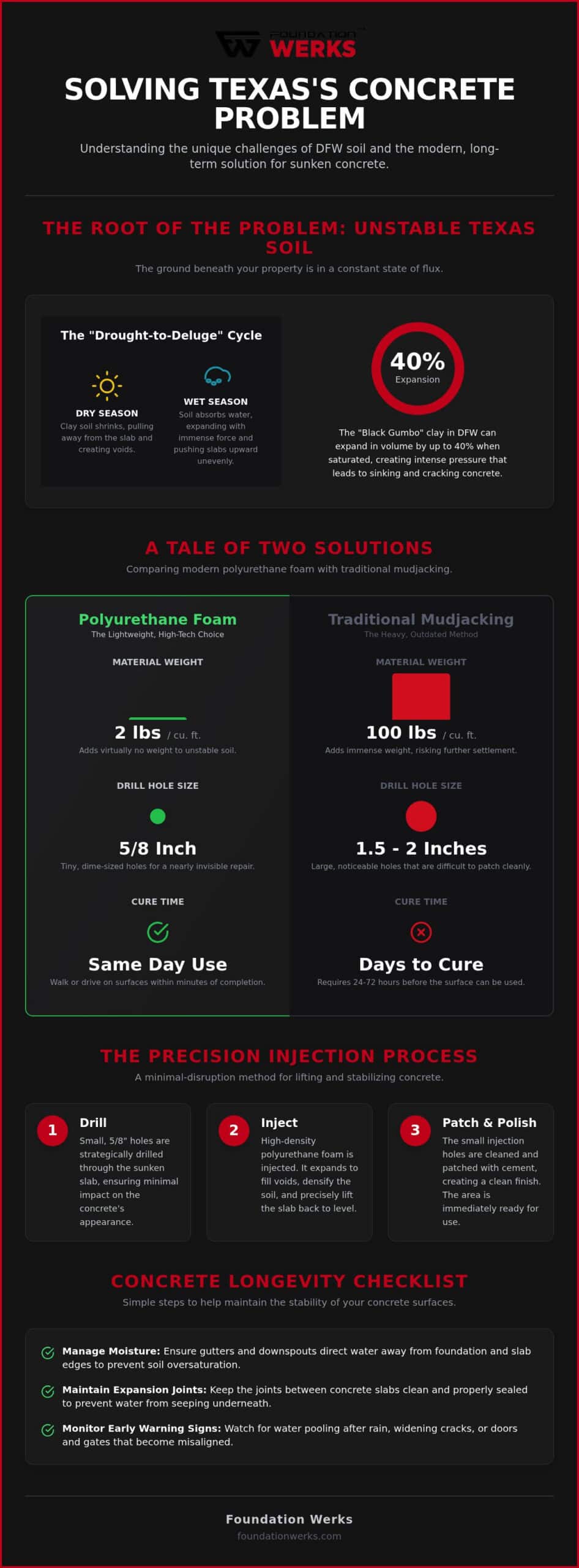
The most common type of expansive clay in our region is Houston Black clay, which is famous for its dramatic shrink-swell behavior. Research shows this soil can expand in volume by 30% to 40% when it becomes saturated. This movement creates a "Drought-to-Deluge" cycle that keeps your property’s foundation in a state of constant flux. Over time, the soil loses its ability to support the heavy weight of concrete, leading to the settlement issues many homeowners and facility managers face.
To better understand how these soil dynamics impact construction and stability in our region, watch this helpful video:
Expansive Clay: The ‘Living’ Soil of North Texas
In cities like McKinney, Frisco, and North Dallas, the soil is often classified as Vertisols. These are "living" soils that shift and move based on moisture content. When the clay shrinks during a dry spell, it pulls away from the bottom of your concrete. If you then apply a heavy traditional repair material, like the 100-pound-per-cubic-foot slurry used in mudjacking, you’re often just adding more weight to a failing surface. This extra weight can actually accelerate secondary settlement, making the problem worse over time. Understanding this soil profile is essential for finding a resolution that lasts.
The Role of Drainage and Erosion
Poor runoff management is another major factor in concrete settling. When water isn’t properly diverted away from your slabs, it can wash out the supporting soil or oversaturate the clay in concentrated areas. This uneven moisture level causes one side of a slab to heave while the other stays put, resulting in deep cracks and tripping hazards. We often see that property owners who neglect gutter systems or fail to install a French drain see much faster rates of concrete failure. Managing the perimeter moisture is a critical step in maintaining the long-term stability of any Texas property.
Identifying the early signs of settlement can save you from costly replacements later. Look for these red flags:
- Water pooling in specific areas of your driveway after a light rain.
- Expansion joints that are wider at the top than the bottom.
- Cracks in pool decks that seem to grow during the summer months.
- Doors or gates that no longer align with their frames.
Polyurethane vs. Mudjacking: Choosing the Best Long-Term Solution for Texas
When you’re deciding how to level your sinking concrete, you’ll likely compare traditional mudjacking with modern polyurethane foam. While mudjacking has been used for decades, it’s often a poor match for the unique geology of North Texas. The fundamental difference lies in how much weight you’re adding to an already stressed soil profile.
Mudjacking involves pumping a heavy slurry of sand, cement, and soil beneath your slab. This mixture weighs roughly 100 pounds per cubic foot. In contrast, our polyurethane foam weighs only 2 pounds per cubic foot. If you consult the Web Soil Survey from the USDA, you’ll see that our local clay has a limited bearing capacity. Adding thousands of pounds of heavy fill can actually force the slab to sink deeper into the soft soil over time.
The Weight Problem in DFW Foundations
Lightweight foam provides a resolution that respects the soil’s limits. By using an eco-friendly, recycled material that expands to fill every hidden void, we can lift the concrete without overloading the ground underneath. This density remains stable even through the brutal heat of a Texas summer. It’s a method that addresses the current settlement while preventing the heavy-weight "secondary settlement" that often follows traditional masonry repairs. We believe in providing a long-term solution that uses innovation to protect your property investment.
Cleanliness and Speed of Installation
The physical process of the repair also differs significantly. Mudjacking requires drilling large, unsightly holes, often two inches in diameter, which are difficult to patch. Polyurethane uses 5/8-inch holes, roughly the size of a dime, that are nearly invisible once we finish. There’s no grout splatter on your siding or heavy trucks tearing up your lawn. Our crews prioritize a clean workspace, ensuring that the only sign of our visit is your leveled concrete.
Speed is another major differentiator. Mudjacking materials can take 24 to 72 hours to fully cure. With polyurethane, the material reaches 90% of its full strength in just minutes. You can walk or drive on your driveway the same day the crew leaves. This rapid return to service is especially vital for commercial warehouses or busy residential driveways where every hour of closure matters. This efficiency is why many property owners choose specialized polyurethane concrete raising when they need to minimize downtime and avoid the mess of a full replacement.
Polyurethane Concrete Raising: A Technical Guide to the Process
The process of raising concrete with polyurethane is a controlled, surgical procedure. We don’t rely on guesswork. Instead, we follow a methodical series of steps to ensure the slab returns to its proper elevation. It starts with identifying the specific injection points that will provide the most effective lift. By mapping out these locations, our crews ensure the foam spreads evenly to fill the voids underneath without creating new stress points in the material.
Once the layout is set, we use precision 5/8-inch drill bits to create small access ports. These holes are roughly the size of a penny, which is much smaller than the large ports used in traditional methods. After drilling, we inject the high-density foam. As the two-part liquid enters the void, it reacts and expands, lifting the concrete with remarkable power. We monitor the lift in real-time, often using laser levels to ensure accuracy within a fraction of an inch. Finally, we patch the small holes with a specialized cementitious material that blends with your existing surface for a clean finish.
Void Filling and Stabilization
The primary goal isn’t just to lift the slab but to stabilize the ground beneath it. We utilize Deep Foamjection™ to address deeper soil issues that are common in Texas. This technique goes beyond surface leveling by injecting foam into the subgrade soils to increase their load-bearing capacity. This is particularly important because research on expansive clay soils in North Texas shows that unstable subgrades are the leading cause of foundation failure. Whether we’re working on residential pool decks or heavy-duty warehouse floors, filling these hidden voids prevents future water accumulation and keeps the slab supported.
Joint and Crack Repair for Durability
Lifting the concrete is only one part of the resolution. To ensure the work lasts, we must also address how water reaches the soil. Open cracks and failing expansion joints act like funnels, directing rainwater straight into the clay we just stabilized. We provide joint seal and mastic installation to create a watertight barrier. This step is a critical long-term solution for maintaining soil moisture balance. For business owners and facility supervisors, we’ve outlined these technical strategies in our Commercial Concrete Crack Repair: The 2026 Facility Manager’s Guide. Sealing these entry points prevents the shrink-swell cycle from starting all over again on your Texas property.
Texas Property Maintenance: A Checklist for Concrete Longevity
Maintaining your concrete in Texas requires a proactive approach. Because our soil is so reactive, ignoring small issues often leads to major settlement. Start with an annual inspection of your expansion joints and mastic seals. These joints are designed to allow the slab to move as temperatures shift, but when the seal fails, water reaches the subgrade. This moisture destabilizes the soil, leading to the sinking and cracking we discussed in previous sections.
Proper drainage is your best defense against soil movement. You want the moisture levels around your slab to stay relatively consistent. During extreme dry spells, using soaker hoses can prevent the clay from pulling away from the concrete. Conversely, you must ensure your runoff is working correctly. French drains and gutter extensions are essential for moving heavy spring rain away from your driveway or warehouse floor to prevent erosion.
Seasonal Concrete Care in the DFW Area
The North Texas climate brings a unique challenge every few months. During the summer, intense heatwaves cause the soil to shrink rapidly, creating gaps between the earth and your concrete. In the spring, flash flooding can wash out the supporting soil from under your sidewalk or pool deck. While our winters are usually mild, occasional freeze-thaw cycles can expand existing cracks if they aren’t properly sealed. Keeping your joints watertight protects the subgrade from these environmental swings year-round.
When to Call a Professional
Small cracks are warning signs. We recommend the "Quarter Test" to determine if you need a professional resolution. If you can fit a quarter vertically into a crack, or if there is a vertical displacement the height of a quarter, the slab has moved significantly. These offsets are more than just eyesores; they are tripping hazards that can lead to liability issues or OSHA violations in commercial settings. Addressing these early is a cost-effective way to avoid full concrete replacement.
Safety standards are particularly strict for industrial spaces. If you notice your forklift operators slowing down or pallets wobbling, your warehouse floor likely needs industrial stabilization. For more detailed technical advice on maintaining large-scale facilities, see our guide on Uneven Warehouse Floor Repair in Dallas: The 2026 Guide to Industrial Stabilization. Catching these issues early ensures a safer environment and provides a long-term solution for your facility.
Foundation Werks: Specialized Concrete Care for North Texas
Choosing a contractor to handle your property’s concrete issues requires more than just finding someone with a drill. It’s about finding a team that understands the unique geological pressures of North Texas. At Foundation Werks, we’ve built our reputation on being a reliable expert with a service heart. Whether you’re in McKinney, Frisco, or anywhere else in the DFW metroplex, we provide a level of expertise that respects both your time and your investment. Our crews aren’t just installers; they’re knowledgeable professionals who understand why your slabs are moving and how to stabilize them correctly.
One of the biggest concerns for property owners is the fear of a costly full concrete replacement. We focus on providing a resolution that is often half the cost of pouring new concrete. By lifting and stabilizing your existing slabs, we save you from the mess of demolition and the long wait times associated with curing new masonry. For residential projects, we focus on high-impact jobs with a minimum project size of $1800, ensuring every client receives the dedicated attention and high-quality materials their home deserves. It’s a straightforward approach that delivers results without the stress of a total overhaul.
Serving the Dallas-Fort Worth Metroplex
Our experience spans the entire region, from the residential neighborhoods of Prosper and Allen to the growing business districts in Fairview and Southlake. We understand that a business park in North Texas faces different drainage and weight-bearing challenges than a backyard pool deck. Facility managers across the DFW area trust us for warehouse floor joint repair because they know we prioritize precision and minimal downtime. We work around your schedule to ensure your operations keep moving while we address the safety hazards beneath your feet.
Start Your Property Resolution Today
We’ve designed our scheduling process to be as simple as possible for busy property owners. We know you’re looking for a long-term solution, not a high-pressure sales pitch. Our educators walk you through the process, explain the technical benefits of our eco-friendly foam, and provide a clear path forward. Our commitment to excellence is reflected in the experiences of our local clients. Kevin C. noted our team’s punctuality and professionalism, while Dan W. appreciated the clean, non-invasive nature of our work. These aren’t just testimonials; they’re a reflection of our promise to treat every property as if it were our own.
Don’t let sinking concrete become a liability or an eyesore. Our team is ready to help you find a durable resolution that restores the safety and value of your property. We provide clear, honest assessments for both residential and commercial projects across the metroplex.
Restore the Stability of Your DFW Property
Managing concrete in the Lone Star State doesn’t have to be a source of constant stress. By understanding how the expansive clay in Texas reacts to our extreme weather, you can make informed decisions that protect your investment. We’ve explored how lightweight polyurethane foam provides a long-term solution without the burden of heavy masonry or the disruption of full replacement. This modern approach respects the limits of our soil while delivering the results you need.
Our process uses patented eco-friendly foam and nearly invisible 5/8-inch drill holes to lift your surfaces with precision. You’ll enjoy the convenience of immediate usability, meaning you can walk or drive on your concrete the same day the work is finished. It’s a clean, efficient resolution designed for the way we live and work in the metroplex.
Request Your Free Concrete Raising Estimate
You don’t have to live with tripping hazards or unsightly cracks. Let our team of local experts help you stabilize your property and regain your peace of mind.
Frequently Asked Questions
Why does concrete sink so often in the Texas DFW area?
Concrete sinks across the DFW metroplex primarily because of the high-plasticity clay soil beneath our properties. These soils, often called "black gumbo," expand significantly when wet and contract when dry. This constant movement creates empty spaces or voids under your slabs. Over time, the heavy weight of the concrete causes it to settle into these gaps, leading to the uneven driveways and sidewalks common throughout Texas.
Is polyurethane foam lifting a long-term solution for my driveway?
Yes, polyurethane injection is considered a highly durable long-term solution for sinking concrete. Unlike traditional materials that can break down, our patented eco-friendly foam is specifically engineered to maintain its density and structural integrity for years to come. It provides a stable resolution for your property by filling the entire void and supporting the slab from beneath, ensuring your driveway remains level even as environmental conditions change.
How much does concrete raising cost compared to replacement in Dallas?
Raising your existing concrete with polyurethane foam is a cost-effective alternative that typically costs about half the price of a full replacement. Choosing to lift rather than replace saves you from the high expenses associated with demolition, removal, and pouring new material. It’s an efficient way to restore the safety and appearance of your property while significantly reducing the total financial investment required for the repair.
How large are the holes drilled for polyurethane concrete lifting?
We use precision 5/8-inch drill bits to create injection ports, which are roughly the size of a penny. This is a major advantage over traditional mudjacking, which requires much larger two-inch holes. Because our holes are so small, they are nearly invisible once we patch them with a matching cementitious material. This non-invasive process ensures your driveway or pool deck maintains a clean, professional look after the work is done.
Can I drive on my driveway the same day it is leveled?
Absolutely. One of the primary benefits of our polyurethane process is immediate usability. The foam reaches 90 percent of its full strength within minutes of being injected. Unlike new concrete pours that require days to cure, you can walk, play, or even drive your vehicle on the leveled surface as soon as our crew finishes the job. This minimizes downtime for your home or business in the busy DFW area.
Does Foundation Werks offer residential concrete repair for small jobs?
Foundation Werks focuses on providing high-quality, professional results for substantial property repairs. For residential projects in cities like McKinney and Frisco, we have a minimum project size requirement of $1800. This ensures that we can dedicate the necessary crew, specialized equipment, and premium materials to deliver a resolution that meets our standards for durability. If you have several areas needing attention, we can often group them into one comprehensive project.
What is the difference between mudjacking and foam lifting for Texas clay?
The main difference is weight. Mudjacking uses a heavy slurry weighing about 100 pounds per cubic foot, which can cause the fragile Texas clay to sink even further under the added load. Our polyurethane foam weighs only 2 pounds per cubic foot. This lightweight material provides the necessary lift without overloading the soil, significantly reducing the risk of secondary settlement that often occurs with heavier, traditional masonry repair methods.
Will the foam lose density or wash away during heavy Texas rains?
No, the polyurethane foam we use is a closed-cell material that is completely waterproof. It won’t wash away, leach into the soil, or lose its density, even during the heaviest North Texas rainstorms. Once the foam has expanded and cured, it becomes a solid, stable structure that remains unaffected by moisture. This durability makes it an ideal choice for stabilizing areas prone to erosion or poor drainage.