

Ignoring a hairline fracture in your warehouse floor isn’t just a cosmetic choice. It’s a financial gamble that could lead to an OSHA citation or a broken forklift axle. Most facility managers assume that once a slab starts to fail, a total replacement is the only path forward. However, industry standards suggest that if less than 30% of your floor area is damaged, concrete crack repair commercial strategies are often the more responsible choice. It’s about finding the right balance between surface sealing and the sub-surface stabilization that our North Texas clay soil requires.
We know the pressure of maintaining a safe, high-traffic environment while keeping operational downtime to a minimum. You need solutions that work quickly, without the staggering price tag of a new pour. This guide will teach you how to evaluate the severity of your concrete issues and choose the right techniques to protect your facility’s value. We’ll walk through modern repair methods, 2026 regulatory updates, and how to address the root causes of slab movement so you can keep your team safe and your equipment moving smoothly.
Key Takeaways
- Understand how North Texas expansive clay soil shifts commercial slabs and why early detection of stress fractures prevents larger structural issues.
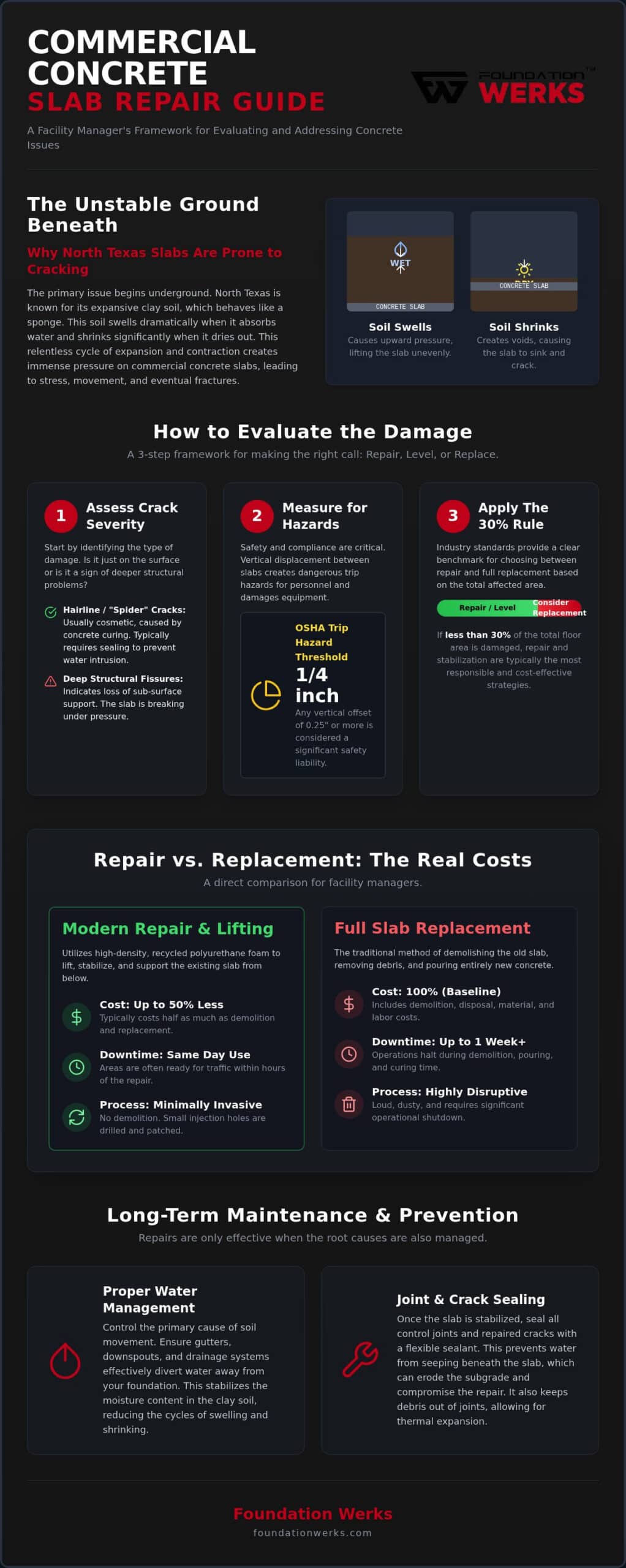
- Learn to apply the 30% rule for evaluating damage and how to spot OSHA trip hazards that exceed the 1/4 inch threshold.
- Discover why modern concrete crack repair commercial techniques using recycled polyurethane foam offer a faster, more cost-effective alternative to slab replacement.
- Explore how proper water management and sub-surface stabilization protect your repair investment and extend the life of your facility’s concrete.
Understanding Commercial Concrete Cracks: Why They Form
Commercial concrete cracks aren’t just an aesthetic annoyance; they’re structural stress fractures. These fractures occur when the internal or external pressures on a slab exceed its tensile strength. In North Texas, these pressures often start deep underground. Our region is known for expansive clay soil that acts like a sponge. It swells when wet and shrinks when dry. This constant cycle of movement creates a “push and pull” effect that forces concrete to bend until it eventually breaks.
You’ll likely notice two distinct types of damage in your facility. Surface-level “spider” cracks are usually shallow and result from the concrete drying too quickly during the initial pour. Deep structural fissures, however, indicate that the slab is losing its support system. Settlement cracks are specifically the result of the underlying soil failing to support the weight of the slab and the assets sitting on top of it. Identifying these early is the first step in effective concrete crack repair commercial planning.
Common Causes: From Shrinkage to Soil Erosion
Drying shrinkage is the primary reason new slabs often crack within their first year. As water evaporates, the material pulls inward. If there aren’t enough control joints, the concrete creates its own. Soil erosion is another major factor. Poor drainage allows water to wash away the subgrade, creating hollow voids. Without a solid foundation, the heavy slab eventually sinks into the empty space. Texas heat also plays a role. Thermal expansion causes concrete to grow in the summer. If joints are filled with debris, the slabs will crush against each other. Understanding these causes of concrete degradation helps managers prioritize repairs before a small gap becomes a major liability.
Industrial Load and Traffic Stress
In a warehouse or retail setting, the weight of your operations causes physical damage. Heavy forklift traffic creates a “rocking slab” effect. As wheels cross a joint, the weight shifts from one slab to the next. If there’s a void underneath, the slab deflects downward and then snaps back. This movement eventually cracks the edges and leads to edge spalling, where the concrete breaks off in chunks. It’s not just moving vehicles, either. Constant vibration from industrial machinery can fatigue the concrete over time. This cumulative stress turns minor fissures into deep-seated problems that require professional concrete crack repair commercial services to stabilize the area and prevent further deterioration.
Evaluating the Damage: Repair, Level, or Replace?
Deciding how to handle a failing slab requires looking past the surface. You shouldn’t treat every crack the same way. A simple filler won’t fix a slab that is physically sinking into a void. Professional concrete crack repair commercial projects start with a structural hierarchy. We look at whether the concrete is stable, if it has shifted vertically, or if the material itself has reached the end of its lifecycle. This assessment prevents you from throwing money at a temporary patch that will fail when the soil shifts again.
Safety is the primary driver for most facility managers. OSHA considers any vertical displacement of 1/4 inch or more to be a significant trip hazard. These offsets often occur at joints or where a structural crack has allowed one side of the slab to drop. Addressing these hazards is a matter of compliance and liability. For those managing routine maintenance of concrete pavements, identifying these shifts early can be the difference between a quick lift and a dangerous workplace accident.
The 2026 Commercial Decision Framework
We use a specific framework to determine the most cost-effective path forward. If you see hairline cracks with no vertical movement, surface sealing is usually sufficient to keep moisture out. However, if the slabs are uneven, you’ll need lifting and stabilization to restore the grade. Replacement is a last resort. It’s only unavoidable when the concrete is severely crumbled or shows “alligator” cracking patterns. These patterns indicate a total subgrade failure that a lift cannot resolve. If you aren’t sure which category your floor falls into, a professional slab evaluation can save you from a premature and expensive replacement project.
Cost Analysis for Facility Managers
The ROI of repair is often much higher than replacement. When you pour new concrete, you aren’t just paying for the material. You’re paying for demolition, disposal, and the long wait for the new slab to cure. Lifting a slab with polyurethane foam typically costs about half as much as a full replacement. You also have to consider the “invisible” costs of downtime. A new pour can shut down a warehouse aisle for a week. A professional concrete crack repair commercial project allows your team to get back to work the same day. For a deeper dive into these numbers, see our guide on Concrete Replacement vs. Lifting Cost: A Commercial Decision Guide for 2026.
Modern Solutions for Commercial Slab Stabilization
Modern concrete crack repair commercial projects have moved away from heavy, invasive methods. Traditional mudjacking once relied on a thick slurry of sand and cement. While effective in the past, that material is incredibly heavy. It often adds too much weight to the already struggling North Texas soil, which can lead to further sinking. Today, we use lightweight polyurethane foam to lift and stabilize slabs without the mess or the added burden on the subgrade.
This shift toward lighter, more precise materials aligns with the Concrete Pavement Restoration Guide, which identifies slab stabilization as a critical step in functional repair. By injecting foam directly into the pockets beneath your concrete, we perform “Void Filling.” This process supports the slab’s weight and stops the rocking effect that causes edge spalling. We only need 5/8-inch drill holes for this process. They’re about the size of a penny and leave a nearly invisible finish once patched.
Polyurethane Foam: The Sustainable Choice
Many facilities have strict ESG (Environmental, Social, and Governance) goals for 2026. Using a patented foam made from recycled materials helps you meet those benchmarks while fixing your infrastructure. For deeper soil issues, we use “Deep Foamjection” to stabilize the ground several feet below the surface. The biggest benefit for a busy warehouse is the speed. You don’t have to wait days for the material to cure. You can drive a forklift over the slab within minutes of us finishing the job.
Joint Sealing and Crack Filling Techniques
Once the slab is level and the voids are filled, we address the visible gaps. Choosing between Polyurea and Epoxy depends on how your floor is used. Polyurea is typically the better choice for control joints because it stays flexible. It moves with the concrete as it expands and contracts in the Texas heat. We prioritize cleaning and prepping every joint to ensure a long-lasting bond. Without proper prep, even the best fillers will eventually peel away from the concrete edges. Understanding why mastic or joint seal maintenance is important in preserving your concrete slabs is essential to making these repairs last. For a deeper look at these materials, check out our Commercial Concrete Joint Sealing: A Resource Guide for North Texas Facilities.
If you’re ready to stabilize your warehouse floors without the cost of a new pour, contact us for a professional site evaluation today.
Long-Term Maintenance: Preventing Future Cracking
Completing a successful concrete crack repair commercial project is a significant first step, but it shouldn’t be the last. Real value comes from protecting that investment through proactive maintenance. In the DFW metroplex, our expansive clay soil is always moving. If you don’t manage the environment around your slab, the same forces that caused the initial damage will eventually return. Maintenance isn’t just about aesthetics; it’s about stopping small fissures from evolving into expensive foundation failures.
Water is the primary enemy of commercial concrete. When water gets under a slab, it either softens the soil until it can’t support the weight or it washes the soil away entirely. This leads to the voids we discussed earlier. To keep your floors stable, you must control where that water goes. Ignoring a small, unsealed crack allows moisture to seep into the subgrade, which accelerates the degradation of the entire section. We recommend a seasonal inspection to catch these issues before they require another round of stabilization.
- Inspect all joint sealants for peeling, cracking, or loss of adhesion.
- Ensure gutters and downspouts are clear and discharging water away from the building.
- Check for “pumping,” which is when mud or water is forced out of a crack as heavy equipment passes over it.
- Look for new vertical offsets or trip hazards that may have developed after heavy rain cycles.
The Role of Commercial Drainage
Proper drainage is often the missing piece in a facility’s maintenance plan. French drains are highly effective at redirecting subsurface water away from your slab foundations. By keeping the moisture levels in the clay soil consistent, you reduce the swelling and shrinking that causes concrete to snap. We saw this firsthand with a McKinney warehouse floor. The facility was dealing with recurring sinking sections until we paired our lifting services with a dedicated drainage plan. Redirecting the runoff stopped the soil erosion and kept the slabs level through several seasons of heavy Texas rain.
Myth-Busting Commercial Repairs
A common misconception among facility managers is that thick concrete slabs are immune to cracking. In reality, even the thickest industrial pour will fail if the soil beneath it disappears. Another trap is the “DIY” patch kit. While these kits might look fine in a residential garage, they rarely hold up under the weight of industrial traffic or the vibration of heavy machinery. These brittle patches often pop out within months, leaving the crack exposed again. For a deeper look at what actually works, read our guide on Commercial Concrete Repair in McKinney: 5 Common Myths Debunked.
Securing Your Facility’s Structural Integrity
Managing a commercial facility in North Texas means staying one step ahead of the environment. You’ve seen how expansive clay soil and heavy industrial loads can compromise even the thickest slabs. By prioritizing concrete crack repair commercial strategies that focus on sub-surface stabilization, you avoid the massive costs and operational headaches of total slab replacement. The right approach balances immediate safety compliance with long-term water management to keep your floors level and your team productive.
At Foundation Werks, we specialize in solutions that respect your time and your budget. Our patented, eco-friendly foam is made from recycled materials and offers same-day usability, so your warehouse or retail center never misses a beat. We have served the entire DFW metroplex with a commitment to transparency and technical excellence. You don’t have to navigate these structural challenges alone.
Take the first step toward a safer, more efficient work environment. Get a Free Commercial Concrete Evaluation from Foundation Werks and let our experts help you protect your facility’s value. We look forward to helping you build a more stable foundation for your business operations.
Frequently Asked Questions
How much does commercial concrete crack repair cost per linear foot?
Costs for a concrete crack repair commercial project depend on the width and depth of the damage. We don’t provide flat rates because every facility has different load requirements and soil conditions. Structural repairs using epoxy injection often cost more than flexible joint sealing with polyurea. We provide custom quotes after a site visit to ensure you only pay for the specific stabilization your warehouse slab actually needs.
Can we use the warehouse floor immediately after the cracks are repaired?
You’re typically able to resume operations immediately after we finish the repair. Our polyurethane foam reaches 90% of its full strength within minutes of injection. Unlike traditional concrete replacement that requires days of curing, our stabilization process is built for high-traffic environments. This minimal downtime is a major benefit for warehouses and retail centers that can’t afford to stop equipment movement for long.
Is polyurethane foam lifting better than traditional mudjacking for commercial slabs?
Polyurethane foam is generally better for commercial slabs because it’s much lighter than the heavy slurry used in mudjacking. Traditional mudjacking can add thousands of pounds to unstable North Texas clay, which often causes more sinking. Our foam is eco-friendly and only requires 5/8-inch drill holes. This provides a cleaner finish and more precise lifting for large slabs without overloading the subgrade or creating a mess.
What is the difference between a control joint and a structural crack?
A control joint is a planned gap placed in the concrete to guide where it cracks as it shrinks. Structural cracks are unplanned fractures caused by soil movement or heavy loads. While joints need regular maintenance to keep debris out, structural cracks indicate a failure in the slab’s support. Identifying this difference is essential for a successful concrete crack repair commercial plan that lasts.
How do I know if my concrete crack is an OSHA violation?
OSHA typically flags any vertical displacement of 1/4 inch or more as a significant trip hazard. If one side of a crack has sunk, it creates an uneven surface that can cause falls or damage forklift tires. We recommend measuring the “lip” of any crack in your high-traffic areas. If it’s over that 1/4-inch threshold, it needs attention to maintain your workplace safety and compliance.
Does Foundation Werks offer warranties on commercial crack and joint repairs?
Yes, we stand behind our workmanship with specific warranties for our commercial projects. We understand that facility managers need a reliable partner who follows through on their word. Our team provides clear documentation of the work performed and the protections included. This accountability ensures you’ve got peace of mind knowing your slab stabilization is backed by a company that values quality and transparency.