

Did you know that a vertical displacement as small as a quarter-inch can be the difference between a safe property and a costly legal headache? In the shifting clay soils of North Texas, maintaining ADA compliant sidewalk repair Dallas standards is a constant battle for property managers who are already stretched thin. You’ve likely felt the frustration of watching your concrete heave and crack, knowing that traditional “rip and replace” methods will drain your budget and disrupt your tenants for days on end.
It’s a stressful position to be in, but you don’t have to choose between a dangerous walkway and a massive construction project. This 2026 guide is designed to show you how to resolve those trip hazards and achieve full ADA compliance using cost-effective, eco-conscious polyurethane leveling. We’ll walk you through why this lightweight solution is the smartest way to address Dallas soil issues while ensuring your facility stays open and accessible. You’ll learn how to secure a long-term resolution for your concrete surfaces that prioritizes both your bottom line and the safety of everyone who visits your property.
Key Takeaways
- Understand the specific legal thresholds for trip hazards and how North Texas soil conditions impact your long-term compliance strategy.
- Learn why polyurethane foam is the smartest choice for ADA compliant sidewalk repair Dallas, providing a lightweight solution that won’t further sink your slabs.
- Review the cost-benefit analysis of concrete lifting to see how you can save 50% compared to traditional replacement methods.
- Follow our 4-step guide to professional hazard mapping and precision leveling for a seamless repair experience with minimal disruption.
- Discover the benefits of using eco-friendly, recycled materials to stabilize your property’s walkways while ensuring same-day usability.
Understanding ADA Sidewalk Standards in Dallas and North Texas
Dallas property managers face a unique set of challenges. You walk your site and notice a small lip on a sidewalk joint. It looks minor, but under federal law, that tiny edge is a significant liability. Achieving ADA compliant sidewalk repair Dallas standards is more than a routine maintenance task; it’s a legal requirement for any business classified as a public accommodation. In North Texas, these standards are particularly difficult to maintain because the ground beneath our feet is constantly in motion.
Under Title III of the Americans with Disabilities Act, property owners are responsible for removing architectural barriers. This isn’t just a suggestion. Failing to address these hazards opens your business to “trip and fall” lawsuits and potential federal fines. Because Dallas sits on highly active soil, what was compliant last year might be a hazard today. Staying ahead of these changes requires a mix of regular inspections and a deep understanding of local environmental factors.
The 1/4 Inch Rule: Why Precision Matters
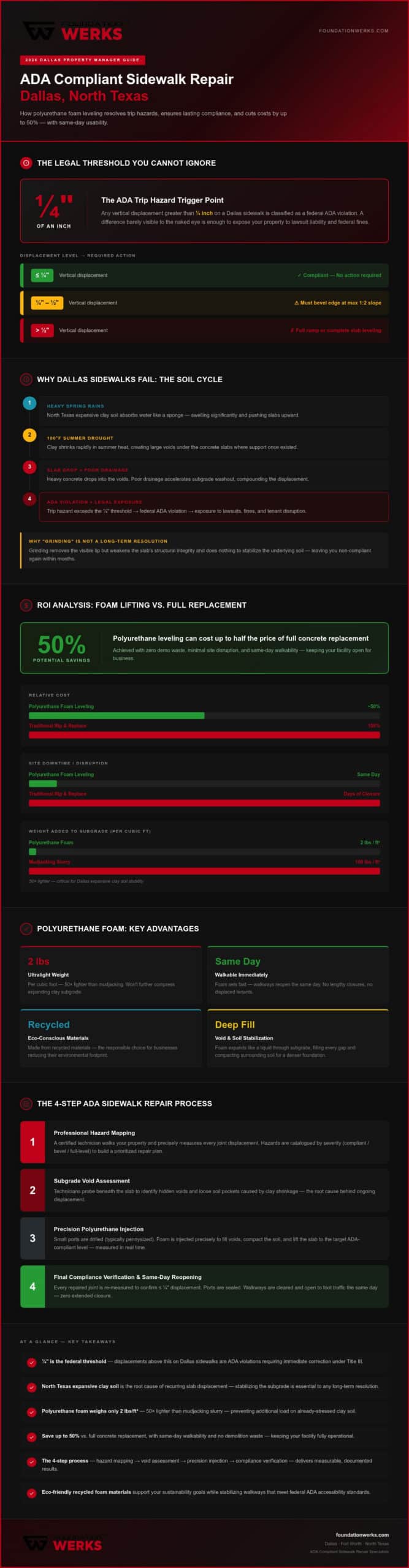
The 1/4 inch rule is the legal threshold for vertical displacement on Dallas sidewalks. According to ADA standards, any vertical change in level greater than 1/4 inch is considered a trip hazard and must be addressed. If the displacement is between 1/4 inch and 1/2 inch, the edge must be beveled with a slope no steeper than 1:2. Anything higher than 1/2 inch requires a full ramp or a complete leveling of the slab.
Many owners try to solve this by “grinding” the concrete. While this removes the immediate lip, it’s rarely a long-term resolution. Grinding weakens the structural integrity of the concrete slab and leaves it thin and prone to cracking. It also does nothing to address why the slab moved in the first place. Without fixing the underlying issue, the concrete will likely continue to sink, putting you right back into non-compliance within a few months.
Dallas Soil Erosion and Concrete Displacement
Why do sidewalks in DFW shift so frequently? The culprit is our expansive clay soil. This soil acts like a sponge, swelling when it’s wet and shrinking during our brutal summer droughts. When the clay shrinks, it creates massive voids under your commercial slabs. Without support, the heavy concrete eventually drops into these gaps, creating the very trip hazards that lead to ADA violations.
Local weather patterns accelerate this process. The rapid shift from heavy spring rains to 100-degree days causes the soil to move violently. Poor drainage often makes the situation worse by washing away the subgrade. Addressing soil erosion and concrete settling is the only way to ensure your repairs actually last through the next season. By stabilizing the soil and filling those hidden voids, you can keep your walkways level and your facility accessible for everyone.
The Polyurethane Solution: Why Foam Leveling Beats Traditional Methods
Polyurethane is the lightweight answer to a heavyweight problem. While mudjacking has been used for years, it often fails in the North Texas region because it relies on a heavy slurry. That mixture of sand and cement weighs about 100 pounds per cubic foot. When you add that much mass to the expansive Dallas clay we discussed earlier, you’re often just pushing the slab down further. It’s a cycle of sinking that many property managers find themselves trapped in.
Polyurethane foam is different. It weighs only 2 pounds per cubic foot. It provides the same lifting power without the crushing weight. This is the smartest path toward ADA compliant sidewalk repair Dallas because it respects the delicate balance of the subgrade. Our foam is also made from recycled materials, which makes it the responsible choice for businesses looking to reduce their environmental footprint while maintaining their infrastructure.
Deep Soil Stabilization and Void Filling
Lifting the concrete is only the first step. To ensure a long-term resolution, you have to fix what’s happening underneath. We use a specialized deep soil stabilization process to inject polyurethane directly into the loose soil and empty pockets beneath the sidewalk. As the foam expands, it moves through the subgrade like a liquid, filling every gap before hardening into a strong, lightweight support structure.
This process doesn’t just fill holes; it actually compacts the surrounding soil. This creates a much denser foundation that is better equipped to handle the weight of the concrete and the stress of foot traffic. If you’ve struggled with recurring trip hazards, it might be time to consult with a concrete lifting expert about stabilizing your subgrade and restoring safety to your walkways.
Minimal Disruption for High-Traffic Areas
One of the biggest headaches for property managers is closing down a facility for repairs. Standard replacement can take days, but polyurethane leveling is built for speed. We use 5/8-inch injection ports, which are roughly the size of a penny. These small holes are far less intrusive than the large gaps required for mudjacking and are nearly invisible once we’ve finished the cleanup.
- Immediate Usability: Pedestrians can walk or drive on the surface within minutes of the injection.
- Clean and Quiet: The entire setup is contained in a single truck, which is much quieter than traditional construction equipment.
- No Heavy Machinery: We don’t need to drive heavy trucks across your grass or landscaping to reach the repair site.
This efficiency allows you to achieve ADA compliant sidewalk repair Dallas standards without the chaos of a construction site. There’s no loud demolition noise to disturb your tenants and no messy cleanup to manage. It’s a clean, quiet, and efficient way to handle vital infrastructure updates in a busy urban environment.
ROI Analysis: Concrete Lifting vs. Full Replacement
When you’re managing a commercial property, every budget line item matters. You’ve likely seen the estimates for tearing out and replacing sunken walkways, and they’re rarely pleasant. Choosing ADA compliant sidewalk repair Dallas through polyurethane lifting typically costs about 50% less than a full replacement. It’s a straightforward way to stretch your maintenance budget while still meeting federal safety standards and protecting your property from liability.
Beyond the initial price tag, there’s the environmental factor. Preserving your existing slabs reduces the amount of concrete waste sent to North Texas landfills. It’s a sustainable approach that works with the infrastructure you already have, rather than starting from scratch. By reusing the existing concrete, you’re choosing a path that is both fiscally responsible and eco-conscious.
Hidden Costs of Sidewalk Replacement
Replacement projects often come with “surprise” expenses that don’t appear in the initial concrete quote. Demolition labor and disposal fees in the Dallas area are significant. You also have to consider the damage caused by heavy machinery. Large concrete trucks and skid steers can easily destroy your landscaping or crack nearby curbs that were previously in good condition. These collateral repairs can add thousands to the final bill.
There’s also a structural risk to consider. If you pour new concrete on top of the same expansive Dallas clay without fixing the underlying voids, history will likely repeat itself. That new, expensive slab will eventually sink into the same gaps that swallowed the old one. Lifting with polyurethane addresses the subgrade issues first, ensuring your repair provides a much longer-term resolution than a simple surface update.
Calculating the Value of Immediate Usability
Time is a critical factor in your return on investment. New concrete slabs require a 24 to 48 hour cure time before they’re ready for foot traffic. During that window, you’re dealing with barricades, restricted access, and an ongoing liability risk. Polyurethane leveling allows for same-day use. This rapid turnaround is essential for maintaining tenant access in busy office parks or retail centers where foot traffic never truly stops.
By choosing concrete lifting instead of replacement, you shrink your liability window from days down to minutes. You don’t have to worry about tenants tripping over caution tape or losing business due to closed walkways. It’s a high-value strategy that prioritizes both your bottom line and the daily operations of your facility. You get a safe, compliant walkway without the logistical nightmare of a full-scale construction zone.
How-To: The 4-Step Process for ADA Sidewalk Repair
Executing an ADA compliant sidewalk repair Dallas project requires a methodical approach to ensure every transition meets federal guidelines. While the technology behind polyurethane injection is advanced, the process itself is remarkably straightforward for the property manager. It begins with a detailed assessment and ends with a clean, level surface that is ready for immediate use. This efficiency is what makes foam leveling the preferred choice for busy DFW commercial centers.
Step 1: Inspecting for ADA Non-Compliance
Precision is the foundation of a successful repair. We start by mapping every hazard on your property, using specialized levels and laser gauges to measure cross-slopes and vertical offsets. We aren’t just looking for that 1/4 inch lip; we’re also checking for underlying issues like drainage failures or tree root interference. If a slab is severely shattered or structurally compromised, we’ll be honest with you about whether it’s a candidate for lifting or if a section needs full replacement.
Identifying the root cause of the sinking helps us determine the best injection points. By mapping the “settle zones,” we can plan a lift that restores the proper pitch for water runoff, which prevents future erosion from North Texas storm surges. This step ensures that our ADA compliant sidewalk repair Dallas strategy addresses the specific needs of your site’s topography.
Step 2: Precision Drilling
Once the mapping is complete, we drill 5/8-inch injection ports through the sunken concrete. These holes are roughly the size of a penny and are strategically placed to maximize the lift and stabilization of the slab. Because the equipment is small and portable, we can work in tight spaces between buildings or near delicate landscaping without causing the damage associated with heavy machinery.
Step 3: The Injection and Lifting Phase
This is where the actual restoration happens. We inject the high-density polyurethane foam through the ports and into the subgrade. As the foam expands, it fills every void and compacts the loose soil beneath the sidewalk. We monitor the lift in real-time, often achieving accuracy within 1/10th of an inch. This level of control is impossible with traditional mudjacking, which relies on heavy, imprecise slurries.
We pay close attention to the pitch of the slab during the lift. It’s vital to ensure that water flows away from the building and off the walkway to prevent the soil from washing away again. The foam creates a stable, water-resistant base that helps maintain the position of the concrete through the changing seasons.
Step 4: Sealing and Cleanup
The final step is to seal the injection ports and clean the joints. We fill the small drill holes with a color-matched concrete grout, making them nearly invisible to the casual observer. We also remove any debris from the joints to ensure the slabs can expand and contract naturally with Dallas temperature swings. Once we’re finished, your maintenance team can remove the barricades and reopen the walkway immediately.
Choosing a Dallas ADA Repair Expert: The Foundation Werks Advantage
When you’re dealing with shifting soil and liability risks, you need more than a contractor with a drill. You need a partner who understands the unique geological challenges of North Texas. At Foundation Werks, we’ve spent years serving property managers in Frisco, McKinney, Dallas, and the surrounding DFW metro. We take a quiet pride in our work because we know that a level sidewalk isn’t just a repair; it’s a commitment to the safety and accessibility of our community.
Our approach is built on transparency and education. We don’t believe in high-pressure sales tactics. Instead, we empower you with the technical knowledge needed to make the best decision for your facility. Whether we’re discussing our eco-conscious, recycled polyurethane materials or our “Same-Day Use” promise, our goal is to provide a long-term resolution that respects your time and your budget. We know that commercial downtime is expensive, which is why our teams are trained to work efficiently without compromising on precision.
Comprehensive Commercial Services
Your property’s needs often go beyond the front walkway. Our expertise extends to other critical infrastructure, including warehouse floor stabilization and loading dock repair. If you’ve noticed sinking in high-traffic industrial areas, we can apply the same precision leveling techniques to restore safety and efficiency. We also look at the bigger picture by integrating French drains when drainage issues are the root cause of your soil erosion. If you’re managing industrial space, you can learn more about our specialized uneven warehouse floor repair Dallas services to keep your operations moving.
Get Your Free ADA Compliance Estimate
Taking the first step toward a safer property shouldn’t be stressful. Our bidding process is designed to be transparent and thorough. When you schedule an on-site consultation, one of our experts will walk your property with you to identify specific ADA hazards and explain the technical requirements for ADA compliant sidewalk repair Dallas. We provide a detailed map of the necessary repairs and a clear, line-item estimate so there are no surprises when the work begins.
We’re here to help you manage the complexities of facility maintenance with confidence. From the initial inspection to the final joint cleanup, we treat your property with the same care we’d give our own. Our team is ready to serve properties throughout the Dallas-Fort Worth area with reliable, prompt, and professional service. Contact us today to see how we can restore your walkways and protect your business from the risks of non-compliance.
Secure Your Property with Precision Concrete Leveling
Managing a facility in North Texas means staying ahead of shifting soils and safety standards. Precision matters. You’ve seen how the 1/4 inch threshold defines your legal liability. By choosing polyurethane leveling, you’re opting for a solution that stabilizes the subgrade without adding the destructive weight of traditional mudjacking. It’s a smart way to protect your property while keeping your budget intact.
This approach is a strategic investment in your facility’s accessibility. Our eco-friendly foam, made from recycled materials, offers a long-term resolution that’s over 50% cheaper than full concrete replacement. Most importantly, your tenants can walk on the surface the same day our crew finishes. When you need reliable ADA compliant sidewalk repair Dallas, trust a team that prioritizes education and quality over a quick sale.
We’re here to help you navigate these challenges with confidence and clarity. Let’s work together to make your walkways safe and accessible for everyone today.
Frequently Asked Questions
Is polyurethane concrete lifting a long-term solution for ADA compliance?
Polyurethane concrete lifting provides a reliable, long-term resolution for property managers requiring ADA compliant sidewalk repair Dallas. By filling the voids and compacting the loose soil beneath the slab, it addresses the root cause of the displacement. Since no repair can stop the natural shifting of the earth forever, this method focuses on stabilization against the expansive clay common in North Texas. It keeps your walkways level for years with proper maintenance.
How much does ADA compliant sidewalk repair cost in Dallas?
The cost for ADA compliant sidewalk repair Dallas depends on the total square footage and the volume of material needed to fill underlying voids. Generally, polyurethane leveling is significantly more affordable than the cost of tearing out and pouring new concrete. Because every project is unique, we provide detailed on-site estimates to ensure you have a clear understanding of the investment required to bring your property back into compliance without exceeding your maintenance budget.
How long does the polyurethane injection process take for a commercial sidewalk?
Most commercial sidewalk repairs are completed in a single day, often within just a few hours. Our specialized crews work efficiently to map the hazards, drill the injection ports, and lift the concrete with minimal noise and mess. This speed allows us to restore large sections of walkway without the lengthy setup or demolition times required for traditional concrete work. It’s an ideal solution for busy retail centers or office parks that cannot afford long-term closures.
Can you lift a sidewalk that is severely cracked or crumbled?
We cannot lift concrete that has completely crumbled or shattered into small, disconnected pieces. Polyurethane leveling requires the slab to have enough structural integrity to be raised as a unit. If your sidewalk is severely damaged, concrete replacement may be the only safe option. During our initial inspection, we’ll evaluate the condition of your slabs and give you an honest assessment of whether they are candidates for lifting or if they require a new pour.
Will the foam used for concrete lifting harm my landscaping or the environment?
The polyurethane foam we use is specifically designed to be eco-conscious and safe for the environment. It is made from recycled materials and won’t leach harmful chemicals into the surrounding soil or groundwater. Because the injection equipment is small and portable, we can reach repair sites without driving heavy trucks over your grass or flower beds. This ensures your landscaping remains intact while we work to stabilize the ground beneath your walkways.
What happens if my sidewalk sinks again after the repair?
While our process compacts the soil to prevent future movement, the expansive clay in North Texas can still shift due to extreme weather or drainage issues. We stand behind our work with professional warranties that cover the lifting and stabilization process. If the concrete settles beyond the agreed-upon threshold within the warranty period, we’ll return to evaluate the site and perform any necessary adjustments to ensure your property remains safe and compliant.
Do I need a permit for sidewalk leveling in Dallas or McKinney?
Permits are generally not required for concrete leveling on private property in Dallas or McKinney. However, if the work takes place in a public right-of-way or involves significant structural changes, local ordinances may apply. Our team is familiar with North Texas municipal requirements and can help you determine if your specific project needs city approval. We handle the technical side of the repair so you can focus on managing your facility’s daily operations.
How soon can pedestrians walk on the sidewalk after the foam is injected?
Pedestrians can walk on the sidewalk immediately after the injection process is finished. The polyurethane foam reaches 90% of its full strength within minutes of being injected under the slab. Unlike new concrete, which requires days of curing time and protective barricades, our “Same-Day Use” promise ensures your property remains accessible. This rapid turnaround is a major advantage for high-traffic commercial areas where closing a walkway for 48 hours is simply not an option.