

Could the most expensive way to handle your sunken driveway or warehouse floor actually be the one that costs the most in the long run? Many property owners assume that tearing out old slabs and starting over is the only way to ensure quality, but the math often tells a different story. When you begin calculating ROI of concrete repair vs replacement, you have to look beyond the initial invoice. You’re likely feeling the pressure of high replacement quotes, the fear of heavy trucks destroying your landscaping, and the dread of closing your business for days while new concrete cures.
We understand that seeing a large crack or a sunken walkway is stressful. You want a durable, long-term solution that doesn’t break the bank or ruin your curb appeal. In this guide, we’ll show you exactly how to measure the financial and operational impact of polyurethane concrete raising compared to traditional replacement. We’ll break down why using a 2lb material instead of 100lb mudjacking fill protects your soil, how to avoid unnecessary downtime, and why a 5/8-inch hole is often better than a sledgehammer for your bottom line. By the end, you’ll know how to maximize your property value without the week-long headache of a construction site.
Key Takeaways
- Learn why polyurethane concrete raising typically costs 50% less than a full pour, offering immediate capital savings for your property.
- Master the process of calculating ROI of concrete repair vs replacement by factoring in hidden expenses like disposal fees and landscaping repairs.
- Understand the technical benefits of using 2lb lightweight recycled foam instead of 100lb traditional fill to stabilize your slabs without overloading the soil.
- Reduce operational downtime with a repair method that allows for foot and vehicle traffic on the same day the work is completed.
- Maintain high-end aesthetics with nearly invisible 5/8-inch drill holes that provide a durable, long-term solution for sunken concrete.
The True Cost of Damaged Concrete: Why Inaction Erodes Property ROI
Concrete doesn’t heal itself. In the shifting clay soils of North Texas, a small crack is often the first sign of a much larger problem beneath the surface. When property owners begin calculating ROI of concrete repair vs replacement, they often focus solely on the immediate price of the work. However, true return on investment includes both direct savings and the preservation of the property’s total value. Waiting to address a sunken slab allows the “Accelerated Decay” principle to take hold. This happens when water enters cracks, washes away the supporting subbase, and creates larger voids. This cycle eventually turns a simple repair into a mandatory, expensive replacement.
Safety Liabilities and OSHA Compliance
For business parks in Dallas and surrounding areas, uneven concrete is a significant financial risk. Safety standards generally identify any vertical change of 1/4 inch or more as a trip hazard. Ignoring these shifts can lead to workplace accidents and costly insurance claims. Facility managers often prioritize commercial concrete raising and joint stabilization because the cost of a single liability lawsuit far outweighs the investment in maintenance. Durable stabilization ensures that high-traffic areas remain safe for employees and visitors alike. It’s a proactive way to maintain compliance and avoid the sudden insurance spikes that follow a reported injury.
Property Value and Market Perception
The visual state of your concrete sends a loud message to appraisers and potential tenants. In residential markets like McKinney or Frisco, a sunken driveway or uneven sidewalk is a major “deferred maintenance” flag. This suggests to a buyer that other parts of the home might also be neglected, which can lead to lower offers. The same logic applies to commercial spaces. A warehouse floor with rocking joints or a storefront with a settled entrance suggests a lack of professional care. By choosing a long-term solution early, you protect the integrity of the subbase. This early intervention keeps your property valuation high and prevents the psychological “value leak” that happens when a property looks worn down. Calculating ROI of concrete repair vs replacement must account for this market perception; a well-maintained exterior is essential for retaining high-quality tenants and maximizing resale price.
Polyurethane Raising vs. Replacement: A Technical ROI Comparison
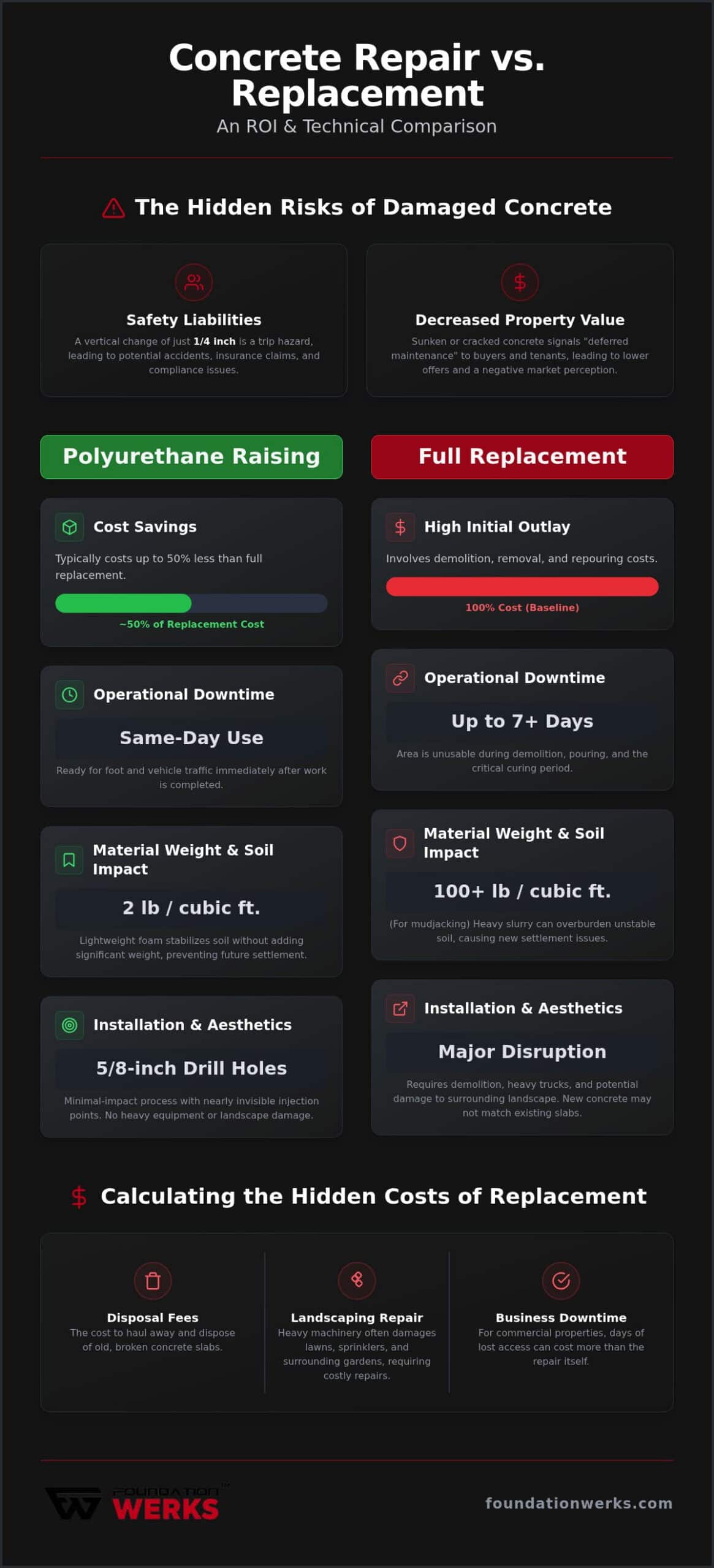
When you’re calculating ROI of concrete repair vs replacement, the most obvious starting point is the invoice price. Polyurethane concrete raising typically costs roughly 50% of the price of a full new pour. This immediate savings is compelling, but the technical reasons behind those savings offer even more value. Choosing to raise instead of replace preserves the existing slab while addressing the root cause of the settlement. It’s a method that avoids the mess and logistical nightmare of a full-scale construction site on your property.
Material Science and Soil Loading
Texas clay soils are notoriously unstable. They expand and contract with moisture, which leads to the voids that cause concrete to sink. Traditional mudjacking uses a heavy slurry that weighs about 100 lb per cubic foot. In contrast, our recycled polyurethane foam weighs only 2 lb per cubic foot. This lightweight profile is vital for the health of your soil. Adding 100 lb of material on top of already weak soil often causes faster secondary settlement. Lightweight foam provides durable stabilization without adding overburden. For more complex issues involving loose sub-soils, Deep Foamjection™ allows us to stabilize sub-slab gravel and even pavers. This creates a stable base that resists future movement without the need for heavy machinery.
Time-to-Service: The Operational ROI
Time is money, especially for commercial property owners. A new concrete pour requires a demolition phase, a pouring phase, and a lengthy curing phase. You often can’t drive on new concrete for seven days. Polyurethane concrete raising changes that timeline entirely. Surfaces are ready for foot or vehicle traffic the same day the work is finished. If you are managing a warehouse floor stabilization project, those lost hours from a week of downtime can dwarf the actual cost of the concrete. By choosing a faster repair, you protect your operational revenue and keep your facility running smoothly. If you’re ready to see how these savings apply to your property, you can request a professional assessment to compare your repair options.
Structural integrity is also a key factor in your decision. Tearing out a slab often disturbs the soil that has naturally compacted over decades. Raising the existing slab through nearly invisible 5/8-inch holes leaves that compaction intact. It fills the voids that caused the issue in the first place, providing a long-term solution that respects the existing engineering of your property. By focusing on stabilization rather than just surface replacement, you ensure a better return on every dollar spent.
Calculating the Hidden Costs of Concrete Replacement
When you receive a quote for a new concrete pour, the bottom line rarely tells the whole story. You’re usually only seeing the price of the material and the labor for that specific task. To be accurate when calculating ROI of concrete repair vs replacement, you must look at the “unseen” line items that follow a demolition crew. These hidden expenses often include disposal fees, administrative delays, and the high cost of restoring your property once the heavy trucks leave.
Demolition and Debris Management
Tearing out old concrete is a violent, loud, and messy process. In dense North Texas neighborhoods, the logistics of hauling away tons of debris can be a logistical nightmare. Local landfills charge significant disposal fees based on weight, and the environmental impact of adding more concrete waste is substantial. Choosing concrete crack repair commercial services allows you to skip the dumpster and the dust. By using recycled polyurethane foam, we keep existing materials out of the landfill while providing durable stabilization. This approach reduces your project’s carbon footprint and avoids the debris management fees that often surprise property owners during a full replacement.
Landscaping and Infrastructure Preservation
Heavy machinery is a major liability for high-end lawns in Prosper and Southlake. Traditional replacement crews often need skid steers or heavy trucks to move wet concrete and haul away old slabs. These machines can easily crush expensive irrigation lines, compact your soil, and destroy meticulously maintained sod. Foundation Werks takes a different approach to protect your investment. We don’t use heavy equipment on your lawn. Our system is self-contained, and we only need to drill nearly invisible 5/8-inch holes to inject the foam. This minimal footprint preserves the aesthetic of your pool decks and patios. It also saves you from the secondary cost of hiring a landscaping crew to fix the damage left behind by a traditional concrete company.
There is also an administrative ROI to consider. Total replacement often triggers the need for city permits and multiple inspections, which can add weeks of delays. Polyurethane raising is typically classified as maintenance, simplifying the process and allowing for immediate use of the area. When you add up the permit fees, the landscaping repairs, and the disposal costs, the financial advantage of repair becomes even more lopsided. Choosing a long-term solution that respects your existing infrastructure is simply the smarter way to manage your property’s budget.
Step-by-Step: Determining the ROI for Your Specific Project
Calculating ROI of concrete repair vs replacement isn’t just about looking at two numbers on a page. It requires a methodical look at your specific site conditions and operational needs. Start by quantifying the total square footage and the degree of settlement. Use a level to find the deepest point of the sink. This measurement helps estimate the volume of polyurethane needed for a durable stabilization.
Next, compare the quotes. A replacement quote should include demolition, hauling, and labor. A raising quote usually covers the injection process and the nearly invisible 5/8-inch hole patches. Don’t forget to factor in downtime. If you’re managing a commercial warehouse, every hour of restricted access costs money. New concrete takes days to cure, while polyurethane is ready for traffic immediately. Finally, evaluate long-term stabilization. In the DFW area, soil movement is the primary enemy. You need to know if the repair addresses the voids left behind by shrinking clay.
The DFW Soil Factor
North Texas expansive clay is a unique challenge for property owners in Plano and Allen. When the soil dries out, it pulls away from the slab, creating a gap. Simply pouring new concrete over these gaps often leads to the same settlement issues within a few years. Effective uneven warehouse floor repair Dallas strategies prioritize void filling. This process pumps lightweight foam into the empty spaces, providing a stable foundation that moves with the soil rather than against it. Durable stabilization in cities like Plano requires this attention to the sub-slab environment.
ROI Formula for Facility Managers
Facility managers can use a straightforward calculation to justify the investment: (Cost of Replacement + Lost Revenue) – Cost of Raising = Instant ROI. This formula captures the immediate cash savings and the value of keeping your operations running. This calculation is the most accurate way of calculating ROI of concrete repair vs replacement for industrial facilities. When you consider the 5 to 10 year outlook, the benefits of durable stabilization become even clearer.
ROI is the total value of recovered safety and functionality minus the cost of intervention.
Maximizing Value with Foundation Werks Professional Solutions
Choosing the right partner is the final piece of the puzzle when calculating ROI of concrete repair vs replacement. At Foundation Werks, we take pride in being more than just a contractor. We’re specialists who understand the unique demands of North Texas soil. Whether you’re in McKinney, Frisco, or Dallas, our focus remains on reliability and customer satisfaction. We want you to feel confident that your property is in expert hands. Our approach combines technical precision with a service heart, ensuring you get the most value out of every dollar invested in your concrete. We don’t believe in one-size-fits-all answers; we believe in providing the right fix for your specific site.
Eco-Conscious Innovation
The materials we use are just as important as the methods we apply. We utilize a patented, eco-conscious foam made from recycled materials. This 2lb foam provides durable stabilization that never loses density once it’s set. Because it’s so lightweight, it won’t overburden the soil like a 100lb mudjacking slurry would. This innovation supports sustainable building practices across the DFW metroplex. You also won’t have to worry about a messy job site. Our injection process is clean, requiring no grout splatter or heavy wash-downs. It’s a professional, low-impact way to achieve a long-term solution for your sunken slabs. We use nearly invisible 5/8-inch drill holes to deliver the foam, preserving the look of your surfaces while strengthening the ground beneath them.
Next Steps for Your Property
Restoring your property value doesn’t have to be a complicated or stressful project. When you’re ready to move forward, the first step is scheduling a free estimate for your driveway, patio, or warehouse floor. Our team will come out, listen to your concerns, and assess the degree of settlement. We’ll then provide a clear, transparent plan for restoration. Most polyurethane injection projects are completed in just a few hours. You won’t have to wait days for curing or deal with the disruption of heavy machinery. It’s a fast, efficient path to a high-ROI concrete restoration. We’re here to help you make an informed decision that protects your property and your budget. Let’s work together to restore the safety and beauty of your concrete.
Protecting Your Property Investment for the Long Term
Your concrete surfaces represent a significant portion of your property’s value and safety. Choosing polyurethane raising over a full new pour is a strategic move that typically costs about 50% of a total replacement. This method avoids the hidden expenses of demolition and landscaping repair that often catch owners by surprise. Because the process is so efficient, surfaces are ready for use immediately after completion. This prevents the lost revenue or personal inconvenience associated with long curing times.
When you focus on calculating ROI of concrete repair vs replacement, you see that the value lies in durable stabilization rather than just a fresh surface. Our lightweight foam addresses the voids in North Texas clay without adding heavy overburden to the soil. The nearly invisible 5/8-inch drill holes ensure your high-end aesthetics remain intact. Investing in a professional assessment ensures that your driveway, warehouse floor, or pool deck remains a safe and attractive asset for years to come.
We’re here to help you navigate these choices with transparency and expertise. Taking action now protects your bottom line and your peace of mind.
Frequently Asked Questions
Is concrete raising a durable stabilization for my sunken driveway?
Polyurethane concrete raising provides a durable, long-term solution for sunken driveways in North Dallas. By filling the voids created by shrinking clay soil, the foam stabilizes the slab from beneath. While it effectively restores the level of your driveway, it’s important to remember that the foam doesn’t stop the underlying soil itself from moving. However, because the material never loses density, it offers a reliable way to maintain your driveway’s integrity for years.
How much does polyurethane concrete lifting cost compared to replacement?
Polyurethane concrete lifting typically costs about 50% of the price of full concrete replacement. When calculating ROI of concrete repair vs replacement, you must also look at the lack of secondary costs. There’s no need for demolition fees, debris hauling, or landscaping restoration. This makes it a high-ROI choice for property owners in McKinney and Frisco who want to fix their concrete issues without the high overhead of a new pour.
Can all concrete slabs be raised, or are some too damaged for repair?
Most solid concrete slabs can be raised and stabilized, but there are exceptions. If your concrete is severely crumbled or has multiple small, spiderweb cracks, it may lack the structural integrity needed for a lift. We assess each project in the DFW area to ensure the slab is a good candidate for repair. If the concrete is too far gone, we can provide a quote for full concrete replacement to ensure a quality result.
How long does the polyurethane foam material last under the slab?
The polyurethane foam we use is engineered to be a durable, long-term solution that lasts as long as the concrete itself. It’s a closed-cell material that never loses density and is resistant to moisture. Unlike traditional mudjacking slurry, which can weigh 100 lb per cubic foot and wash away, our 2 lb foam remains stable. This durability is why so many facility managers in Irving and North Dallas choose foam for warehouse floor stabilization and void filling.
Will the drill holes be visible after the concrete repair is finished?
The drill holes are very small, measuring only 5/8 inch in diameter, which is roughly the size of a penny. Because we use fewer holes than traditional mudjacking, the visual impact is minimal. Once the injection is complete, we patch the holes with a concrete mixture that blends in with your existing slab. For high-end pool decks and patios in Prosper, these nearly invisible patches help maintain your property’s aesthetic while providing structural support.
How soon can I drive on my driveway after polyurethane raising?
You can drive on your driveway the same day the repair is finished. One of the biggest benefits of polyurethane raising is the immediate return to service. Unlike new concrete, which requires a seven-day cure time before it can support vehicles, our foam reaches full strength in minutes. This speed is a major factor when calculating ROI of concrete repair vs replacement, as it eliminates the cost and headache of restricted access to your property.
What happens if the soil under my concrete continues to erode?
If soil erosion continues due to poor drainage, we may recommend additional services like French drain installation to divert water away from your foundation. Our Deep Foamjection™ technique can also stabilize deeper soil layers to prevent future sinking. By addressing both the settled concrete and the underlying soil issues, we provide a more comprehensive approach to property maintenance in Allen and Fairview. This proactive strategy helps prevent recurring settlement and protects your long-term investment.
Is polyurethane foam lifting safe for the environment and my landscaping?
Yes, our polyurethane foam is eco-conscious and safe for your North Texas landscaping. We use a patented foam made from recycled materials that doesn’t leach chemicals into the ground. Because the process requires no heavy machinery, your lawn and gardens in Southlake are protected from tire ruts and soil compaction. There’s also no grout splatter or messy wash-downs, making it the cleanest repair option available for environmentally minded homeowners and commercial property managers.