

What if a crack in your warehouse floor signals movement rather than a surface flaw? Choosing a commercial concrete floor crack filler starts with documenting the crack and considering whether the slab is stable, uneven, or showing other signs of change.
A straightforward repair matters when employees, equipment, and deliveries rely on the floor. But filler addresses the visible opening, not necessarily the reason it formed. The right approach depends on the crack, the surrounding concrete, and how the area is used.
This guide explains how to assess cracks, compare filler and joint-repair options, and recognize when the slab may need broader attention. For Dallas commercial properties, Foundation Werks provides commercial concrete crack and joint repairs, along with concrete raising and slab stabilization when the floor needs more than crack treatment. The goal is to match the repair scope to the observed condition, rather than simply cover what’s visible.
Key Takeaways
- Choose a commercial concrete floor crack filler based on the crack’s condition, possible movement, and traffic demands, not the product label alone.
- Before selecting a repair approach, document the crack’s location, pattern, nearby joints, and surrounding floor conditions.
- Crack filling, joint repair, void filling, and slab lifting address different conditions and are not interchangeable.
- Compare product instructions with the floor’s needs, including preparation, application, and return-to-use guidance.
- Plan work zones, access, timing, and communication. Consider commercial concrete raising or leveling when the slab needs more than crack treatment.
What Commercial Concrete Floor Crack Filler Can, and Cannot, Address
A crack in a commercial floor is easy to see, but its cause may not be. Before comparing products, distinguish the visible opening from conditions beneath or around it. Filler can treat a crack, but it does not automatically explain why the crack formed or correct movement in the slab.
Commercial concrete floor crack filler treats a visible opening; concrete leveling changes a slab’s position or support. These approaches address different conditions. Depending on the material and application, filling may close or protect a crack. It does not raise a low slab, restore lost support beneath it, or identify the source of cracking.
Crack, joint, or slab movement: identify the condition first
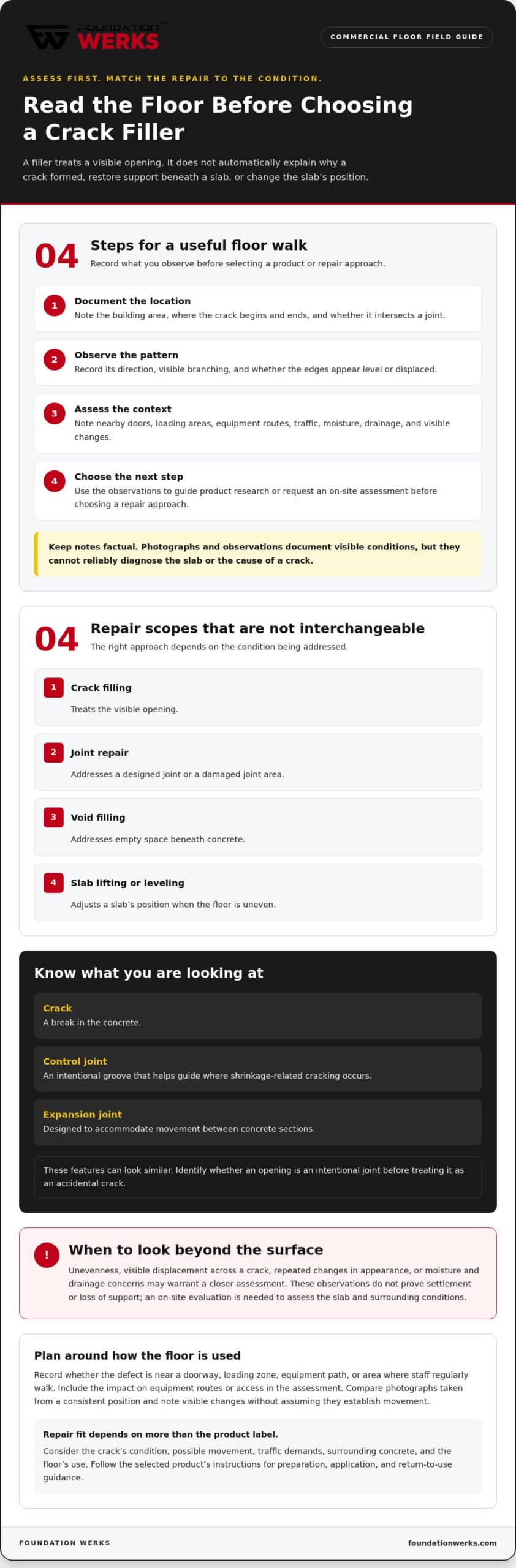
A crack is a break in the concrete. A control joint is an intentional groove that helps guide where shrinkage-related cracking occurs. An expansion joint is designed to accommodate movement between concrete sections. Because these features can look similar, identify whether an opening is an intentional joint before treating it as an accidental crack.
Look for uneven concrete beside the opening, visible displacement across it, or signs of a gap beneath the slab. These observations may warrant a closer assessment, but appearance alone does not confirm settlement or loss of support. Photographs and notes can document what you see, but they cannot reliably diagnose the slab or the cause of a crack.
Concrete cracking has different possible causes, and Self-healing concrete and crack formation offers context on cracking and repair approaches. For an existing commercial floor, record the visible condition and surrounding details rather than assuming one product suits every opening.
When commercial floor crack filler may be only one part of repair
Match the repair to the condition. A stable, localized crack may call for a different treatment than a damaged joint, a void beneath a slab, or a floor section that has settled. The material and method also need to suit the crack and the floor’s use. Follow the selected product’s instructions instead of assuming all fillers work alike.
- Crack filling treats the visible opening.
- Joint repair addresses a designed joint or a damaged joint area.
- Void filling addresses empty space beneath concrete.
- Slab lifting or leveling adjusts a slab’s position when the floor is uneven.
Crack repair and slab stabilization are not interchangeable. Filling an opening does not by itself stabilize the slab, and stabilization does not serve the same purpose as treating a visible crack. If movement or settlement is a concern, consider the broader floor condition before choosing a surface treatment. An assessment can help distinguish the visible symptom from the repair scope without treating any single observation as proof of the cause.
How to Assess a Commercial Concrete Floor Crack Before Choosing Filler
Start with a record, not a product choice. A consistent floor inspection helps facility teams describe what they see, track changes, and explain how the defect affects operations. It cannot diagnose the cause, but it gives you a clearer basis for deciding whether surface repair may fit or a broader slab assessment is needed.
Use this sequence during a floor walk:
- Document the location. Note the building area and where the crack begins, ends, or intersects a joint.
- Observe the pattern. Record its direction, visible branching, and whether the edges appear level or displaced.
- Assess the context. Note nearby doors, loading areas, equipment routes, traffic, moisture, drainage, and visible changes.
- Choose the next step. Use your observations to guide product research or request an on-site assessment before selecting a repair approach.
This sequence helps separate observations from assumptions. For repair planning, resources from the International Concrete Repair Institute provide broader industry context. The right commercial concrete floor crack filler depends on the condition being treated, so a clear description of the floor is more useful than a guess based on crack width alone.
What facility teams should document during a floor walk
Mark the crack’s start and end points, and note where it meets nearby joints or other visible defects. Take photographs from a consistent position, using the same reference, such as a ruler or floor marker. Add the date and location so you can compare images later. Keep the record factual: describe what is visible, not what you think caused it.
Include operational context. Record whether the crack is near a doorway, loading zone, equipment path, or area where staff regularly walk. Note recurring moisture or drainage concerns and whether they appear close to the defect. This information helps an assessor understand how the floor is used and which surrounding conditions may need closer review.
Clues that call for a broader slab assessment
Unevenness, visible displacement across a crack, or repeated changes in its appearance are reasons to look beyond the surface. Moisture or drainage concerns can add useful context. None of these observations proves settlement, loss of support, or another specific cause. An on-site evaluation is needed to assess the slab and surrounding conditions.
Compare your records over time, noting changes without assuming they establish movement. If the defect affects equipment routes or access, include that impact in the assessment request. Foundation Werks provides commercial concrete crack and joint repair for Dallas properties, with the repair approach based on the observed floor condition.
Commercial Concrete Crack Filler Types: Compare the Repair Fit
Choosing a filler by chemistry alone can overlook the real issue. A commercial concrete floor crack filler needs to suit the crack, possible movement, facility traffic, and application conditions. Epoxy and polyurethane are broad product categories, not one-size-fits-all solutions. Products within each category can have different instructions and intended uses, so compare the technical information with the floor conditions you recorded.
Repair selection depends on the crack’s condition and the floor’s intended use. Use this comparison to narrow your questions, not as a substitute for product instructions or an assessment of the slab.
Epoxy category
Consider: Whether the product is intended for the crack condition and whether the crack is stable or may move. A category label alone does not establish how a product will perform under facility traffic.
Check: Surface preparation, application conditions, traffic guidance, and limitations in the manufacturer’s technical instructions.
Polyurethane category
Consider: Whether the product’s stated properties and intended use suit the crack condition and the floor’s movement needs. Product characteristics vary, so do not choose by category name alone.
Check: Required preparation, application method, curing or return-to-use directions, and stated use limitations.
Joint repair material
Consider: Whether the opening is a designed joint rather than an unintended crack. Joint repair serves a different purpose and should suit the condition of the joint.
Check: Whether the product is specified for that joint and the expected facility use.
Compare filler formats against the job requirements
Application format affects access and work-area planning. A pourable material may suit a layout where it can be placed as directed; a cartridge format offers another way to apply material along a crack. Neither format establishes whether the product matches the slab condition. Crack orientation, nearby equipment, access, and the size and layout of the repair area all affect practical planning.
Read the specific product’s technical and preparation instructions before selecting or applying it. Do not transfer directions from one formula to another, even when both are described as epoxy or polyurethane.
Separate crack filling from joint repair and concrete leveling
Joints are intentional features that accommodate or guide movement. An unintended slab crack is a different condition. Concrete leveling is different again: it addresses uneven or settled concrete rather than filling an opening. Keeping these scopes distinct prevents a surface product from being mistaken for a solution to a floor-height or support concern.
For a closer look at repair planning, explore this commercial concrete crack repair guide. Consider the observed condition, intended use, and product instructions together when narrowing the repair fit.
How to Plan Commercial Floor Crack Repair Around Facility Operations
A repair plan should account for more than the crack. Map the affected floor area and note operational constraints before scheduling work. This gives facility managers, repair teams, and space users a shared understanding of access needs and work boundaries. Keep product-specific preparation and cure instructions separate from general site coordination.
Start with a short planning checklist:
- Mark the work area. Identify affected aisles, entrances, loading zones, work areas, and equipment routes. Note nearby areas that need to remain accessible.
- Record operational limits. Describe traffic patterns, equipment movement, delivery activity, and facility functions that could be affected by restricted access.
- Choose a workable timing plan. Coordinate a proposed work window with facility users. Base the schedule on the repair scope and site conditions, not an assumed project duration.
- Share the plan. Communicate affected zones, access arrangements, and relevant updates to employees, tenants, delivery teams, and other facility users.
If the work involves a commercial concrete floor crack filler, do not treat general planning notes as application instructions. Preparation, application, and cure requirements depend on the specific product. Keep its technical directions with the repair plan and use them to guide access restrictions and return to use.
Coordinate the work area and facility communication
Clear communication reduces avoidable confusion. Explain which routes or entrances are affected, what alternate access is planned, and who will share updates if the work area or facility plan changes. A repair near a loading area, for example, may affect deliveries differently from work in a low-traffic storage zone. Make those operational details clear before agreeing on a schedule.
Keep the communication factual. Do not promise a completion time until the scope and site conditions are understood. A product’s stated cure guidance is not the same as a full project schedule, which can also depend on the work area and repair tasks.
Build a useful repair scope for a commercial estimate
A clear estimate starts with useful site information. Summarize crack locations, visible changes, nearby joints, floor use, and affected operational areas. Attach dated photos or a simple marked floor plan if available. Describe recurring moisture or drainage concerns as observations, not diagnoses. Ask for an estimate that explains the proposed repair scope and how it relates to the recorded condition.
Joint conditions can affect warehouse floor repair planning. The warehouse floor joint repair comparison outlines different considerations for joint repair and floor work.
When Filler Is Not Enough: Foundation Werks Commercial Concrete Repair in Dallas
A crack may be the visible part of a larger floor concern. If the surrounding slab is uneven or appears to have settled, surface filler alone may not address the condition facility managers need resolved. Foundation Werks provides commercial concrete crack and joint repairs for Dallas properties, as well as concrete raising and leveling when the slab needs that scope. The proposed repair starts with the observed condition, not an assumption that one material suits every floor.
This distinction matters in active facilities. Treating a crack and adjusting a slab’s position are different kinds of work. A clear estimate explains the proposed scope and how it relates to the floor observations, helping managers plan around the work and understand what it addresses.
How Quick Level fits a commercial slab repair plan
For commercial concrete raising and leveling, Foundation Werks’ Quick Level system uses pressurized foam injected beneath the slab through dime-size holes. The holes are then sealed with concrete patch. The system uses closed-cell, eco-conscious polyurethane foam containing over 40% recycled materials. The foam does not break down over time, and the material is Made in the U.S.A.
The foam cures in approximately 20 minutes, and the repaired surface is usable immediately after the 20-minute cure. This can help facility teams plan access to the repaired area, while the project scope and site conditions still guide the overall schedule. Quick Level is a leveling approach, not a crack filler product. It may be relevant when the slab needs raising or leveling as part of the broader repair plan.
A clear next step for Dallas facility managers
Before requesting an estimate, gather crack locations, nearby joint details, photos, and notes about affected work zones or equipment routes. This gives the conversation a useful starting point. An estimate should explain the proposed repair scope in relation to the observed floor condition, including whether the work concerns cracks, joints, slab leveling, or a combination.
Foundation Werks is family-owned and not a franchise. The company has a 4.9 / 5 Google rating based on Trustindex-verified reviews. Share your facility’s concerns and review the estimate to understand the scope before deciding how to proceed.
Make Your Next Floor Repair Decision with Confidence
Turn your floor concerns into a clear repair conversation. Choosing a commercial concrete floor crack filler should support the condition you’re addressing, not distract from questions about the slab or facility needs. A well-defined scope helps you understand what the proposed work covers before deciding how to move forward.
Use the estimate discussion to clarify the intended outcome, operational considerations, and how the work fits your priorities. A clear description of the crack, nearby joints, and floor use helps Foundation Werks assess the repair scope for your Dallas commercial property.
With a clear scope and next step, you can make an informed repair decision for your facility.
Frequently Asked Questions
Can commercial concrete crack filler stop a slab from sinking?
No. Crack filler addresses the visible opening; it does not raise a sinking slab or restore support beneath it. If a crack comes with a change in floor height, a gap beneath the slab, or recurring visible changes, the repair may also need to address the slab condition. An on-site assessment can help determine whether filling, stabilization, raising, or a combination fits the observed problem.
How do I estimate how much commercial concrete crack filler a floor needs?
Measure the crack’s length and estimate its width and depth only if you can do so safely and without damaging the slab. Compare those measurements with the product’s stated coverage or volume guidance. Coverage can vary by format and application instructions, so do not estimate from length alone. For irregular cracks, follow the manufacturer’s guidance rather than guessing.
Can concrete crack filler be used on a damp commercial floor?
It depends on the specific product’s moisture requirements. Some products may require a dry surface, while others may specify different preparation conditions. Check the technical and preparation instructions before applying anything. If moisture repeatedly appears near the crack, record where and when it occurs, along with nearby drainage concerns. This context can help determine whether the repair needs a broader assessment rather than surface treatment alone.
How long does commercial concrete crack filler take to cure?
There is no single cure time for every commercial crack filler. The product’s instructions determine its cure and return-to-service guidance, so check them before reopening the area to foot or equipment traffic. Do not assume a filler follows the same schedule as another repair material, or that a surface that feels dry is ready for facility use. Include the product’s access requirements in your work-area plan.
What should a facility manager include in a commercial floor crack repair request?
Include the facility address, crack location, dated photos, nearby joints, and visible changes. Describe the floor’s use, such as regular forklift travel or a nearby receiving area, and explain which access routes or operations could be affected. Note recurring moisture or drainage observations without assigning a cause. This information gives the estimator useful context to define the proposed scope and account for facility constraints.
Can a commercial concrete floor crack be filled without replacing the slab?
Yes, a crack may be repairable without replacing the slab, depending on its condition and the surrounding concrete. Replacement is not the only approach, but filling may not address unevenness, movement, or a support concern. An assessment can help distinguish a localized crack repair from a broader scope. Share signs such as displacement or repeated changes so the proposed repair accounts for more than the visible opening.