

In North Texas, the ground beneath your facility is in a constant state of flux. High-performance concrete joint sealing commercial solutions are the only effective barrier against the relentless expansion and contraction of our regional clay soils. It’s a common frustration to see cheap, standard sealants fail within months, leaving you with recurring maintenance costs and mounting OSHA trip hazard liabilities. You shouldn’t have to settle for a cycle of temporary repairs that don’t address the root cause of slab instability.
We understand that your priority is a durable, long-term resolution that protects your foundation from water intrusion without disrupting your daily operations. This guide explores how modern materials, adhering to the ASTM C920-18 gold standard and the July 2025 TxDOT DMS-6310 specifications, provide superior protection for industrial and retail spaces. You’ll discover the specific techniques needed to stabilize your concrete and maintain safety compliance in the unique Dallas-Fort Worth climate. We’ll walk you through the technical requirements for high-traffic facilities and show you how to achieve a stable, resilient finish that stands up to the Texas heat.
Key Takeaways
- Identify how specialized elastomeric sealants accommodate structural movement and thermal expansion to preserve the integrity of your concrete slabs.
- Compare the technical benefits of polyurethane and silicone technologies to determine which material offers the best adhesion and durability for your facility’s unique traffic patterns.
- Master the “Seal and Stabilize” method for concrete joint sealing commercial applications, ensuring that underlying voids are filled with polyurethane foam before the surface is secured.
- Protect your facility from costly foundation repairs and OSHA safety liabilities by implementing a comprehensive maintenance plan that addresses water intrusion and soil movement.
The Strategic Importance of Commercial Concrete Joint Sealing
Concrete joint sealing commercial services aren’t just about appearances; they represent a sophisticated barrier of high-performance elastomers applied to control and expansion joints. These intentional gaps allow your slab to breathe. Without them, the natural thermal expansion and structural movement would cause the concrete to shatter under its own pressure. By using advanced sealant technologies, we create a flexible bridge that maintains its integrity even as the building shifts.
To better understand the precision required for these joints, watch this helpful demonstration:
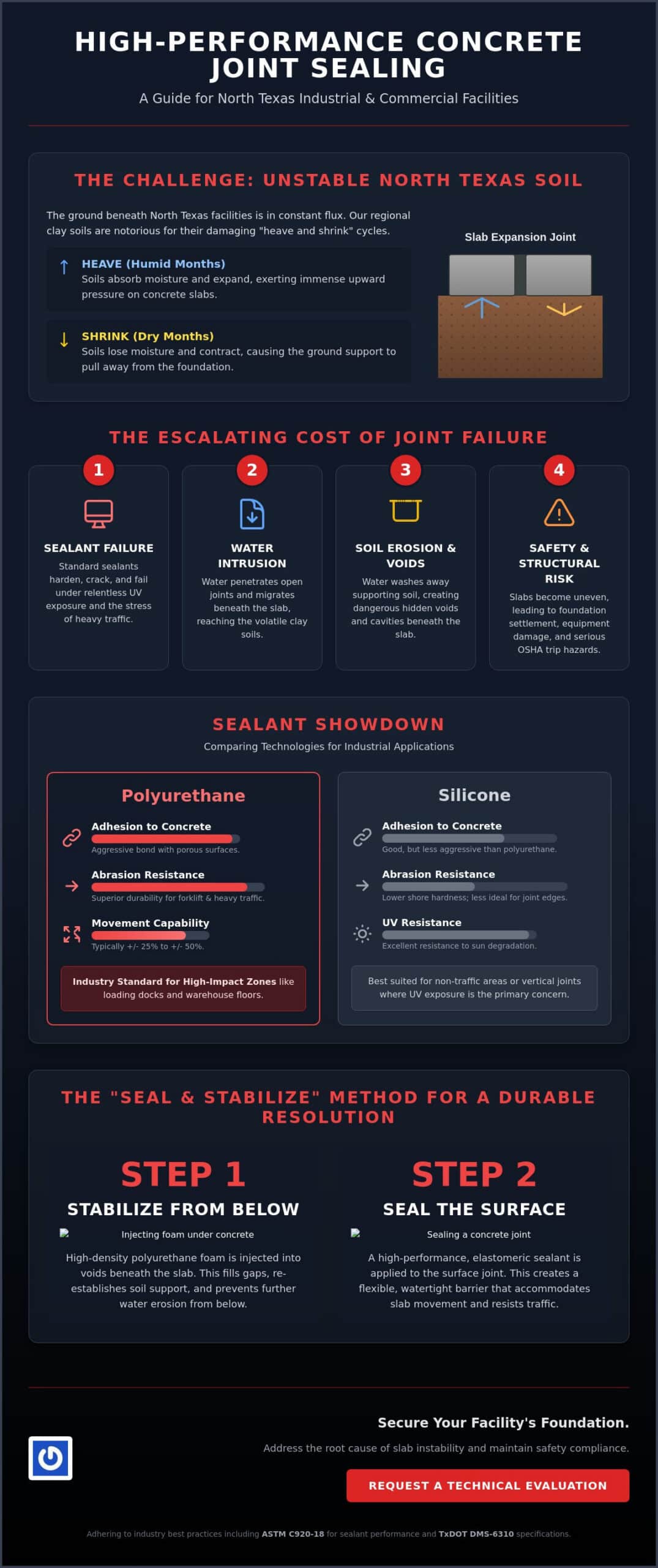
In Dallas and Fort Worth, this process is complicated by our unique geology. Our clay soils are notorious for their “heave and shrink” cycles. When these soils expand during humid months and contract during droughts, they exert immense pressure on your foundation. High-quality joint sealing prevents water from reaching these volatile soils, helping to maintain a stable environment beneath your facility.
Why Expansion Joints Fail in Dallas Facilities
Dallas facilities face brutal conditions. High-traffic loads from heavy machinery and forklifts put constant mechanical stress on joint edges, often leading to spalling. Meanwhile, the relentless Texas sun delivers high UV exposure that degrades retail-grade products. You’ll recognize failure when the material hardens, loses its grip on the concrete walls, or develops “alligator” cracking patterns across the surface.
The High Cost of Water Infiltration
When sealants fail, water becomes your greatest enemy. It migrates through the open joints and washes away the supporting soil, creating dangerous voids beneath the slab. This leads to uneven surfaces and eventually foundation settlement. Addressing these issues early is vital. It’s often the difference between a targeted repair and the significantly higher concrete replacement vs lifting cost that comes with total slab failure. Proper drainage and joint integrity go hand in hand to ensure long-term structural stability.
Evaluating Sealant Technologies: Polyurethane vs. Silicone
Selecting the right material is the first step in a high-performance concrete maintenance strategy. For concrete joint sealing commercial projects, the decision between polyurethane and silicone depends on the specific stressors of your facility. Polyurethane excels in its aggressive adhesion to porous concrete surfaces, creating a bond that resists the mechanical pull of shifting slabs. Silicone, while highly UV resistant, often lacks the shore hardness required to protect joint edges from the crushing weight of industrial equipment like forklifts.
Movement capability is another critical metric for North Texas. We look for ratings of at least +/- 25% to accommodate seasonal soil shifts, adhering to the ASTM C920-18 gold standard. Higher performance elastomers can handle +/- 50% movement, ensuring the seal remains intact during extreme temperature swings. We also prioritize cure times to minimize operational interruptions. Choosing a fast-curing material allows your team to return to the floor in hours, which is vital for busy operations. Quality sealants typically offer a service life of 5 to 10 years, though high-traffic areas may require more frequent attention every 3 to 7 years.
Polyurethane Sealants for High-Traffic Slabs
Loading docks and warehouse floors demand superior abrasion resistance. Polyurethane is the industry standard for these high-impact zones because it absorbs the shock of hard-wheeled traffic without tearing. It’s also the preferred choice for slabs requiring stabilization, as it works in tandem with underlying support structures. At Foundation Werks, we use modern, eco-conscious polyurethane formulations that provide exceptional durability without harsh chemical odors. If you’re looking to protect your investment, you can evaluate your facility’s specific needs with our technical team.
Self-Leveling vs. Non-Sag Applications
Application method is as important as chemical composition. Self-leveling (SL) sealants are fluid, designed to flow into horizontal joints for a perfectly flat finish. Non-sag (NS) sealants are thicker, staying exactly where they are placed on vertical walls or sloped surfaces. You can use this checklist to identify which application your facility requires:
- Horizontal Warehouse Floors: Choose Self-Leveling (SL) for a smooth, forklift-ready surface.
- Loading Dock Curbs: Use Non-Sag (NS) to prevent the sealant from running out of the joint.
- Sloped Ramps: Non-Sag (NS) is required to maintain uniform depth on an incline.
Implementing a Comprehensive Concrete Maintenance Strategy
Surface protection is only half the battle when securing an industrial foundation. For concrete joint sealing commercial projects to be truly effective, they must be part of a broader slab stabilization plan. We utilize a “Seal and Stabilize” approach that addresses the root cause of joint failure. If the soil beneath your slab has washed away, even the highest quality elastomer will eventually tear under the weight of shifting concrete. By filling these underlying voids with high-density polyurethane foam, we create a rigid foundation that allows the surface sealant to perform its job without excessive mechanical stress.
The professional installation process requires meticulous attention to detail to ensure a long-term resolution. Following the technical standards found in the American Concrete Pavement Association’s Guide to Joint Sealing, our team begins by routing the joints to create a clean, uniform reservoir. We then remove all dust and old material before placing a specialized backing rod. This rod is essential; it prevents the sealant from bonding to the bottom of the joint, ensuring the material can stretch and contract between the two concrete sidewalls as temperatures fluctuate.
Combining Joint Sealing with Polyurethane Stabilization
Stabilizing the soil is the most effective way to prevent the “pumping” action that occurs when heavy machinery crosses a joint. You can often tell if your facility needs warehouse floor joint repair Dallas services if you notice slabs rocking or “clicking” under forklift traffic. Proactive stabilization offers a significant return on investment by preventing the accelerated wear of vehicle tires and avoiding the high costs of emergency foundation repairs. It’s a strategic move that keeps your facility safe and operational.
Scheduling and Long-Term Maintenance
North Texas commercial properties should undergo a professional joint inspection at least once every 12 to 24 months. During these assessments, we look for signs that the sealant has reached the end of its service life, such as debonding from the concrete edge or visible punctures. While our methods provide exceptional stability, the dynamic nature of regional clay soils means that no application is an everlasting solution without oversight. Regular check-ups allow us to identify minor issues before they evolve into structural liabilities, ensuring your facility remains compliant with safety standards and protected from water intrusion.
Securing Your Facility’s Structural Integrity
Maintaining a high-traffic facility in Dallas or McKinney requires a specialized approach to structural health. You’ve seen how effective concrete joint sealing commercial strategies depend on matching the right elastomeric technology to your specific load requirements. By combining these surface seals with eco-conscious polyurethane stabilization, you address the underlying voids created by North Texas clay soil movement. This dual-layered defense ensures your warehouse floors and loading docks remain stable and compliant with modern safety standards. Facility managers in the area may also benefit from understanding how commercial concrete repair in McKinney is often misunderstood, as debunking common myths can help you make more informed decisions about your infrastructure.
While no repair is an everlasting solution in our volatile climate, a commitment to technical precision provides a reliable, long-term resolution for your property. Our team understands the unique challenges of regional soil and offers the meticulous craftsmanship your foundation deserves. You don’t have to wait for major cracks or trip hazards to compromise your operations. Request a Professional Concrete Assessment from Foundation Werks to ensure your facility remains a safe, productive environment for years to come.
Frequently Asked Questions
How long does commercial concrete joint sealant typically last?
Quality joint sealants in North Texas typically offer a service life of 5 to 10 years. In high-traffic industrial zones, this interval may decrease to 3 to 7 years due to mechanical wear from forklifts and heavy machinery. Regular inspections help identify when a material has lost its elasticity or adhesion before structural damage occurs.
Is polyurethane or silicone better for commercial expansion joints?
Polyurethane is generally superior for concrete joint sealing commercial projects involving warehouse floors because of its high abrasion resistance and shore hardness. Silicone is an excellent choice for vertical joints or areas with extreme UV exposure, as it maintains flexibility longer under direct sunlight. We select the specific material based on your facility’s traffic patterns and environmental exposure.
Can you seal joints on a slab that has already started to sink?
Sealing joints on a sinking slab is only effective if you first address the underlying soil instability through polyurethane concrete raising. Applying sealant to a moving slab will lead to immediate material failure. We recommend a “Seal and Stabilize” approach where we fill the voids beneath the concrete to provide a firm foundation before securing the surface joints. Before committing to full slab removal, facility managers should carefully weigh the concrete replacement vs lifting cost to determine the most cost-effective path to structural stability.
What is the difference between a control joint and an expansion joint?
Control joints are intentional weak points cut into the concrete to manage where cracks occur during the drying process. Expansion joints are deeper, full-depth gaps designed to accommodate the structural movement and thermal expansion of the building. Both require specialized sealants to prevent water from undermining the foundation and causing soil erosion in our regional clay.
How much downtime should my facility expect during the sealing process?
Most facilities experience minimal downtime because we utilize modern, fast-curing elastomers that allow for foot and light vehicle traffic within a few hours. For large-scale industrial projects, we often work in phases to keep your operations running smoothly. Our goal is to provide a long-term resolution for joint failure without compromising your production schedule.
Does sealing concrete joints help prevent OSHA trip hazard violations?
Yes, proactive joint sealing is a critical step in maintaining OSHA compliance and avoiding trip hazard liabilities. When joints are left open, the edges of the concrete slabs often spall or “curl,” creating uneven transitions that exceed safety limits. Properly sealed joints protect these edges from breaking down under heavy wheel loads, keeping your floor surfaces level and safe for employees.