

Could a single quarter-inch of uneven concrete really cost your property $12,000 in ADA fines? In 2026, implementing a strategy for concrete raising for property managers isn’t just about curb appeal; it’s a critical shield against rising liability risks and expensive tenant complaints. You likely feel the pressure of balancing safety compliance with a budget that doesn’t always account for the high cost of total concrete replacement. It’s frustrating to choose between leaving a tripping hazard or dealing with a week of blocked access for your residents.
We understand that your facility’s infrastructure should be an asset, not a source of stress. This guide promises to show you how polyurethane technology protects your property from liability while saving 50% over the cost of new concrete. We’ll preview the science of lightweight, recycled foam and provide a clear roadmap for achieving long-term structural stability with minimal disruption to your daily operations. From ADA audits to industrial floor stabilization, you’ll learn how to keep your walkways level and your residents safe.
Key Takeaways
- Learn how to identify subtle trip hazards that could lead to $12,000 ADA fines before they turn into costly legal claims.
- Discover why concrete raising for property managers is a strategic financial move that cuts repair budgets by 50% compared to full slab replacement.
- Understand the science behind recycled polyurethane foam, a lightweight solution that stabilizes soil without adding the heavy weight of traditional mudjacking.
- See how to maintain property access with a repair process that allows tenants to use sidewalks and parking lots just minutes after completion.
Managing Liability: Why Sunken Concrete is a Property Manager’s Biggest Risk
Sunken concrete isn’t just an eyesore. For those managing multi-family complexes or commercial centers, uneven pavement represents a significant legal and structural liability that grows more dangerous over time. Settlement occurs when the soil beneath a slab shifts or erodes, leaving the concrete unsupported. This creates uneven surfaces that are difficult for residents to navigate and impossible for wheelchairs to cross safely. Utilizing Concrete leveling techniques allows you to address these hazards before they escalate into expensive litigation.
We often see property managers struggling to decide between a temporary patch and a full-scale renovation. A quick patch often fails to address the underlying void, while a full renovation is usually unnecessary and budget-breaking. Understanding the legal landscape helps clarify this decision. In 2026, the emphasis on proactive ADA maintenance has never been higher. Documenting your repairs and showing a clear history of hazard mitigation is your best defense against lawsuits that target aging properties. Taking a methodical approach to concrete raising for property managers is simply good business.
ADA and OSHA Compliance Standards for Managed Properties
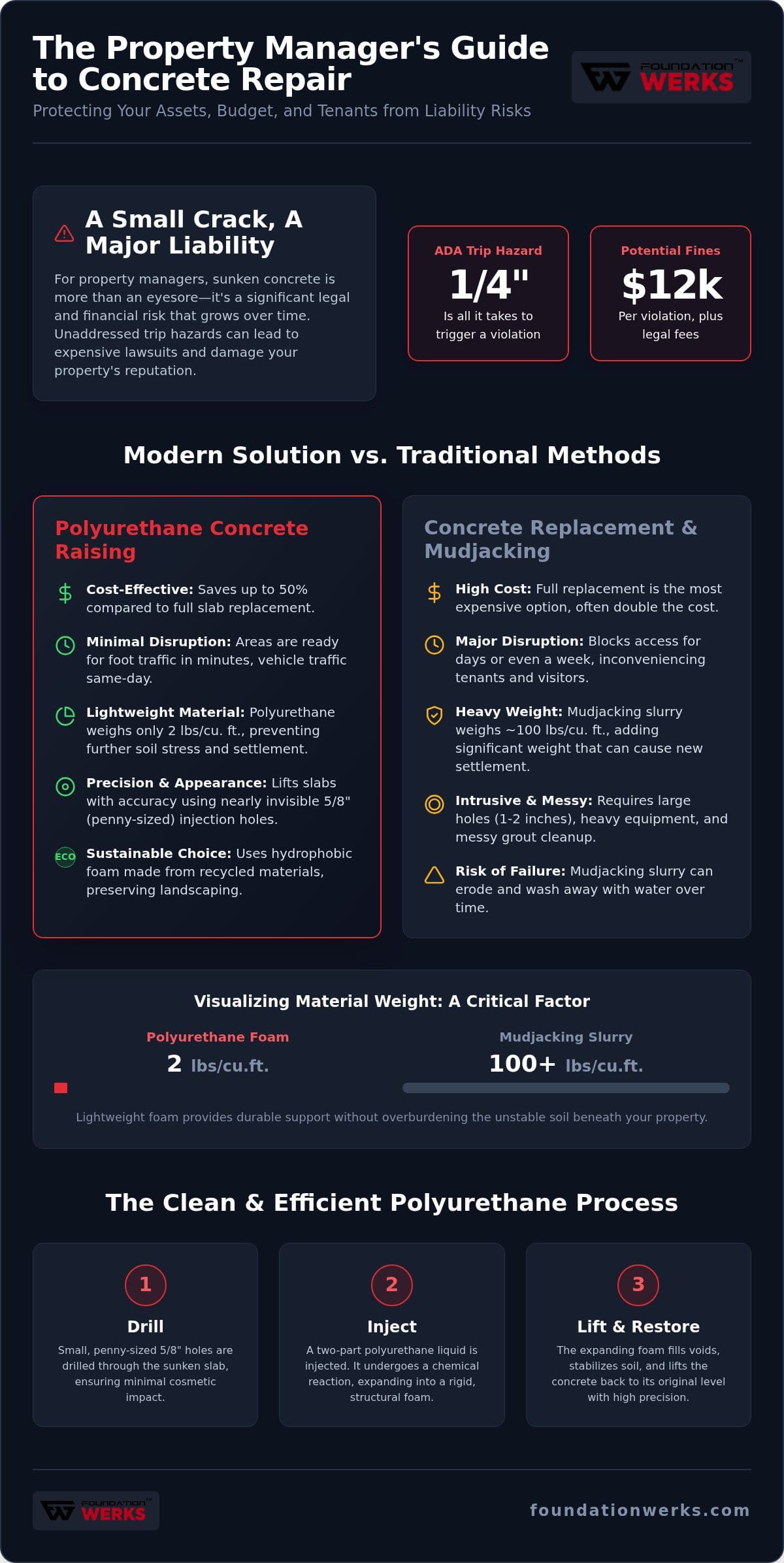
Compliance is a daily reality for modern property management. Under current ADA standards, any vertical displacement of more than 1/4 inch is classified as a trip hazard and a violation. These small lips on sidewalks or ramps can trigger fines ranging from $4,000 to $12,000 per issue. In a commercial setting, these hazards also catch the attention of OSHA inspectors, who prioritize site safety for employees and visitors alike. Promptly scheduling concrete raising for property managers is a fiduciary duty for HOA boards and owners, as it protects the community’s financial reserves from avoidable legal claims and high insurance premiums.
The Hidden Costs of Deferred Concrete Maintenance
Ignoring a small dip today creates a much larger problem tomorrow. When a slab settles, it often creates a low point where water pools during Dallas rainstorms. This standing water eventually finds its way into cracks and joints, which accelerates soil erosion and creates deeper voids beneath the surface. What started as a minor nuisance soon leads to a full slab failure that requires total replacement. Proactive maintenance preserves the structural integrity of the site. It ensures tenant satisfaction by providing a safe, well-maintained environment that supports high property values and long-term residency. Taking action early prevents the disruption of major construction while keeping your maintenance budget under control.
The Science of Polyurethane Concrete Raising for Commercial Slabs
Modern concrete raising for property managers relies on a high-precision injection method that replaces the brute force of older techniques. We start by drilling small, 5/8-inch holes in the settled slab. These holes are roughly the size of a penny, making them nearly invisible once the job is finished. Through these ports, we inject a two-part polyurethane liquid that reacts and expands into a rigid, structural foam. This expansion allows our crews to lift the concrete with incredible accuracy, often to within a fraction of an inch of its original position.
The weight of the material is the most critical factor for properties in North Texas. Traditional mudjacking uses a heavy slurry of sand and cement that weighs about 100 pounds per cubic foot. In the expansive clay soils of McKinney and Frisco, adding that much weight can actually cause the concrete to sink again. In contrast, our polyurethane foam weighs only 2 pounds per cubic foot. It provides the necessary lift without stressing the already fragile sub-soil. This lightweight nature is essential for ensuring the repair doesn’t contribute to further settlement issues down the road.
Why Recycled Polyurethane Foam is the Sustainable Choice
Foundation Werks prioritizes environmental responsibility by using patented foam made from recycled materials. This eco-conscious approach helps property managers meet corporate sustainability goals without sacrificing performance. Unlike traditional grout, this foam is hydrophobic. It won’t lose density or wash away during the heavy rainstorms common in the DFW area. The process also requires no heavy machinery on your lawn. This means your landscaping remains intact, and there is no messy wash-down or grout splatter left behind on your buildings or resident vehicles.
Deep Foamjection™ for Soil Stabilization
Sometimes the problem isn’t just the slab; it’s the soil several feet below. We use a process called Deep Foamjection™ to stabilize these sub-soils and provide a more reliable foundation. By injecting foam at various depths, we fill the massive voids that often form under warehouse floors and high-traffic loading docks. This technique isn’t limited to concrete. It’s also highly effective for stabilizing gravel areas, blacktop, and even pavers that have become uneven. If you’re noticing signs of settlement in your parking areas, it’s a good idea to consult with a specialist about soil stabilization options. This proactive approach helps maintain long-term structural stability while minimizing disruption for your tenants.
Concrete Raising vs. Replacement: A Cost-Benefit Analysis
When you’re staring at a series of uneven sidewalk slabs or a sunken loading dock, the first instinct might be to rip it all out and start over. However, for most facility leaders, concrete raising for property managers is the more fiscally responsible choice. Total replacement is a massive undertaking that involves heavy machinery, jackhammers, and high labor costs. By choosing to lift and stabilize the existing slab, you typically save 50% over the cost of full replacement. This isn’t just about the invoice; it’s about the total cost of ownership for your facility’s infrastructure.
The “hidden” costs of replacement often surprise budget committees. Demolition and disposal fees can add thousands to a project before the first yard of new concrete is even poured. Then there’s the issue of downtime. A new pour requires days of curing before it can handle heavy traffic. In contrast, polyurethane lifting is completed in hours. Because our foam expands and reaches structural rigidity almost instantly, your tenants won’t have to navigate caution tape for a week. This speed minimizes the disruption to your daily operations and keeps your residents happy.
ROI for HOAs and Commercial Facilities
For many associations, concrete raising for property managers offers a clear path to budget optimization. Consider a typical 100-foot sidewalk repair project in a multi-family complex. If you choose replacement, you’re paying for the removal of old material, the cost of new concrete, and the labor for a multi-day job. By using polyurethane injection, those funds are cut in half. That saved capital can be reallocated to other pressing needs like roofing updates, fresh paint, or landscaping improvements. Plus, the surface is usable immediately for both pedestrians and vehicles. There is no lost revenue from blocked parking spots or restricted access to building entrances.
Aesthetic Advantages: Minimal Holes and Seamless Integration
Maintaining the visual appeal of a high-end property is part of your brand. Traditional mudjacking requires drilling large, 2-inch holes that are difficult to hide once the job is done. We use 5/8-inch drill holes that are nearly invisible once patched. This precision ensures that the repair blends into the existing concrete, preserving the look of your walkways and driveways. To keep your property in top shape, check out our Commercial Concrete Crack Repair: The 2026 Facility Manager’s Guide for tips on maintaining your joints and preventing future settlement. Lifting provides a long-term solution that keeps your infrastructure safe without the headache of a construction zone.
Planning Your Project: From Site Assessment to Same-Day Access
Successful concrete raising for property managers starts with a thorough site assessment. We don’t just look at the sunken slab; we look at the soil conditions and the surrounding environment. In the DFW area, our expansive clay soil behaves like a sponge, swelling when wet and shrinking during our long, hot summers. This movement is the primary culprit behind uneven walkways. Our workflow is designed to be as non-invasive as possible. After the initial evaluation, our crews arrive, set up quickly, and complete most repairs in just a few hours.
Cleanliness is a major priority for managed communities. Unlike traditional mudjacking, which involves heavy hoses and wet slurry, polyurethane injection is a contained process. There’s no grout splatter on your siding or brickwork. We don’t need a massive wash-down after the job, so you won’t have to worry about runoff into storm drains or onto your residents’ vehicles. This tidiness allows us to maintain a professional site presence that reflects well on your management team.
Scheduling is often the biggest hurdle for facility managers. We offer the flexibility to work around your peak business hours or specific tenant schedules. Since the foam reaches structural strength in minutes, we can finish a parking lot repair before the morning rush or stabilize a sidewalk during a quiet afternoon. You won’t need to block off sections of your property for days at a time.
The Role of Drainage in Concrete Longevity
Water management is the key to preventing future settlement. In cities like McKinney and Frisco, poor drainage can quickly wash away the sub-soil, leaving your concrete slabs hanging over empty space. We often recommend installing a French drain alongside our raising services to direct water away from the foundation. Combining concrete raising for property managers with professional joint sealing creates a robust defense. The sealant keeps water from seeping under the slab, while the drain manages the runoff, ensuring your repair remains stable for the long term.
Warehouse and Industrial Floor Stabilization
Industrial settings present unique challenges. Warehouse floors and loading docks endure constant stress from heavy forklift traffic. Even a small void under a joint can lead to slab cracking or equipment damage. Our void-filling process stabilizes these high-traffic areas without the need for facility shutdowns. By injecting foam directly into the pockets beneath the concrete, we restore full support to the slab. For more details on managing these environments, read our guide on Uneven Warehouse Floor Repair in Dallas: The 2026 Guide to Industrial Stabilization. This approach keeps your operations running smoothly and protects your facility assets from preventable wear.
Partnering with Foundation Werks for DFW Property Maintenance
Choosing the right partner for concrete raising for property managers is about more than just finding a low price. It’s about finding a team that understands the logistical dance of managing a busy multi-family complex or a high-traffic commercial center. Foundation Werks isn’t a faceless corporate machine. We’re a local team of experts who take a quiet pride in delivering results that keep your residents safe and your budget intact. We’ve built our reputation on transparency, showing up when we say we will and doing exactly what we proposed.
Our approach combines modern technology with a service-oriented heart. We prioritize solutions that offer immediate results, allowing your property to return to full operation the same day we arrive. By utilizing recycled, eco-friendly polyurethane foam, we help you meet modern sustainability goals while providing a structural lift that is 50% more cost-effective than pouring new concrete. We treat every walkway, driveway, and warehouse floor as if it were on our own property, ensuring a clean work site and professional finish every time.
Serving the Dallas-Fort Worth Metroplex
We focus our expertise on the communities where we live and work, including McKinney, Frisco, Prosper, Allen, and North Dallas. This local focus is critical because we’re intimately familiar with the “Blackland Prairie” soil that defines North Texas. This heavy, expansive clay is notorious for shifting and eroding, especially during our extreme cycles of summer heat and spring deluges. Our crews are trained to recognize these local soil patterns and adjust our injection techniques to provide the most stable outcome possible for your specific site conditions.
Get Started with a Professional Concrete Assessment
Taking the first step toward a safer property is simple. We provide a comprehensive free estimate process for both commercial and residential properties. During this assessment, our knowledgeable crews identify specific trip hazards, evaluate underlying soil voids, and check for drainage issues that might contribute to future settlement. We often encourage property managers to bundle their repair needs. Addressing sidewalks, driveways, and pool decks in a single mobilization is the most efficient way to maintain your facility’s infrastructure and curb appeal.
Secure Your Property’s Future with Smarter Maintenance
Managing a property in the Dallas-Fort Worth area requires a proactive approach to safety and infrastructure. A small quarter-inch lip can escalate into a major liability. Traditional replacement drains your budget and disrupts tenant life. Choosing concrete raising for property managers allows you to address these risks with precision. By utilizing eco-friendly foam made from recycled materials, you’re investing in a solution that respects both your bottom line and your sustainability goals.
The benefits are clear. You’ll save 50% compared to the cost of new concrete and restore your walkways for immediate same-day use. This method provides long-term structural stability without the mess of heavy machinery. It’s about making a choice that protects your residents and preserves your facility’s value for years to come.
Our team is ready to help you navigate your next maintenance project with confidence. Let’s work together to keep your property safe, level, and looking its best.
Frequently Asked Questions
How long does polyurethane concrete lifting last on commercial properties?
Polyurethane foam provides a long-term solution because it is hydrophobic and won’t wash out from under the slab. Unlike traditional materials that can degrade or erode over time, this structural foam never loses its density. It effectively fills the voids that cause settlement in the first place. While no repair is an eternal solution, this method offers remarkable durability for high-traffic commercial walkways and parking areas that face heavy daily use.
Will tenants be able to use the sidewalks during the repair process?
Your tenants and residents can use the concrete surfaces almost immediately after the work is finished. The polyurethane foam reaches its full structural strength within 15 to 30 minutes of injection. This rapid curing time means you won’t need to block off sidewalks or parking spots with caution tape for days. It is one of the primary reasons concrete raising for property managers is preferred over the lengthy downtime of pouring new slabs.
How does the cost of concrete raising compare to full replacement?
Choosing concrete raising for property managers typically saves you about 50% compared to the total cost of concrete replacement. You avoid the high expenses of demolition, hauling away old debris, and the labor required for a new pour. Because the process is much faster, you also save on the indirect costs of property disruption. It allows you to stretch your maintenance budget further while still addressing critical safety hazards across your entire facility.
Can polyurethane foam lift heavy industrial warehouse floors?
High-density polyurethane foam is specifically designed to lift and stabilize heavy industrial surfaces, including warehouse floors and loading docks. The material has the compressive strength required to support heavy forklift traffic and industrial machinery. By filling the voids beneath the slab, the foam provides a stable base that prevents further cracking. This process is much faster than replacement, ensuring your facility operations continue with minimal interruption to your daily warehouse logistics.
Is the foam material environmentally friendly?
The foam material we use is an eco-friendly option made from recycled components. It is a green win for property managers who need to meet corporate sustainability goals. Because the material is hydrophobic, it won’t leach chemicals into the surrounding soil or groundwater. Additionally, the process has a much smaller carbon footprint than manufacturing and transporting new concrete, making it a responsible choice for modern property maintenance in the Dallas area.
What is the difference between mudjacking and polyurethane raising?
The main differences lie in the weight of the material and the size of the injection holes. Traditional mudjacking uses a heavy slurry weighing 100 pounds per cubic foot and requires large 2-inch holes. Polyurethane raising uses a lightweight foam weighing only 2 pounds per cubic foot and uses tiny 5/8-inch holes. The lighter material is much better for the fragile soils found in Dallas and Frisco as it doesn’t cause secondary settlement.
Will the drill holes be visible after the project is completed?
Patching makes the 5/8-inch drill holes nearly invisible once the project is complete. We use a specialized concrete grout to fill the holes, matching the color and texture of your existing slab as closely as possible. Because the holes are roughly the size of a penny, they blend into the surface much better than the large patches required for mudjacking. This preserves the high-end aesthetic of your community or commercial facility without unsightly scars.
How does North Texas soil affect concrete settling and repair?
North Texas is known for expansive clay soil, often called Blackland Prairie soil, which swells when wet and shrinks during dry summers. This constant movement creates the voids that lead to sunken concrete. Lightweight polyurethane foam is the ideal solution for this environment because it doesn’t add significant weight to the already stressed soil. Heavy mudjacking slurry often causes the soil to compress further, leading to more settlement issues shortly after the repair is done.