

Investing in new concrete without first addressing the shifting earth beneath it is often a costly exercise in futility. You’ve likely noticed the uneven slabs and expanding cracks across your Dallas property and assumed a full, expensive tear-out is the only path forward. It’s a common frustration for local business owners who fear that a fresh pour will simply sink again into our notorious black gumbo clay. However, prioritizing concrete stabilization before replacement is the strategic first step that many property managers overlook.
We understand that your priority is a safe, level floor that supports heavy loads without the weeks of downtime required for traditional demolition. You’ll discover how focusing on subgrade integrity can save you from the cycle of recurring repairs. This guide explores the technical advantages of high-density polyurethane and the importance of soil moisture management. We’ll show you how this modern approach provides a long-term resolution for erosion and restores stability to your property with minimal disruption to your daily operations.
Key Takeaways
- Understand why pouring new concrete on Dallas’s expansive clay is often a temporary solution and how reinforcing the subgrade breaks the “sinking cycle.”
- Learn why performing concrete stabilization before replacement is the most efficient way to restore load-bearing capacity without the high costs of a total tear-out.
- Discover the technical advantages of high-density polyurethane injection, a non-invasive process that compacts soil and fills voids through tiny, penny-sized holes.
- Evaluate the true ROI of stabilization, which typically costs 50-70% less than replacement while eliminating hidden expenses like demolition permits and business downtime.
- Gain peace of mind with a long-term resolution for soil erosion that ensures your property remains level and functional under heavy industrial loads.
The Logic of Stabilization: Why Fix the Soil Before the Slab?
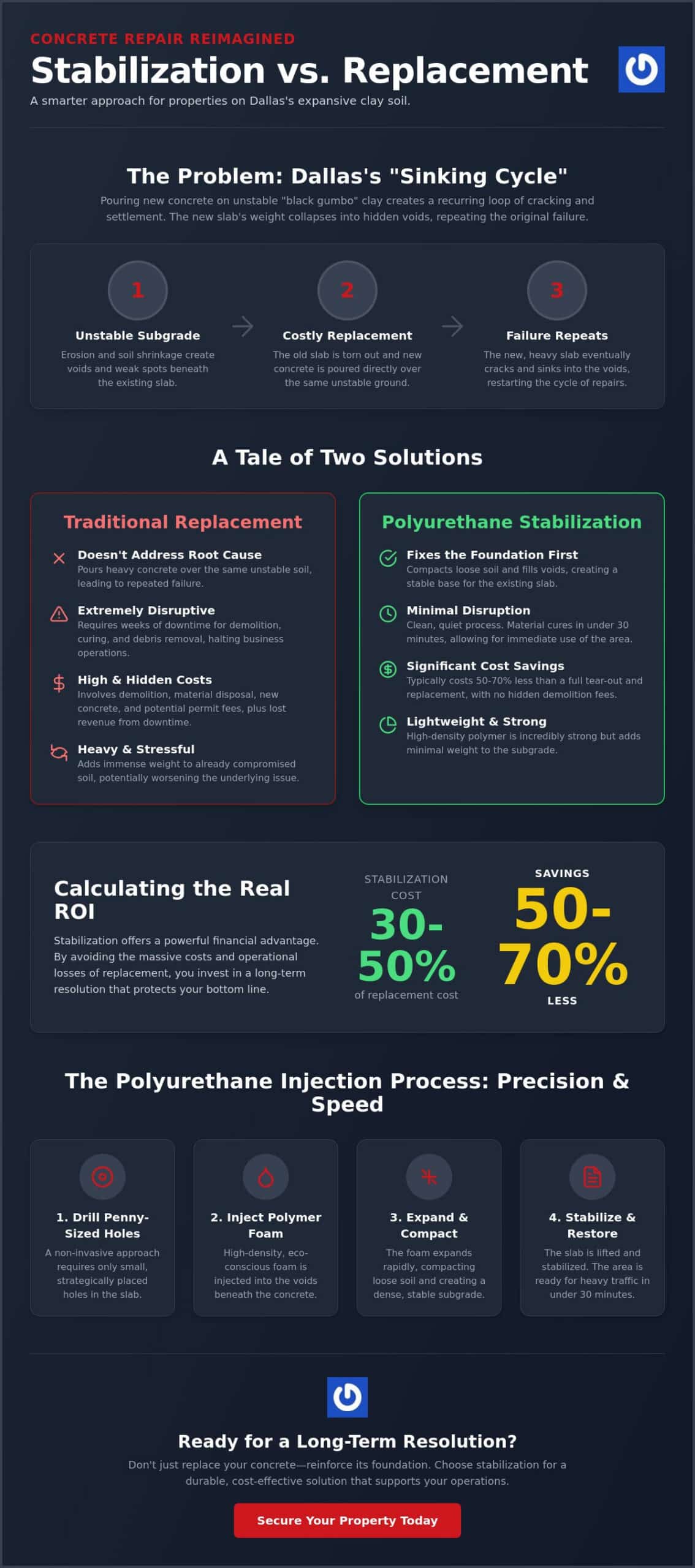
Concrete stabilization is the precise process of reinforcing the load-bearing capacity of the subgrade. In Dallas and McKinney, this step is non-negotiable for property longevity. Our local “black gumbo” clay is notorious for its dramatic volume changes. It expands when saturated and shrinks during our intense North Texas droughts, creating hollow spaces. If you pour new concrete over these unstable pockets, you’re essentially entering the “Sinking Cycle.” The weight of the new slab eventually collapses into the existing voids, leading to the same cracks and settlement you just paid to replace. Prioritizing concrete stabilization before replacement ensures that your investment rests on a firm foundation.
To better understand how this process compares to traditional methods, watch this helpful video:
The Role of Soil Erosion and Voids
Sub-slab instability often begins with poor moisture management. When water isn’t directed away from your property via professional French drain installation, it seeps beneath the slab, washing away the fine particles of the subgrade. This creates a dangerous “bridge effect.” Your concrete slab is left hanging over empty space, forced to support heavy loads without any ground support. Eventually, the tension exceeds the concrete’s strength, resulting in a structural failure that no simple patch can resolve.
Why Surface-Level Repairs Often Fail
Many property owners attempt to address these issues with cosmetic patches or traditional mudjacking. However, these methods often fail because they don’t address the underlying soil density. Mudjacking uses heavy slurries that add significant weight to already stressed soil. In contrast, modern concrete leveling techniques focus on creating a stable environment beneath the surface. True resolution requires specialized void filling under concrete slabs to restore the soil’s integrity. By increasing the density of the subgrade first, you provide a long-term resolution that supports your operations without the risk of immediate re-settlement.
Polyurethane Injection: The Modern Standard for Stabilization
Polyurethane injection represents the pinnacle of modern geotechnical engineering. Unlike traditional mudjacking, this method is remarkably non-invasive. Technicians drill penny-sized holes through the existing slab to deliver a high-density polymer directly into the subgrade. Once injected, a sophisticated chemical reaction occurs. The foam expands rapidly, seeking out every micro-void and compacting the loose soil beneath. Choosing concrete stabilization before replacement allows property owners to address the root cause of slab failure without the chaos of a full demolition.
This methodology aligns with established engineering standards for Soil Stabilization for Pavements, which emphasize improving the subgrade’s physical properties to ensure long-term performance. The high-density foam we utilize is not just powerful; it’s also environmentally responsible. We prioritize patented, eco-conscious materials made from recycled components that won’t leach into the surrounding Dallas soil. Most importantly, the material reaches 95% of its load-bearing capacity in under 30 minutes, meaning your property is ready for traffic almost immediately.
Stabilizing Warehouse and Industrial Floors
Industrial environments demand extreme resilience. For logistics hubs, combining stabilization with warehouse floor joint repair in Dallas is essential for operational safety. The injection process manages the intense point-loads generated by heavy racking systems and constant forklift traffic. By reinforcing the subgrade first, you prevent the vertical movement that leads to joint spalling and equipment damage.
Precision Leveling vs. Simple Stabilization
There’s a distinct difference between simple void filling and active lifting. While stabilization secures the ground, precision leveling uses controlled expansion to return the slab to its original grade. Achieving this degree of accuracy requires a commercial concrete leveling McKinney expert who understands the nuances of local soil behavior. If you are noticing uneven transitions in your facility, it may be time to consult a specialist about restoring your floor’s integrity before the damage worsens.
Replacement vs. Stabilization: Calculating the Real ROI
Choosing concrete stabilization before replacement isn’t just a technical preference; it’s a financial imperative. While a new reinforced slab in Dallas might range from $6 to $11 per square foot, that “sticker price” is often deceptive. Full replacement involves demolition and removal costs, which typically add $1.10 to $1.80 per square foot to your project. When you factor in the expense of city permits and the significant revenue lost during days of business downtime, the total cost of replacement can become overwhelming. In contrast, stabilization usually costs 50% to 70% less than a total tear-out, offering a much higher return on investment for your facility budget.
Beyond the immediate savings, there’s a compelling environmental case for restoration. Every slab we stabilize is one less ton of debris entering North Texas landfills. It’s a forward-thinking approach that prioritizes sustainability without sacrificing structural integrity. However, every property eventually hits a “point of no return” where the concrete is too fractured to be salvaged. Identifying these signs early is the key to avoiding unnecessary capital expenditures.
When Replacement is Necessary (And Why You Still Stabilize)
There are instances where replacement is the only logical path forward. If your concrete exhibits structural “alligator cracking”—a pattern of deep, interconnected fractures—the slab’s internal integrity is gone. Even in these cases, the logic of stabilization still applies. Paving a fresh slab over the same unstable Dallas clay that destroyed the previous one is a mistake. We recommend stabilizing the subgrade during the replacement process to protect your new infrastructure from future settlement and movement.
A Long-Term Resolution for Property Managers
For property managers, high-density polyurethane foam provides a long-term resolution that traditional cement-based grouts can’t match. Unlike mudjacking slurries that can shrink or erode over time, our foam is moisture-impermeable. It creates a stable, hydrophobic barrier that prevents future soil washouts and resists the aggressive expansion of local clay. This methodical approach ensures your facility floor remains level and capable of supporting heavy industrial loads, giving you peace of mind and predictable maintenance costs.
Effective property management often requires a combination of major structural interventions and small, smart upgrades; for those looking to refine their interior spaces, 2d6 Designs offers creative 3D-printed home improvement solutions that ensure every detail of your building is as precise as your foundation.
Secure Your Property’s Structural Integrity
Choosing a strategic path for your property means looking beyond the surface. We’ve explored how identifying the root cause of slab failure, specifically the volatile North Texas clay, prevents the cycle of recurring damage. By prioritizing concrete stabilization before replacement, you ensure that your facility benefits from a reinforced subgrade that can actually handle industrial loads. This modern approach, powered by patented eco-friendly foam technology, restores integrity to warehouse and industrial floors with minimal disruption.
Our team specializes in the unique challenges of Dallas soils, using commercial-grade equipment to deliver precise, long-term results. You don’t have to settle for the high costs and extensive downtime of traditional demolition. It’s time to invest in a solution that values both your budget and your operational continuity. Get a Professional Concrete Stabilization Assessment today. We’re ready to help you achieve a level, stable floor that supports your business’s future success.
Frequently Asked Questions
Is concrete stabilization a long-term resolution for sinking slabs?
Concrete stabilization provides an effective, long-term resolution for sinking slabs by reinforcing the subgrade’s load-bearing capacity. While environmental factors like the shifting North Texas clay mean that no solution is definitively final, high-density polyurethane is designed for lasting stability. It creates a moisture-impermeable barrier that resists the erosion common in Dallas, maintaining its structural integrity far longer than traditional cement-based methods.
How long does the stabilization process take for a commercial warehouse?
Most commercial warehouse stabilization projects are completed within a single business day. The speed of the injection process is a primary advantage over a full tear-out, which can take weeks. Because our technicians use specialized equipment to inject foam through small, penny-sized access points, we can treat large facility areas without requiring you to clear out inventory or halt your entire operation.
Can I drive heavy machinery on the concrete immediately after stabilization?
You can typically resume heavy machinery operations within 15 to 30 minutes of the injection process. High-density polyurethane reaches 95% of its full load-bearing capacity almost instantly. This rapid curing time is essential for industrial environments where downtime impacts the bottom line. Whether you’re operating heavy forklifts or managing warehouse racking, the floor is ready to support standard traffic shortly after we finish.
What is the cost difference between stabilization and full concrete replacement?
Choosing concrete stabilization before replacement typically reduces project costs by 50% to 70% compared to the price of a new pour. This significant difference arises because you bypass the high expenses of demolition, debris hauling, and the logistical nightmare of a full site shutdown. By restoring the existing slab’s foundation, you protect your capital budget while achieving a level, reliable surface for your daily operations.