

Why would you pay to tear out and replace a functional concrete slab when the real issue is hiding several inches underground? In North Texas, our heavy clay soils can expand and contract by as much as 40 percent, leaving behind empty voids that cause your driveway or warehouse floor to sink. Using concrete stabilization foam addresses these gaps without the heavy dead weight of traditional mudjacking. These uneven surfaces aren’t just ugly. They’re liability risks that can halt commercial operations or damage your home’s curb appeal. You’ve likely felt the frustration of watching a small crack turn into a major trip hazard after a single season of flash flooding.
We understand that dealing with sinking concrete is stressful. You want a solution that actually lasts without the mess of a construction zone. This 2026 guide explores how high-density polyurethane provides a lightweight, eco-friendly, and cost-effective alternative to a full repour. We will show you how this hydrophobic material creates a level surface you can drive on the same day. You’ll learn why this durable resolution is built to withstand heavy rains and how it reinforces the soil to keep your property safe and level.
Key Takeaways
- Understand how North Texas clay soils create voids and why heavy repair methods often fail to provide a long-term resolution.
- Learn how concrete stabilization foam uses high-density, closed-cell polyurethane to fill gaps and lift slabs without adding excessive weight.
- Discover why choosing foam stabilization typically costs half as much as a full concrete replacement while allowing same-day use.
- Explore the benefits of using eco-friendly materials that require only minimal, near-invisible injection holes for a cleaner finish.
- Identify how to prevent safety liabilities and equipment damage by stabilizing warehouse floors and commercial slabs.
Why Concrete Sinks: The Role of Soil and the Need for Stabilization
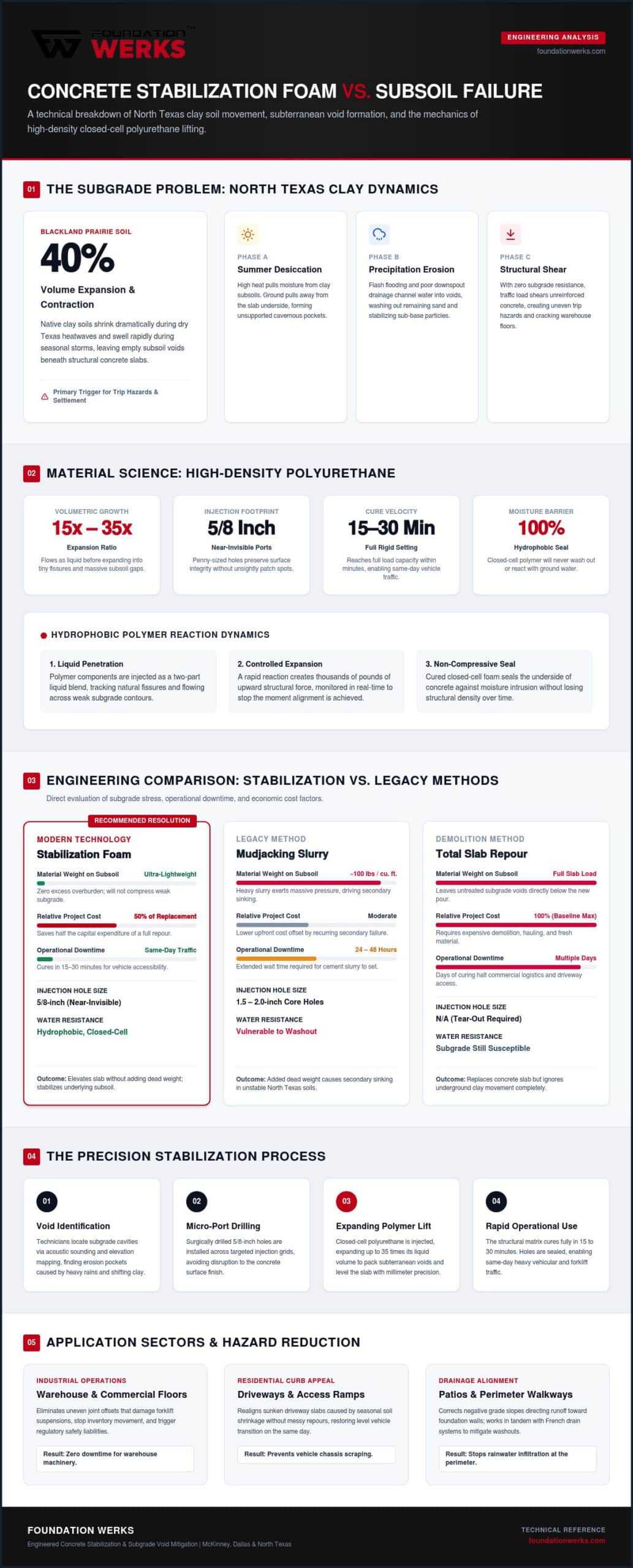
Concrete slabs are only as strong as the ground beneath them. When the soil shifts or washes away, the concrete loses its support and begins to crack or settle. In many cases, property owners see a trip hazard and assume the concrete is the problem. However, the real culprit is usually a void created by unstable subsoil. Attempting to fix this by adding heavy materials like traditional mudjacking slurry can actually make things worse. Because that slurry weighs about 100 pounds per cubic foot, it puts massive pressure on weak soil, often leading to secondary sinking within just a few years.
Identifying these issues early is vital for long-term slab health. If you notice "hollow" sounds when walking on your patio or see gaps forming between the slab and the soil, you likely have a void. Addressing these gaps early with expanding structural foam leveling can prevent the need for a total and expensive replacement. It provides a way to reinforce the ground without adding the stress of heavy cementitious fillers.
To better understand how these voids form and how they are addressed, watch this helpful video:
Soil Erosion and Void Formation
Water is the primary enemy of a stable concrete base. Poor drainage allows rainwater to flow under the slab, slowly carrying away the sand and dirt that keep the concrete level. This erosion is particularly common near downspouts or on sloped driveways. One of the most effective ways to stop this cycle is through professional French drain installation. By redirecting water away from your concrete, you protect the subgrade from future washouts. This ensures that your concrete stabilization foam has a firm, dry environment to provide lasting support.
The North Texas Clay Factor
Properties in Dallas, McKinney, and across the DFW metroplex deal with some of the most challenging soil in the country. Our native "Blackland Prairie" clay is highly expansive. During a hot Texas summer, this clay loses moisture and shrinks significantly, creating large gaps under your driveway or warehouse floor. When the fall rains arrive, the clay swells rapidly. This constant movement puts immense stress on unreinforced concrete. Using concrete stabilization foam is effective here because it’s lightweight and fills those seasonal voids without adding the dead weight that causes further settlement. It stabilizes the soil environment itself, providing a durable resolution that respects the local geology.
What is Concrete Stabilization Foam and How Does it Work?
Concrete stabilization foam is a high-density, closed-cell polyurethane material used to lift slabs and fill voids. Unlike the heavy mud and cement mixtures used in the past, this modern polymer starts as a liquid before reacting and expanding into a rigid, structural solid. This transition allows it to flow into the smallest fissures and gaps beneath your concrete, creating a customized support system that matches the exact shape of the void. Because the material is hydrophobic, it won’t react with water or wash away during heavy Texas storms. It effectively seals the underside of the slab, preventing future moisture from reaching the subgrade and causing further damage.
The Polyurethane Expansion Process
The engineering behind this repair method lies in the chemical reaction. Once injected through near-invisible 5/8-inch holes, the foam expands 15 to 35 times its original liquid volume. This expansion creates an upward force strong enough to lift thousands of pounds of concrete with surgical precision. Technicians monitor the lift in real-time, stopping the flow the moment the slab reaches its original position. Because the foam is lightweight, it doesn’t compress the subgrade further. It simply fills the space created by the seasonal swelling and shrinking of clay soils. Once the material cures, which happens in about 15 to 30 minutes, it never loses its density. It remains a rigid, supportive structure that handles the weight of vehicles and heavy equipment without flinching. You can drive your car over the repaired area almost immediately after the crew finishes.
Eco-Friendly Engineering
Sustainability is a core part of how we work at Foundation Werks. We use a patented foam formulation that incorporates recycled materials, reducing the environmental impact of your repair. This shift toward eco-conscious materials doesn’t sacrifice quality. In fact, polyurethane is often superior to organic fillers because it doesn’t decay or leach chemicals into the ground. It’s a clean, inert solution that keeps tons of concrete rubble out of local landfills by preserving your existing slabs. By choosing concrete stabilization foam, you’re opting for a high-tech approach that values both your property and the local environment. If you’re curious about how this technology can save your driveway or patio, you can request an assessment from our team to see the difference for yourself.
Comparison: Stabilization Foam vs. Mudjacking vs. Replacement
Choosing the right repair method depends on balancing cost, speed, and long-term results. While many property owners default to tearing out concrete or using older mudjacking techniques, concrete stabilization foam offers a more refined engineering approach. The primary differentiator is weight. Traditional mudjacking uses a heavy slurry of sand, cement, and soil that weighs roughly 100 pounds per cubic foot. In contrast, high-density polyurethane weighs only about 2 pounds per cubic foot. When you add 100 pounds of dead weight to soil that’s already failing to support a slab, you often trigger secondary settlement. The very material meant to fix the problem ends up sinking it further.
Foam vs. Traditional Mudjacking
The differences extend beyond weight to the actual footprint of the repair. Mudjacking requires drilling large, 2-inch holes into your concrete to pump the thick slurry. These patches are difficult to hide and often look like obvious spots on your driveway or patio. Our process uses 5/8-inch injection ports that are roughly the size of a dime. These near-invisible holes require minimal patchwork and blend much more naturally into the existing surface. Additionally, mudjacking slurry is prone to shrinking and washing away during heavy rains. Because polyurethane is hydrophobic and follows established concrete slab stabilization guidelines, it doesn’t lose density or erode. It stays exactly where it’s injected, providing a reliable foundation for your property.
Lifting vs. Total Concrete Replacement
Replacing a slab is a massive undertaking that involves jackhammers, heavy trucks, and significant downtime. A full replacement typically costs about twice as much as a professional foam lift. It also puts your landscaping at risk, as heavy equipment can rut your yard or crack adjacent healthy slabs. We generally recommend replacement only when the concrete is severely crumbled or has missing sections. If the slab is structurally sound but simply out of level, lifting is the superior choice. You’ll see a significant ROI by choosing concrete stabilization before replacement, especially in commercial settings where downtime equals lost revenue. While new concrete takes up to 28 days to reach full strength, foam-stabilized slabs are ready for vehicle traffic in about 30 minutes. This allows you to get back to your routine without the mess or the wait.
Common Applications for Polyurethane Concrete Stabilization
Concrete stabilization foam isn’t just for leveling driveways. It’s a versatile tool for any situation where the ground has lost its ability to support the weight above it. While we often focus on solid concrete slabs, our Deep Foamjection™ process allows us to stabilize the soil beneath gravel areas, blacktop, and even pavers. By injecting high-density foam deeper into the subgrade, we compact loose base layers and create a solid foundation before any surface lifting begins. This prevents the "churning" effect that often happens in high-traffic commercial zones or residential gravel paths. It’s an ideal way to reinforce the earth without the need for expensive excavation.
Commercial and Industrial Solutions
In a commercial setting, a sinking slab is more than an eyesore; it’s a liability. We frequently address uneven warehouse floor hazards where shifting concrete can cause forklifts to tip or drop loads. These issues often lead to costly OSHA violations and equipment repairs. Loading docks also endure constant pounding from heavy trucks. Over time, this vibration creates voids that lead to slab failure. Our void filling process restores full contact between the concrete and the soil, ensuring the dock stays level under pressure. By stabilizing joints, we stop the "rocking" motion that eventually causes slabs to snap. This process is fast enough that warehouse operations can continue with minimal downtime, keeping your facility running safely and efficiently.
Residential Property Improvements
For homeowners, stabilization is about protecting your investment and restoring curb appeal. Sunken porches, stoops, and patios are common trip hazards that can lower your property value. We can lift these areas back to their original position without the need for heavy equipment that might damage your lawn. Pool decks are another popular application. Because the foam is lightweight and precise, we can level the concrete without putting pressure on the pool liner or plumbing. Inside the home, stabilizing interior floor slabs is critical. If a slab sinks beneath a load-bearing wall, it can lead to drywall cracks and stuck doors. Early intervention is essential for your home’s structural integrity. We treat every residential project with the same care we’d give our own homes, ensuring that every injection is precise and every hole is carefully patched.
The Foundation Werks Process: Precision Stabilization in North Texas
Before we begin any lift, our expert crews perform a detailed assessment of your concrete and soil conditions. We don’t believe in guessing. We look for the underlying cause of the settlement, whether it’s poor drainage or the natural movement of North Texas clay. This thorough evaluation is why property managers in McKinney and Dallas trust us with their high-traffic areas. They need a solution that works without shutting down their operations for weeks. Our process identifies the exact locations where support has failed, allowing us to target the repair with surgical accuracy.
The concrete stabilization foam process is designed for speed and precision. We drill a series of tiny 5/8-inch holes in a strategic pattern across the sunken slab. These holes are roughly the size of a dime, ensuring we preserve the aesthetic look of your driveway or warehouse floor. Once the ports are set, we inject the high-density polyurethane. You can actually watch the slab rise back to its original position in real-time. Because we control the flow of material so carefully, we achieve level results that are difficult to match with traditional methods.
What to Expect During Your Service
One of the biggest advantages of using concrete stabilization foam is the cleanliness of our job sites. We don’t use heavy machinery that ruts your lawn or leaves behind a layer of grout splatter. Our equipment is self-contained, and our crews take pride in leaving your property exactly how they found it, just with level concrete. There’s no need for a massive wash-down or landscaping repair after we leave. We treat your home or facility with the respect it deserves, ensuring a professional experience from the first drill bit to the final patch.
Most importantly, we respect your time. While new concrete requires a 28-day cure cycle, our structural foam reaches 90 percent of its compressive strength in under 30 minutes. This means:
- Warehouse operations can resume immediately after injection.
- Homeowners can park their cars in the garage the same afternoon.
- Sidewalks and storefronts in busy areas like Southlake or Irvin stay open for foot traffic throughout the day.
Serving the DFW Metroplex
Our team has deep roots in Frisco, Prosper, and the surrounding North Dallas areas. We understand the unique challenges of Texas foundations because we live and work here. We know how the local soil behaves during a drought and how it reacts to our intense spring rains. This local expertise allows us to provide a durable resolution that stands up to our environment. We’re committed to your satisfaction and take quiet pride in delivering results that improve your property’s safety and value. Our neighbors trust us because we do exactly what we propose, every single time.
Restore Your Concrete with Confidence
Sinking concrete doesn’t have to be a source of stress or a major liability for your property. By choosing concrete stabilization foam, you’re opting for a modern, eco-friendly solution that reinforces the ground without the mess of traditional repairs. Our patented foam is made from recycled materials. This ensures your project is as sustainable as it is effective. Because we use nearly invisible 5/8-inch drill holes, your slabs maintain their clean look while getting the structural support they need to handle North Texas soil cycles.
You don’t have to wait weeks for results. Most projects allow you to walk or drive on the surface the same day we finish. This efficiency saves you time and money compared to a full replacement. It provides a durable resolution that respects both your budget and your schedule. We take pride in helping our neighbors in the DFW metroplex keep their properties safe and level.
Get a Free Estimate for Your Concrete Stabilization Project
Taking the first step toward level concrete is easier than you think. We’re here to explain the process and help you make the best decision for your home or facility.
Frequently Asked Questions
How long does concrete stabilization foam last?
High-density polyurethane foam is designed to provide a long-term resolution for sinking slabs. Unlike organic materials or cementitious slurries, this structural polymer never loses its density or shrinks over time. It remains a rigid support system beneath your concrete for the life of the slab. Because it’s hydrophobic, it won’t be affected by groundwater or seasonal moisture changes common in the DFW metroplex. This durability ensures your driveway stays level without the need for constant reapplications.
Is polyurethane foam environmentally safe for my yard?
Yes, our patented foam is an eco-conscious choice for North Texas homeowners. We use a formulation made from recycled materials that is fully inert once it cures. It won’t leach harmful chemicals into your soil or affect nearby landscaping in Frisco or McKinney. This sustainability is a key part of our mission at Foundation Werks. By choosing concrete stabilization foam, you’re opting for a clean repair method that protects both your property and the local environment.
Can you drive on the concrete immediately after the foam injection?
You can drive on your concrete the exact same day the work is finished. Most slabs are ready for vehicle traffic within 15 to 30 minutes after the injection is complete. This immediate usability is a major advantage over pouring new concrete, which requires 28 days to reach a full structural cure. Whether it’s a residential driveway in Dallas or a busy commercial loading dock, our process minimizes downtime and gets your property back to full operation quickly.
What is the cost difference between foam lifting and concrete replacement?
Stabilizing and raising your concrete typically costs about half as much as a full replacement project. Tearing out and repouring a slab involves expensive labor, disposal fees, and material costs that quickly add up. Foam stabilization avoids these expenses by preserving your existing concrete. It’s a cost-effective way to remove trip hazards and restore curb appeal without the high price tag of a full construction crew. We recommend this approach for any structurally sound slab that has settled.
Will the foam material lose density or shrink over time?
No, the high-density polyurethane we use will not lose density or shrink after it has cured. It is a closed-cell material that maintains its structural integrity even when exposed to moisture or heavy loads. Our foam weighs only 2 pounds per cubic foot, making it 50 times lighter than mudjacking slurry. This prevents the material from compressing the soil further. It provides a stable, rigid foundation that supports your slabs through the intense heat and heavy rains typical of the North Dallas climate.
What happens if there are large voids under my warehouse floor?
Large voids are prime candidates for our specialized void filling and stabilization service. We use concrete stabilization foam to fill every crevice beneath the warehouse floor, restoring full contact between the concrete and the subgrade. This prevents the rocking motion that leads to joint damage and forklift accidents. For deeper soil issues, we use Deep Foamjection to compact loose base layers several feet underground. This comprehensive approach ensures your facility remains safe and compliant with industrial safety standards.
How large are the holes drilled into the concrete for the foam?
We drill near-invisible holes that are only 5/8 inch in diameter, which is roughly the size of a dime. Because the foam is a liquid that expands rapidly, we don’t need the large 2-inch holes required by traditional mudjacking crews. This smaller drill pattern preserves the aesthetic look of your patio or sidewalk. Once the injection is finished, we carefully patch the holes with a matching cement product, leaving your concrete looking clean, uniform, and professionally restored.
Can all types of concrete slabs be raised with foam?
Most solid concrete slabs can be successfully raised and stabilized using this method. This includes driveways, sidewalks, pool decks, and interior floors across the DFW area. However, if the concrete is severely crumbled or has missing sections, it might be too damaged to lift effectively. During our free assessment, we evaluate the condition of your concrete and the soil beneath it. We’ll always give you an honest recommendation on whether stabilization or a full replacement is the right choice for your property.