

The lowest quote for lifting a settled slab may not be the best value if it covers less work or a different result. That’s why comparing foam jacking vs mudjacking cost means looking beyond the initial total. Mudjacking often has a lower upfront price, while foam jacking uses a lighter material and smaller drill holes. Which option makes sense depends on the slab and what the project needs to accomplish.
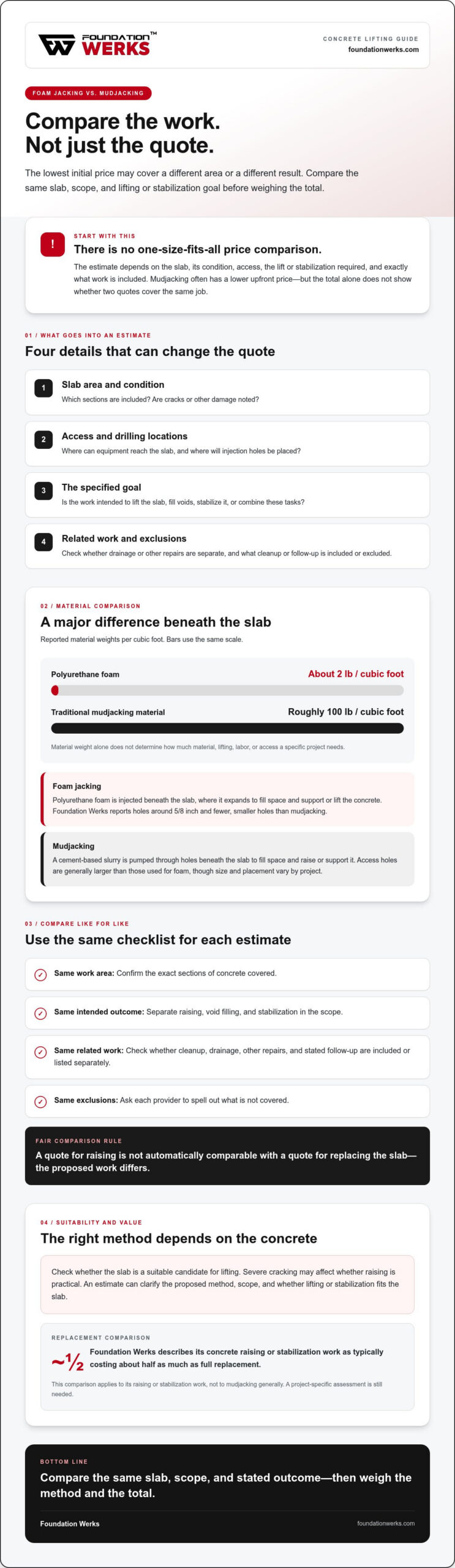
It’s understandable to want a clear, like-for-like comparison before choosing a repair. But quotes can be hard to weigh when they describe different areas, voids, lift requirements, or follow-up work. The material matters, too: Foundation Werks’ polyurethane foam is about 2 pounds per cubic foot, compared with roughly 100 pounds per cubic foot for traditional mudjacking material.
This guide explains the factors that shape each estimate, how to compare scope and expected outcomes, and what to ask about slab suitability. You’ll also learn what details to gather before requesting an estimate, so you can assess whether lifting or stabilization may help address the problem without jumping straight to replacement.
Key Takeaways
- There’s no one-size-fits-all price comparison for foam jacking vs mudjacking cost; the work area, slab condition, and requested result all affect an estimate.
- Compare quotes against the same work area and lifting or stabilization goal, and ask providers to spell out what’s excluded.
- Check whether the slab is a suitable candidate for lifting. Severe cracking may affect whether raising is practical.
- Use an estimate to clarify the proposed method, project scope, and whether lifting or stabilization fits your concrete.
Foam jacking vs. mudjacking cost: what determines the quote?
Foam jacking and mudjacking are methods for raising or supporting settled concrete by injecting material beneath a slab. Foam jacking injects polyurethane foam, while mudjacking pumps a cement-based slurry through drilled holes. Both can address settlement, but the method alone doesn’t determine the project’s price.
There’s no reliable universal price comparison in the supplied source material. A quote needs to reflect the specific slab, its condition, access, the lift or stabilization required, and exactly what work is included. For a neutral overview of how different methods fit into concrete leveling, see the linked reference.
For a visual overview of foam jacking and mudjacking, watch this video:
What can change the cost of concrete lifting?
Separate the slab’s needs from the injection material when reviewing an estimate. A larger area may require more work, but size alone doesn’t show how much lifting or stabilization is needed. Ask the provider to identify:
- Slab area and condition: Which sections are included, and are cracks or damage noted?
- Access and drilling locations: Where will equipment reach the slab, and where will injection holes be placed?
- Specified work: Is the goal to lift the slab, fill voids beneath it, stabilize it, or combine these tasks?
- Related work: If drainage or other repairs are proposed, are they listed separately from the lifting scope?
Foundation Werks describes its concrete raising or stabilization work as typically costing about half as much as full replacement. That comparison applies to its raising or stabilization work, not to mudjacking generally. A project-specific assessment is still needed to determine which option suits the slab.
Why the lowest quote may not cover the same work
Check whether each estimate includes lifting, void filling, cleanup, and any stated follow-up, or lists these as exclusions. Also confirm the exact work area and intended result. A quote for raising is not automatically comparable with one for replacing the slab, since the proposed work differs.
Comparable quotes need to cover the same slab, scope, and stated outcome. Use that standard to compare foam jacking vs mudjacking cost fairly, rather than choosing by the total alone.
How foam jacking and mudjacking differ beneath the slab
Both methods work through access holes in the concrete, but the injected material and installation details differ. Foundation Werks describes polyurethane foam as lightweight and reports using fewer, smaller holes for foam injection. These differences may affect site disruption, but neither hole size nor material weight alone determines the foam jacking vs mudjacking cost for a specific project.
| Comparison | Foam jacking | Mudjacking |
|---|---|---|
| Material | Polyurethane foam, about 2 lb per cubic foot according to Foundation Werks. | Traditional mudjacking material, averaging about 100 lb per cubic foot according to Foundation Werks. |
| Injection approach | Foam is injected beneath the slab, where it expands to fill space and support or lift the concrete. | A cement-based slurry is pumped through holes beneath the slab to fill space and raise or support it. |
| Drill holes | Foundation Werks reports holes around 5/8 inch and fewer holes than mudjacking. | Access holes are generally larger than those used for foam, though size and placement vary by project. |
| Site disruption | Smaller holes may mean less visible drilling. The process and access needs still depend on the site. | Slurry placement and equipment needs vary with the slab and work area. |
Material weight and what it does, and does not, tell you
The weight figures help explain a basic difference between the materials. A lighter injected material adds less weight beneath the slab, while a heavier slurry adds more. But those figures don’t show how much material a project needs, how much lifting is required, or what labor and access are involved.
Material density describes the injected material, not the total project cost. For background on concrete leveling methods, see this technical reference.
Worksite disruption and concrete readiness
Drilling, injection, and site access can differ by contractor and slab. Foundation Werks reports that its foam process can reduce splatter and avoid taking heavy equipment over landscaping. It also says concrete can be walked on, driven on, or played on the same day after completed work. Confirm the expected access and return-to-use timing for your own project.
If you’re weighing foam raising for a settled slab, review Foundation Werks’ concrete raising information as one way to understand the method and discuss whether it fits the site.
Which method offers better value for your concrete project?
There isn’t a universal winner in the foam jacking vs mudjacking cost comparison. Value depends on what the slab needs, the condition it’s in, how much disruption the work may cause, and whether each quote includes the same scope. A lower quote may not deliver the outcome you want if it leaves out needed stabilization or addresses a different area.
Start with the slab itself. A settled slab that remains solid may be a candidate for lifting or support. Severe cracking, crumbling edges, or other visible damage calls for closer assessment before choosing a method. Lifting and stabilization address settlement or support beneath existing concrete; replacement is a different scope of work. Neither lifting method is suitable for every slab, and an estimate should explain why the proposed approach fits.
When foam jacking may fit the project
Foam jacking may be worth considering when a solid slab has settled and the goal is to raise or support it. Foundation Werks reports using smaller injection holes and fewer holes than mudjacking, which may matter where owners want to limit visible drilling or reduce disruption around a work area. Actual access needs depend on the site and should be confirmed during assessment.
Examples of concrete that may need evaluation include residential walkways or driveways and commercial slabs. For facility managers, uneven warehouse floor repair in Dallas offers more context on addressing uneven warehouse floors. The right approach still depends on the slab’s condition and the outcome required.
When the slab needs closer assessment
Severe cracks or crumbling concrete can affect whether a slab can be lifted without further damage. Ask the estimator to explain what they observed and whether lifting, stabilization, additional repairs, or replacement should be considered. If the concrete is a commercial slab with cracks or joint concerns, review this commercial concrete crack repair guidance alongside the proposed lifting scope.
Before comparing methods, ask each provider to state the intended result and any limits. Will the work raise the slab, fill voids, stabilize it, or address more than one need? Are damaged areas included? Clear answers help you compare like with like, rather than treating a material choice as a substitute for assessing the concrete.
Choose based on a sound assessment and a clearly defined outcome, not a blanket claim that one method is always better. If the slab’s condition makes lifting uncertain, ask what other options should be weighed before committing to the work.
How to compare foam jacking and mudjacking estimates
To compare the foam jacking vs mudjacking cost fairly, ask each provider to price the same slab and desired result. A written estimate makes differences in method, scope, and exclusions easier to spot before you decide.
Use this checklist for each proposal:
- Confirm the method. Which material and injection method does the estimate specify?
- Match the work area. Does it include the same slab sections and boundaries as the other quote?
- Define the work. Is the provider proposing lifting, void filling, stabilization, or a combination?
- Review exclusions. Are repairs beyond lifting, such as crack or joint work, included or priced separately?
- Clarify site conditions. What access is needed, how will drilling locations be selected, and what surface preparation is expected?
- Ask about disruption and use. What should you expect during the work, how will cleanup be handled, and when can the area be used again?
Questions to ask every concrete-lifting provider
Ask how the provider assessed the slab and what signs informed their recommendation. If there are cracks, crumbling areas, or uneven sections, ask whether those conditions affect lifting suitability. Request a clear explanation of what the proposed work is meant to accomplish, what it won’t address, and whether any additional repairs should be considered separately.
Written answers help prevent a low initial quote from appearing comparable when it covers a different area or less work. They also give you a practical record to refer to if the proposed scope changes after the slab is assessed more closely.
How to assess the quoted outcome
Compare the stated result and its limits, not just the starting total. Ask whether the goal is to raise the slab to a specified level, stabilize it, or fill voids beneath it. Clarify how drill holes will be finished, what cleanup is included, and whether access restrictions or surface-readiness requirements apply. Don’t assume each provider includes the same steps.
A useful estimate connects the proposed method to a clearly defined scope. Foundation Werks offers free estimates by phone. Treat any estimate as a project-specific assessment, not a guaranteed final price; confirm what it covers and whether the scope may change after inspection.
Get a foam jacking estimate in the Dallas-Fort Worth area
Foundation Werks is based in McKinney and serves the Dallas metropolitan area. An estimate can help clarify whether polyurethane concrete raising or stabilization may suit your slab, what work the project involves, and what factors shape the quote. Service coverage can depend on the project location, so confirm that your property is within the company’s current service area.
Projects may involve settled driveways, sidewalks, patios, pool decks, interior slabs, or warehouse floors. An assessment may also consider whether void filling is needed beneath the concrete. These are examples of surfaces and conditions to discuss, not a promise that every slab is suitable for lifting. For a useful foam jacking vs mudjacking cost comparison, describe the specific area and outcome you’re seeking.
What to prepare before requesting an estimate
A few details can help the estimator understand the project. Be ready to identify the surface, approximate affected area, and any visible cracks, crumbling, or settlement. Note access limits, such as equipment needing to reach a backyard or a work area that must remain accessible for household or business use.
Ask what photographs or on-site information would help assess the slab. If the area is used by customers, employees, or family members, explain any scheduling or access needs so they can be considered during the estimate. The assessment should connect those details to the proposed scope, rather than treating every settled slab the same way.
What Foundation Werks can assess
Foundation Werks focuses on polyurethane concrete raising, concrete stabilization, and void filling. For a commercial property, the discussion may include warehouse floors or other commercial concrete areas. The estimate should identify the work area, describe the proposed scope, and explain whether raising or stabilization appears suitable based on the slab’s condition.
Customer feedback can offer context about the service experience. Foundation Werks testimonials mention knowledgeable, professional crews and workmanship. These are customer reports, not a guarantee of a particular result. Use the estimate to ask questions about your own slab and clarify what the proposed work includes.
For a free estimate, call 800-464-9684. There’s no need to choose a method before discussing the project. Share what you’ve observed and ask what information is needed to assess the concrete.
Make your next concrete decision with confidence
The best choice isn’t determined by the injection material alone. Compare foam jacking vs mudjacking cost using the same slab, work area, and desired outcome. Then weigh the proposed scope against the concrete’s condition, access needs, and expected disruption. A clear assessment can help you understand whether lifting or stabilization is suitable, or whether another approach should be considered.
Foundation Werks is based in McKinney and serves the Dallas metropolitan area. Customer testimonials describe professional crews and positive experiences with concrete work. An estimate can help connect your slab’s condition to a project-specific scope, without assuming one method fits every situation.
Request a free concrete-lifting estimate
Gather a few details about the affected area, note any visible cracks or settlement, and ask questions about what the work includes. With a clear comparison, you can take the next step with greater confidence.
Frequently Asked Questions
How much does foam jacking cost compared with mudjacking?
There’s no universal price or method that always costs less. The foam jacking vs mudjacking cost for a specific project depends on slab condition, access, project scope, and the work included in each estimate. Ask providers to quote the same slab and intended result, then compare lifting, stabilization, and any additional work listed. Foundation Werks’ comparison with replacement is separate: it says its raising or stabilization work typically costs about half as much as full replacement.
Is foam jacking more expensive than mudjacking?
There isn’t a universal yes or no. The comparison depends on the site, method, provider, and scope in the estimate. Check whether each proposal includes the same work, such as lifting, stabilization, cleanup, and any additional repairs. Foam’s lower material weight or smaller drill holes don’t establish that a project will cost less. Request written estimates for the same area and outcome, and ask providers to explain any differences in scope.
What affects the cost of concrete jacking?
Concrete jacking estimates can vary with the slab’s size and condition, access to the work area, and the amount of lifting or stabilization specified. Repairs beyond lifting may also affect the scope, so ask whether they’re included or listed separately. Estimates can’t be compared fairly if they cover different areas or outcomes. Ask each provider to identify inclusions, exclusions, and the intended result before weighing the quotes.
Is foam jacking cheaper than replacing concrete?
Foundation Werks’ materials describe its concrete raising or stabilization work as typically costing about half as much as full replacement. This is the company’s general comparison, not a guaranteed outcome or price for every project. Suitability depends on the slab’s condition and the work required. A solid slab may be a candidate for raising, while severe cracking can mean it’s too damaged to lift. Request an assessment before comparing options.
How large are the holes for polyurethane foam concrete raising?
Foundation Werks reports that its polyurethane foam injection holes are approximately 5/8 inch and that fewer holes are needed than with mudjacking. The number and placement depend on the slab and work required. The company describes the holes as nearly invisible, but that isn’t a promise about how they’ll look on every surface. Ask the provider where holes will be drilled and how they’ll be finished.
How soon can I use concrete after foam jacking?
Foundation Werks says concrete can be walked on, driven on, or played on the same day after completed work. That describes the company’s reported process, not a universal schedule for every project. Conditions and instructions can vary, so confirm when the specific area will be ready for use with the contractor doing the work. Ask about any access limits that apply while the job is underway and before the surface is released for use.
Can every sunken or cracked concrete slab be raised?
No. Foundation Werks says solid slabs can be raised and stabilized, while severely cracked slabs may be too damaged to lift. The appropriate method depends on an assessment of the concrete’s condition and the intended result. Don’t assume that lifting or replacement is automatically right based on settlement alone. Ask the estimator to explain the slab’s suitability and whether raising, stabilization, or another option should be considered.