

What if the most durable solution for your sunken driveway actually started in a recycling bin? Most North Texas homeowners feel a sense of dread when they see a concrete slab begin to tilt or crack. You’re likely worried about heavy machinery crushing your flower beds or the environmental footprint of traditional cement grouts. It’s frustrating to think that fixing your home might mean damaging your yard or the local ecosystem.
We agree that you shouldn’t have to choose between a stable foundation and a healthy planet. That’s why foundation repair with recycled materials has become the gold standard for 2026. In this guide, you’ll discover how eco-conscious polyurethane foam, which can contain over 40% recycled content, provides a high-performance fix that’s ready to walk or drive on in minutes. We’ll explain how this sustainable approach offers a permanent, level surface while saving you from the high costs and massive downtime of a full concrete replacement.
Key Takeaways
- Learn how modern polyurethane foam uses a patented, eco-conscious formulation to create high-density structural support for your home or business.
- Compare the lightweight benefits of recycled polymers against heavy traditional mudjacking to prevent further soil settlement and sinking.
- Discover why foundation repair with recycled materials is less invasive, using tiny 5/8-inch drill holes that won’t leave your concrete looking like a construction zone.
- Find out how to identify trip hazards on your property and determine if stabilization is a more cost-effective alternative to full concrete replacement.
- Understand the precision injection process that lets you walk or drive on your repaired concrete surfaces the very same day.
Understanding Foundation Repair with Recycled Materials
Choosing foundation repair with recycled materials means you are opting for a sophisticated, eco-friendly polymer instead of old-fashioned slurry. This method uses a patented polyurethane foam where a significant percentage of the raw ingredients are sourced from recycled components. Some modern formulations even contain over 40% recycled materials, according to industry data. By diverting these materials from landfills, we can provide a high-performance solution that doesn’t rely solely on new, virgin plastics. It’s a cleaner way to work that aligns with the growing demand for sustainable construction in North Texas.
The industry is moving away from traditional grout for several reasons. Cement production is one of the largest contributors to carbon emissions globally. When we use recycled polymers, we significantly lower the carbon footprint of your home repair. These materials are also inert once they cure, which means they won’t leach chemicals into the McKinney or Frisco soil over time. This approach to foundation repair with recycled materials ensures that your property remains safe for your family and the local environment.
The Evolution of Concrete Stabilization
Concrete repair has come a long way from the days of “mudjacking.” That older process involves pumping a heavy mixture of soil, water, and cement under a slab. It’s a carbon-intensive method that often creates a massive mess. Modern polyurethane applications have refined this into a surgical process. We now use high-density recycled materials that expand to fill voids with incredible precision. This shift is driven by a desire for efficiency and a commitment to “green” building standards that prioritize repairing existing structures over the waste of full replacement.
Why Material Weight Matters in DFW
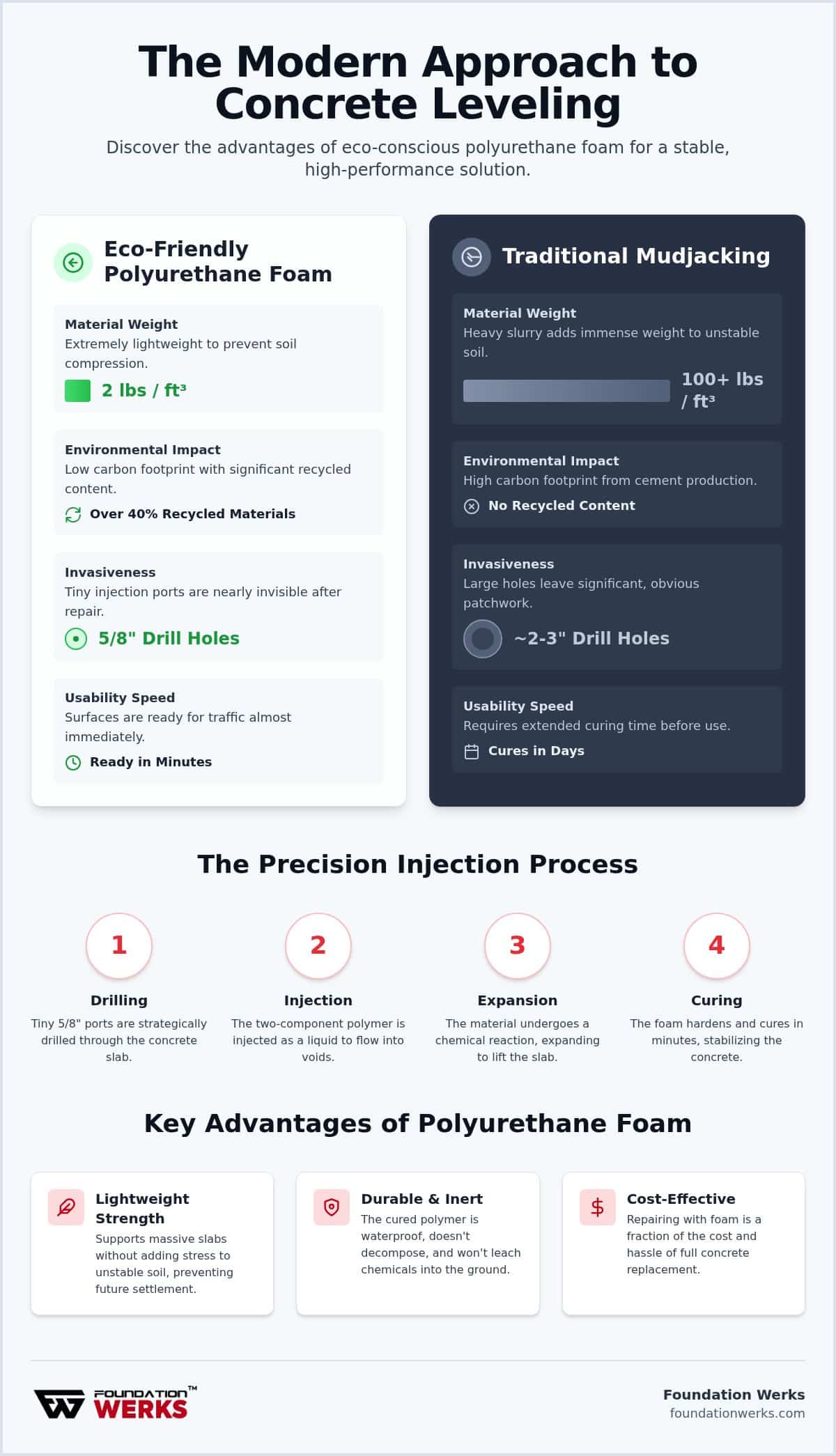
In the Dallas-Fort Worth area, our expansive clay soil is notoriously temperamental. It shifts constantly based on moisture levels. If you add 100 pounds of traditional grout for every cubic foot of space under your driveway, you’re putting immense pressure on already unstable ground. This often leads to secondary settlement, where the weight of the repair itself causes the concrete to sink again.
Our recycled foam solves this problem by weighing only 2 pounds per cubic foot. It provides the necessary lift without the crushing weight of grout. This lightweight structural polymer offers an exceptional weight-to-strength ratio, allowing a few pounds of material to permanently support and stabilize massive concrete slabs. By reducing the overburden on the soil, we ensure your driveway or pool deck stays level for the long term.
The Science of Recycled Polyurethane Foam
The success of foundation repair with recycled materials relies on a precise chemical reaction that happens right beneath your feet. We start with two liquid components that, when combined, expand rapidly to fill every hidden pocket and void under your concrete. This isn’t just a physical filler; it’s a structural transformation. Within seconds, the liquid becomes a rigid, high-density foam that can support thousands of pounds. Unlike traditional mudjacking, which relies on organic soils that can decompose, this polymer is engineered to last for decades without changing shape or losing its lift.
Safety is a major concern for families across North Texas. Once the foam cures, it becomes completely inert. It doesn’t react with the soil or leach harmful chemicals into the groundwater. This is a critical advantage over some older grouts that can break down or potentially contaminate the local ecosystem. You get a stable driveway or patio without compromising the land your home sits on. The material is designed to stay exactly where it’s placed, providing a permanent barrier against soil erosion.
Patented Eco-Conscious Formulations
The development of Sustainable Rigid Polyurethane Foams represents a major breakthrough in construction technology. By repurposing chemical by-products that would otherwise end up in a landfill, manufacturers have created a material that meets strict residential safety standards. Some of these patented formulations now contain over 40% recycled materials while maintaining the same density and lift capacity as virgin polymers. It’s a sophisticated way to reduce the overall environmental impact of your home repair. If you’re curious about how this tech applies to your property, you can explore our polyurethane concrete raising options to see the process in action.
Structural Integrity and Load Bearing
Don’t let the word “recycled” lead you to think the material is less durable. The compressive strength of this foam is remarkable. It’s designed to provide uniform slab support by filling even the smallest gaps that traditional mudjacking often misses. This stability is why we trust these materials for everything from residential pool decks to massive industrial warehouse floors.
- High Compressive Strength: Easily handles the weight of heavy vehicles and warehouse inventory.
- Zero Shrinkage: Unlike grout, which loses volume as water evaporates, recycled foam stays at its cured size forever.
- Waterproof: It creates a sealed barrier that prevents future water infiltration and soil washout.
Recycled foam never loses density. It doesn’t rot or wash away during the heavy spring rains we see in McKinney and Frisco. It remains a solid, dependable foundation for your concrete for the life of the structure.
Recycled Foam vs. Traditional Mudjacking: A Comparison
When you compare repair methods, the physical footprint is the first thing you’ll notice. Mudjacking is often considered the “brute force” approach to concrete leveling. It involves pumping a heavy slurry of sand, water, and cement under your slab. Foundation repair with recycled materials, however, is more like a surgical strike. It uses lightweight, high-density polymers that expand to fill voids without adding massive weight to your property. This modern approach solves the root cause of the sinking without creating new problems for your soil to manage.
The technical differences are stark. Mudjacking grout weighs approximately 100 pounds per cubic foot. In contrast, our recycled foam weighs just 2 pounds per cubic foot. This 98% weight reduction is vital for North Texas homes. It prevents the “sinking stone” effect, where the heavy repair material actually pushes the slab deeper into the soft clay over time. Additionally, mudjacking requires large 2-inch holes that can leave your driveway looking like Swiss cheese. We use 5/8-inch holes, which are about the size of a dime and nearly invisible once we patch them.
Performance in the Texas Climate
North Texas weather is notoriously hard on concrete surfaces. In McKinney and Frisco, we deal with intense summer heat followed by torrential spring rains. Mudjacking grout is susceptible to washout because it’s essentially a dirt-based mixture. If water gets under the slab, it can erode that slurry, leaving your concrete unsupported again. Recycled foam is completely waterproof. It binds to the underside of the concrete and the soil, creating a permanent seal that water cannot penetrate. This level of durability is especially critical for commercial settings, such as uneven warehouse floor repair Dallas, where constant heavy traffic demands a material that won’t shift or erode under pressure.
Cost-Effectiveness Over the Lifecycle
Many homeowners focus only on the initial quote when choosing a repair method. While mudjacking might seem cheaper on paper, the hidden costs add up quickly. You often have to wait 24 to 48 hours for traditional grout to cure, meaning your driveway or warehouse floor is out of commission. Plus, the heavy trucks used for mudjacking can crack your curb or ruin your landscaping. Foundation repair with recycled materials is ready for use the same day. You won’t spend money on lawn restoration or secondary repairs because the foam doesn’t wash out. It’s a high-performance resolution that offers the best long-term value for your home or business.
Assessing Your Property for Sustainable Repair
North Texas soil is rarely still. The heavy clay in McKinney and Frisco expands when wet and shrinks when dry, leaving your concrete slabs unsupported. Before you commit to a full tear-out, you need to determine if your property is a candidate for foundation repair with recycled materials. Often, the concrete itself is structurally sound; it has simply lost the ground beneath it. Lifting the slab is faster and more affordable than pouring a new one.
Residential Checklist: Driveways to Patios
Look for specific warning signs on your driveway or pool deck. Are there sections where one slab has dropped an inch or more below the other? These trip hazards are common indicators of soil washout. Check for cracks that seem to be widening or joints that no longer line up. For business owners, maintaining these surfaces is about more than just aesthetics. Proper concrete crack repair commercial standards ensure your facility remains safe for employees and heavy equipment like forklifts. If your concrete is intact but uneven, it’s likely a perfect candidate for polymer injection.
The Role of Professional Soil Stabilization
Sometimes the issue goes deeper than a few inches. If your soil has eroded significantly, you might need deep soil stabilization. We use specialized methods like Deep Foamjection™ to reach the unstable layers of gravel or blacktop. This process fills the deep-seated voids that cause recurring sinking. It’s a clean, same-day service that doesn’t require the massive excavation of traditional methods. In industrial settings, a sunken loading dock can bring operations to a halt. Stabilizing these warehouse floors requires a material that can handle constant vibration and extreme weight. Recycled polyurethane provides that rigid support without the mess of cement grout.
Lifting the concrete is only half the battle. If water continues to pool near your foundation, the soil will eventually wash away again. We often recommend integrating French drain installation to redirect runoff away from your newly leveled surfaces. This proactive step protects your investment and ensures the recycled polymers have a dry, stable environment to do their job. By combining stabilization with proper drainage, you create a long-term solution that respects the local environment.
The Foundation Werks Approach to Eco-Friendly Lifting
At Foundation Werks, we believe that high-performance repairs shouldn’t come at the expense of your property’s aesthetics or the local environment. Our team takes quiet pride in being a leading provider of foundation repair with recycled materials across North Texas. We aren’t just another faceless contractor; we’re your neighbors, and we treat every driveway, warehouse floor, and patio as if it were our own. This commitment to quality means using the best materials available while providing a level of transparency that’s rare in the construction trade.
The process is designed for minimal disruption to your daily life. We don’t bring heavy, lawn-crushing machinery to your home. Instead, our precision injection system allows us to work from a small trailer, reaching sunken sections with surgical accuracy. This method ensures that we leave your property exactly as we found it, only level and safe. Because the recycled foam cures almost instantly, you can drive your car onto your driveway or resume warehouse operations the same day we finish the job. We value your time and work hard to keep your project moving without unnecessary delays.
Serving the Dallas Metropolitan Area
Our crews have deep experience navigating the unique soil challenges found in Prosper, Allen, and Southlake. We understand how the “black gumbo” clay in these areas behaves during a drought versus a rainy spring. This local expertise allows us to customize our approach for every project, ensuring the stabilization lasts for the long term. Whether we’re lifting a residential pool deck in Frisco or stabilizing a massive industrial loading dock in Dallas, we bring the same level of care and technical knowledge to the site. It’s this people-first mentality that has built our reputation for reliability across the metroplex.
Next Steps for Your Concrete Resolution
If you’ve noticed trip hazards or uneven slabs, the best time to act is before the damage worsens. We offer a straightforward, educational consultation process. When you schedule an on-site visit, one of our specialists will assess your property, explain the science behind our methods, and provide a clear plan for stabilization. We’ll answer your questions about material density, drainage, and cure times without any high-pressure sales tactics. We want you to feel empowered and confident in the solution we propose for your home or business.
Ready to restore your concrete surfaces with a sustainable, high-performance solution? Contact Foundation Werks today to schedule your free estimate and see how we can help you achieve peace of mind.
Restore Your Concrete with Confidence
Choosing foundation repair with recycled materials is more than just an environmental statement. It’s a commitment to a smarter, more durable way of maintaining your property. By opting for high-density polymers instead of heavy, traditional grout, you protect your home from secondary settlement while supporting the local ecosystem. You’ve learned how our patented eco-friendly foam provides superior stabilization without the mess or destruction of older methods.
The process is designed to be as stress-free as possible. We use nearly invisible 5/8-inch drill holes to inject the material, leaving your surfaces looking pristine. Best of all, you get immediate same-day use of your driveway, pool deck, or warehouse floor. There’s no need to wait days for a heavy slurry to dry or worry about landscaping damage from massive machinery. We’re here to help you achieve a level, safe property with minimal disruption.
We look forward to helping you stabilize your North Texas home or business. Your peace of mind starts with a firm foundation and a partner who cares about the details.
Frequently Asked Questions
Is foundation repair with recycled materials as strong as traditional methods?
Yes, it is just as strong as traditional methods and often more reliable. High-density polyurethane foam provides a consistent structural support that easily handles the weight of heavy vehicles. Unlike soil-based grouts, this material won’t erode or shift over time. It binds directly to the underside of the slab, creating a solid platform that remains stable even in our tough North Texas clay. Foundation repair with recycled materials is a high-performance choice for any property.
How long does recycled polyurethane concrete lifting last?
Recycled polyurethane concrete lifting is a permanent solution designed to last as long as the concrete itself. Because the foam is waterproof and inert, it doesn’t rot or decompose like organic fillers. It won’t wash away during a heavy storm or break down under the intense Texas sun. Once the material is in place, you don’t have to worry about it losing its lifting power or shifting position.
Can I drive on my driveway immediately after the foam injection?
You can drive on your driveway about 15 to 30 minutes after the injection process is complete. The foam cures rapidly and reaches its full load-bearing capacity within minutes. This speed is one of the biggest benefits for busy homeowners in the Dallas area. You won’t have to park on the street for days or wait for a new concrete slab to dry and cure.
Will the recycled foam leach chemicals into my yard or garden?
The recycled foam is completely safe and won’t leach any harmful chemicals into your yard or garden. Once the liquid components react and turn into a solid foam, the material becomes totally inert. It won’t react with the soil or contaminate the local groundwater in McKinney or Frisco. You can feel good about using this eco-friendly option near your flower beds, trees, and landscaping.
How much does eco-friendly concrete raising cost compared to replacement?
Foundation repair with recycled materials typically costs much less than a full concrete replacement. You’re paying for a surgical repair rather than a massive demolition and reconstruction project. By choosing to lift instead of replace, you avoid the high costs of disposal fees and heavy labor. It’s a high-performance resolution that saves you money while delivering a level, safe surface for your home or business.
What happens if my concrete is too cracked for foam lifting?
If your slab is broken into very small, disconnected pieces, it might be too damaged for foam lifting. We look for slabs that are still mostly intact but have simply sunken or tilted. If the concrete has lost its structural integrity, we’ll be honest and recommend replacement instead. Our goal is to provide a repair that actually lasts, rather than a temporary fix that won’t hold up.
Does the foam material lose density over time?
No, the foam material never loses density or shrinks after it has cured. Traditional mudjacking grout can shrink as it loses moisture, which often leads to the slab sinking a second time. This polymer is a closed-cell material that stays at its original volume forever. It remains rigid and supportive, regardless of how much the North Texas soil moisture levels change throughout the year.
Do you serve commercial properties in the Dallas-Fort Worth area?
We proudly serve commercial properties across the entire Dallas-Fort Worth metroplex. Our crews are experienced in stabilizing warehouse floors, loading docks, and commercial parking lots where heavy traffic is a daily reality. We understand that business downtime is expensive. Our team works quickly to get your facility back to full capacity on the same day we arrive at your site.