

Soil stabilization can improve ground support, but can the surface still shift over time? Yes. Soil and site conditions can change, and results depend on how well the method suits the ground, drainage, surface, and loads. The long term effects of soil stabilization are therefore specific to the treatment and the property.
This article explains what stabilization is intended to do, which site conditions can affect performance, and what changes are worth documenting. It also distinguishes soil stabilization from lifting a settled concrete slab, filling a void beneath concrete, or replacing damaged concrete, since each addresses a different condition.
Foundation Werks utilizes advanced polyurethane injection methods to stabilize soil beneath gravel areas, blacktop, and pavers. Polyurethane concrete raising addresses a different issue: settled concrete slabs. Knowing which surface has changed, and what lies beneath it, is a practical first step in choosing an approach.
Key Takeaways
- The long term effects of soil stabilization vary with the method, soil, drainage, loads, and site conditions.
- Record when and where settlement or surface changes appear. A dated photo log can help you identify patterns and describe them clearly.
- Soil stabilization, concrete raising, void filling, and replacement address different conditions. Matching the work to the problem matters.
- Water movement, erosion, surface condition, and repeated loading are useful factors to assess when considering how stabilized ground may perform.
- Deep Foamjection™ stabilizes soil beneath gravel, blacktop, and pavers. Concrete raising and void filling address relevant conditions beneath slabs.
What Are the Long-Term Effects of Soil Stabilization?
The long term effects of soil stabilization depend on the ground, treatment, and intended use of the area. Stabilization aims to improve ground performance for a specific purpose, such as supporting a surface. It doesn’t make every site behave the same way, and it doesn’t automatically repair damage to the concrete above it.
In brief: Soil stabilization is intended to improve ground performance for a defined use. Its results depend on the method, soil, moisture pathways, surface, applied loads, and changing site conditions.
What changes can stabilization make to ground performance?
The intended result is improved ground support or surface usability suited to the project. What that means in practice depends on the method and the condition being addressed. Treating soil beneath gravel, blacktop, or pavers has a different purpose from raising a settled concrete slab.
Soil stabilization includes different approaches, so this Soil Stabilization Overview can help explain why the method matters. A general description, however, can’t predict the result at a particular property. Set expectations around the work being done and the conditions at the site, rather than assuming every treatment called “stabilization” performs alike.
Stabilizing ground also doesn’t repair every visible surface problem. A crack may involve the concrete itself, the supporting ground, or other site conditions. Ground treatment alone may not address a concrete problem. Identifying what has moved or deteriorated helps keep the work focused on the observed issue.
How is stabilization different from concrete lifting or replacement?
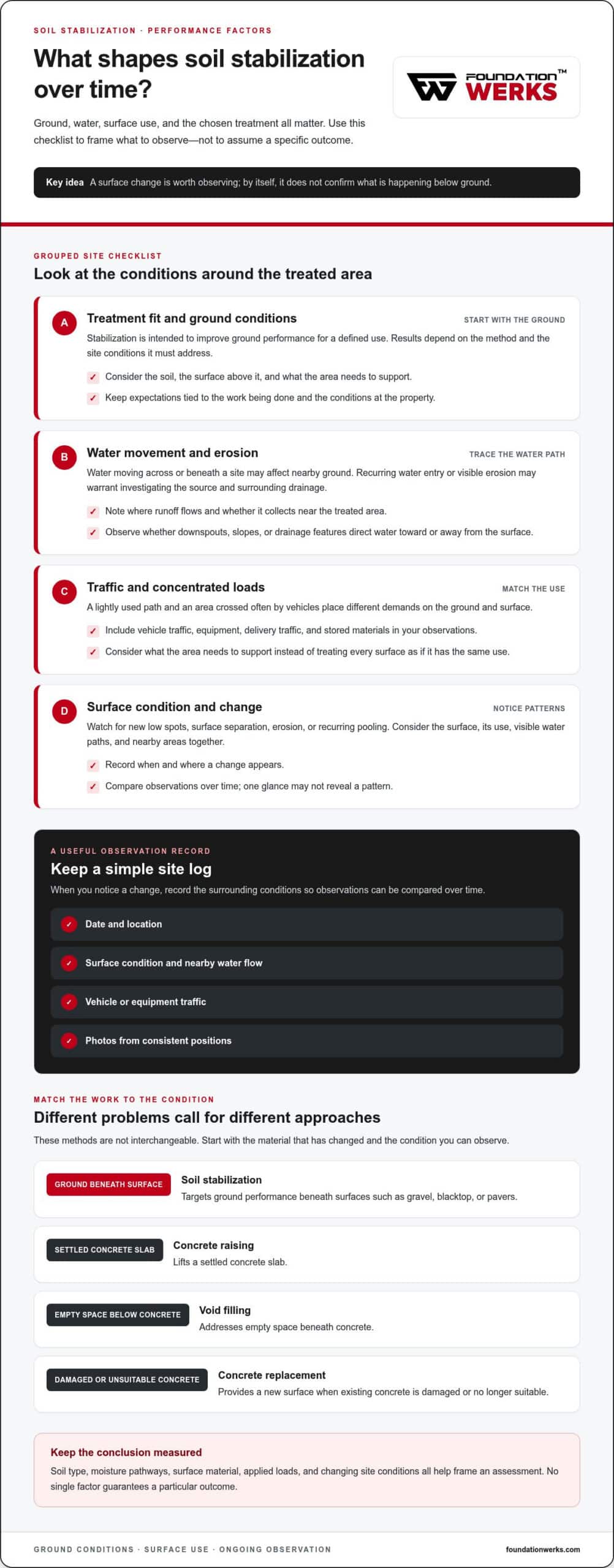
These approaches address different conditions. Soil stabilization targets the ground. Polyurethane concrete raising lifts a settled slab, while void filling addresses empty space beneath concrete. Concrete replacement provides a new surface when existing concrete is damaged or no longer suitable. These issues can occur in the same area, but the approaches aren’t interchangeable.
For example, an uneven concrete slab may need attention to its position or the space beneath it. That is different from stabilizing soil beneath a nearby gravel or paver surface. Start with the material that has changed and the condition you can observe, rather than assuming that every settlement issue has the same cause.
Why do long-term outcomes vary from site to site
Soil type, moisture pathways, surface material, and applied loads all affect the conditions a treatment must address. Water moving across or beneath a site may affect nearby ground. Regular vehicle traffic or stored materials can also put different demands on a surface than occasional foot traffic. These factors help frame an assessment, but none guarantees a particular outcome.
Foundation Werks serves the Dallas metropolitan area, including Frisco, McKinney, Dallas, Prosper, Allen, Fairview, Southlake, Irving, North Dallas, and the wider DFW area. Location alone doesn’t determine what a property needs. Conditions can differ between nearby sites, so an assessment should connect what you observe with the surface, its use, and the ground conditions.
How Soil Stabilization Performs Over Time: The Factors That Matter
Stabilized ground remains exposed to the conditions around it. Water may follow a path across the site, a surface may wear, or traffic may place demands on the area. Watching these factors can help you distinguish ordinary use from a change worth assessing.
Performance depends on the treatment method, moisture movement, erosion, surface condition, repeated loads, and how the site is used and maintained. No single factor predicts the result. A surface change is a reason to observe the area and its surroundings, not proof on its own that stabilization has failed.
How water movement and erosion can affect stabilized areas
Trace where water goes. Note where runoff flows, whether it collects near the treated area, and whether downspouts, slopes, or drainage features direct it toward or away from the surface. Recurring water entry or visible erosion may warrant investigating the source and surrounding drainage. Neither observation by itself confirms what is happening below ground.
Drainage planning is part of understanding site conditions. If you are reviewing ways to manage water around your property, see this guide to French drain installation in North Texas.
How traffic, equipment, and surface use influence performance
A lightly used path and an area crossed often by vehicles place different demands on the ground and surface. Equipment, delivery traffic, and concentrated loads matter too. A useful assessment accounts for what the area needs to support instead of treating every surface as if it has the same use.
For commercial property owners, track repeated traffic alongside changes in floor condition. The guide to uneven warehouse floor repair in Dallas discusses concerns related to industrial floors.
What to monitor as conditions change
What to monitor depends on how the site is used and what you observe. Keep a simple record of the date, location, surface condition, nearby water flow, and vehicle or equipment traffic. Take photos from consistent positions when you notice a new low spot, surface separation, erosion, or recurring pooling.
Compare observations over time rather than relying on a single glance. If a pattern changes, consider the full setting: the surface, its use, visible water paths, and nearby areas. If you’re considering ground stabilization or related concrete work, request a free estimate to discuss the conditions you’ve observed.
Soil Stabilization Methods Compared: What Each One Is Meant to Address
Choosing an approach starts with identifying what has changed: the ground, the concrete, or the space beneath it. Similar symptoms, such as an uneven surface, can point to different conditions. The table compares methods by purpose and typical surface. It isn’t a ranking: the right fit depends on the site, its use, and the condition of the existing surface.
| Approach | Purpose | Suitable surface or condition | Intended outcome | Key limitation |
|---|---|---|---|---|
| Soil stabilization | Improve ground performance for a specific use | Ground beneath gravel, blacktop, or pavers | Improve support for the intended surface and use | Doesn’t repair every surface defect or concrete problem |
| Polyurethane concrete raising | Raise a settled concrete slab | Existing concrete that may be suitable for lifting | Adjust the slab’s position | Severely damaged concrete may not be suitable for lifting |
| Void filling | Fill space beneath a slab | Concrete with a void beneath it | Address the empty space under the slab | Filling a void isn’t the same as correcting every surface or ground issue |
| Concrete replacement | Replace existing concrete | Concrete that is damaged or no longer suitable | Provide a replacement surface | Replacing the concrete alone doesn’t establish the condition of the ground or drainage |
When soil stabilization differs from concrete raising or void filling
Foundation Werks’ Deep Foamjection™ stabilizes soil beneath gravel areas, blacktop, and pavers. Concrete raising has a different target: a settled, solid slab that may be suitable for lifting. Void filling focuses on space beneath a slab. These distinctions matter because treating ground, adjusting a slab, and filling an underlying space address different conditions. One approach shouldn’t be assumed to substitute for another.
When stabilization may not be the right response
If concrete is severely damaged, lifting may not be suitable. A damaged surface needs a different assessment from ground that needs support. Recurring water or erosion also points to conditions to consider alongside the surface issue. Separating these signs helps clarify the problem before choosing work. It also avoids assuming soil treatment will correct a crack, a damaged slab, or a drainage concern.
The long term effects of soil stabilization depend partly on whether the method matches the ground and the surface above it. A settled slab with a void beneath it raises a different question from loose or unstable ground beneath pavers. Looking at the surface, what lies below it, and how water moves nearby can help identify the relevant work without assuming the same outcome for every property.
How to Assess Long-Term Soil Stabilization Needs Before Work Begins
A useful assessment starts with observations, not assumptions. A dip, crack, or eroded edge can have more than one explanation. Record what you see, where it occurs, and how the area is used. Those details give a site evaluation a clearer starting point and can help distinguish a ground-support concern from drainage or surface damage.
Use this sequence to organize what you know before work begins:
- Document the symptoms. Note uneven areas, cracks, visible gaps or signs of a void, erosion, and changes in how the surface can be used. Record the date and exact location. If the change returns, note when it reappears.
- Identify the surface and its use. Record whether the area is gravel, blacktop, pavers, or a concrete slab. Describe the traffic it handles, including regular vehicle use, equipment, deliveries, or foot traffic. Intended use puts the observed condition in context.
- Examine water paths. Look at where runoff travels and collects, and whether downspouts or slopes direct water toward the area. Note recurring wet spots or signs of erosion without assuming water is the only cause.
- Assess the condition as a whole. Consider whether the main change appears to involve the ground, the surface, drainage, or several factors. Photos from consistent viewpoints make it easier to compare conditions over time.
What to document about the surface and site
Keep notes specific and factual. Instead of writing “the patio is getting worse,” record which edge looks lower, when you first noticed it, and whether the change affects walking or other use. Photograph cracks and uneven spots, but don’t treat them as proof of a particular cause. Include nearby water flow and the kinds of loads the area regularly supports.
How to interpret early signs without overdiagnosing
Recurring settlement or erosion deserves attention, but neither confirms the cause or predicts what will happen next. A crack describes surface damage; movement or a possible loss of ground support describes a different concern. Both may be present, or one may occur without the other. Clear observations help keep an evaluation focused on evidence rather than assumptions.
The long term effects of soil stabilization can’t be assessed from a regional label alone. Properties across the Dallas-Fort Worth area have different surfaces, drainage patterns, uses, and visible conditions. A local site evaluation is more useful than assuming similar-looking problems have the same cause. Your notes can help clarify whether ground stabilization, drainage work, or concrete repair is relevant.
Foundation Werks Soil Stabilization: A Practical Next Step in North Texas
Understanding the long term effects of soil stabilization starts with understanding what the work is meant to support. Foundation Werks serves the Dallas metropolitan area with Deep Foamjection™, a soil stabilization service for gravel areas, blacktop, and pavers. Consider the surface, how it’s used, and what has changed. That gives the discussion a practical starting point, based on your property rather than a general promise about how any treatment will perform.
What Foundation Werks can address with soil and concrete services
Deep Foamjection™ is designed for soil beneath gravel areas, blacktop, and pavers. Foundation Werks uses lightweight polyurethane foam at approximately 2 pounds per cubic foot. The foam material does not lose density over time. That describes the material, not a prediction of how every site will respond to changing water conditions, loads, or other site factors.
Concrete raising serves a different purpose: it lifts and levels eligible solid slabs that have settled. Void filling addresses empty space beneath a slab. These approaches focus on a concrete surface and the area directly below it, rather than soil beneath gravel, blacktop, or pavers. The slab’s condition matters too. Severely damaged concrete may not be suitable for lifting.
Water management may also be relevant when runoff, pooling, or recurring water entry is part of the concern. Foundation Werks provides French drain installation for drainage needs. Drainage work and ground stabilization address different parts of a site, so observed water paths and surface conditions should inform the approach.
What to expect when discussing a stabilization project
Bring practical details to the conversation. Describe the surface type, where it has changed, when you first noticed the issue, how the area is used, and any nearby drainage concerns. Photos and a simple timeline can show whether a condition is isolated or recurring. These observations support a site-specific discussion, but don’t determine the cause on their own.
Foundation Werks customer testimonials describe professional crews and garage-floor and patio projects. This feedback offers a glimpse of customers’ service experiences, but it doesn’t establish a universal result for other properties. Site conditions, surface type, and intended use still matter when choosing an approach.
A useful estimate discussion connects visible symptoms with the work being considered. If the concern is soil beneath pavers, Deep Foamjection™ may be relevant. If a solid slab has settled, concrete raising or void filling may better match the condition. Understanding what the proposed work addresses helps set realistic expectations for the project.
Make Your Next Step Site-Specific
You don’t need to choose a treatment before understanding the condition you’re addressing. Bring together what you’ve observed and what the area needs to support. That gives the conversation a practical starting point and keeps expectations grounded in the property itself.
The long term effects of soil stabilization are easier to evaluate when decisions account for the site’s actual use and conditions rather than relying on a general lifespan or one-size-fits-all promise. Keep your notes and questions focused on what has changed, what the area needs to support, and what outcome you hope to achieve. A straightforward discussion can help turn uncertainty into a more informed plan.
For a site-specific next step, request a free estimate from Foundation Werks. Your property deserves an approach shaped around its needs.
Frequently Asked Questions
Does soil stabilization last indefinitely?
No single service life applies to every method or property. Materials, ground conditions, water movement, surface type, and use all shape long-term performance. Rather than relying on a universal duration, consider what the proposed approach is designed to address and what could change around the treated area. For example, a shift in drainage patterns or a change in how the surface is used is worth documenting and discussing during an assessment.
Can stabilized soil still move over time?
Yes. Stabilization doesn’t make a site immune to changing conditions. If you notice a new dip beside a treated area, record its location, when it appeared, and whether it changes after rainfall or increased use. Those observations help describe the issue without assuming its cause. Movement, erosion, and surface wear can look similar at first, so track what you can see without treating one sign as a diagnosis.
What is the difference between soil stabilization and concrete raising?
Soil stabilization addresses ground conditions, while concrete raising adjusts the position of an eligible settled slab. Void filling addresses empty space beneath concrete. Loose ground beneath pavers presents a different concern from a settled, solid patio slab. Identifying whether the affected area is loose surface material, concrete, or a space beneath concrete helps narrow down which work is relevant.
Does soil stabilization prevent erosion?
Not necessarily. Stabilization approaches have different purposes, and treatment shouldn’t be assumed to stop erosion or correct its cause. If water repeatedly flows across an area, note where it comes from, where it collects, and whether soil loss is visible. That information can help clarify whether drainage conditions need attention alongside the ground or surface. Consider the full site rather than judging performance by erosion alone.
How can I tell if a property needs soil stabilization?
Recurring settlement, uneven ground, or a surface that has become harder to use can justify an assessment, but these signs don’t prove stabilization is the right response. Note the material, affected area, changes over time, nearby water flow, and typical use. For properties in Frisco, McKinney, Dallas, Prosper, Allen, Fairview, Southlake, Irving, North Dallas, and the wider DFW area, site-specific details are more useful than assuming similar-looking problems have the same cause.
Can polyurethane foam stabilize soil beneath gravel, blacktop, or pavers?
Yes. Foundation Werks offers Deep Foamjection™ for soil stabilization beneath gravel areas, blacktop, and pavers. The appropriate approach depends on the surface and how the area is used. A paver walkway and a blacktop area exposed to regular vehicle traffic, for example, have different uses to describe during an assessment. Deep Foamjection™ addresses soil conditions, not the lifting of a settled concrete slab or filling a void beneath one.