

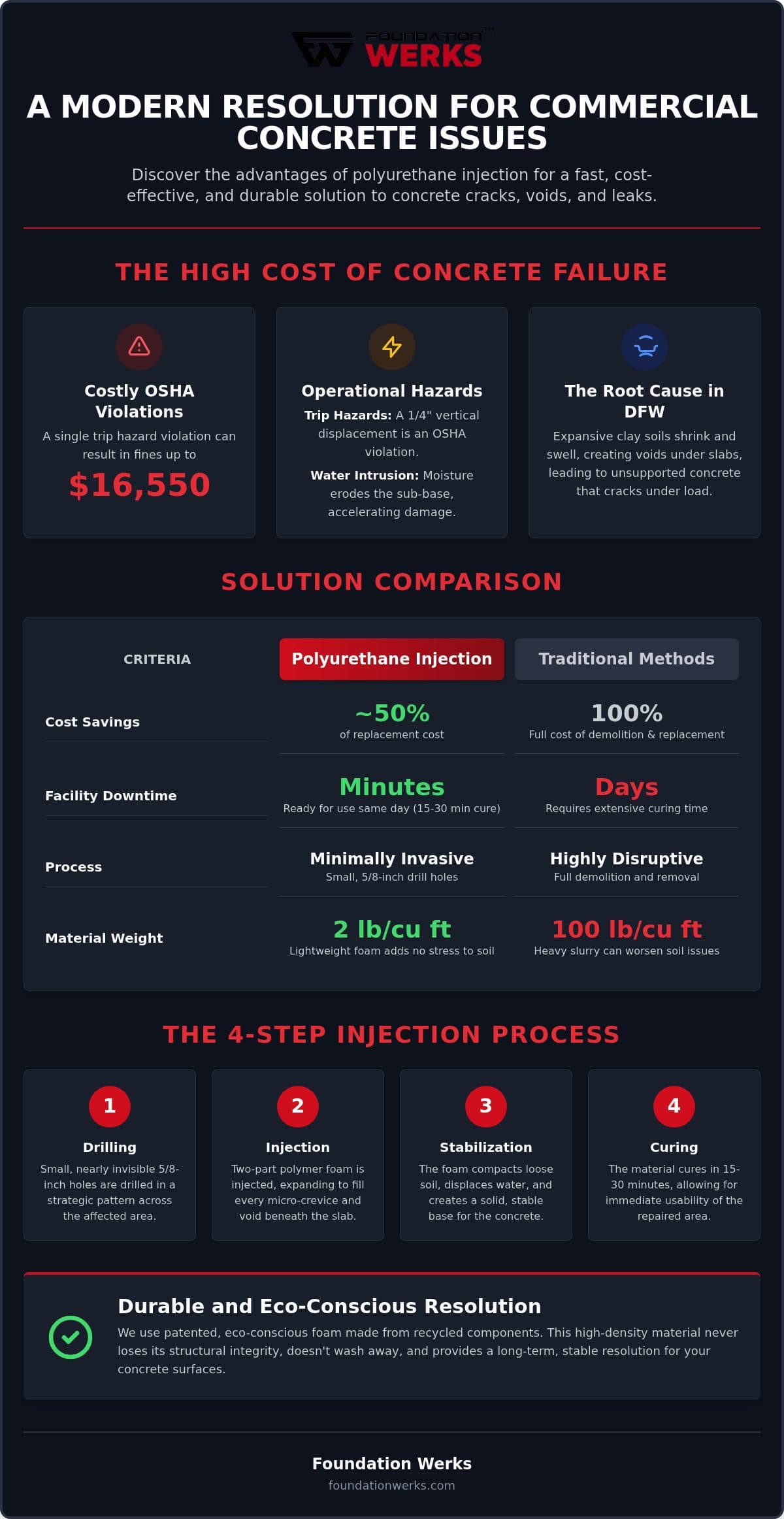
Did you know that a single OSHA trip hazard violation can now cost your facility upwards of $16,550? It’s a steep price for a problem that often feels unavoidable when the alternative is a week of downtime. Fortunately, polyurethane crack injection for commercial concrete offers a way to address these hazards and recurring water infiltration without the disruption of a full tear-out.
We understand that halting production isn’t just an inconvenience; it’s a direct hit to your bottom line. You need a solution that is fast, reliable, and cost-effective. This guide explores how our recycled, eco-conscious foam provides a durable resolution for cracks and voids at roughly 50% of the cost of traditional replacement. It’s about keeping your facility safe while respecting your budget and your schedule.
You’ll discover how we use nearly invisible 5/8-inch drill holes to stabilize slabs and stop foundation leaks. We’ll also explain the technical process that allows for immediate usability, so your team can get back to work the same day the repair is finished. By the end of this guide, you’ll have a clear roadmap for maintaining your concrete floors with minimal impact on your daily operations.
Key Takeaways
- Save up to 50% on repair costs compared to full concrete replacement while avoiding the expenses of demolition and disposal.
- Learn how polyurethane crack injection for commercial concrete allows for immediate usability, letting your facility return to full operation the same day.
- Identify and resolve OSHA trip hazards and water infiltration issues before they lead to costly fines or structural damage.
- Understand the benefits of using eco-conscious, recycled foam and nearly invisible 5/8-inch drill holes for a clean, professional finish.
The Impact of Concrete Cracks on Commercial Operations
A crack in your warehouse floor isn’t just a cosmetic problem. It’s a liability, a structural warning sign, and a maintenance cost waiting to grow. Polyurethane crack injection for commercial concrete addresses the root cause of these failures, sealing moisture pathways and stabilizing the sub-base rather than simply masking the surface. Understanding why cracks form in the first place is the clearest path to stopping them from coming back.
The Mechanics of Slab Failure in DFW
North Texas sits on some of the most expansive clay soil in the country. During dry summers, that soil shrinks and pulls away from your slab. When rain returns, it swells back. This constant push-and-pull creates voids beneath the concrete, and once a void forms, the slab above it loses support and begins to fracture under load.
Not every crack signals the same level of urgency. Hairline cracks are often superficial, the result of normal concrete curing. Structural fractures, particularly those with vertical displacement or widening gaps, indicate that the slab has shifted and the sub-base is compromised. Void-induced cracking in industrial settings occurs when unsupported concrete deflects under repeated load cycles until it eventually breaks.
Surface patching won’t solve this. If the void beneath the slab remains, any filler applied on top will flex, crack, and fail again within months. The underlying problem is the absence of support, not the crack itself.
Safety and Liability: Trip Hazards and Water Intrusion
OSHA identifies a vertical displacement of 1/4 inch or more as a trip hazard threshold. In a busy warehouse or distribution center, that’s a meaningful risk, especially in high-traffic forklift lanes where an uneven joint can also damage equipment and destabilize loads.
Water intrusion compounds the problem significantly. When moisture enters through a crack, it erodes the compacted base material beneath the slab. Over time, this accelerates void formation and can cause joint failure across entire sections of your floor. What begins as a single crack can migrate into a pattern of failures that affects your entire operational footprint.
This is why polyurethane is increasingly used as a grout material in commercial concrete repair; it bonds to the crack walls, expands to fill voids, and resists water infiltration in a way that cementitious patches simply can’t match. Addressing the crack and the void together is what separates a durable repair from one that fails by next quarter.
How Polyurethane Injection Works for Industrial Concrete
Polyurethane crack injection for commercial concrete relies on a controlled chemical reaction rather than brute force. When the two-part polymer components meet, they expand into a high-density foam that seeks out every micro-crevice and void. This expansion creates a structural seal that stops water infiltration and stabilizes the slab from the bottom up. We use high-pressure injection for deep-seated leaks or thick slabs, while low-pressure methods are ideal for finer cracks where precision is the priority.
The Injection Sequence: From Drilling to Curing
The process begins with drilling small, nearly invisible 5/8-inch holes in a strategic grid pattern across the affected area. We then insert mechanical packers into these holes to ensure the foam reaches the full depth of the slab without leaking back to the surface. As the material is injected, it displaces trapped water and compacts loose soil, creating a solid base. Because the foam cures within 15 to 30 minutes, your facility gains immediate usability, which is a major advantage over traditional methods that require days of drying time.
One of the biggest advantages of this method is its weight. Traditional mudjacking uses a heavy slurry weighing about 100 lb/cu ft, which often adds too much stress to already weak soil. Our lightweight foam weighs only 2 lb/cu ft, providing the necessary lift and stabilization without the risk of further sinking. It’s a smarter way to handle commercial concrete raising because it addresses the problem without adding more burden to the ground.
Material Properties: Recycled and Eco-Conscious Foam
We take pride in using patented, eco-conscious materials made from recycled components. This isn’t just about being green; it’s about performance. High-quality polyurethane never loses its density or structural integrity over time. It doesn’t wash away with groundwater or degrade in the harsh North Texas environment. For property managers focused on corporate ESG goals, choosing a sustainable material that offers a long-term resolution is a responsible and effective business decision.
ROI Analysis: Polyurethane Injection vs. Traditional Concrete Replacement
For most facility managers, the decision to repair or replace comes down to the bottom line. Traditional concrete replacement is an invasive process that involves jackhammering, hauling away debris, and pouring new material. Polyurethane crack injection for commercial concrete typically costs about 50% less than a full tear-out. This price difference exists because injection requires less labor, no heavy machinery for demolition, and significantly fewer raw materials.
The hidden costs of new concrete often surprise property owners. Beyond the contractor’s quote, you have to account for disposal fees and the environmental impact of sending tons of old concrete to a landfill. There’s also the risk of damaging underground utilities or adjacent slabs during the demolition phase. Choosing injection avoids these complications by using the existing slab as a finished surface, simply restoring the support it lost over time.
Calculating the True Cost of Facility Downtime
In an industrial environment, time is quite literally money. Research indicates that business disruption from traditional concrete replacement can cost a company up to 40% of its revenue during the construction period. New concrete requires a standard 28-day curing cycle to reach full weight-bearing capacity. If a loading dock or high-traffic aisle is out of commission for a month, the operational bottleneck can be devastating.
Polyurethane changes that equation through immediate usability. The foam reaches 90% of its structural strength within 15 minutes of injection. This speed allows your team to resume forklift operations and heavy pallet movement the same day. For managers dealing with specific slab edge issues, our analysis of warehouse floor joint repair Dallas provides a deeper look at how injection protects your equipment from the jarring impact of uneven joints.
Polyurethane vs. Mudjacking vs. Epoxy
While epoxy is a common choice for sealing cracks, it is often too brittle for slabs sitting on North Texas clay. If the soil continues to shift, the rigid epoxy bond can snap or cause the surrounding concrete to spall. Mudjacking is another alternative, but it carries a significant weight penalty. While traditional mudjacking grout weighs approximately 100 lb/cu ft, our polyurethane foam weighs only 2 lb/cu ft. This lightweight profile ensures the repair doesn’t add unnecessary stress to the soil, which helps prevent future settlement. By stabilizing the base and filling the voids, we provide a long-term resolution that addresses the cause of the crack rather than just the symptom.
Preparing Your Facility for Commercial Concrete Injection
Preparing for a structural repair shouldn’t feel like preparing for a major renovation. When we perform polyurethane crack injection for commercial concrete, our goal is to minimize your workload before we even arrive. Unlike traditional replacement, which requires full-scale site clearing and heavy machinery access, our process is contained and surgical. You won’t need to shut down your entire operation just to fix a few sections of the floor.
The Professional Inspection Process
Every project begins with a comprehensive site assessment. A Foundation Werks expert identifies active leaks and maps the void locations beneath the slab to ensure we place our 5/8-inch drill holes exactly where they’ll be most effective. We also evaluate the structural integrity of the concrete itself. If a slab has reached the point of total pulverization, we’ll be honest and let you know if replacement is the better path. Our priority is providing a long-term resolution that makes sense for your facility’s future and your budget.
We look for specific patterns in the crack network to determine the best injection port placement. This mapping allows us to reach every micro-crevice with the expanding foam, displacing water and compacting loose soil as we go. It’s a methodical approach that ensures the slab is stabilized from the bottom up without guessing where the material is flowing.
Operational Continuity: Work While We Repair
Preserving your facility’s environment is a major benefit of this method. There’s no dust, no flying debris, and no jackhammer noise to disrupt office staff or production lines. This non-invasive approach protects your landscaping and interior clean zones from the typical mess associated with concrete demolition. For managers handling complex logistics, our uneven warehouse floor repair Dallas guide offers specific scheduling tips to help you coordinate these repairs during your standard shifts.
Once the injection is complete, we remove the mechanical packers and patch the small 5/8-inch holes with a color-matched grout. The cleanup is fast because there’s no demolition waste to haul away. Because the material cures so quickly, you get immediate usability. Your loading docks and forklift lanes are ready for heavy traffic the same day we finish the job.
Durable Concrete Resolutions with Foundation Werks in DFW
North Texas soil presents a unique set of challenges that national contractors often overlook. The aggressive expansion and contraction of clay in cities like McKinney, Frisco, and Dallas require a localized approach to stabilization. We understand how the local water table and seasonal shifts impact your facility’s foundation. This regional expertise allows us to provide a more accurate assessment and a more effective resolution than a one-size-fits-all strategy.
Our team at Foundation Werks approaches every commercial project with a service-oriented heart. We take quiet pride in our technical competence and our ability to empower facility managers with honest, straightforward information. We aren’t just here to fill a gap; we’re here to build a partnership based on accountability and high-quality results. Our reputation in the DFW area is built on doing exactly what we propose, on time and within the agreed-upon scope.
Custom Stabilization Plans for North Texas Facilities
Every industrial site has different load requirements. A heavy-duty manufacturing plant in Irving needs a different injection density than a retail space in Southlake. We tailor our polyurethane crack injection for commercial concrete to match the specific demands of your operations. In many cases, we integrate French drain installation to manage groundwater and prevent future soil erosion. For a comprehensive look at facility maintenance, you can review our guide on commercial concrete crack repair.
The Foundation Werks Advantage: Eco-Friendly and Efficient
We prioritize innovation that respects the environment. Our patented, eco-conscious foam is made from recycled materials and maintains a lightweight profile of only 2 lb/cu ft. This ensures that we provide the necessary structural support without adding unnecessary weight to the sensitive clay soil. Because our material reaches structural strength so quickly, your facility gains immediate usability, allowing you to return to normal forklift and pallet traffic the same day.
Choosing Foundation Werks means choosing a long-term resolution for your concrete issues. We manage expectations by focusing on realism and precision. While no repair is strictly eternal, our methods provide a durable and reliable update to your facility’s infrastructure that stands up to heavy industrial use. Contact our Dallas-area team for a free professional estimate and experience the difference that knowledgeable, local service makes for your commercial restoration project.
Secure Your Facility’s Operational Future
Managing a commercial property requires balancing immediate safety with long-term financial health. Polyurethane crack injection for commercial concrete provides a way to achieve that balance by resolving OSHA trip hazards and stabilizing foundations without the massive overhead of new construction. You’ve seen how this method protects your equipment and prevents recurring moisture damage while saving you significant capital on repair costs compared to a full replacement.
We take pride in serving the Dallas, McKinney, and Frisco areas with a process that prioritizes your uptime. Our patented, eco-friendly recycled foam offers immediate weight-bearing capacity, so your loading docks and warehouse floors don’t have to stay closed for days. It’s a smart, responsible way to restore your concrete while keeping your facility moving at full speed. This approach ensures your floors are ready for heavy industrial loads just minutes after the injection is complete.
We look forward to helping you create a safer, more stable work environment. Our team is ready to provide the professional insight and reliable service your facility deserves. Let’s get your facility back on solid ground today.
Frequently Asked Questions
How long does polyurethane crack injection last on a commercial floor?
Polyurethane provides a durable resolution for industrial floors. The foam is engineered to remain stable and never loses its density, even under the weight of heavy machinery. While environmental conditions or future soil movement can change the landscape, the material itself does not degrade or wash away. It stays in place to support your slab through years of daily operational use in the North Texas climate.
Can I drive heavy forklifts on the floor immediately after injection?
Yes, your facility can return to full service the same day. Polyurethane crack injection for commercial concrete reaches 90% of its structural strength within 15 to 30 minutes of application. This rapid cure time allows heavy forklifts and pallet jacks to resume traffic almost immediately. Unlike new concrete that requires a 28-day wait, our process ensures that your production schedule in Dallas or Frisco remains largely uninterrupted.
Is polyurethane injection better than epoxy for commercial concrete?
Polyurethane is often superior for slabs sitting on North Texas clay because it remains flexible. Epoxy is a rigid adhesive that can become brittle over time; if the soil beneath your McKinney facility shifts, epoxy may snap or cause the surrounding concrete to spall. Polyurethane expands to fill voids and provides a structural seal that moves with the slab, offering a more resilient resolution for industrial environments.
What is the cost difference between injection and full concrete replacement?
Raising and stabilizing your existing concrete typically costs about half of a full replacement. You save money by avoiding the high costs of demolition, debris hauling, and pouring new material. Additionally, the lack of downtime saves your business from significant revenue loss. It’s a cost-effective alternative that addresses the underlying soil issues without the massive price tag and logistical headache of a total warehouse floor tear-out.
How large are the holes drilled for the polyurethane injection process?
We use nearly invisible 5/8-inch drill holes to deliver the foam beneath your slab. These holes are much smaller than the 2-inch or 3-inch openings required for traditional mudjacking. Because we use a surgical grid pattern, we require fewer injection points to achieve complete coverage. Once the job is finished, we patch the holes with a color-matched grout, leaving your warehouse floor looking clean and professional.
Does polyurethane foam lose density or shrink over time?
No, the high-density polyurethane foam we use never loses its density and does not shrink. Once the chemical reaction is complete, the material becomes a solid, lightweight structure that’s impervious to water and decay. It won’t wash away during heavy DFW rainstorms or break down due to underground temperature changes. This stability ensures that the support provided to your commercial slab remains consistent for years to come.
Can polyurethane injection stop active water leaks in a foundation?
Yes, polyurethane crack injection for commercial concrete is an excellent solution for stopping active water leaks. The foam is hydrophobic, meaning it displaces water as it expands into cracks and voids. It creates a watertight seal that prevents moisture from entering your foundation or warehouse floor. This is particularly valuable for facilities in the Dallas area that struggle with recurring water infiltration during the wet spring and fall seasons.
Why is polyurethane preferred over mudjacking for North Texas soil?
Polyurethane is preferred because it’s significantly lighter than mudjacking material. While traditional grout weighs about 100 lb per cubic foot, our foam weighs only 2 lb per cubic foot. In the expansive clay soil found in Frisco and McKinney, adding heavy grout often causes the slab to sink again. Polyurethane provides the necessary lift and stabilization without putting additional stress on the fragile soil beneath your facility.