

Can a lightweight material support a heavy concrete slab? With polyurethane foam structural support, the foam’s weight is not what supports the slab. Injected beneath the concrete, it expands to fill voids and help stabilize the surface above.
Foundation Werks uses its Quick Level system for concrete lifting and leveling. The system injects patented, eco-conscious, closed-cell polyurethane foam containing over 40% recycled materials. The material is Made in the U.S.A. and does not break down over time. It cures in approximately 20 minutes, and the repaired surface is usable immediately after the 20-minute cure.
This guide explains how foam injection supports a settled slab, what to look for when assessing the problem, and how lifting compares with mudjacking and concrete replacement. You’ll also learn what to expect during the process and what details to note before discussing a Dallas-area project, including where the slab has settled and nearby drainage or soil conditions.
Key Takeaways
- Polyurethane foam structural support fills voids beneath a slab to help stabilize the concrete. It is different from molded foam used in manufactured products.
- The process uses dime-size access holes for foam injection, monitors the slab’s response, then seals the holes with concrete patch.
- Foam raising, mudjacking, and concrete replacement differ in material, disruption, and whether the existing slab remains.
- Note where the concrete has settled, how the area is used, and nearby drainage or soil conditions to help describe the project.
What Does Polyurethane Foam Structural Support Mean for Concrete?
Polyurethane foam injected beneath concrete expands into available gaps and helps restore support under the slab. This is under-slab support, not foam that forms part of the concrete itself. The method addresses a common problem: a slab can become uneven when the ground beneath it no longer supports it evenly.
The phrase polyurethane foam structural support can also refer to foam used in manufactured components. The application matters. Beneath concrete, foam is injected into a void; in a manufactured product, it may be shaped or incorporated into a larger assembly. The material family has many uses, as the overview of Polyurethane explains, but the process and purpose differ.
To see how foam injection is used to address gaps beneath a slab, watch this video:
How is polyurethane foam structural support different from foam components?
HR Technologies describes structural foam in the context of lightweight composites and vehicle-related components. In those applications, foam is formed into or incorporated within a manufactured part. Under-slab injection serves a different purpose: foam is placed in a gap below existing concrete, where it expands to fill space and support the slab from underneath. It is not a molded part attached to the concrete.
What concrete problems can under-slab support address?
Under-slab support may be useful when a driveway, sidewalk, patio, pool deck, or commercial concrete slab has settled, become uneven, or developed a gap beneath it. Filling that gap can help restore contact below the affected area. The slab’s condition and the cause of settlement inform the assessment, so the approach is considered in relation to the specific project.
The foam’s low weight does not mean it has no role in supporting concrete. Placement is central: injected beneath a slab, it fills space where support is missing rather than relying on a heavy material to bear down on the ground. As it expands into the void, it can make contact with the slab and the supporting material below. The aim is to address the gap beneath the concrete, not to assign a load capacity to a particular slab.
A visibly uneven surface can indicate a change below the slab, but the surface alone may not show why it settled or how extensive the void is. Soil composition, moisture, tree roots, drainage, and compaction can all contribute to movement. Note the affected area and surrounding conditions to help explain the problem. The slab and site still need to be assessed to determine the appropriate work.
How Does Injected Polyurethane Foam Support a Concrete Slab?
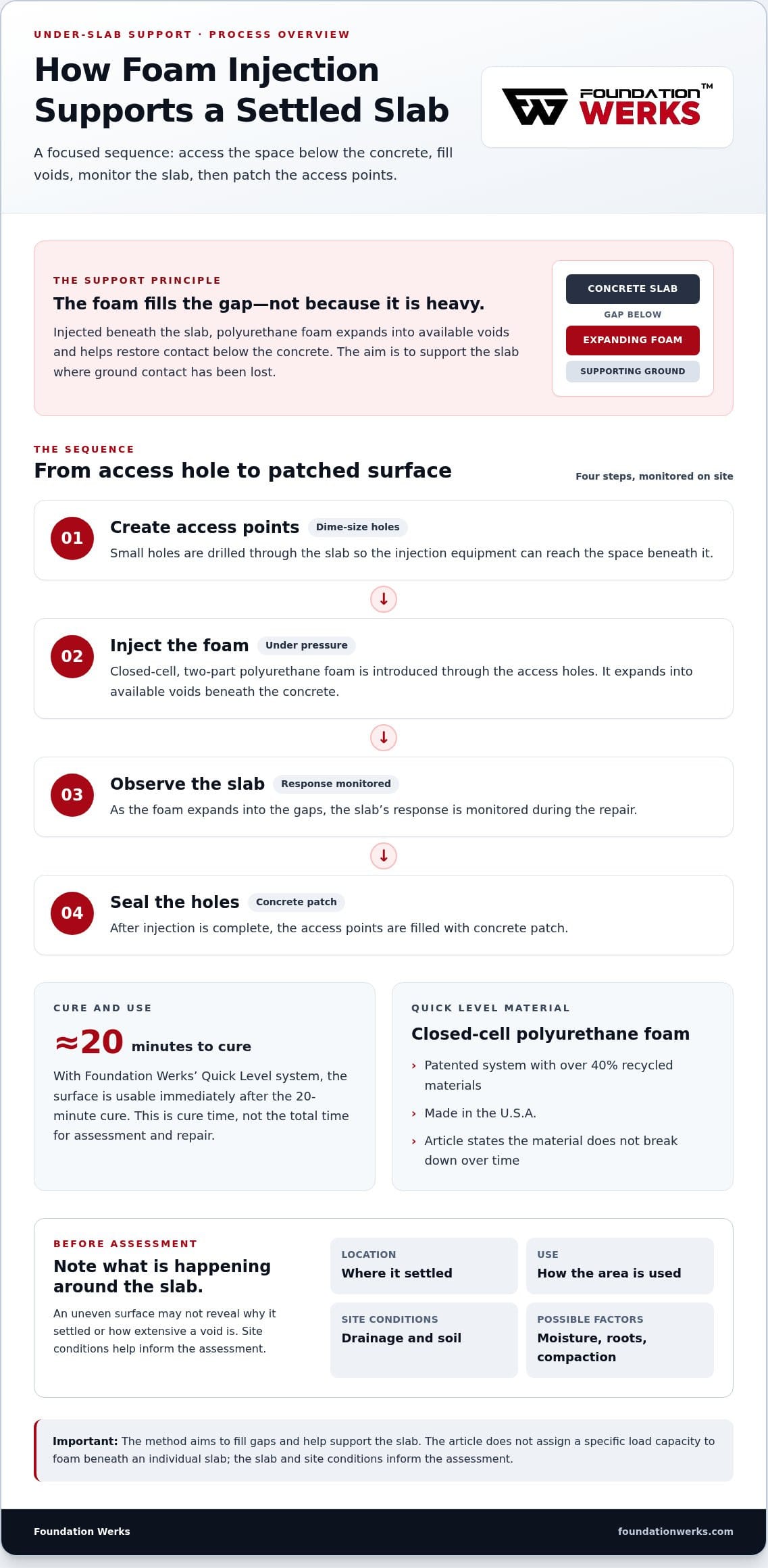
Polyurethane foam structural support is created by injecting foam beneath an existing slab, where it expands to fill empty space and help restore contact below the concrete. The process follows a clear sequence: dime-size access holes are drilled, closed-cell two-part foam is injected under pressure, the slab’s response is observed, and the holes are sealed with concrete patch.
The foam’s role is to occupy voids under the slab. As it expands into those spaces, it can provide support where contact with the ground has been lost. The work is directed at the area being addressed, with the slab and conditions beneath it informing the process.
What happens during foam injection beneath concrete?
Small access holes let the injection equipment reach the space below the concrete. The two-part foam is delivered under pressure and expands within available voids. During the work, the slab’s response is monitored. After injection, the access holes are filled with concrete patch.
Here’s the process in order:
- Create access points. Dime-size holes are drilled through the slab to reach the space beneath it.
- Inject the foam. Closed-cell, two-part polyurethane foam is introduced under pressure through the holes.
- Observe the slab. As the foam expands into voids, the slab’s response is monitored during the repair.
- Seal the holes. Once injection is complete, the access points are closed with concrete patch.
Foam products can be formulated for different purposes. General Plastics discusses high-density polyurethane foam in applications where durability and structural integrity matter, but that description is not a load rating for foam injected beneath a particular slab. Under concrete, support depends on placement and project conditions. The aim is to fill the gap and support the slab, not to claim a specific capacity.
When can the repaired concrete be used?
The foam used in Foundation Werks’ system cures in approximately 20 minutes. The surface is usable immediately after the 20-minute cure. This describes the foam’s cure time, not the total duration of assessment and repair, which depends on the concrete area and site conditions.
For a Dallas-area slab, note where the surface has settled and which section is affected. Foundation Werks provides concrete lifting and leveling using this injection approach, with the work planned around the conditions at the site.
How Does Foam-Based Slab Support Compare With Other Repair Approaches?
Polyurethane foam structural support is one way to address a settled slab. Foam raising and mudjacking both add material beneath existing concrete, while replacement takes a different approach by replacing the concrete surface. Compare the methods by looking at the slab’s condition, the repair area, how the space is used, and how much disruption each approach involves.
| Approach | Method and disruption | Material weight | When the surface can be used | Does the existing concrete remain? |
|---|---|---|---|---|
| Polyurethane foam raising | Foam is injected through dime-size holes, with less patchwork than mudjacking. | Approximately 2 lb per cubic foot | Usable immediately after the foam’s approximately 20-minute cure. | Yes, the existing slab is raised or stabilized. |
| Mudjacking | Slurry is pumped beneath the slab through larger access holes, requiring more patchwork. | Approximately 100 lb per cubic foot | Depends on the material and repair process. | Yes, the existing slab is raised. |
| Full concrete replacement | The existing surface is replaced with new concrete, making it a more extensive surface-level project. | Not applicable to the under-slab material comparison | After the new concrete is ready for use. | No, the concrete surface is replaced. |
What distinguishes foam injection from mudjacking?
Polyurethane foam weighs approximately 2 lb per cubic foot, while mudjacking material averages approximately 100 lb per cubic foot. Foam injection also uses dime-size access holes and requires less patchwork than mudjacking. These differences help explain how the methods vary, but they do not determine which approach suits a particular slab. The concrete’s condition and the project’s needs matter too.
When is raising different from replacing concrete?
Raising works with the slab that is already in place. Replacement, by contrast, replaces the concrete surface. When the existing slab is suitable for lifting, raising can address settlement while retaining that surface. Foam raising typically costs less than half of full concrete replacement, though the appropriate approach depends on the slab and its condition.
For a commercial facility, consider more than whether a floor is uneven. Cracks and joints can also affect the concrete, so the commercial concrete crack repair guide can help put those concerns in context. Warehouse operators comparing lifting with replacement can also review this warehouse floor repair comparison when weighing the approaches for a working facility.
What Should You Assess Before Choosing Polyurethane Foam Structural Support?
A settled or uneven slab is a visible sign, not a full explanation of what is happening beneath it. Before considering polyurethane foam structural support, note where the surface has changed, which sections are affected, and how people or equipment use the space. A driveway with one low section, for example, has a different use pattern from a commercial floor crossed by carts or machinery.
For a Dallas-area project, record what you can see and when you first noticed it. Then consider nearby ground and water conditions. Soil composition, moisture, tree roots, drainage patterns, and soil compaction can all contribute to concrete settling, but none of these observations alone confirms the cause at a particular property.
Which site conditions can contribute to sinking concrete?
Different conditions can affect how well the ground supports a slab. Soil type and compaction influence the material beneath the concrete; moisture and drainage can change ground conditions, and nearby tree roots may also affect the area. These are possible contributing factors, not a diagnosis. If water flow or pooling is part of the concern, the North Texas French drain guide offers more context on drainage considerations.
Look for patterns rather than drawing conclusions from a single clue. Note whether unevenness appears near a downspout, along a walkway beside landscaping, or where water collects. Those details help describe the setting, but do not establish that drainage, roots, or soil conditions caused the settlement.
What information helps assess a slab-support project?
Make a simple record of the affected area. Photos from consistent angles can show where changes are visible. Notes can describe how the surface is used and whether unevenness interferes with that use. Include nearby features that may help explain site conditions, while leaving the cause open for assessment.
- Location: Identify the slab and the specific section that appears settled.
- Surface condition: Note uneven areas, visible cracks, and changes in level.
- Use: Describe foot traffic, vehicles, equipment, or other regular activity.
- Surroundings: Record nearby trees, drainage paths, downspouts, or places where water collects.
- Extent: Mark whether the concern affects one section or several connected areas.
For commercial floors, consider both the concrete surface and the conditions below it. An uneven area in a warehouse may affect how the space functions, so the uneven warehouse floor guide can help put those concerns in context. Clear notes make it easier to describe the slab’s condition without mistaking a symptom for its underlying cause.
How Foundation Werks Provides Polyurethane Foam Structural Support
Foundation Werks uses Quick Level, its poly concrete raising and leveling system, for residential and commercial projects. The system provides polyurethane foam structural support by injecting foam beneath concrete to fill voids and help stabilize the surface. The assessment focuses on the affected slab and conditions beneath it.
What does Foundation Werks’ Quick Level process include?
Quick Level uses pressurized injection through dime-size holes. The foam expands beneath the slab to fill available voids, and the access points are sealed with concrete patch after injection. The material is patented, eco-conscious, closed-cell polyurethane foam containing over 40% recycled materials. It is Made in the U.S.A. and does not break down over time.
The foam cures in approximately 20 minutes, and the surface is usable immediately after the 20-minute cure. This is the foam’s curing period, not the total time required for a project. The slab’s condition and the affected area inform the work, and Foundation Werks explains the process so customers understand what is being addressed.
Quick Level is a slab-raising and leveling method, not molded foam used in manufactured components. Its purpose is to place foam beneath existing concrete to fill space and support stabilization. The closed-cell construction and recycled content are material specifications; the assessment focuses on the concrete and site conditions.
What can customers expect from the service?
Foundation Werks is family-owned and takes a customer-education-first approach. The team explains the work and its proposed scope in clear terms, helping customers understand the repair before deciding how to proceed. For a residential slab or commercial concrete area, knowing what the work addresses helps set clear expectations.
Customer feedback highlights professionalism, timely completion, clear explanations, and quality of work. Foundation Werks’ displayed Google rating is 4.9 / 5 based on Trustindex-verified reviews. These details offer a snapshot of customer experience, alongside a project discussion focused on the slab, its visible condition, and the support approach being considered.
Monthly payment options are available through a 60-second pre-qualification that does not affect your credit score. For a Dallas concrete project, you can request an estimate and review the proposed work. Foundation Werks provides clear estimates so you can understand the project scope and decide how to move forward.
Take the Next Step Toward a Better-Supported Slab
Choosing polyurethane foam structural support is a project-specific decision. Start by noting what the concrete needs to support, how the area is used, and what you have observed about the slab. For a Dallas project, those details can help frame a discussion about the work without assuming the cause before the site is assessed.
Bring your questions, priorities, and observations. A clear explanation of the proposed work can help you compare the approach with your needs and decide how to proceed.
Explore next steps for your Dallas concrete project
With a clear understanding of the slab and the proposed work, you can make a more informed decision about your concrete.
Frequently Asked Questions
How does polyurethane foam provide structural support beneath concrete?
Closed-cell, two-part foam is injected through dime-size holes beneath a slab, where it expands into voids and helps stabilize the concrete. This is under-slab support, not molded foam construction. The polyurethane foam structural support method fills gaps beneath existing concrete rather than acting as a separate component. The slab’s condition and the space below it inform how the work is planned.
Can polyurethane foam support a concrete slab even though it is lightweight?
Yes. Foundation Werks’ foam weighs approximately 2 lb per cubic foot, and its role is to fill and stabilize space beneath existing concrete. It is not a freestanding structural component; its placement under the slab is central to how it provides support. The weight figure alone does not establish a load rating or predict the result for a particular surface. The slab and the space below it still need to be considered.
How soon can I use concrete after polyurethane foam injection?
The foam cures in approximately 20 minutes, and the repaired surface is usable immediately after the 20-minute cure. This describes the foam’s cure time, not the full project duration. Injection and patching are also part of the work, so follow the stated cure and completion of the repair before using the surface.
Does closed-cell polyurethane foam break down over time?
Foundation Werks’ closed-cell polyurethane foam does not break down over time. The foam fills and stabilizes space beneath concrete, but that material fact is not a guarantee about how every slab will perform. Ground conditions can change, and future movement may be influenced by conditions beneath or around the concrete. An assessment considers the slab and its site conditions as well as the foam.
Is polyurethane foam structural support more affordable than replacing concrete?
Polyurethane concrete raising or stabilization typically costs less than half of full concrete replacement. The cost of an individual Dallas project depends on the concrete and work involved. Foundation Werks provides a clear estimate based on the project, so you can review the proposed scope and cost for your slab.
Is polyurethane foam used for concrete lifting environmentally conscious?
Yes. Foundation Werks uses patented, eco-conscious polyurethane foam containing over 40% recycled materials, and the material is Made in the U.S.A. These details describe the foam used in its concrete raising and leveling system. They do not imply a particular certification or quantify the project’s environmental impact. Consider these material attributes alongside the slab’s condition and the proposed repair approach.
What causes concrete slabs to sink?
Soil composition, moisture, tree roots, drainage issues, and improper soil compaction can all contribute to sinking concrete. Their influence varies by property. A low spot beside a walkway or a crack across a driveway is an observable symptom, but it does not identify the exact cause on its own. For a Dallas-area slab, assessing the concrete and surrounding site conditions helps distinguish visible movement from possible contributing factors.
Does Foundation Werks offer monthly payment options for concrete raising?
Yes. Monthly payment options are available through a 60-second pre-qualification that does not affect your credit score. Pre-qualification is separate from assessing the slab and preparing a project estimate. If you are considering concrete raising in Dallas, note the affected area and how it is used so the project discussion can focus on your needs. Request an estimate to review the proposed work for your concrete project.