

The cheapest way to fix your sinking driveway might actually be the most expensive mistake you make this year. If you’ve noticed trip hazards on your sidewalk or water pooling near your foundation, you’re likely weighing the pros and cons of polyurethane vs mudjacking. It’s a common dilemma for North Texas homeowners who want a level surface without the massive cost of a total concrete replacement. You want a solution that stays level and doesn’t disrupt your daily life, but the wrong choice can lead to further settlement just a few years down the road.
We understand that dealing with concrete issues is stressful. You’re looking for reliability and a clean finish that lasts. In this 2026 guide, you’ll discover why modern polyurethane foam is outperforming traditional mudjacking for North Texas repairs and which method offers the best long-term value for your property. We’ll break down how these materials interact with our unique clay soils, the difference in installation time, and why the lighter choice is often the strongest one for your home’s future.
Key Takeaways
- Learn why adding 100 pounds of weight per cubic foot can actually accelerate concrete sinking in North Texas clay.
- Compare the long-term ROI of polyurethane vs mudjacking to see why a lower upfront cost often leads to more repairs later.
- Discover how 5/8-inch injection holes and a 30-minute cure time minimize disruption to your daily routine.
- See how eco-conscious, lightweight foam stabilizes voids without putting extra burden on unstable soil.
Understanding the Basics: How Polyurethane and Mudjacking Work
Most homeowners start their search because they want to avoid the massive bill and headache of tearing out and repouring concrete. Whether it’s a sunken patio or a slanted driveway, the goal is a level surface that restores safety and curb appeal. Understanding Concrete Leveling is the first step in deciding which method fits your property best. Both mudjacking and polyurethane raising serve as cost-effective alternatives to total replacement, but they achieve results through very different mechanics.
When comparing polyurethane vs mudjacking, the primary difference lies in the material and the force used to lift the slab. Mudjacking relies on a heavy, semi-liquid slurry made of sand, soil, and Portland cement. This mixture is pumped under the concrete using high-pressure mechanical pumps. In contrast, polyurethane concrete raising uses a two-part liquid polymer that reacts chemically. Instead of being pushed up by the volume of a heavy liquid, the slab is lifted by the controlled expansion of the foam as it turns into a rigid, structural solid.
The Mudjacking Process: A Heavy Tradition
Mudjacking is often referred to as a traditional method because it’s been around for decades. It requires drilling large holes, often up to 2 inches in diameter, into your concrete. A massive mud truck must be parked nearby to mix and pump the heavy grout. Because the slurry is thick and pressurized, it often splatters during the process. This leads to a significant cleanup job for the crew and often leaves large, noticeable circular patches on your driveway or sidewalk once the job is done. The mechanical force required to move that much weight can be hard to control with precision.
The Polyurethane Injection Method: Modern Foamjacking
Polyurethane injection is the cleaner, more modern evolution of the trade. We use tiny 5/8-inch drill holes, which are roughly the size of a penny. The two-part liquid is injected through these small ports, where it begins to expand immediately. This expansion allows for incredible precision. We can monitor the lift in real-time and stop the flow the moment the slab reaches the desired height. The result is a nearly invisible repair that doesn’t leave your property looking like a construction zone. When evaluating polyurethane vs mudjacking, the difference in impact on your landscaping and the final aesthetic of the concrete is night and day.
Material Density and Soil Burden: Why Weight Matters
The success of a concrete repair often depends on what happens beneath the surface. When you compare polyurethane vs mudjacking, the most critical differentiator isn’t the price. It’s the weight. Your concrete slab likely sank because the soil underneath couldn’t support its mass. Adding a heavy repair material to that same soil can create a cycle of sinking that never quite ends. Understanding the burden you’re placing on your property’s foundation is key to a long-term result. Weight matters. The soil failed once; don’t give it a reason to fail again.
The Problem with Heavy Grout in North Texas
Mudjacking relies on a slurry of sand, cement, and soil that weighs roughly 100 pounds per cubic foot. In North Texas, our expansive clay soils are notoriously fragile. When a contractor pumps hundreds of pounds of this heavy grout under your sidewalk or driveway, they are creating an “overburden” effect. This extra weight often compresses the sub-soil even further. It’s a common reason why mudjacking repairs frequently require a “re-lift” within just a few years. You aren’t just filling a void. You’re adding a massive weight that the ground may not be able to hold. This leads to secondary settlement and the return of those dangerous trip hazards.
Eco-Friendly Stabilization with Polyurethane
Polyurethane foam takes a much smarter approach to physics. Our material weighs only about 2 pounds per cubic foot. This allows us to lift and level your concrete without adding any significant burden to the underlying soil. At Foundation Werks, we prioritize sustainability by using a patented foam made from 39% to 49% recycled and renewable materials. Using green concrete lifting materials ensures you aren’t just fixing your home, but doing so with the environment in mind.
The benefits of foam extend beyond its light weight. Because it’s a closed-cell polymer, it’s completely waterproof. It won’t wash away or erode during the heavy rain cycles we see in the Dallas-Fort Worth metroplex. The foam expands to fill every tiny crevice in the soil, binding it together and creating a stable, high-density base. If you’re tired of watching your concrete shift with every season, scheduling a professional assessment can help you determine the best path forward for your specific soil conditions.
Speed, Aesthetics, and Impact: Side-by-Side Comparison
Nobody wants their home to look like a construction site for days on end. When you’re choosing between polyurethane vs mudjacking, the visual and logistical impact on your property is often the deciding factor. While the previous sections focused on the science of soil and weight, the day-to-day reality of the repair process is what you will live with long after the crew leaves. One method feels like a surgical procedure, while the other can feel like a heavy construction project. This difference shows up in how quickly you can use your driveway and how much of the repair remains visible to your neighbors.
Site cleanliness is another major differentiator. Mudjacking involves thick hoses, heavy mixing equipment, and a slurry that can splatter onto your siding or landscaping. Crews often have to wash down the entire area with water once they finish. Polyurethane injection is a self-contained process. The material stays under the slab, and because the injection ports are so small, there is virtually no mess to clean up. You won’t find grout splatter on your garage door or dried mud in your flower beds.
Return-to-Service: Immediate vs. Delayed
Time is the most valuable resource for any property owner. Polyurethane foam cures to nearly its full strength within 15 to 30 minutes of application. This means you can walk on your sidewalk or park your car on your driveway almost immediately after we finish the job. For a busy North Texas family, this eliminates the stress of coordinating parking or keeping kids and pets away from wet concrete.
In a commercial setting, this speed translates directly to better ROI. Warehouse managers can’t afford to close a loading dock for three days while waiting for mudjacking grout to dry. Traditional mudjacking often requires a 24 to 72-hour waiting period before the surface can handle heavy vehicle traffic. By choosing foam, businesses avoid costly downtime and keep their operations moving without interruption.
Drill Hole Size and Surface Integrity
The structural integrity of your concrete slab depends on how much of it remains intact. Mudjacking requires drilling holes that are 1.5 to 2 inches in diameter. These large gaps can actually weaken the concrete, creating new stress points where cracks might form in the future. Once patched, these large circles are very difficult to hide and often look like a series of polka dots across your patio.
Polyurethane injection uses holes that are only 5/8-inch in diameter, which is roughly the size of a penny. We drill fewer holes because the foam travels much further under the slab than thick mud slurry does. This preserves the original strength of your concrete and results in a much cleaner aesthetic finish. On high-visibility surfaces like pool decks or decorative entryways, these tiny patches are nearly invisible once they are textured and colored to match your existing surface.
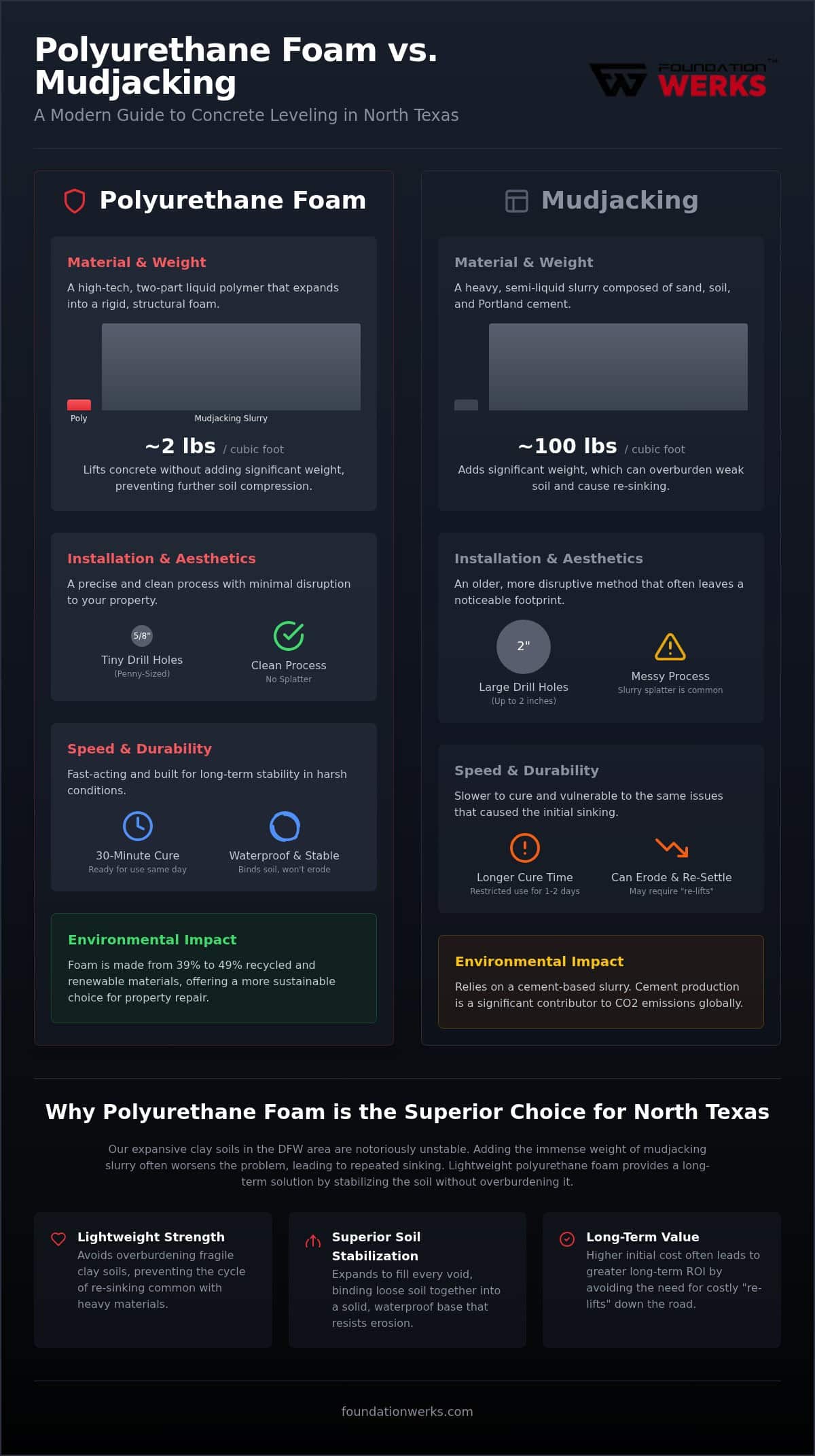
- Foam Hole Size: 5/8-inch (nearly invisible)
- Mudjacking Hole Size: 2 inches (highly noticeable)
- Foam Cure Time: 15-30 minutes
- Mudjacking Cure Time: 24-72 hours
Cost vs. Value: ROI for Commercial and Residential Properties
When you look at the initial quote for polyurethane vs mudjacking, the mudjacking price often looks more attractive at first glance. It’s a traditional method with a lower upfront sticker price. However, savvy property owners look beyond the first check. The true cost of a repair includes its lifespan and the likelihood of needing to do it all over again in a few years. Choosing a cheaper method that adds 100 pounds of weight to failing soil often leads to a cycle of recurring expenses. You save money today only to spend it again when the heavy grout causes the slab to sink a second time.
Investing in high-density foam provides a much higher ROI of polyurethane foam because it addresses the root causes of settlement. The foam doesn’t just lift the slab. It expands to seal the underside, creating a water-resistant barrier that helps prevent future erosion from rain and runoff. This is significantly more cost-effective than a total concrete replacement. In fact, leveling typically costs 50% to 70% less than the price of tearing out and pouring new concrete. You get a leveled surface without the high price tag or the mess of a full construction project.
Commercial Applications: Warehouse and Industrial Floors
In industrial settings, the financial stakes are much higher. A sunken joint in a warehouse floor can destroy forklift tires and lead to expensive equipment repairs. High-density polyurethane is specifically engineered to handle extreme load-bearing capacities. This makes it a preferred choice for heavy machinery and constant pallet jack traffic. Because the foam cures in minutes rather than days, logistics hubs in the Dallas area can maintain their schedules. You avoid the massive financial hit of a multi-day shutdown. Stabilizing these joints early prevents the concrete from cracking under pressure, which saves your business from more invasive structural repairs down the road.
Residential Value: Driveways, Patios, and Pool Decks
Homeowners in McKinney and across North Texas often choose foam to protect their property’s curb appeal. A driveway full of large, two-inch mudjacking patches can actually hurt your home’s resale value. It signals to buyers that there are underlying issues. By choosing a durable, long-term solution, you ensure your outdoor spaces remain safe and attractive. Lifting your existing concrete is almost always a better financial move than pouring new slabs. It avoids the costs of demolition, hauling away heavy debris, and the risk of damaging your landscaping with heavy cement trucks. It’s an investment in your home’s future that pays off in both safety and aesthetics.
The North Texas Context: Why Foam Wins in DFW Soil
Living in the Dallas-Fort Worth metroplex means dealing with soil that acts like a sponge. Our region is famous for expansive clay that swells during rainy spring months and shrinks into deep cracks during the scorching August heat. This constant movement is the primary reason concrete slabs sink in North Texas. When you weigh the options of polyurethane vs mudjacking, you have to consider how these materials interact with our unique geology. Mudjacking grout is essentially more earth added to an earth problem. Because it is porous, it can absorb moisture and shift right along with the clay, often leading to a return of the original problem.
Hydrophobic polyurethane foam offers a different path. It is completely unaffected by the moisture levels in the ground. Whether we are in a record-breaking drought or a week of heavy thunderstorms, the foam remains stable and rigid. It doesn’t wash away, and it doesn’t settle further into the soft clay. This reliability makes it the preferred choice for property owners who want a long-term resolution to their drainage and leveling issues without the constant worry of seasonal soil movement.
Handling Soil Erosion and Voids
In areas like McKinney and Frisco, soil erosion often creates hidden pockets of empty space beneath your driveway or pool deck. Mudjacking slurry is thick and heavy, which means it often fails to reach the smallest crevices. Polyurethane injection starts as a liquid, allowing it to flow into every tiny void before it expands. This creates a fully supported base that reinforces the ground itself. Using polyurethane concrete raising in McKinney TX helps stabilize the sub-grade and prevents future washouts by creating a water-resistant barrier that stays exactly where we put it.
Choosing a Local Specialist for Your Project
Selecting the right contractor is just as important as choosing the right material. You need a team that understands the specific challenges of North Dallas neighborhoods and commercial zones. A one-size-fits-all approach doesn’t work here. At Foundation Werks, we focus on a “Foam Lifts & Levels” philosophy that prioritizes technical precision and site cleanliness. We don’t just guess at the problem. We provide a professional site evaluation to determine exactly why your concrete is failing.
When you look for a local specialist, insist on a detailed estimate that explains the process from start to finish. Our goal is to empower you with the knowledge needed to make a confident decision for your property. We take pride in delivering a clean, aesthetic finish that restores your curb appeal and safety. If you are ready to address those trip hazards with a modern, eco-conscious approach, we are here to help you get your concrete back on solid ground.
Secure the Future of Your North Texas Property
Choosing the right method for your home or business comes down to understanding the long-term impact on your soil. When you evaluate polyurethane vs mudjacking, the lightweight nature of foam stands out as the superior choice for our local clay. You get a leveled surface without the risk of adding heavy grout that can cause secondary sinking. Plus, the nearly invisible drill holes and same-day return-to-service mean your daily routine isn’t interrupted. We focus on providing a reliable solution that addresses the root cause of the settlement while keeping your property clean and aesthetic.
Foundation Werks takes pride in using a patented, eco-conscious foam made from recycled materials. Whether you’re in McKinney, Dallas, or anywhere in the DFW metroplex, our team is here to help you restore safety and curb appeal. You don’t have to live with dangerous trip hazards or unsightly pooling water near your foundation. We’re ready to provide a thorough evaluation and a methodical approach to getting your concrete back on solid ground.
Your concrete doesn’t have to be a source of stress. We’re here to help you make an informed decision and deliver a result that keeps your surfaces level for years to come. Reach out today to see how our foam lifts and levels can transform your property.
Frequently Asked Questions
Is polyurethane foam concrete lifting better than mudjacking?
Polyurethane is generally considered the superior choice for North Texas properties because it is lightweight and won’t stress our fragile clay soils. While mudjacking is a traditional method, its extreme weight often leads to secondary sinking. Foam provides a cleaner, faster, and more precise lift that addresses the root cause of settlement without adding a heavy burden to the ground.
How much more does polyurethane foam cost compared to mudjacking?
Polyurethane typically has a higher initial price point, but it offers better long-term value for homeowners and businesses. When you compare polyurethane vs mudjacking, the cheaper upfront cost of mudjacking often disappears when you account for the cost of recurring repairs. Investing in foam helps prevent the cycle of sinking and re-lifting that is common with heavier materials.
How long does polyurethane concrete raising last?
Polyurethane concrete raising is designed to last as long as the concrete slab itself remains structurally sound. Because the material is waterproof and does not biodegrade, it provides a stable base that won’t wash out or shift with seasonal moisture changes. It’s a reliable, long-term solution for managing the unique soil challenges found throughout the Dallas-Fort Worth area.
Can I drive on my driveway immediately after polyurethane injection?
Yes, you can typically drive your vehicle onto the leveled surface within 15 to 30 minutes of the job’s completion. The chemical expansion process happens quickly, and the foam reaches nearly its full structural strength almost immediately. This minimal downtime is a significant advantage for busy households and commercial warehouses that cannot afford to close off access for several days.
Does polyurethane foam wash away over time in heavy rain?
No, the high-density foam we use is a closed-cell polymer that is completely waterproof and won’t erode. Unlike mudjacking slurry, which consists of soil and sand that can soften or wash away during heavy North Texas rain cycles, foam remains a rigid solid. It actually helps seal the underside of your concrete to prevent future soil washouts and erosion.
Will mudjacking or polyurethane foam fix my foundation problems?
No, these methods are specifically designed for leveling flatwork like driveways, sidewalks, and patios, rather than structural foundation repair. While leveling your driveway can improve drainage away from your home, it won’t address deep-seated foundation settlement. If you suspect structural issues, we recommend a professional evaluation to determine if residential foundation repair is necessary for your home’s safety.
Are the holes from concrete lifting visible after the job is done?
The injection holes are very small and become nearly invisible once we patch them with color-matched cement. We only need to drill 5/8-inch holes, which are roughly the size of a penny, to perform the lift. This is a major aesthetic improvement over traditional mudjacking, which requires much larger 2-inch holes that often leave noticeable circular patches across your concrete.
Is the polyurethane foam used for concrete lifting environmentally friendly?
Yes, we use a patented, eco-conscious foam that is made from 39% to 49% recycled and renewable materials. When weighing polyurethane vs mudjacking, many property owners choose foam because it is non-toxic and won’t leach harmful chemicals into the surrounding soil. It’s a responsible way to repair your property while prioritizing the health of your local North Texas environment.