

That recurring crack in your warehouse floor, the uneven surface in your parking lot, or the pooling water around your driveway or pool deck isn’t just an eyesore, it’s often a symptom of a much deeper issue beneath the surface. Many property owners assume sinking concrete is simply a concrete or masonry problem, but in North Texas, expansive clay soils and subgrade erosion are frequently the real culprits. If you’ve dealt with trip hazards, standing water, or recurring settlement issues on warehouse floors, commercial parking lots, sports courts, driveways, or pool decks, only to see them return months after a repair, you’re not alone. It’s frustrating to invest in repairs that fail to address the root cause, leaving you with ongoing maintenance costs and potential liability concerns.
The key to long-term stability is solving the problem below the slab, not just patching the surface. This guide explores the critical connection between soil erosion, concrete settling, and lasting structural performance. You’ll learn how advanced polyurethane stabilization technology fills underground voids, strengthens weak soils, and precisely lifts settled concrete without the disruption of traditional replacement methods. We’ll also discuss the role of effective water management solutions, including French drain installation and drainage corrections, in preventing future soil movement. From warehouse floors and parking lots to sports courts, driveways, and pool decks, these innovative repair strategies minimize downtime, maintain accessibility, and restore the integrity of your concrete surfaces. By the end of this guide, you’ll understand how modern, engineering-driven solutions can break the cycle of recurring settlement and deliver a stable, long-lasting foundation for your property.
Key Takeaways
- Recognize that sinking slabs are a symptom of subgrade failure, where water creates hidden air pockets that compromise your property’s structural support.
- Learn why the expansive Blackland Prairie clay in North Texas makes professional soil erosion concrete settling repair essential for achieving long-term stability.
- Discover the advantages of high-strength polyurethane injection, an eco-conscious method that provides reliable support without the excessive weight of traditional mudjacking.
- Understand why integrating French drains is a critical step to intercept subsurface water and prevent the return of dangerous voids beneath your concrete.
- Evaluate the significant ROI of specialized concrete lifting, which often costs 50-70% less than the disruptive process of full slab replacement.
Table of Contents
-
Understanding the Link Between Soil Erosion and Concrete Settling
-
The North Texas Factor: How Expansive Clay Drives Concrete Failure
-
Polyurethane Injection: The Superior Solution for Eroded Subgrades
-
Beyond the Lift: Integrating Drainage and French Drains for Long-Term Stability
-
Implementing a Long-Term Concrete Stabilization Plan in Dallas
Understanding the Link Between Soil Erosion and Concrete Settling
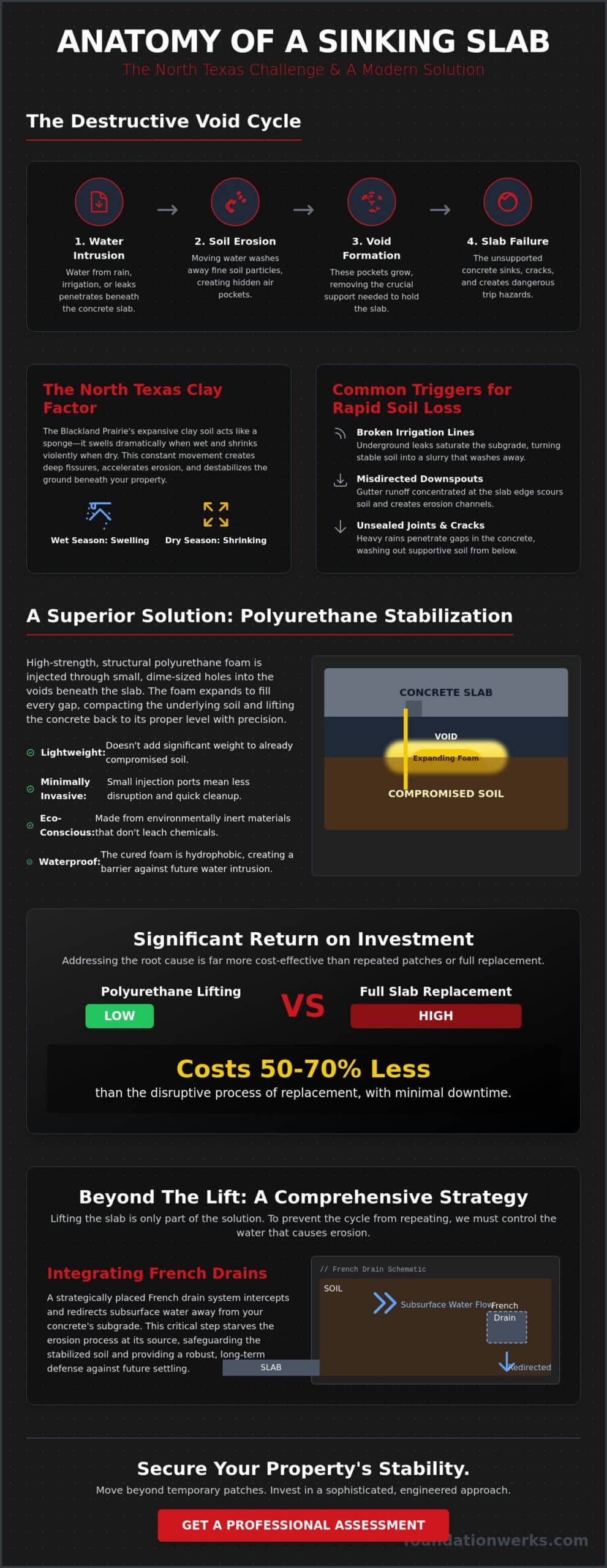
Concrete settling is often misunderstood as a product defect or a simple age-related issue. In reality, it represents the structural failure of the subgrade support system. When the earth beneath a warehouse floor or driveway can no longer bear the load, the slab inevitably shifts. Soil erosion plays a central role here, creating a destructive "Void Cycle." As water moves under the concrete, it washes away fine particles, leaving behind air pockets. These pockets grow over time, removing the critical support necessary to keep the surface level.
Ignoring these symptoms leads to exponential repair costs and increased safety liabilities, such as trip hazards that can result in costly legal claims. Unlike natural soil consolidation, which occurs slowly as air is pressed out of new fill, active erosion is a persistent threat driven by moving water. Effective soil erosion concrete settling repair focuses on identifying these voids before they lead to a complete collapse of the section.
To better understand how these subsurface changes impact your property, watch this helpful video on erosion repair:
The Anatomy of a Sinking Slab
Gravity is relentless. When weight is distributed across a slab with underlying voids, the concrete is forced into those empty spaces. You might notice soil washout at the edges or hear a distinct hollow sound when walking over certain areas. Subgrade failure is the primary cause of slab displacement. These warning signs indicate that the support system has been compromised, requiring professional intervention to stabilize the ground before the concrete cracks under its own weight.
Common Triggers for Rapid Soil Loss
Several factors accelerate the loss of soil beneath your property. While natural weather patterns contribute, human-made issues often cause the most rapid damage:
-
Broken irrigation lines: Leaking underground pipes can saturate the subgrade, turning stable soil into a slurry that washes away easily.
-
Misdirected downspouts: Gutters that discharge water directly against the concrete edge scour the soil and create deep channels underneath the slab.
-
Rain cycles: Heavy North Texas rain penetrates unsealed concrete joints, allowing water to wash out fines and widen existing gaps.
-
Tree root influence: Large trees can draw significant moisture from the clay subgrade, causing the soil to shrink and pull away from the slab. For property owners in Central Texas, We Love Trees offers specialized arborist care to help maintain a healthy balance between your landscape and your concrete structures.
Addressing these triggers is a vital component of any soil erosion concrete settling repair strategy, ensuring that the ground remains stable long after the initial lift is performed.
The North Texas Factor: How Expansive Clay Drives Concrete Failure
Dallas and McKinney sit atop the Blackland Prairie, a region known for its highly expansive clay soil. This isn’t just a geological trivia point; it’s the primary reason why local properties require specialized soil erosion concrete settling repair. Unlike the sandy or loamy soils found in other states, North Texas clay acts like a sponge. It swells significantly when saturated and contracts violently during our characteristic droughts. This constant movement creates deep fissures in the earth, often reaching several feet down, which undermines the very foundation of your concrete.
Standard construction often involves compacting soil before pouring a slab, but in Texas, that compaction can fail within a single season. When the clay dries out, it loses volume and pulls away from the structure. When the rains eventually return, hydrostatic pressure can initially push slabs upward, a phenomenon known as heaving. However, as that water flows through the new fissures, it carries away the soil fines. This leads to the void-creation cycle where the support system literally washes away from beneath the surface.
Why North Texas and DFW area Properties are High-Risk
The local climate is a major driver of structural instability. With 100-degree summers being the norm, the rate of soil dehydration is accelerated, leading to rapid shrinkage. Large commercial slabs and warehouse floors are particularly vulnerable because their sheer size and weight distribution make them less tolerant of uneven support. If you’re noticing these shifts, evaluating your subgrade with professional concrete stabilizing can help prevent further deterioration before the damage becomes structural.
Identifying "Texas-Style" Erosion
You can often spot the signs of trouble by looking for the "August Gap." This occurs when the soil physically pulls away from the edge of your foundation or driveway during the peak of summer heat. These gaps act as funnels for winter rains, which liquefy the dry soil and wash it out from under the slab. This dangerous cycle of heaving in the spring followed by settling in the fall is a uniquely Texan challenge. It requires a solution that addresses both the soil’s chemistry and the site’s drainage to achieve long-term stability.
Polyurethane Injection: The Superior Solution for Eroded Subgrades
While traditional methods often struggle with the dynamic North Texas soil described previously, polyurethane injection offers a modern, high-strength alternative. This material is remarkably lightweight yet capable of supporting heavy commercial loads. When injected, the patented foam expands to approximately 15 times its liquid volume, allowing it to penetrate every hidden air pocket and crevice created by subsurface movement. This comprehensive void filling is essential for effective soil erosion concrete settling repair, as it reinforces the subgrade without adding the destructive weight of older technologies.
Unlike traditional mudjacking slurry, which is essentially a water-based mixture of soil and cement, polyurethane is inherently waterproof. It won’t wash away during the heavy rain cycles common in the Dallas Metro. This characteristic ensures that the support remains intact even when moisture levels fluctuate. It’s a precise, tech-driven way to restore the integrity of your property’s foundation.
Polyurethane vs. Mudjacking for Erosion Repair
The most significant differentiator is weight. Mudjacking adds roughly 100 pounds per cubic foot to an already stressed subgrade, potentially accelerating the very settling it aims to fix. In contrast, polyurethane weighs only 2 to 4 pounds per cubic foot. Business owners also appreciate the efficiency of this method; the foam cures in about 15 minutes, allowing warehouse floors and driveways to return to service almost immediately. While we avoid the term "permanent fix," foam provides a highly durable subgrade stabilizer that resists the erosion patterns that plague traditional repairs.
The Environmental and Structural Benefits
Our commitment to sustainability is reflected in our choice of materials. We utilize patented foams formulated with recycled components, aligning your repair needs with modern commercial environmental goals. For property owners looking to meet 2026 sustainability standards or LEED goals, exploring sustainable concrete repair North Texas methods can help you achieve both structural integrity and environmental responsibility. The application is also minimally invasive, requiring only penny-sized injection holes that leave the aesthetic of your concrete undisturbed. Polyurethane creates a hydrophobic barrier under the slab, effectively repelling water and preventing future soil washout. This tech-forward approach ensures a sophisticated, long-term resolution for even the most challenging soil erosion concrete settling repair projects.
Beyond the Lift: Integrating Drainage and French Drains for Long-Term Stability
Lifting concrete without addressing the underlying water issue is like painting a house that’s on fire. It might look better for a moment, but the structural threat remains active. A truly effective soil erosion concrete settling repair requires a shift from surface-level thinking to a holistic view of the property’s ecosystem. We position our approach as a "Total Stabilization System." We don’t just treat the symptom; we neutralize the cause by managing how moisture interacts with your subgrade.
This integrated strategy is what sets a professional restoration apart from a temporary patch. While competitors might treat concrete lifting and drainage as separate services, we recognize they’re inseparable components of a stable foundation. By controlling water flow, we protect the polyurethane buffers we’ve installed, ensuring the soil remains exactly where it belongs.
A Holistic 4-Step Repair Strategy
-
Step 1: Identify and mitigate the water source through strategic French drain installation.
-
Step 2: Lift and level the slab using precision polyurethane injection to restore the original profile.
-
Step 3: Fill deep voids to prevent future soil collapse or the development of "hollow" spots.
-
Step 4: Seal joints and cracks to create a weather-tight surface that repels runoff from above.
French Drains: The Unsung Hero of Concrete Longevity
While simple downspout extensions might suffice for small residential gardens, they rarely handle the high-volume runoff found on commercial parking lots or large driveways. French drains manage the water table around your infrastructure, intercepting subsurface flow before it can reach the slab. Professional installation is mandatory to calculate the correct slope and discharge point; water must move away from the structure rather than pooling beneath it. For those managing complex sites, our French Drain Installation for North Texas Properties provides the necessary defense against relentless rain cycles. You can request a comprehensive site evaluation to determine the optimal drainage configuration for your property.
Implementing a Long-Term Concrete Stabilization Plan in Dallas
Investing in your property requires a strategic outlook that prioritizes both structural integrity and financial logic. While full concrete replacement might seem like a definitive path, it’s often an unnecessary expense that causes significant disruption. Choosing a specialized soil erosion concrete settling repair instead typically costs 50% to 70% less than the price of pouring new slabs. This isn’t just about the immediate budget; it’s about avoiding the massive operational downtime that comes with demolition. For warehouse floors and commercial driveways, every hour of closure impacts your bottom line. A tech-driven stabilization allows you to return to full capacity in a fraction of the time.
A "commercial-grade" approach is essential for high-traffic environments. You need a partner who understands that a warehouse floor supporting heavy machinery requires different engineering than a residential sidewalk. By focusing on high-compressive strength materials and precise void filling, we ensure your surfaces can handle the daily rigors of industrial use without the risk of recurring failure. This sophisticated method protects your property value while providing the peace of mind that comes from a job done right the first time. Property owners who want to stay ahead of evolving industry standards can also review the latest 2026 trends in sustainable concrete repair for North Texas to understand how eco-friendly stabilization methods are reshaping commercial restoration projects.
Choosing a Partner in McKinney and Dallas
Local knowledge of North Texas soil is non-negotiable for a lasting resolution. You aren’t just looking for a contractor with a pump; you need an innovative expert who understands how Blackland Prairie clay behaves during a Dallas drought. We differentiate ourselves by using patented, eco-friendly polyurethane that aligns with modern sustainability goals. Our team acts as a transparent guide, helping you understand the "why" behind the "how" during every professional assessment. For commercial or high-value residential projects, this specialized expertise ensures that the unique variables of your site are fully accounted for before the first injection begins.
Maintenance Tips to Prevent Future Settling
Stability is maintained through consistent vigilance. Even the most robust repairs benefit from a proactive maintenance plan to ensure the subgrade remains protected. We recommend the following steps:
-
Conduct annual inspections of joints and seals to catch small cracks before they allow water to bypass the surface.
-
Monitor drainage discharge points during heavy Dallas rain events to ensure water is flowing away from the structure as intended.
-
Check for new soil gaps near the foundation during peak August heat when clay shrinkage is most aggressive.
Proactive care is the best way to extend the life of your infrastructure. Schedule your professional concrete assessment with Foundation Werks today.
Secure Your Property’s Foundation for the Long Term
Restoring your concrete is a two-fold process that requires stabilizing the subgrade and managing the environmental factors that caused the initial failure. You’ve seen how North Texas clay creates a cycle of instability and why simply lifting a slab without addressing drainage is a short-term gamble. By integrating soil erosion concrete settling repair with advanced moisture control, you protect your infrastructure from the unique geological challenges of the Blackland Prairie.
Foundation Werks specializes in commercial and high-value residential projects across McKinney, Dallas, and the surrounding region. We utilize a patented, eco-friendly polyurethane foam that provides high-strength support while minimizing environmental impact. Our methodical approach ensures that your warehouse floors or driveways are restored with precision and minimal downtime, allowing you to focus on your business or home with renewed confidence.
Don’t let hidden voids compromise your property’s value any longer. Our team is ready to provide the specialized expertise needed for a stable, long-term resolution. Get a Professional Concrete Stabilization Quote and take the first step toward a more resilient property today.
Frequently Asked Questions
Does soil erosion always mean I need to replace my entire concrete slab?
No, soil erosion doesn’t automatically necessitate a full replacement of your concrete. In most cases, we can restore the subgrade using polyurethane injection to fill voids and lift the slab back to its original position. This method is significantly less disruptive and more cost-effective than demolition. It preserves your existing concrete while addressing the underlying instability that caused the settling in the first place.
How do I know if the settling is caused by erosion or poor soil compaction?
You can often distinguish between the two by looking for specific physical cues on your property. Erosion typically manifests as visible soil washout at the slab edges or a distinct hollow sound when you tap the surface. Poor compaction usually results in a more uniform sinking that occurs shortly after construction. A professional assessment is the most reliable way to determine the specific cause and develop a targeted plan for soil erosion concrete settling repair.
Can a French drain really stop my concrete from sinking further?
A French drain is a highly effective tool for managing the subsurface water that drives erosion. By intercepting water before it reaches the slab’s subgrade, the drain prevents the "Void Cycle" from starting or continuing. While it doesn’t lift the concrete, it stabilizes the environment around the repair. This ensures that the soil remains consistent and protected from the scouring effects of heavy North Texas rainfall.
Is polyurethane foam safe for the environment and my local Dallas landscape?
Modern polyurethane foams are designed with environmental responsibility in mind. We use patented formulations that utilize recycled materials and blowing agents with low global warming potential. Once the foam cures, it becomes an inert, stable solid that doesn’t leach chemicals into the surrounding Dallas soil. This makes it a safe, eco-conscious choice for stabilizing high-traffic commercial areas and high-value residential landscapes alike.
How long does the concrete lifting and soil stabilization process take?
The entire process is remarkably efficient and typically takes only a few hours to complete. Because the polyurethane foam reaches 90% of its full strength within 15 minutes of injection, there’s minimal downtime for your property. You can often drive on a repaired driveway or operate machinery on a warehouse floor the same day. This speed is a primary reason why businesses prefer injection over traditional concrete replacement.
What happens if I only lift the concrete but don’t address the soil erosion?
Lifting the concrete without addressing the water source is a temporary measure that ignores the root problem. If the erosion continues, new voids will eventually form around the repair, leading to further settling and potential structural failure. Achieving long-term stability requires a holistic approach that combines lifting with strategic drainage improvements. This dual strategy ensures that the subgrade remains supported and protected from future moisture-driven damage.
Will polyurethane foam wash away if the erosion problem isn’t fixed immediately?
Polyurethane foam is hydrophobic, meaning it won’t wash away or degrade even in the presence of standing water. Unlike traditional mudjacking slurry, which can be eroded by moisture, cured foam remains a solid, stable barrier. While the foam itself is secure, it’s still vital to fix the erosion issue. If water continues to scour the native soil around the foam, the surrounding ground could still shift over time.
Is there a minimum project size for residential concrete repair in McKinney?
We focus our expertise on commercial projects and high-value residential jobs that meet a specific scope. For residential properties in McKinney and the surrounding North Texas area, we generally require a minimum project size of $1800. This threshold allows us to deploy the specialized equipment and high-grade materials necessary to provide the sophisticated, tech-driven results our clients expect for their soil erosion concrete settling repair needs.
Your Foundation Werks Team