

Choosing to replace your sunken driveway or warehouse floor might actually be the most destructive decision you can make for your property’s long-term value. Most North Texas property owners feel trapped in a cycle of patching cracks only to watch the region’s expansive clay soil shift them again months later. You’re likely feeling the pressure to meet 2026 sustainability standards or LEED goals while trying to keep your operations running smoothly. It’s why sustainable concrete repair North Texas has shifted from a niche preference to a commercial necessity.
We understand the frustration of seeing heavy equipment tear up your land, only to worry if the new pour will settle just like the last one. This article explores how modern restoration methods, specifically those utilizing recycled polyurethane foam, provide a stable, long-term resolution without the massive carbon footprint of traditional demolition. You’ll discover the latest 2026 trends in eco-friendly stabilization and see how these high-tech materials are outperforming heavy mudjacking slurry in our unique local environment. By prioritizing precision and environmental responsibility, you can restore your property’s foundation while minimizing both waste and operational downtime.
Key Takeaways
- Understand the environmental and financial benefits of choosing restoration over replacement to significantly reduce your property’s carbon footprint.
- Explore how sustainable concrete repair North Texas now leverages advanced polyurethane foams engineered from recycled materials for superior, eco-conscious results.
- Learn why lightweight stabilization methods are more effective than heavy mudjacking for managing the unique pressures of expansive clay soils in Dallas and McKinney.
- Discover how a holistic approach, including French drain installation, protects your investment by managing the moisture levels that cause concrete to settle.
- Find out how these modern technologies allow for faster project completion, reducing business downtime while meeting 2026 LEED and sustainability standards.
The Shift Toward Restoration: Why Repair is the New Sustainable Standard in North Texas
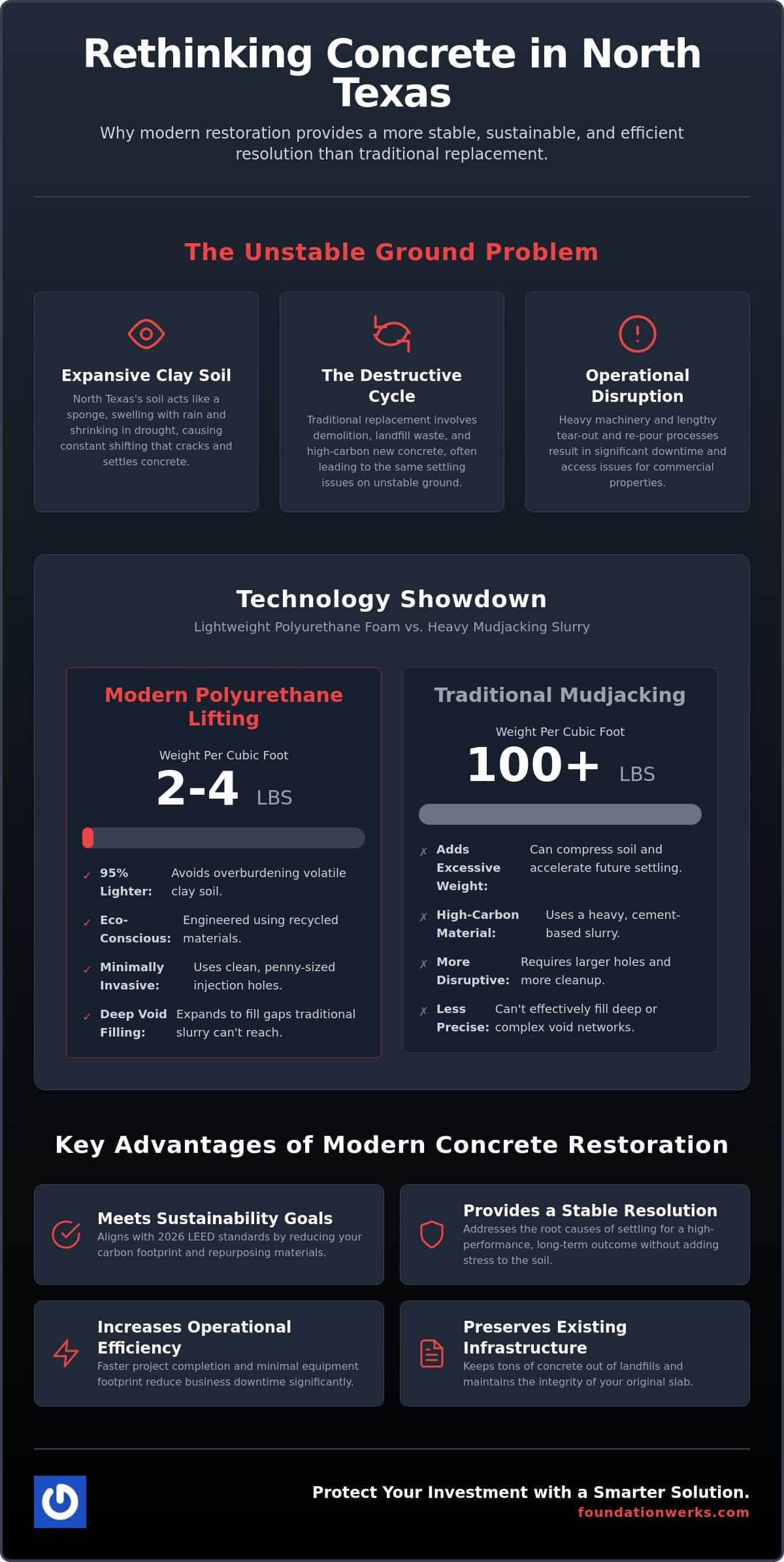
The landscape of property maintenance in the DFW metroplex is undergoing a profound transformation. As we move into 2026, property managers are abandoning the outdated mindset of “disposable infrastructure” in favor of restorative maintenance. This shift isn’t just about fiscal responsibility; it’s about addressing the heavy environmental impact of traditional construction. When you choose to replace a slab, you’re contributing to a massive carbon footprint that includes industrial demolition, hauling waste to landfills, and the high-energy production of new cement. Choosing restoration over replacement keeps thousands of tons of concrete out of Texas landfills every year.
Instead, sustainable concrete repair North Texas focuses on maximizing the lifespan of existing structures with minimal environmental disruption. By intervening before failures become catastrophic, you can resolve the underlying causes of concrete degradation without the need for heavy machinery or the carbon-heavy cycle of fresh concrete pours. This proactive approach ensures that your infrastructure remains functional while aligning with modern corporate sustainability goals.
To better understand this concept, watch this helpful video:
The Carbon Calculus of Concrete
The cement industry is a major carbon emitter, making the decision to preserve existing slabs a powerful environmental choice. Every cubic yard of new concrete carries a heavy embodied carbon debt. Sustainable concrete repair is a high-performance restoration process that utilizes recycled materials to provide long-term stability. By opting for restoration, you effectively lock in the carbon already stored in your infrastructure while avoiding the emissions associated with new manufacturing and transport.
Regional Challenges: The DFW Soil Factor
North Texas presents a unique set of challenges that make traditional replacement strategies less effective. Our region is famous for its expansive clay soils, which act like a sponge during the intense drought and flood cycles common to Dallas and Fort Worth. This constant movement leads to soil erosion and concrete settling repair needs that can’t be solved by simply pouring more heavy material on top of unstable ground. A sustainable approach requires a flexible, adaptive strategy that works with the soil rather than fighting against it.
Polyurethane Lifting: The Eco-Conscious Alternative to Traditional Mudjacking
Traditional mudjacking often fails to address the underlying mechanics of soil failure in cities like McKinney and Dallas. By pumping tons of heavy, cement-based slurry under a settling slab, contractors frequently add excessive weight to already compressed clay. This 100-pound-per-cubic-foot load can actually accelerate future settling. In contrast, sustainable concrete repair North Texas utilizes high-density polyurethane foam that weighs only 2 to 4 pounds per cubic foot. This 95% reduction in weight allows for precise lifting without overburdening the delicate soil structure beneath your property.
Modern polyurethane has evolved far beyond its industrial origins. Today’s foams are often engineered using recycled polyols, effectively repurposing plastic waste into a high-performance construction material. Technical assessments of polyurethane foam for lifting concrete highlight its remarkable strength-to-weight ratio and its ability to fill deep voids that traditional materials simply can’t reach. Because the application requires only penny-sized injection holes, the structural integrity of your existing slab remains intact, avoiding the destructive nature of full replacement.
Sustainability Comparison: Foam vs. Slurry
The environmental advantages of polyurethane extend to logistics and lifecycle performance. A single service truck carrying foam components can often complete a project that would require multiple heavy cement mixers. This efficiency significantly lowers transport emissions and reduces site congestion. Once injected, the foam becomes a chemically inert, moisture-resistant barrier. It won’t leach into the North Texas water table or degrade over time, ensuring a high degree of effectiveness for years to come. If you’re looking to minimize your environmental footprint, it’s wise to consult with a specialist about these advanced material options.
Industrial Applications and Durability
Facility managers often question if a lightweight foam can withstand the rigors of heavy machinery. High-density foams are specifically engineered for warehouse floor joint repair in Dallas, providing the necessary support for constant forklift traffic and heavy pallet racking. These materials don’t just lift; they stabilize the subgrade by filling microscopic voids. This creates a uniform support system that handles heavy loads with the same reliability as traditional methods, but with a much lower carbon cost.
Future-Proofing Infrastructure: A Holistic Approach to Stabilization
Selecting eco-friendly materials is a vital first step, but material choice is only half the battle. In the challenging environment of the DFW metroplex, water is the primary catalyst for soil erosion and slab failure. True sustainable concrete repair North Texas requires a comprehensive strategy that addresses why the concrete settled in the first place. By combining precision lifting with strategic moisture management, you create a system designed for long-term stability rather than just a visual correction.
Our “Relentless” Expert approach focuses on identifying these environmental stressors before they cause recurring damage. We don’t just look at the surface; we analyze the subgrade and the surrounding landscape to ensure our intervention supports the property’s overall health. This methodology positions Foundation Werks as an innovative partner for property managers who value technical precision and environmental responsibility.
For those seeking international expertise in high-performance infrastructure maintenance, fibrwrap-ccuk.com is a leading engineering contractor specializing in structural strengthening and concrete repair.
The Synergy of Drainage and Leveling
Managing North Texas runoff is the single most effective way to extend the life of your concrete. Integrating French drain installation alongside polyurethane lifting prevents the subgrade from washing out during heavy seasonal storms. This strategy acts as a sustainability multiplier, ensuring that the soil remains consistent and provides a reliable foundation for the restored slab. We view this as a strategy for long-term resolution, protecting your investment by removing the root cause of instability.
Beyond exterior drainage, maintaining the integrity of indoor concrete surfaces is equally important, with The Garage RX providing professional guidance on preparing garage floors for long-lasting protective finishes.
Choosing a Sustainable Partner in McKinney
When evaluating a contractor, look for a partner who prioritizes both technical excellence and environmental stewardship. A true expert should provide transparency regarding recycled material certifications and utilize specialized equipment that minimizes site disruption. Foundation Werks combines these high-tech capabilities with a deep respect for your property’s longevity and the local environment. This commitment to quality is shared by industry leaders like Warrens Power Washing, who provide the professional exterior cleaning necessary to maintain the results of your structural investments.
Our team utilizes patented, eco-conscious foam to achieve precise uneven warehouse floor repair in Dallas. By pairing this advanced material with commercial-grade joint sealing, we prevent surface water from penetrating the slab. This multi-layered approach to sustainable concrete repair North Texas ensures your facility remains operational and safe while meeting the rigorous LEED and sustainability standards of 2026. Trusting an innovative partner means moving beyond reactive patches toward a future-proofed infrastructure.
Invest in a Resilient and Responsible Foundation
The evolution of property maintenance in 2026 rewards those who prioritize restoration over demolition. By choosing lightweight, high-density polyurethane over heavy traditional slurry, you protect the delicate subgrade of your property while drastically reducing environmental waste. These modern methods prove that technical excellence and sustainability aren’t mutually exclusive. High-performance materials, especially when paired with proactive moisture management, provide the stability needed to navigate the specific challenges of our local environment without the need for a total replacement. For those seeking similar high-quality restoration for their patios and decks, you can discover Cascade Outdoor Services for professional hardscaping and structural outdoor construction.
Foundation Werks brings professional authority to every project, specializing in the unique behaviors of North Texas expansive clay soils. We utilize a patented eco-conscious foam crafted from recycled materials to ensure your repair aligns with the highest environmental standards. Whether you’re managing a commercial warehouse or a high-value residence, our team provides the specialized knowledge required for a long-term resolution. It’s time to move beyond reactive patches and embrace a smarter way to maintain your infrastructure. Request a Sustainable Concrete Assessment from Foundation Werks today and take the first step toward sustainable concrete repair North Texas. Your property deserves a solution that is as forward-thinking as it is reliable.
Frequently Asked Questions
Is polyurethane foam concrete repair actually eco-friendly?
Yes, modern polyurethane restoration is a cornerstone of sustainable concrete repair North Texas because it utilizes recycled polyols and prevents thousands of tons of waste from entering landfills. By choosing restoration over replacement, you avoid the massive carbon emissions associated with new cement production. Additionally, the lightweight nature of the material requires fewer transport vehicles, which significantly reduces the total carbon footprint of your property maintenance project.
How long does a sustainable concrete repair last in North Texas?
A professionally executed repair provides a long-term resolution that can endure for many years when paired with proper soil moisture management. The polyurethane material is chemically inert and moisture-resistant; it doesn’t wash away or degrade underground like traditional mudjacking slurry. While environmental factors require ongoing attention to property drainage, these advanced stabilization methods ensure the repair remains effective through the region’s intense drought and flood cycles.
Can polyurethane foam handle heavy commercial traffic in a warehouse?
High-density polyurethane is specifically engineered to support the rigorous demands of heavy commercial traffic and industrial machinery. It maintains exceptional compressive strength, making it ideal for warehouse floors where forklifts and heavy pallet racking are standard. Because the foam expands to fill microscopic voids in the subgrade, it creates a uniform support system that handles heavy loads more reliably than unstable, settling soil.
Will sustainable repair methods work on the expansive clay soil in McKinney?
Sustainable restoration is the preferred method for McKinney’s expansive clay because it stabilizes the ground without adding excessive weight. Traditional mudjacking adds approximately 100 pounds per cubic foot, which often causes the clay to compress and settle even further. Since polyurethane is about 95% lighter than slurry, it provides the necessary lift and stabilization without triggering the secondary settling common with heavier alternatives.