

What if the per-foot number tells you less about your drainage project than you think? The cost of French drain per foot, Texas property owners see in an estimate is only one part of the picture. Route length, access, site conditions, the planned water destination, and surface restoration can all affect the scope. Without those details, a figure is hard to compare or plan around.
It’s understandable to want a clear number, especially when water concerns appear alongside cracks or settling concrete. Drainage work and concrete movement can have different causes, so one shouldn’t be assumed to explain or resolve the other. This article explains what shapes a French drain estimate for a Dallas project, what a useful proposal should spell out, and how to prepare for a project discussion. Foundation Werks installs French drains for Dallas-based projects and also provides concrete raising and stabilization for relevant concrete concerns.
Key Takeaways
- The cost of French drain per foot Texas estimates show is useful only when you understand the full project scope.
- Route length, site access, discharge planning, and surface restoration all shape the work an estimate covers.
- Compare estimates by checking whether they include the same project details, not just similar per-foot figures.
- Before an assessment, note where water collects, when it appears, and which areas matter most to you.
- Foundation Werks installs French drains for Dallas-based projects and provides clear, project-specific estimates.
Texas French Drain Cost Per Foot: Why Estimates Vary
What should the cost of French drain per foot Texas property owners see actually tell them? It can describe the measured length of drain included in a proposal, but it isn’t a complete project quote by itself. Two estimates can show the same linear footage and still cover different routes, site conditions, or tasks.
A per-foot figure is meaningful only when the scope and conditions are comparable. Before weighing the unit price, look at what the proposed work includes and how the route was selected. A clear estimate ties its measurements to the project, so you can see what the number covers.
What does a per-foot French drain estimate describe?
Linear footage is the measured length of the proposed drain route. It helps show how much of the route the estimate addresses, but it doesn’t describe the entire job. The measurement alone won’t tell you where the drain runs, what conditions crews may encounter, or what work is included around it.
For a broader overview of how a French drain is structured and used, Wikipedia offers background on the system. For estimating, focus on the property-specific details: compare the route and included work, not just the price attached to each foot.
Why Texas-wide figures may not fit a Dallas project
Texas is a large state, and an example from East Texas describes a project in that region, not a universal price or a Dallas estimate. Regional examples can offer context, but they can’t account for the route, access, site conditions, or restoration involved at a particular property. Treat broad figures as general reference points, not substitutes for a project-specific scope.
For a Dallas property, evaluate the actual work area and planned route rather than relying on assumptions about soil, climate, or drainage requirements. An estimate should connect its proposed work to details observed at the property.
As you review an estimate, look for a clear description of:
- The proposed drain route and its measured length.
- Site conditions or access factors that affect the work plan.
- Which installation and surface restoration tasks are included.
- Where the system is intended to direct collected water.
If those details aren’t clear, the per-foot figure is difficult to interpret on its own. Defining the scope first helps you understand what the estimate represents and compare proposals on a like-for-like basis.
What Shapes a French Drain Estimate for a Dallas Property?
A clear estimate connects the proposed drain route to the work the property needs. The cost of French drain per foot Texas property owners see can describe a measured portion of the project, but it won’t account for every condition along that route. Some details, such as visible paths, obstacles, and surfaces, can be noted before the project discussion. Other factors require an on-site assessment.
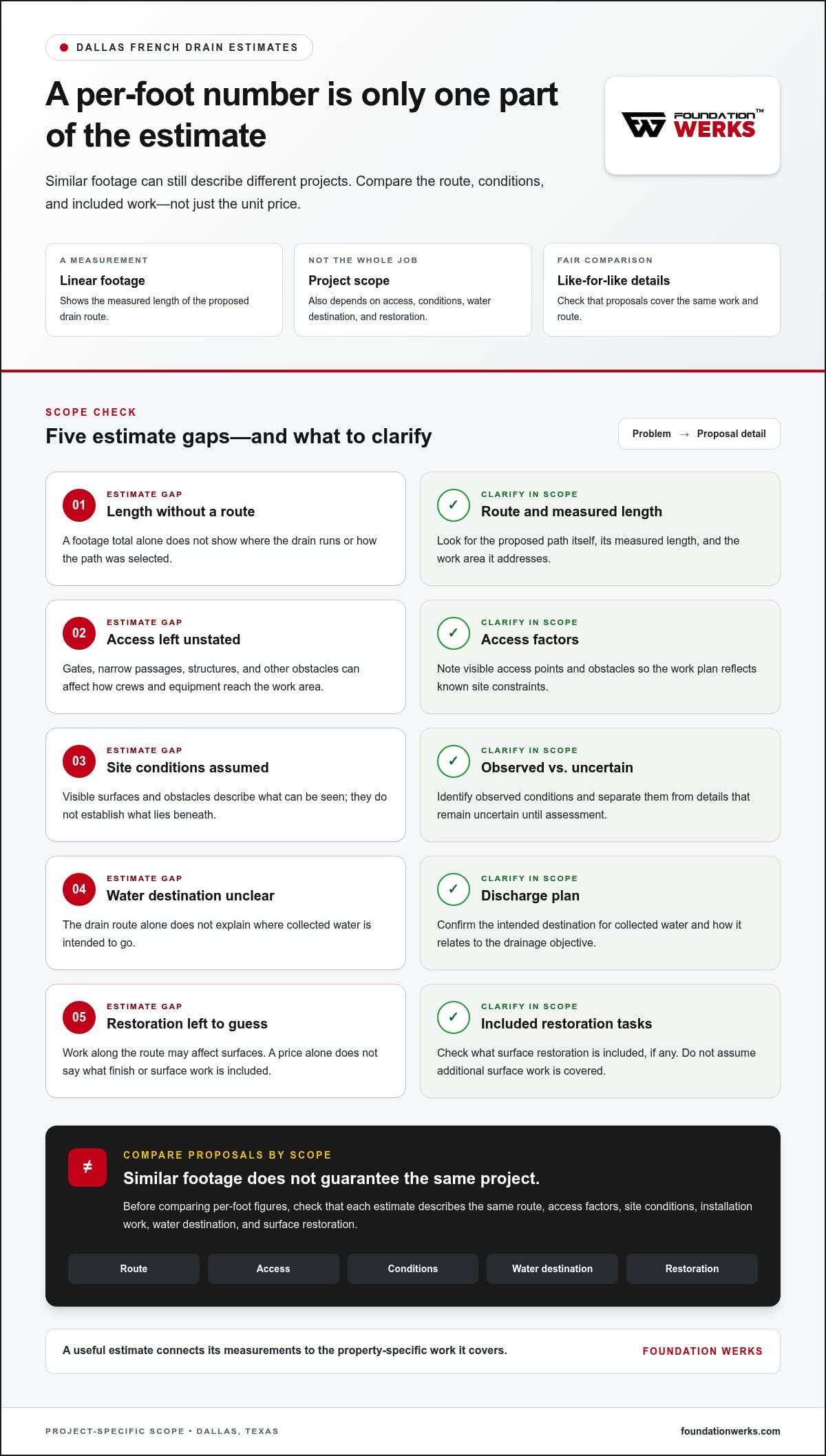
Route length alone cannot define project scope because access, site conditions, water destination, and restoration also shape the work. A useful estimate distinguishes observed details from assumptions that still need to be resolved.
- Route length: The proposed path determines how much drain route is included. A route that changes direction or avoids part of the work area may involve a different plan from a direct path. Look for the route itself, not only its total measurement.
- Access: The path to the work area can affect how crews and equipment reach it. Note gates, narrow passages, existing structures, and other obstacles so the estimate reflects known access conditions.
- Site conditions: Visible surfaces and obstacles help describe the work area, but they don’t establish what lies beneath it. A useful estimate identifies observed conditions and separates them from anything that remains uncertain.
- Discharge planning: The estimate should identify where collected water is intended to go. This clarifies how the proposed route is designed to serve the drainage objective and makes the plan easier to review.
- Surface restoration: Work may affect the surface along the route. The estimate should say what restoration is included, if any. Don’t assume a particular finish or additional surface work is covered unless it appears in the scope.
Route, access, and work area
Walk the proposed work area and note what’s visible: the likely route, access points, and obstacles. These observations help frame the project, but they don’t determine trench dimensions, depth, or installation time. Those details should be based on the project plan and assessment, not on an assumed standard. A scope that identifies the route and access constraints gives you a more useful basis for understanding the work.
Water destination and surface restoration
Water needs an intended destination, so the proposal should make that part of the plan clear. The destination and relevant site conditions should be considered for the specific property. Similarly, restoration should be described in terms of the surface work included in the scope. Clear descriptions make it easier to distinguish the planned work from assumptions about the finished yard or drainage requirements.
For Dallas property owners, a project-specific estimate can bring these elements together. Foundation Werks emphasizes customer education and transparent estimates for Dallas-based projects. A Dallas French drain project estimate can clarify how the proposed route, site conditions, water destination, and stated restoration fit into the scope.
Compare French Drain Estimates by Scope, Not Just by Foot
Two estimates can show similar footage and still describe different projects. One may specify the route, work area, water destination, and surface restoration, while another leaves some details unstated. If scope is implicit, the estimates can look more comparable than they really are.
To interpret the cost of French drain per foot Texas estimates show, look past the rate and compare what the proposed work covers. Use the table below to organize the details side by side.
| Estimate element | Question to resolve | Why it matters |
|---|---|---|
| Route and length | Where will the drain run, and what route length is included? | A measured length without a mapped or described route doesn’t show where work will take place. |
| Work area and access | Which areas are included, and what access conditions are assumed? | Obstacles or limited access can affect the work plan. A stated assumption makes that factor visible. |
| Site conditions | Which conditions were observed, and which still need assessment? | This separates known details from assumptions about the property. |
| Water destination | Where is the proposed system intended to direct water? | A clear destination helps explain how the planned route fits the drainage objective. |
| Included work and restoration | What installation and surface work does the estimate describe? | Without these details, two proposals may cover different tasks despite similar footage. |
Which details should appear in a clear estimate?
Look for a defined route, the work area, and clear project boundaries. The estimate should describe the work included and state whether surface restoration is part of the scope. It should also identify assumptions, such as access or conditions that haven’t been assessed, rather than leaving you to infer what the proposal means.
How to compare quotes without relying on a single rate
Set estimates side by side and compare the route, site assumptions, intended water destination, included work, and restoration. If one proposal describes restoration and another doesn’t, treat that as an unresolved difference rather than assuming both include the same work. Similar footage alone doesn’t make different scopes equivalent.
For broader drainage context, the North Texas French drain guide offers related information. When comparing estimates, use the same project boundaries and note any unanswered scope questions. This keeps the review focused on what each proposal describes, not an unsupported market average or a rate detached from the work.
Prepare for a Dallas French Drain Assessment
A few clear observations can make a drainage assessment more productive. You don’t need to identify the cause or design a solution before discussing the project. Describe what you’ve noticed and what you want the proposed work to address. Site-specific details help shape a clear estimate, but they don’t guarantee a particular result.
Use this simple sequence to prepare:
- Identify affected areas. Note where water collects or where you’ve seen a recurring concern. A brief description can help you point out the areas during an assessment.
- Record water patterns. If you know when the issue appears, such as after rain or in another familiar circumstance, include that observation. If you don’t know, say so rather than guessing.
- Clarify your priorities. Identify the area or concern you most want the proposed work to address. This keeps the discussion focused on the project’s purpose.
- Review the proposed scope. Look at the route, work area, intended water destination, and included tasks. Make sure any assumptions are clear.
Observations to share before discussing the project
Describe where water pools, how far it appears to spread, and when you’ve noticed it, if known. Also point out nearby concrete areas with visible settling, cracking, or other changes. These details provide useful context, but they don’t prove that drainage caused the concrete change or that one project addresses both. Share what you see and leave the cause to the assessment.
Photos or brief notes can help you remember details, especially if the pattern isn’t visible during the visit. Keep the record factual: location, timing, and what changed. You don’t need to determine why water gathers in a particular spot. Your observations describe what you’ve experienced, not a technical conclusion about the cause.
Questions that clarify the proposed work
Once a proposed approach is presented, use a few direct questions to understand its boundaries. Ask which area and route the proposal covers, where the system is intended to direct water, and which installation or surface tasks are included. You can also ask how the estimate accounts for observed site conditions and which assumptions remain. Clear answers make the scope easier to review.
- Does the described route cover the area I’m concerned about?
- Where is water intended to go under this plan?
- Which work is included, and what surface restoration is specified?
- What site details are confirmed, and what remains an assumption?
These notes can help you understand a project-specific estimate more fully than a general figure for the cost of French drain per foot Texas property owners may encounter. The estimate should relate the proposed work to the conditions and priorities discussed, without treating an observation as proof of a cause or a promised outcome.
French Drain Installation in Dallas: A Clear Next Step
Foundation Werks installs French drains for Dallas-based projects. A project-specific estimate helps you understand the work being proposed and how it relates to the property, rather than relying on a per-foot figure alone. The cost of French drain per foot Texas property owners see is more useful when the route, site conditions, and included work are clearly explained.
Customer education is part of the process. A transparent estimate should make the proposed scope understandable, including what the drainage work addresses and which details shape the plan. That clarity helps you make an informed decision without suggesting that any installation can guarantee a particular outcome.
What to expect from a project-specific estimate
An estimate should connect the proposed work to the observed property conditions. It can explain the area and route under consideration, the intended water destination, and the tasks included in the project. Any assumptions should be stated plainly. The goal is a clear description of the proposed scope, not an unsupported promise about timing, results, or specifications.
As you review the estimate, focus on whether it answers practical questions:
- Which area is the proposed work intended to address?
- What route and related tasks are included in the scope?
- How do the observed site conditions shape the proposed work?
- Which details are established, and which are assumptions?
These answers can help distinguish a defined project plan from a figure that lacks context. If the proposal describes a route or task differently from what you discussed, understand the difference before deciding how to proceed.
When drainage and concrete concerns appear together
Water concerns and visible concrete settling can occur in the same area, but their presence together doesn’t establish that one caused the other. Note what you’ve observed and describe each concern separately. Foundation Werks also provides concrete raising and stabilization for relevant concrete concerns. The company’s Quick Level poly concrete raising and leveling system uses patented, eco-conscious polyurethane foam containing over 40% recycled materials. The closed-cell foam does not break down over time. After its 20-minute cure, the repaired surface is usable immediately.
Keeping the work clearly defined matters. A French drain estimate should explain the drainage project, while any proposed concrete raising or stabilization should have its own clear description. This prevents assumptions that drainage installation alone will resolve every water or concrete issue, and gives you a more useful picture of the work under consideration.
For Dallas property owners, a clear estimate and a straightforward discussion of the proposed scope are practical next steps. Foundation Werks can explain the drainage work being considered and how the estimate reflects the project details.
Take the Next Step With a Clear Project Scope
Planning a drainage project starts with understanding your property and the work being considered. Rather than treating the cost of French drain per foot Texas as a standalone answer, use your observations to start a focused conversation about the route, site conditions, and project priorities. That gives you a practical basis for reviewing a proposal and deciding how to move forward.
Foundation Werks is family-owned, not a franchise. For Dallas property owners, the next step is to discuss the drainage concern and get a project-specific estimate that reflects the proposed work. You don’t need to diagnose the cause yourself. Share what you’ve observed and use a clearly defined scope to guide your planning.
A well-defined project is easier to understand and plan. Request a project estimate from Foundation Werks to discuss your Dallas drainage needs.
Frequently Asked Questions
How much does a French drain cost per foot in Texas?
There isn’t one Texas-wide per-foot figure that can describe every project. For the cost of French drain per foot Texas property owners are considering, the route, access, intended water destination, and included work all matter. Two proposals with similar measured lengths may cover different tasks or site conditions. Use a per-foot amount as context, then review the project scope to understand what it represents.
Does a French drain always need a specific discharge point?
A drainage plan should explain where collected water is intended to go, but the appropriate destination depends on the property and proposed design. An outlet arrangement that suits one site may not suit another. For example, a plan should make clear whether water is directed toward a particular area or connection. The estimate should explain the intended destination for the specific project.
How long does French drain installation take?
Installation time depends on the proposed scope and site conditions, so a general per-foot measurement can’t establish a reliable duration. A route with limited access or additional work may involve a different schedule from a more straightforward plan. Review the expected timing in relation to the specific project and make sure it covers the work described in the estimate.
Can a French drain help with water near a concrete slab?
A French drain may be part of a plan for managing water, but water near a slab doesn’t by itself identify why concrete is settling or changing. Note where the water appears and describe any visible slab movement separately. Foundation Werks also provides concrete raising and stabilization. The Quick Level system uses patented, eco-conscious polyurethane foam containing over 40% recycled materials. The foam cures in 20 minutes, and the repaired surface is usable immediately after the cure. Whether this work is relevant depends on the observed condition and proposed scope, so drainage alone shouldn’t be assumed to resolve every concrete concern.
Does a French drain need maintenance after installation?
Maintenance needs depend on the installed system and the conditions around it. Follow the care guidance provided for the project. Keep a record of visible changes, such as water collecting in a different area, and refer to the installation details when reviewing them. Maintenance tasks and intervals can vary with the specific project.
What should I look for in a French drain estimate?
Look for a defined work area, the proposed route, and a plain description of included tasks. The estimate should state relevant assumptions and explain the intended water destination. Check whether surface restoration is described as part of the work. These details can help you spot differences between proposals, such as one defining restoration while another leaves it unstated, without relying on a per-foot measurement alone.
Can a per-foot rate be compared between two properties?
Only cautiously, because equal route lengths don’t mean two properties require identical work. Access, observed conditions, water destination, and included tasks may differ. A proposal that covers surface restoration isn’t directly equivalent to one that doesn’t describe it. Compare the written scope and assumptions first. A per-foot rate can offer context, but it isn’t a universal Texas benchmark or a substitute for a property-specific estimate.