

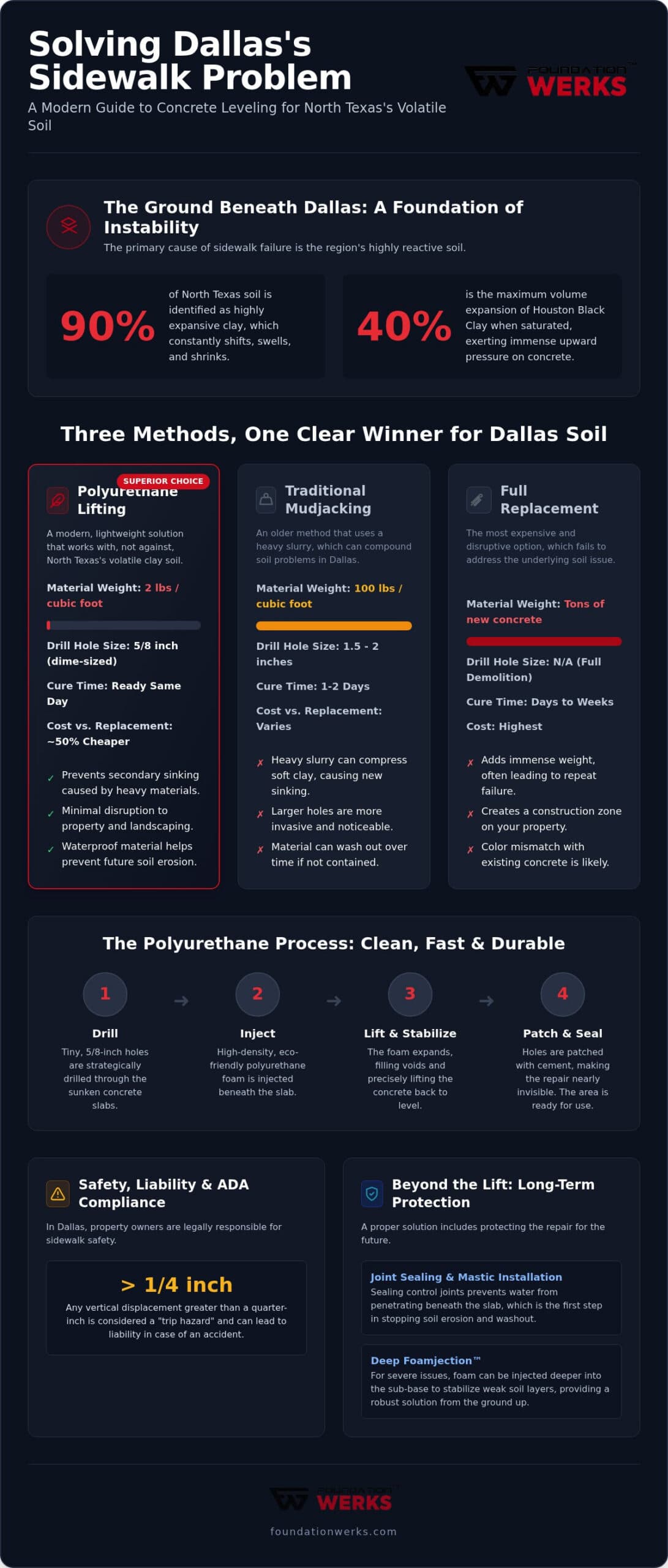
Did you know that over 90% of the soil in North Texas is identified as highly expansive clay? This material, known as Houston Black Clay, can expand by as much as 40% when saturated, which is the primary reason your walkway looks like a roller coaster. If you’re worried about a neighbor tripping or a potential lawsuit, you aren’t alone. Dealing with an uneven sidewalk repair Dallas project often feels like a choice between an eyesore and a construction zone, but it doesn’t have to be that way.
You deserve a safe, level property without the stress of a week-long demolition. We understand that your time is valuable and your landscape is an investment you want to protect. This guide will show you how to eliminate those dangerous vertical displacements using modern, eco-friendly polyurethane foam. You’ll discover how this quietly innovative process uses tiny 5/8-inch holes to lift your concrete back into ADA compliance. We will walk you through why foam is the superior choice for our volatile soil, how it saves you significant money compared to replacement, and why you can get back to your normal routine the very same day the work is finished.
Key Takeaways
- Understand why uneven sidewalk repair Dallas projects require lightweight solutions to combat the region’s heavy, expansive clay soil.
- Learn why polyurethane foam, weighing only 2 lbs per cubic foot, prevents the secondary sinking often caused by traditional 100-lb mudjacking slurries.
- Discover how to bring your property back into ADA compliance by identifying and addressing vertical displacements greater than a quarter-inch.
- Identify the specific maintenance steps, like joint sealing and mastic installation, needed to manage moisture and protect your repair over time.
- Explore how Deep Foamjection™ provides a robust solution for areas requiring deep soil stabilization beyond the surface level.
Why Dallas Sidewalks Sink: The Role of North Texas Clay
Most homeowners in the DFW area don’t realize they are living on top of some of the most volatile soil in the country. Over 90% of North Texas soil is identified as highly expansive clay. Specifically, Houston Black Clay can expand in volume by as much as 40% when it’s fully saturated. This constant movement is the primary culprit behind the need for uneven sidewalk repair Dallas. Our local earth acts like a giant sponge, swelling during rainy seasons and shrinking during our intense summer droughts.
The weather in Dallas accelerates this cycle. During long dry spells, the clay pulls away from the concrete, leaving it unsupported. When the heavy rains finally arrive, the soil expands rapidly and pushes against the slabs from below. This cycle creates a “pump” effect that leaves sidewalks cracked, tilted, and misaligned. It’s a natural process, but it’s one that concrete isn’t flexible enough to handle on its own.
To better understand how these soil shifts impact your concrete, watch this helpful video:
Simply pouring new concrete over this unstable base is a recipe for repeat failure. The new slab adds immense weight to a sub-base that is already struggling to stay level. When choosing between Polyurethane Lifting vs. Traditional Mudjacking, understanding the weight of the material is vital. Adding 100 pounds of heavy mudjacking slurry or several tons of new concrete often causes the soil to compress even further. This is why many traditional repairs in Dallas sink again within just a few years.
Soil Erosion and Void Formation
Poor drainage often washes away the supporting sub-base under your walkway. This creates “voids,” or empty pockets of air, beneath the slab. In North Texas, we see a mix of “settling,” where the slab sinks into a void, and “heaving,” where the clay pushes the slab upward. Early warning signs include small hairline cracks or standing water on your path after a light rain. If you notice a gap between the soil and the concrete edge, a void has likely already formed and is waiting for a heavy load to cause a collapse.
The Cost of Inaction: Liability in Dallas
According to Dallas City Ordinance Chapter 43, the legal responsibility for repairing hazardous sidewalks falls on the owner of the abutting property. A “trip hazard” is generally defined as any vertical displacement of 1/4 inch or more. For business owners, uneven warehouse floor repair in Dallas is equally critical to prevent workplace injuries and maintain OSHA compliance. Ignoring these shifts doesn’t just lower your property value. It creates a significant financial risk from potential trip and fall accidents on both residential and commercial paths.
Polyurethane Lifting vs. Traditional Mudjacking and Replacement
When you’re faced with a sinking walkway, the method you choose matters just as much as the result. Traditional mudjacking has been the standard for decades, but it comes with a heavy price, literally. Mudjacking uses a thick slurry of sand, cement, and water that weighs roughly 100 pounds per cubic foot. In the soft, expansive clay common across North Texas, adding that much weight to an already unstable sub-base often backfires. The heavy slurry can cause the soil to compress even further, leading to more sinking shortly after the repair is finished.
Modern polyurethane foam offers a much smarter alternative. This material weighs only 2 pounds per cubic foot, providing the lift you need without the burden of excessive mass. It’s a lightweight solution that treats the underlying soil with care. For homeowners considering an uneven sidewalk repair Dallas project, this method is typically 50% cheaper than a full concrete replacement. It’s an efficient way to restore safety while staying mindful of your budget, especially since residential projects usually require a minimum investment of $1,800 to ensure a high-quality, professional result.
Why Replacement is Rarely the Best First Option
Tearing out and replacing concrete is a massive undertaking that most properties don’t actually need. The environmental cost is high, as old slabs are hauled off to DFW landfills in heavy, fuel-consuming trucks. New concrete also requires a 28-day curing period to reach its full strength, which creates a long-term disruption to your home life. Polyurethane lifting, however, allows you to use your sidewalk in as little as 15 minutes. By keeping your original slabs, you also avoid the patchwork look of bright white new concrete clashing with your existing, weathered driveway or porch.
The Science of High-Density Polyurethane
The magic of this process lies in how the foam behaves once it’s injected through tiny, 5/8-inch drill holes. As the liquid enters the space beneath the concrete, it undergoes a chemical reaction that causes it to expand. This expansion fills every microscopic void and crevice, creating a solid, moisture-resistant base that won’t wash away during a heavy Texas downpour. Our patented foam is even made from recycled materials, making it a win for both your property and the environment. For deeper stability issues, we utilize Deep Foamjection™ to reach and strengthen the soil layers far below the surface.
If you aren’t sure which method is right for your property, you can explore our concrete raising options to see how we restore safety with minimal footprint.
The Foundation Werks Process: Clean, Fast, and Durable
Our approach to uneven sidewalk repair Dallas is built on technical precision and a deep respect for your property. We don’t believe in guesswork. Every project follows a methodical four-step process designed to deliver high-quality results with a minimal footprint. First, our team performs a precision assessment. We use specialized tools to map out the voids beneath your concrete and determine the exact points of failure. This ensures we target the root cause of the sinking rather than just the visible symptoms.
Once the assessment is complete, we move to the drilling phase. Unlike older methods that require large, unsightly holes, we use 5/8-inch drill holes. These are roughly the size of a penny and are placed strategically to maximize the lift. After the holes are ready, we inject our eco-conscious polyurethane foam. This liquid expands into a dense structural solid in seconds. As it grows, it provides a controlled, powerful lift that brings the slab back to its original height. Finally, we clean the area and seal the injection ports, leaving your sidewalk level and stabilized.
Minimal Disruption for Dallas Homeowners
We know that home repairs can be stressful. We’ve designed our service to be as neighborly as possible. You won’t see heavy equipment tearing up your lawn or blocking your driveway for days. Our specialized trucks stay parked on the street, and we run small hoses directly to the repair site. This setup keeps your landscaping intact and prevents heavy machinery from causing further soil compaction. For residential projects, we focus on high-impact areas that meet our $1,800 project minimum, ensuring we can provide the specialized equipment and expert team your home deserves. Because our foam cures almost instantly, we can promise that you’ll be able to walk on your sidewalk immediately after we finish. There is no dust, no splatter, and no waiting for concrete to dry.
Commercial-Grade Precision for Large Facilities
For facility managers, every hour of downtime is a loss. We specialize in performing warehouse floor joint repair in Dallas without requiring you to shut down operations. Our team uses laser levels to ensure every panel transition meets strict ADA compliance, which is vital for preventing workplace injuries. We also recommend professional concrete crack repair commercial services to be performed alongside the lifting process. This comprehensive approach helps maintain the structural integrity of your facility floors under heavy forklift traffic and constant use.
Compliance and Safety: Meeting ADA Standards in Dallas
Dallas property owners must adhere to the Americans with Disabilities Act (ADA) to ensure public safety on all walkways. A trip hazard is defined as any vertical rise of 1/4 inch or more between concrete panels. For ramps and specialized walkways, the ADA requires a maximum slope of 1:12. This means for every inch of vertical rise, the path needs twelve inches of horizontal length. When your walkway shifts due to our local clay soil, these strict measurements are often the first things to fail. Achieving this level of precision during an uneven sidewalk repair Dallas project requires more than just a quick patch. It requires a method that can lift the slab to the exact millimeter to restore a safe, compliant surface.
Many people consider grinding down the high edge of a slab as a shortcut. While grinding removes the immediate lip, it actually damages the concrete in the long run. It shaves away the finished surface, exposes the aggregate underneath, and thins the slab. This makes the concrete more likely to crack or crumble under weight. Polyurethane lifting does the opposite. By injecting foam beneath the concrete, we strengthen the sub-base and restore the slab to its original height. You keep the full thickness and structural integrity of your concrete while meeting safety codes.
Avoiding Litigation with Proactive Maintenance
Commercial facilities in Dallas face significant liability risks if their walkways are neglected. Proactive maintenance is a key part of modern risk management. Facility managers often prioritize foam lifting for high-traffic entryways because it’s fast and provides a documented safety resolution. Keeping detailed records of these repairs can be vital for insurance purposes and protecting your business against potential litigation. It shows a commitment to property safety that city inspectors and insurance adjusters look for when evaluating a site.
The ‘Invisible’ Repair
We understand that aesthetics matter, especially in historic Dallas neighborhoods like Munger Place or Kessler Park. You don’t want your repair to look like a construction site. Our team uses a careful color-matching process for the 5/8-inch drill hole patches. We blend the material to match your existing, weathered concrete so the repair is nearly invisible once we finish. This maintains the aesthetic continuity of your path while ensuring a smooth, safe transition between slabs to prevent future tripping incidents.
Beyond the Lift: Preventing Future Sidewalk Sinking
Lifting your concrete is a vital step, but it’s only half the battle. If you don’t address why the soil moved in the first place, you’re essentially waiting for the next shift to occur. In North Texas, the primary enemy is moisture. Managing how water interacts with your soil is what separates a temporary patch from a high-quality, long-term resolution. Our goal is to provide a comprehensive update that keeps your paths safe and level by stabilizing the environment around the concrete.
French Drain Installation for Dallas Properties
Standing water near your walkway is a major red flag. When rain sits against the edge of a slab, it saturates the clay and causes the expansion we discussed earlier. We often recommend French drain installation alongside our lifting services to prevent this. These drains act as a relief valve for your property. They capture storm runoff and redirect it safely away from your concrete and foundation. This is especially critical during the intense North Texas rainy seasons when our local drainage systems can become overwhelmed. By integrating drainage, we ensure the soil beneath your sidewalk stays as consistent as possible.
Mastic and Joint Sealing
Open joints and cracks are like open doors for water. Once moisture gets under the slab, it washes away the supporting soil, creating the very voids we just filled with foam. Joint seal or mastic installation is the final layer of protection for your uneven sidewalk repair Dallas project. We use professional-grade, flexible sealants that can handle the 100-degree temperature swings common in DFW. These materials expand and contract with the concrete without pulling away. This keeps the sub-base dry and prevents the erosion that leads to sinking. A durable repair isn’t truly finished until every seam is watertight.
Creating a Durable Solution
A long-term solution requires looking at your property as a whole. For residential clients, combining polyurethane lifting with these preventative measures is the most effective way to meet our $1,800 project minimum. It ensures you aren’t just fixing a symptom, but updating your property’s entire defense against the elements. Our checklist for a successful project includes:
- Precision lifting with 5/8-inch injection points.
- Full void filling to provide a stable, lightweight base.
- Redirecting runoff with French drains or gutter updates.
- Sealing all joints with high-grade mastic to lock out moisture.
Taking these extra steps ensures that your property remains safe and compliant for years to come. It’s a proactive approach that saves money on future repairs and maintains the value of your home or facility.
Take Control of Your Property’s Safety
Dealing with shifting soil is a reality for North Texas property owners, but it doesn’t have to be a constant source of stress. By choosing high-density polyurethane lifting, you’re opting for a method that works with the land rather than against it. This quietly innovative process uses eco-conscious foam made from recycled materials to provide a powerful lift without adding the heavy mass that causes traditional repairs to sink. It’s a smart, responsible way to update your property while respecting the local environment.
Your path back to a level walkway is faster and cleaner than you might think. With nearly invisible 5/8-inch drill holes and same-day usability, an uneven sidewalk repair Dallas project can be completed with zero disruption to your daily routine. Whether you’re managing a busy commercial facility or a residential property, addressing these hazards now protects your investment and ensures everyone who walks your path stays safe. We’re here to help you navigate these repairs with transparency and expert care.
Let’s get your concrete back on solid ground and restore the peace of mind you deserve.
Frequently Asked Questions
How much does uneven sidewalk repair cost in Dallas compared to replacement?
Polyurethane lifting typically costs about half of a full concrete replacement. While replacement involves demolition, hauling, and pouring new material, lifting uses your existing slabs to save on labor and material costs. It’s a highly efficient way to handle an uneven sidewalk repair Dallas without the heavy financial burden of starting from scratch. This method allows you to restore safety while staying mindful of your budget.
Can you lift a sidewalk if it is severely cracked into many pieces?
We can lift slabs with minor cracking, but concrete that is shattered into many small pieces usually requires replacement. Lifting relies on the structural integrity of the slab to distribute the pressure of the expanding foam. If the pieces are too small to stay together during the process, we’ll recommend our concrete replacement services instead. We always assess the slab’s condition before beginning any work.
How long do I have to wait to walk on the sidewalk after polyurethane lifting?
You can walk on your sidewalk immediately after we finish the injection process. The polyurethane foam reaches 90% of its full strength within about 15 minutes. This is a significant advantage over pouring new concrete, which often requires several days of curing time before it can handle foot traffic. Our process is designed to minimize disruption so you can get back to your normal routine right away.
Will the polyurethane foam wash away during a heavy Dallas rainstorm?
No, the cured polyurethane foam is completely resistant to water and won’t wash away during a heavy Dallas rainstorm. Unlike mudjacking slurry, which is made of soil and cement, our high-density foam is a closed-cell material. It remains stable even in saturated soil conditions. This prevents the internal erosion that often causes traditional soil-based repairs to fail when the North Texas weather turns wet.
Is polyurethane concrete raising eco-friendly?
Yes, our patented polyurethane foam is an eco-conscious choice. It’s manufactured using recycled materials and doesn’t leach harmful chemicals into the surrounding soil or groundwater. By choosing to lift rather than replace, you also keep old concrete slabs out of local landfills. This reduces the carbon footprint of your repair while providing a durable solution that respects the North Texas environment.
What size are the holes you drill into the concrete?
We drill precision 5/8-inch holes into the concrete to inject the foam. These holes are roughly the size of a penny. They’re much smaller than the two-inch holes required for traditional mudjacking. Once the lift is complete, we patch the holes with a color-matched grout. This ensures the repair is nearly invisible and maintains the aesthetic appeal of your residential or commercial property.
Does Foundation Werks offer residential sidewalk repair for small jobs?
Foundation Werks specializes in residential and commercial repairs with a minimum project cost of $1,800. This threshold allows us to deploy our specialized equipment and expert crews to ensure every project meets our high standards. If you have a single small trip hazard, we recommend grouping it with other concrete needs, like driveway or patio leveling, to meet this residential project minimum.
How do I know if my sidewalk needs a French drain instead of just lifting?
Lifting addresses the sunken slab, but a French drain is necessary if you have recurring ponding water or poor drainage near the concrete. If water consistently sits against your walkway after a storm, it’ll continue to destabilize the soil. We often integrate drainage solutions with our uneven sidewalk repair Dallas services. This holistic approach provides a more durable, long-term resolution by managing the moisture levels.