

You step out to grab the mail in McKinney or Frisco, only to catch your toe on a concrete lip that wasn’t there last season. It’s a frustrating sight that brings immediate concerns about trip-and-fall liability and the potential cost of a full replacement. If you’ve found yourself staring at an uneven walkway and asking, "Why is my sidewalk sinking." you aren’t alone. Most North Texas homeowners face this exact issue as our local environment takes its toll on heavy concrete slabs.
We understand the anxiety that comes with structural shifts, but a sinking sidewalk doesn’t have to mean a massive construction project. You’ll discover the specific environmental and structural reasons behind this movement and how modern polyurethane technology provides a durable resolution without the mess of demolition. We’ll explain how DFW’s expansive clay soils create these gaps and how a lightweight, eco-friendly foam can stabilize your concrete and restore your home’s safety in just one afternoon.
Key Takeaways
- Understand how the unique “shrink-swell” cycle of DFW clay soil answers the question, “Why is my sidewalk sinking.“
- Compare the benefits of lightweight polyurethane foam against traditional mudjacking to prevent secondary sinking caused by heavy fill materials.
- Discover how eco-friendly, recycled materials and nearly invisible 5/8-inch injection holes provide a clean alternative to total concrete demolition.
- Learn to identify dangerous trip hazards early to restore walkway safety and ensure your sidewalk is ready for use the same day.
- Explore long-term stabilization methods that protect your property value for approximately half the cost of full concrete replacement.
Understanding Why Sidewalks Sink in North Texas
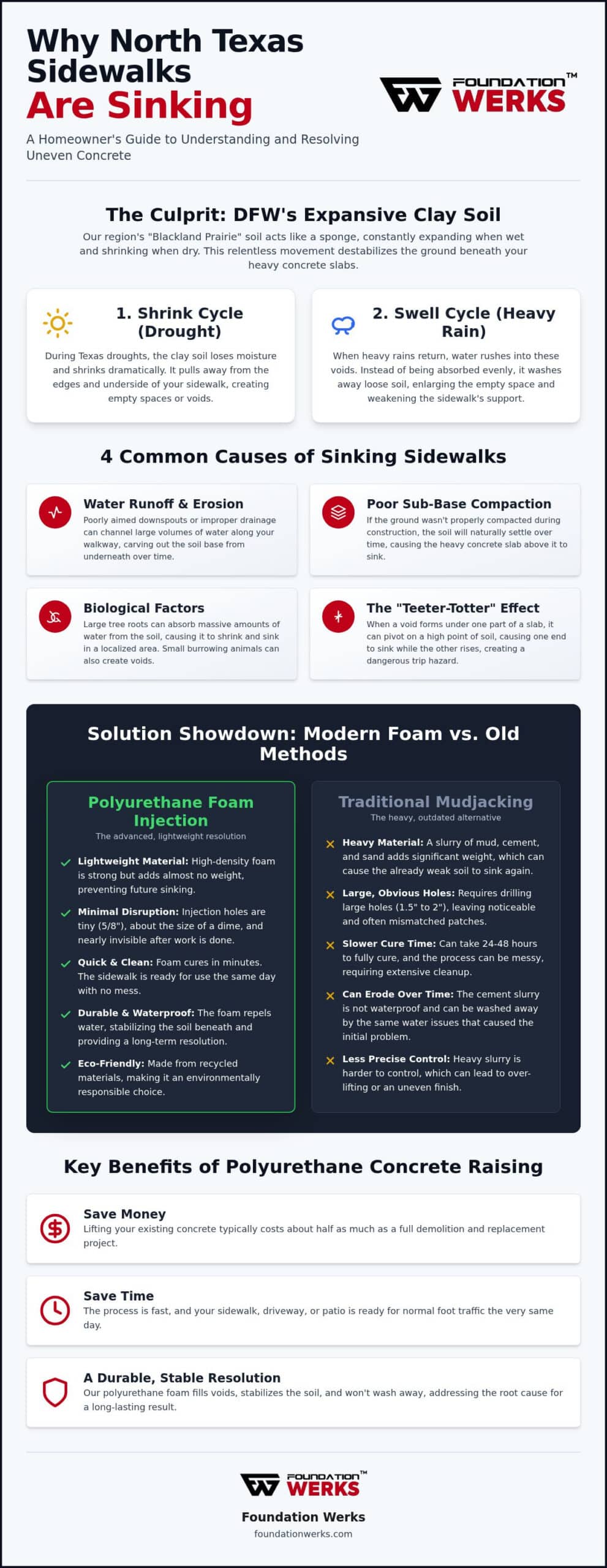
North Texas is famous for its "Blackland Prairie" soil. This isn’t just ordinary dirt; it’s a dynamic foundation that reacts to every weather event. When you’re asking, "Why is my sidewalk sinking." the answer usually starts with the geology of the DFW metroplex. Our region is dominated by expansive clay soils that behave more like a sponge than a solid base.
These clays grow in volume when they absorb water and shrink significantly during our intense summer droughts. This movement is a primary reason why sidewalks in McKinney and Dallas show signs of distress so quickly. The constant shifting creates a moving target for heavy concrete slabs that were designed to stay stationary.
To help visualize how these environmental factors impact your home’s exterior, watch this brief explanation:
The Impact of Soil Moisture Cycles
The Texas weather cycle is brutal on concrete sub-bases. During a drought, the soil dries out and pulls away from the concrete, leaving the edges of the sidewalk unsupported. When we experience sudden, heavy downpours, the water rushes into those gaps. Instead of soaking in evenly, it washes away the dry, loose material. This leaves the sidewalk "bridging" over empty space. Without a solid foundation, the heavy concrete eventually snaps or tilts into the hole. North Dallas properties are particularly susceptible because they often sit on deep layers of this reactive clay.
Poor Sub-Base Compaction
New construction isn’t immune to these problems. In fact, many DFW homeowners see sinking within the first two years of moving in. This often points to poor sub-base preparation. If the ground wasn’t mechanically compacted or if organic debris was buried under the path, the soil will naturally settle as that material breaks down. You might notice these common signs of soil-related sinking:
- Gaps appearing between the sidewalk edge and the lawn.
- Water pooling in the center of a walkway after a light rain.
- Cracks that seem to grow wider during the hot months of August and September.
Adding a "cap" of new concrete on top of a sunken area is a common mistake. The extra weight of the new layer just pushes the slab further into the unstable soil. It addresses the symptom but ignores the root cause of the movement.
The Root Causes: Soil Erosion and Voids Beneath the Slab
While the soil type itself is a major factor, the physical movement of that soil creates the most immediate problems. When you ask, "Why is my sidewalk sinking." you’re often looking at the result of empty space. Concrete is incredibly strong under compression, but it’s brittle when it doesn’t have a solid base. If the dirt underneath moves or disappears, the weight of the slab eventually forces it to collapse into the opening.
This often manifests as the "teeter-totter" effect. You might notice one end of a concrete section rising while the other end sinks. This happens because the slab is pivoting on a high point of soil while the rest of the section hangs over a hollow area. As people walk on the unsupported end, the pressure forces that side down and kicks the opposite side up. Without addressing the hollow space, the concrete will eventually crack under the stress.
Water Runoff and Erosion
Water is the most common cause of sub-surface erosion in North Texas. If your gutters aren’t functioning correctly, downspouts often discharge a high volume of water directly at the edge of your walkway. This concentrated flow carves out paths beneath the concrete. Over time, this creates "piping," which are small underground channels that grow larger with every rainstorm. A void is the empty space created when sub-soil migrates away. These hidden gaps are dangerous because the sidewalk looks fine on the surface until it suddenly drops. Proper drainage is essential, but if the damage is already done, professional void filling and stabilization is necessary to restore the base.
Biological Factors
Nature also plays a role in destabilizing your walkways. Large trees near a sidewalk are beautiful, but their root systems are aggressive moisture seekers. During a DFW summer, these roots extract hundreds of gallons of water from the clay soil. This causes the soil to shrink much faster than it would on its own, leading to localized sinking. Conversely, roots can grow directly under the slab and lift it, creating a dangerous trip hazard.
Burrowing animals like armadillos or rodents can also accelerate the problem. They find the protected area under a concrete slab to be an ideal home. Their tunneling removes the very soil that supports the weight of the concrete. Signs that your landscaping or local wildlife are contributing to the issue include holes near the concrete edge or cracks that align with the path of nearby tree roots. Identifying these factors early helps you choose a resolution that targets the cause rather than just the symptom.
Comparing Solutions: Why Polyurethane Foam Outperforms Mudjacking
If you’ve spent weeks asking, "Why is my sidewalk sinking." you’re likely ready for a solution that doesn’t involve a sledgehammer. Many homeowners default to mudjacking because it’s the traditional method they’ve heard of for years. However, mudjacking often fails in North Texas because of a simple math problem: weight. Traditional mudjacking slurry weighs approximately 100 pounds per cubic foot. In the unstable clay of the DFW metroplex, adding that much weight to already failing soil often triggers secondary sinking. You’re essentially trying to fix a sinking ship by adding more lead to the hull.
Our polyurethane foam offers a smarter alternative. It weighs only 2 pounds per cubic foot, providing the necessary lift without overtaxing the sub-base. This lightweight profile is a primary reason why modern Polyurethane Concrete Raising has become the preferred choice for residential and commercial properties alike. We also prioritize the environment by using a patented, eco-friendly foam made from recycled materials. This process is significantly cleaner than mudjacking, requiring only nearly invisible 5/8-inch drill holes rather than the large 2-inch holes needed for heavy slurry injections.
Speed and Usability
Time is a major factor when you’re dealing with high-traffic areas or commercial storefronts. Mudjacking requires a lengthy curing process that can keep a sidewalk out of commission for days. Polyurethane foam is different. It reaches its full weight-bearing capacity within minutes of injection. This speed is critical for maintaining safety and accessibility. Concrete can be walked on immediately after the injection process. You don’t have to worry about cordoning off your property for a week or managing the logistics of a multi-day construction site. We can often stabilize a standard residential sidewalk in just a few hours.
Durability and Density
The durability of your repair depends on how well the material resists the elements. Mudjacking material is essentially a mixture of dirt, water, and cement, which makes it susceptible to the same erosion that caused the initial sinking. Polyurethane foam is hydrophobic, meaning it repels water and will not wash out during heavy Texas rainstorms. It maintains its density over time and provides a long-term stabilization solution for our notoriously reactive soils. By focusing on professional Void Filling and Stabilization, we reinforce the ground beneath the slab. This creates a dense, waterproof barrier that prevents future water accumulation and protects the structural integrity of your walkway.
When to Act: Identifying Trip Hazards and Preventing Damage
Many homeowners notice a slight tilt in their walkway and hope it stops on its own. Unfortunately, in the DFW metroplex, soil issues rarely resolve themselves without intervention. If you’re currently asking, "Why is my sidewalk sinking." you’re likely at a crossroads. You can act now while the slab is still intact, or you can wait until the stress causes a structural snap that requires a full, expensive replacement. Early intervention is the key to maintaining property value and avoiding a massive construction project.
Safety and Liability Standards
The Americans with Disabilities Act (ADA) sets a strict 1/4-inch threshold for vertical changes in walking surfaces. This might seem like a small number, but it’s the industry standard for a trip hazard. You can test your sidewalk by placing a standard quarter against the raised edge. If the concrete is higher than the coin, it’s time to take action. For HOAs and commercial property owners, this measurement is a critical metric for liability. A small trip hazard can quickly turn into a major legal or financial headache if left unaddressed.
Falling behind on these repairs puts you at risk for injury claims and municipal fines. In cities like Dallas and McKinney, the responsibility for sidewalk safety falls directly on the property owner. It’s much easier to explain a proactive maintenance plan than it is to defend an uneven walkway after an accident occurs. For those managing larger properties, we’ve developed a Commercial Concrete Crack Repair guide to help you navigate these facility standards and protect your investment.
Preventative Maintenance Strategies
Protecting your concrete means controlling the water around it. Professional gutter installation is a simple but effective way to prevent the erosion that creates voids. By directing roof water away from the sidewalk’s edge, you stop the soil from washing out. In areas where the lawn naturally slopes toward the concrete, a French drain installation is often necessary to catch and redirect groundwater before it can saturate the sub-base. These drainage solutions work together to keep the soil beneath your sidewalk as stable as possible.
After we lift a slab, we focus on keeping it stable. Joint seal or mastic installation is a vital final step in the process. This flexible material fills the gaps between concrete sections, acting as a waterproof barrier. It keeps rain and debris from reaching the soil underneath, which helps prevent the return of the "shrink-swell" cycle that caused the sinking in the first place. By sealing the joints, you’re adding an extra layer of protection against the volatile North Texas environment.
Professional Concrete Raising with Foundation Werks
At Foundation Werks, we’ve refined our approach to handle the specific challenges of North Texas. When you ask, "Why is my sidewalk sinking." you aren’t just looking for a temporary patch. You need a solution that addresses the unstable soil dynamics we’ve discussed in previous sections. Our specialized approach to Polyurethane Concrete Raising in McKinney and Dallas focuses on precision and long-term stability. We use a patented Deep Foamjection™ process that doesn’t just lift the concrete but actively stabilizes the loose soil beneath it. This innovation provides a durable resolution for about half the cost of full concrete replacement. We take pride in delivering TOP QUALITY service that respects your property and your schedule.
The Foundation Werks Process
Our process is designed to be as non-invasive as possible. We start by drilling small, 5/8-inch holes in the affected slabs. These holes are roughly the size of a penny, making them nearly invisible once the job is finished. We then inject our eco-friendly, recycled polyurethane foam. As the foam expands, it fills voids and provides a controlled, precision lift to bring the sidewalk back to its original level. This methodical approach ensures your home looks better than we found it, with no messy cleanup required.
One of the biggest benefits is that we don’t need heavy equipment. Your landscaping remains untouched because we don’t have to drive large trucks or excavators across your lawn. Everything we need is housed in a single truck that stays on the street or driveway. Since the foam reaches full weight-bearing capacity in minutes, you can walk on your restored sidewalk before our team even leaves your property. It’s a clean, fast, and efficient way to handle structural settling.
Ready to Restore Your Sidewalk?
Don’t wait for your concrete to crack or crumble before seeking help. A professional assessment can identify voids before they lead to a total collapse. We’re proud to serve neighbors across the metroplex, including Frisco, Prosper, Allen, and the wider DFW area. Our team treats every project with a service heart, ensuring you understand the process before any work begins. We aren’t here to pressure you into a sale; we’re here to empower you with the knowledge needed to protect your home and its curb appeal.
If you’re tired of navigating uneven walkways and unsightly gaps, it’s time to restore your property’s safety. Our team is ready to provide a clear, honest evaluation of your concrete’s condition. You can regain your peace of mind and your walkway’s aesthetics in just one afternoon. Reach out to us today to schedule your concrete restoration and experience the difference of professional stabilization.
Restore Your Property’s Safety and Curb Appeal
Dealing with an uneven walkway is more than just an eyesore; it’s a liability that grows with every North Texas rainstorm. Now that you understand why is my sidewalk sinking., you can see that the real solution lies in addressing the soil voids rather than just replacing the surface concrete. By choosing a method that respects the unique DFW clay cycles, you protect your property from the ongoing cycle of settling and shifting.
Our polyurethane injection process offers over 50% savings compared to the high cost of full concrete replacement. We take pride in using a patented, eco-friendly foam made from recycled materials that delivers immediate results. You won’t have to worry about long wait times or messy construction sites. You’ll enjoy same-day usability for all raised surfaces, allowing you to get back to your routine without delay. This approach keeps your landscaping beautiful and your walkways level while providing a durable resolution.
Get a Free Estimate for Your Sidewalk Repair
You deserve a safe, beautiful home that reflects the pride you take in your neighborhood. We’re here to help you navigate these repairs with transparency and local expertise. Let’s work together to stabilize your concrete and restore your peace of mind today.
Frequently Asked Questions
Is a sinking sidewalk a sign of foundation trouble?
A sinking sidewalk is often an isolated issue, but it stems from the same expansive clay soil that causes foundation movement. If you’re asking, "Why is my sidewalk sinking." it’s usually because the soil beneath the slab has shifted or eroded. While a sunken walkway doesn’t always mean your home’s main foundation is failing, it does indicate that the ground around your property is active and requires professional stabilization to prevent further damage.
How much does it cost to fix a sinking sidewalk compared to replacement?
Polyurethane concrete raising typically costs about half of a full concrete replacement. This makes it a highly cost-effective solution for homeowners in Frisco and Allen who want to restore their property’s aesthetics without the high price of demolition. By choosing to lift and level your existing slabs, you avoid the labor-intensive process of removing old concrete and pouring new material, saving you both significant time and money.
Can I walk on my sidewalk immediately after polyurethane lifting?
You can walk, drive, or play on your sidewalk the same day the injection is finished. Unlike new concrete pours that require days to cure, our polyurethane foam reaches its full weight-bearing capacity within minutes. This immediate usability makes it the preferred choice for high-traffic commercial walkways and busy residential driveways. Our team ensures the work area is clean and ready for use before we leave your property.
Will the foam used to lift my sidewalk wash away in heavy rain?
The polyurethane foam we use is hydrophobic, meaning it repels water and will not wash away during heavy North Texas rainstorms. Unlike traditional mudjacking slurry, which is made of dirt and cement, our material maintains its density regardless of soil moisture levels. This resistance to erosion is vital for maintaining the structural integrity of your sidewalk in the volatile DFW climate where sudden downpours and high humidity are common.
How small are the holes drilled for the polyurethane injection?
We drill nearly invisible holes that are only 5/8 of an inch in diameter. This is roughly the size of a penny. Because the foam expands so efficiently, we require fewer injection points than traditional mudjacking. Once the lifting process is complete, we patch these small holes with a specialized cement mixture that blends into your existing concrete, resulting in a clean finish that preserves your home’s curb appeal.
What happens if I ignore a sinking sidewalk trip hazard?
Ignoring a sinking sidewalk increases your liability for trip-and-fall accidents and can lead to more severe structural damage. A small sink often creates a "teeter-totter" effect that eventually causes the concrete to snap. Addressing the question of "Why is my sidewalk sinking." early prevents a total collapse and the much higher cost of a full replacement. Maintaining even walkways is especially important for HOAs and business owners meeting ADA standards.
Does polyurethane concrete raising work in the heavy North Texas clay?
Polyurethane raising is exceptionally effective in North Texas because of its lightweight profile. The foam weighs only 2 pounds per cubic foot, compared to the 100 pounds per cubic foot of traditional mudjacking material. This prevents secondary sinking in our heavy, expansive clay soils. By using a lightweight material, we stabilize the slab without overtaxing the already unstable ground, providing a durable resolution for properties in McKinney and Dallas.
Can severely cracked concrete still be raised and leveled?
Most solid concrete slabs can be successfully raised and leveled even if they have some cracking. However, if a sidewalk is shattered into many small, disconnected pieces, it may lack the structural integrity needed for a successful lift. During our professional assessment, we evaluate the condition of your concrete to determine if stabilization is a viable option or if a partial replacement is a better path for your specific situation.