

Did you know that the expansive clay soil beneath your Dallas home can swell by up to 30% after a typical North Texas rainstorm? It’s a staggering figure that explains why so many local driveways and patios eventually begin to crack and sink. You’ve likely stood on your porch after a heavy downpour, watching water pool near your slab and worrying about the long-term damage. The fear of facing a massive bill for foundation piering is enough to keep any homeowner awake at night.
The good news is that you don’t have to settle for a swampy yard or crumbling concrete. By investing in professional foundation drainage solutions dallas residents can effectively manage the moisture levels that dictate how their soil behaves. In this article, you’ll discover how a combination of smart water management and modern soil stabilization protects your property from the volatile North Texas environment. We’ll show you how to maintain a dry, stable foundation and prevent future settling using cost-effective methods that avoid the headache and expense of a full concrete replacement.
Key Takeaways
- Understand the “Dallas Clay Challenge” and how seasonal moisture cycles create destructive pressure on your concrete slabs.
- Identify why high-quality French drain systems are the first line of defense against standing water and soil erosion.
- Learn how eco-friendly polyurethane foam provides a long-term resolution for sinking concrete by filling soil voids and stabilizing the sub-grade.
- Discover why integrated foundation drainage solutions dallas experts recommend are more cost-effective than total concrete replacement.
- Gain insights into commercial-grade strategies that protect warehouse floors and heavy-traffic areas from saturated soil failure.
Understanding the Dallas Clay Challenge: Why Proper Drainage is Non-Negotiable
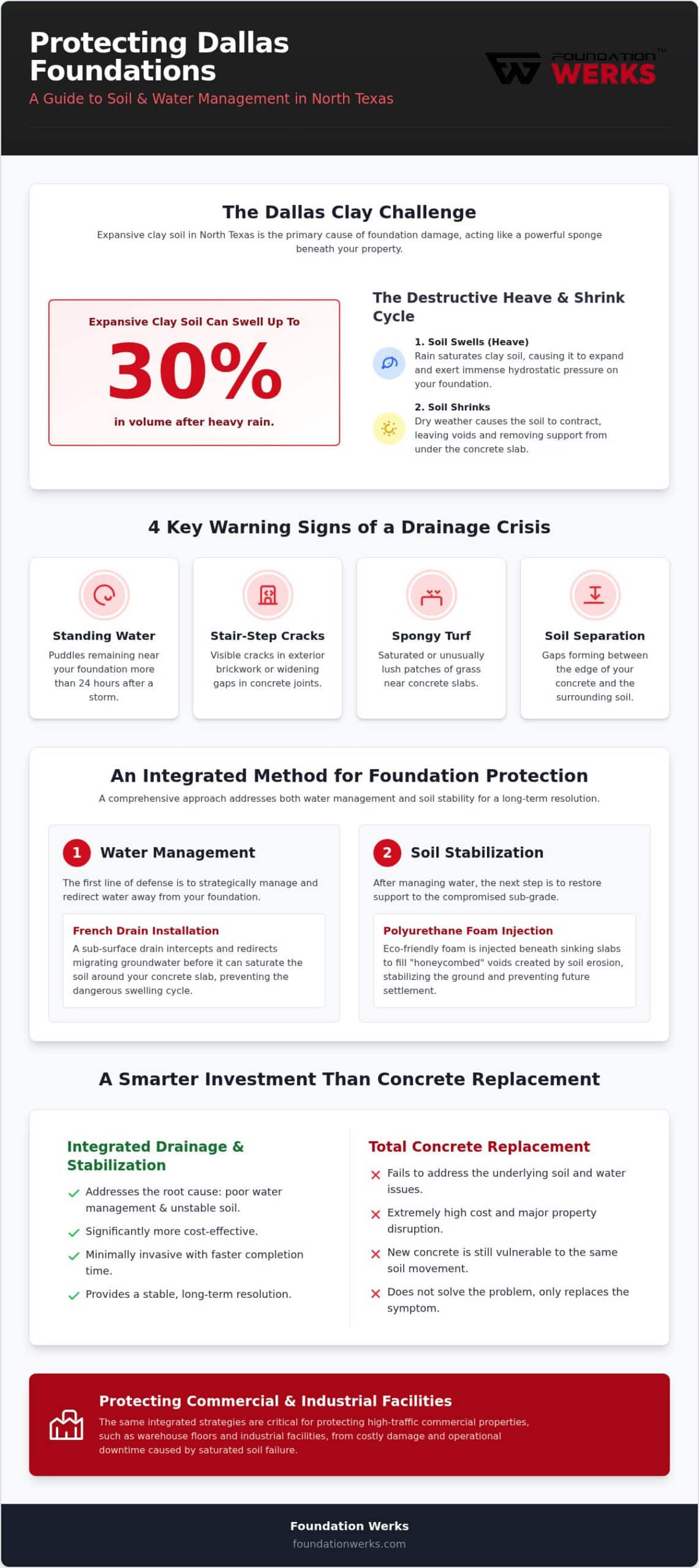
Living in North Texas means dealing with soil that acts like a heavy-duty sponge. In cities like Dallas, Frisco, and McKinney, the dominant soil type is expansive clay. This material is unique because it doesn’t just get wet; it physically changes size. Research shows that some local clays can change in volume by up to 30% as they absorb and lose moisture. When it rains, the clay swells and exerts massive hydrostatic pressure against your concrete slabs. When the Texas sun returns, the soil shrinks, leaving your foundation unsupported. This constant heave and shrink cycle is the primary cause of structural instability. Without effective foundation drainage solutions dallas homeowners often find their property’s longevity at risk.
Managing this cycle requires more than just a quick fix. It’s about maintaining a consistent moisture level in the soil year-round. When water is allowed to pool or saturate the ground unevenly, the resulting pressure can shift even the heaviest concrete. This is why drainage isn’t just a landscaping choice; it’s a structural requirement for any property built on North Texas clay.
The Mechanics of Soil Erosion and Concrete Settling
Moving water away from your home is the first step toward a stable sub-grade. If runoff isn’t controlled, it carves out "honeycombed" voids beneath your driveway, sidewalk, or porch. Poor gutter discharge is a common culprit. When downspouts dump water directly at the corner of a slab, it saturates the soil locally while the rest remains dry. This uneven moisture leads to localized sinking and cracking. Surface-level patches will eventually fail if the underlying soil moisture isn’t managed. When evaluating foundation drainage solutions dallas residents should look for systems that address both surface runoff and sub-surface saturation. A professional French Drain Installation is often the most effective way to intercept this sub-surface water before it can compromise your property’s foundation.
Signs Your North Texas Property Has a Drainage Crisis
Early detection can save you from expensive repairs later. You don’t need to be an engineer to spot the warning signs of a drainage failure. If you notice these symptoms, it’s time to take a closer look at your water management strategy:
- Standing water: Puddles that remain within five feet of your foundation for more than 24 hours after a storm.
- Stair-step cracks: Visible cracks in your exterior brickwork or widening gaps in concrete joints.
- Spongy turf: Saturated or unusually lush patches of grass near your slabs while the rest of the yard is dry.
- Soil separation: Large gaps between the edge of your concrete and the surrounding dirt during dry spells.
These signs indicate that the soil is moving more than it should. Addressing these issues early prevents the "honeycombing" effect that leads to significant slab settlement. Proper water management ensures your soil remains a reliable support system rather than a destructive force.
French Drain Installation: A Strategic Approach to Surface Water Management
According to the American Society of Civil Engineers, expansive soils like the ones found in North Texas cause more financial damage to U.S. structures annually than floods, hurricanes, and earthquakes combined. This data highlights why effective foundation drainage solutions dallas homeowners choose must be built to withstand extreme soil movement. A French drain serves as a sub-surface interceptor. It’s designed to capture migrating water before it reaches your concrete slab, preventing the soil from reaching that dangerous 30% volume expansion. By redirecting this water to a safe discharge point, you maintain a more stable environment for your foundation.
Not all systems are built the same. Many installers rely on flexible, corrugated "black ADS" piping because it’s inexpensive and easy to move. However, these lines are prone to crushing under the weight of heavy Dallas clay and often trap silt in their ridges. We prefer high-quality rigid PVC piping with a smooth interior. This material resists root intrusion and maintains its shape over time. When wrapped in professional-grade filter fabric and surrounded by clean gravel, rigid PVC provides a reliable, long-term resolution for water management. If you are seeing water pool near your home, a professional French drain installation can help protect your property’s value.
The Anatomy of a High-Performance French Drain
A successful system requires specific dimensions to handle North Texas rain events. We typically dig trenches 12 inches wide and deep enough to ensure water flows away from the slab’s "active zone." The choice of aggregate is just as critical. We use clean, crushed gravel rather than smooth river rock or recycled base because the angular edges of crushed stone create more void space for water to travel. We also include clean-out ports at strategic bends. These ports allow you to inspect or flush the system in the future, ensuring it stays clear of debris without needing a total excavation.
A Professional Approach to Drainage Correction
Installing a drainage system is a technical process that requires precision. We follow a methodical series of steps to ensure the water actually moves where it’s supposed to go:
- Step 1: Utility marking and site assessment. We locate all underground lines and identify the most efficient discharge points, such as a curb outlet or a natural low spot in the landscape.
- Step 2: Precision trenching. Gravity is the engine of a French drain. We use lasers to ensure a consistent downward grade of at least one inch for every ten feet of pipe.
- Step 3: Lining and pipe placement. The trench is lined with non-woven geotextile fabric to keep silt out. We place the perforated pipe with the holes facing down, which allows the water table to rise into the pipe and be whisked away.
- Step 4: Gravel backfill and restoration. The trench is filled with clean gravel and topped with soil or sod. This results in a system that works silently underground with minimal impact on your landscaping.
Proper grading is the most important factor in this process. Without a clear slope, water will simply sit in the pipe and saturate the soil you’re trying to protect. Our methodical approach ensures that every gallon of runoff is accounted for and moved safely away from your foundation.
Beyond the Trench: How Poor Drainage Causes Concrete Settling and Voids
Installing a high-quality French drain is a massive win for your property, but it is often only the first half of a durable resolution. While a drain stops new water from collecting, it cannot undo the damage that years of poor drainage have already caused beneath your concrete. Water is a powerful solvent. As it moves through the earth, it carries away fine soil particles in a process called piping. This leaves behind "honeycombed" voids. These air pockets are weak points where the soil can no longer support the weight of the concrete above. Eventually, the slab settles into these gaps, leading to the uneven driveways and cracked porches so common in North Texas.
This is why we view soil stabilization as the necessary partner to drainage correction. If you move the water but leave the voids, your concrete will likely continue to shift. By filling those underground cavities with eco-friendly polyurethane foam, we restore the structural integrity of the sub-grade. For facility managers in industrial settings, addressing these issues early is even more critical. You can learn more about specialized strategies for high-traffic areas in our guide on warehouse floor joint repair Dallas. Combining these methods ensures that the soil stays put even when the weather doesn’t cooperate.
The Role of Hydrostatic Pressure in Slab Failure
Trapped water doesn’t just wash soil away; it also exerts a physical force known as hydrostatic pressure. This is an upward or lateral force that can be strong enough to lift or crack heavy concrete slabs. In areas with heavy traffic, a phenomenon called "pumping" often occurs. When a vehicle drives over a saturated slab, the weight forces water and liquefied soil out through the cracks or joints. Each time this happens, the void beneath the slab grows larger. Professional joint sealing acts as a critical secondary defense by keeping surface water from entering the sub-grade in the first place. When integrated with the right foundation drainage solutions dallas experts provide, these steps stop the cycle of erosion before it compromises your entire structure.
Identifying Voids Before They Lead to Total Collapse
You don’t always need a shovel to know there is a problem underground. One of the simplest ways to check for soil erosion is the "hollow sound" test. Take a heavy tool or even a broom handle and tap it firmly against different areas of your concrete. A well-supported slab will produce a dull, solid thud. A slab sitting over a void will sound like a drum. It’s a clear signal that the earth has moved. Small cracks are often the first visible symptom of these hidden air pockets. Addressing these gaps early with concrete crack repair commercial services prevents a small settling issue from turning into a total structural failure. We believe in empowering property owners with this knowledge so they can act before expensive replacements become the only option.
Commercial and Industrial Drainage Strategies for DFW Facilities
Commercial facilities in the DFW metroplex operate under a different set of rules than residential properties. Large-scale logistics hubs in Dallas and Irving must manage massive volumes of surface runoff from expansive roofs and parking lots. When this water isn’t directed properly, it saturates the sub-grade beneath heavy-duty concrete. Heavy truck traffic then acts as a giant piston, compressing the wet soil and causing it to shift. This is why robust foundation drainage solutions dallas facility managers rely on often include more than just French drains. Catch basins and channel drains are required to capture the immediate surge of water during a North Texas storm, keeping it away from critical loading zones. These systems act as a primary defense, whisking away thousands of gallons before they can soak into the clay.
If the soil beneath a warehouse floor becomes saturated, the load-bearing capacity of the entire slab is compromised. For more detailed information on maintaining these environments, see our uneven warehouse floor repair Dallas guide. Addressing these issues before they lead to structural failure keeps your operations running smoothly and safely.
Managing Runoff for Expansive Parking Lots and Loading Docks
Loading docks are particularly vulnerable to drainage failures. Because they are often the lowest point on a commercial site, they naturally collect water. If the joint seals or mastic are not maintained, water enters the sub-base and causes the slabs to tilt. A tilted loading dock slab isn’t just an eyesore; it’s a safety hazard for forklifts and personnel. We focus on directing water away from these high-traffic concrete joints using integrated channel systems. This prevents the "pumping" effect from hollowing out the ground beneath your most active areas. Properly maintained mastic combined with a clear drainage path ensures that your parking lots remain stable under the weight of constant delivery traffic.
Industrial Stabilization: Protecting the Sub-Base
Warehouse floors require a deeper level of drainage intervention than a standard residential patio. The sheer weight of inventory and equipment means the margin for error is slim. We’ve found that implementing a preventative maintenance schedule for your commercial drainage systems is far more cost-effective than an emergency floor replacement. A typical drainage correction costs significantly less than tearing out and re-pouring thousands of square feet of reinforced concrete. By focusing on sub-base protection through better water management, you extend the life of your facility and avoid the downtime associated with major structural repairs. Regular inspections of catch basins and clear discharge lines are simple steps that prevent large-scale settling.
Comprehensive Foundation Protection: The Foundation Werks Integrated Method
At Foundation Werks, we don’t believe in halfway measures. While many contractors focus solely on moving water or simply patching cracks, we’ve developed a dual-track approach that addresses both the cause and the symptom. By combining professional French drain installation with Polyurethane Concrete Raising, we provide a comprehensive resolution to the "Dallas Clay Challenge." This integrated method ensures that your property is protected from future water damage while restoring the structural support your concrete needs right now. It’s the most effective way to implement foundation drainage solutions dallas homeowners can rely on for long-term stability.
Our process uses an eco-conscious polyurethane foam made from recycled materials. This isn’t just better for the North Texas environment; it’s also a superior engineering choice. Unlike traditional mudjacking slurry, our foam is incredibly lightweight and won’t add unnecessary stress to the fragile, expansive clay beneath your home. The material is also remarkably durable. Once it cures, it never loses its density or washes away, ensuring the voids beneath your slabs remain filled even during the heaviest spring storms.
Why Foam Injection is the Logical Partner to Drainage
Think of a French drain as your property’s first line of defense. It removes the moisture that causes soil to swell and erode. However, the drain cannot fill the "honeycombed" air pockets that years of uncontrolled runoff have already created. That’s where our foam injection comes in. We inject the foam into the sub-grade to displace air and water, lifting the concrete back to its original position. Because our foam weighs only 2 lb per cubic foot, it provides maximum lift without the risk of further sinking. Best of all, the process is fast. You can drive your car onto your newly leveled driveway the same day we finish the work.
A Clean, Professional Experience for DFW Property Owners
We respect your time and your property. Traditional concrete replacement involves heavy jackhammers, dump trucks, and days of messy demolition that can ruin your North Texas landscaping. Our method is different. We don’t use heavy equipment that traverses your lawn. Instead, we use a specialized delivery system that requires only small, 5/8-inch drill holes. Once the lift is complete, we patch these holes with concrete, making them nearly invisible to the naked eye. This approach is not only cleaner but also significantly more cost-effective. Most property owners find that our integrated drainage and lifting service costs approximately half of what they would pay for full concrete replacement. For residential projects over $1800, we provide a streamlined, professional experience that restores your peace of mind without the corporate headache.
Secure Your Property Against the North Texas Soil Cycle
Managing the volatile clay beneath your feet requires more than just reactive repairs. We’ve explored how professional French drain systems act as a critical first line of defense by redirecting runoff before it saturates the sub-grade. When combined with polyurethane stabilization, you address the voids left by years of erosion. This integrated approach provides a long-term resolution that protects your concrete slabs from the destructive heave and shrink cycles common in DFW. By choosing integrated foundation drainage solutions dallas property owners can avoid the massive expense and mess of full concrete replacement.
Our method uses eco-friendly foam made from recycled materials. We prioritize your property’s appearance by using nearly invisible 5/8-inch holes that leave your landscaping intact. There’s no waiting for days for concrete to cure. You’ll have immediate same-day use of your driveway once we’re finished. It’s a clean, efficient way to restore your property’s value and safety.
Get a Free Estimate for Your Dallas Drainage and Concrete Stabilization Needs
You don’t have to live with standing water or sinking walkways. Taking action today ensures your foundation remains a reliable support for your home or business for years to come.
Frequently Asked Questions
Do French drains really work for Dallas foundation protection?
French drains are highly effective because they intercept sub-surface water before it can saturate the clay soil surrounding your slab. In the Dallas area, where soil volume can change by up to 30%, keeping moisture levels consistent is vital. By whisking away excess water, these drains prevent the hydrostatic pressure that leads to foundation upheaval. They are a primary component of the foundation drainage solutions dallas experts recommend for long-term property protection.
How much does a French drain installation cost in McKinney or Frisco?
The cost of installation in cities like McKinney or Frisco depends on several factors, including the length of the trench, the depth required for proper grading, and the choice of discharge points. While every property is unique, investing in a drainage system is significantly more affordable than a full concrete replacement. For residential projects, we focus on high-quality resolutions for jobs over $1800, ensuring your investment provides lasting value and structural stability.
Can poor drainage cause my concrete driveway to sink?
Poor drainage is the leading cause of driveway settlement. When water isn’t moved away, it washes out the fine soil particles beneath the concrete, creating "honeycombed" voids. Without the support of the earth, the heavy slab eventually cracks and sinks into these empty spaces. Our integrated approach uses polyurethane foam to fill these gaps and level the surface, while a French drain prevents the erosion from recurring during future North Texas storms.
What is the best type of pipe for a long-term drainage solution?
Rigid PVC with a smooth interior is the superior choice for North Texas properties. Unlike flexible corrugated pipe, rigid PVC doesn’t have ridges that trap silt and debris, which significantly reduces the risk of clogs. It also resists crushing under the weight of heavy clay soil. When paired with high-quality filter fabric and clean gravel, this type of piping ensures your drainage system remains functional and efficient for many years without requiring constant maintenance.
How do I know if I need a French drain or a surface drain?
You need a French drain if you have "spongy" turf or standing water that lingers for hours after a rain event, as this indicates sub-surface saturation. Surface drains, like catch basins, are better for capturing immediate runoff from large areas like patios or downspouts. Many Dallas properties benefit from a combination of both. We assess your specific landscape to determine which method will best protect your concrete slabs from North Texas soil movement.
Will a French drain solve standing water in my warehouse loading dock?
A French drain is often a critical part of a commercial water management plan. Loading docks are frequently the lowest point on a site and naturally collect water, which can lead to slab tilting and safety hazards. By installing sub-surface drainage, we remove the water that compromises the sub-base. This prevents the "pumping" effect caused by heavy truck traffic, keeping your facility’s concrete stable and your operations running smoothly.
Can Foundation Werks install a drain and lift my concrete at the same time?
Yes, Foundation Werks specializes in a dual-track approach where we install the necessary drainage and lift your concrete in the same timeframe. This integrated method is the most efficient way to address both the cause of the settlement and the sunken slab itself. Because our polyurethane foam cures in minutes and requires only 5/8-inch holes, we can often complete both tasks in a single day, leaving your property clean and ready for use.
What happens if I ignore drainage issues on my North Texas property?
Ignoring water issues in North Texas leads to a destructive cycle of soil movement. The expansive clay will continue to heave and shrink, putting immense stress on your foundation and concrete surfaces. Over time, small cracks will widen into major structural failures, and voids beneath your slabs will grow until the concrete collapses. Addressing these problems early with professional foundation drainage solutions dallas specialists provide is the best way to avoid the high cost of total demolition.